Window
Artwork Details
- Title: Window
- Maker: Frank Lloyd Wright (American, Richland Center, Wisconsin 1867–1959 Phoenix, Arizona)
- Date: 1912
- Culture: American
- Medium: Glass, zinc
- Dimensions: 86 1/4 x 28 x 2 in. (219.1 x 71.1 x 5.1 cm)
- Credit Line: Purchase, The Edgar J. Kaufmann Foundation and Edward C. Moore Jr. Gifts, 1967
- Object Number: 67.231.1
- Rights and Reproduction: © 2026 Artists Rights Society (ARS), New York
- Curatorial Department: The American Wing
Audio
4531. Window
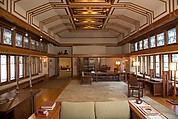
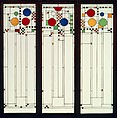
MORRISON HECKSCHER: Frank Lloyd Wright referred to this joyful triptych as part of his “kinder-symphony,” or symphony for children. The triptych was the focal point of a long band of side and clerestory windows, each one different, that decorated a small building a playhouse on the Avery Coonley estate, outside Chicago, Illinois. The playhouse served as a kindergarten run by Mrs. Coonley for neighborhood children. Wright, who completed the playhouse in 1912, was considered America’s foremost architect. He was also one of America’s top innovators in stained glass windows. Wright considered his windows as part of an ensemble. They were integral to the design of the whole building. And the Coonley windows are hailed as his masterpiece. Curator Alice Cooney Frelinghuysen.
ALICE COONEY FRELINGHUYSEN: And yet they are a direct departure from anything he had done prior to that time.
MORRISON HECKSCHER: His earlier windows tended to be loosely geometric interpretations of nature, with a palette of soft earthtones. But here, primary colors flood the window.
ALICE COONEY FRELINGHUYSEN: It's totally geometric and its inspiration was really things for children. It was said to have been a parade. So you have circles of primary colors, which look like balloons. You even have the American flag. And it's punctuated with little squares of black which are meant to evoke confetti. It's bright. It's vibrant. It's in a sense, you know, it's really long before, Piet Mondrian, whose work it's often compared to.
More Artwork
Related Content
 Free to download
Research Resources
The Met provides unparalleled resources for research and welcomes an international community of students and scholars. The Met's Open Access API is where creators and researchers can connect to the The Met collection. Open Access data and public domain images are available for unrestricted commercial and noncommercial use without permission or fee.
To request images under copyright and other restrictions, please use this Image Request form.
Feedback
We continue to research and examine historical and cultural context for objects in The Met collection. If you have comments or questions about this object record, please contact us using the form below. The Museum looks forward to receiving your comments.
Content Notice
The Metropolitan Museum of Art presents over 5,000 years of art from around the world, and our online collection reflects ongoing work conducted over the course of our more than 150-year history. You may encounter objects or images that may be inappropriate for some viewers or information that may be outdated.