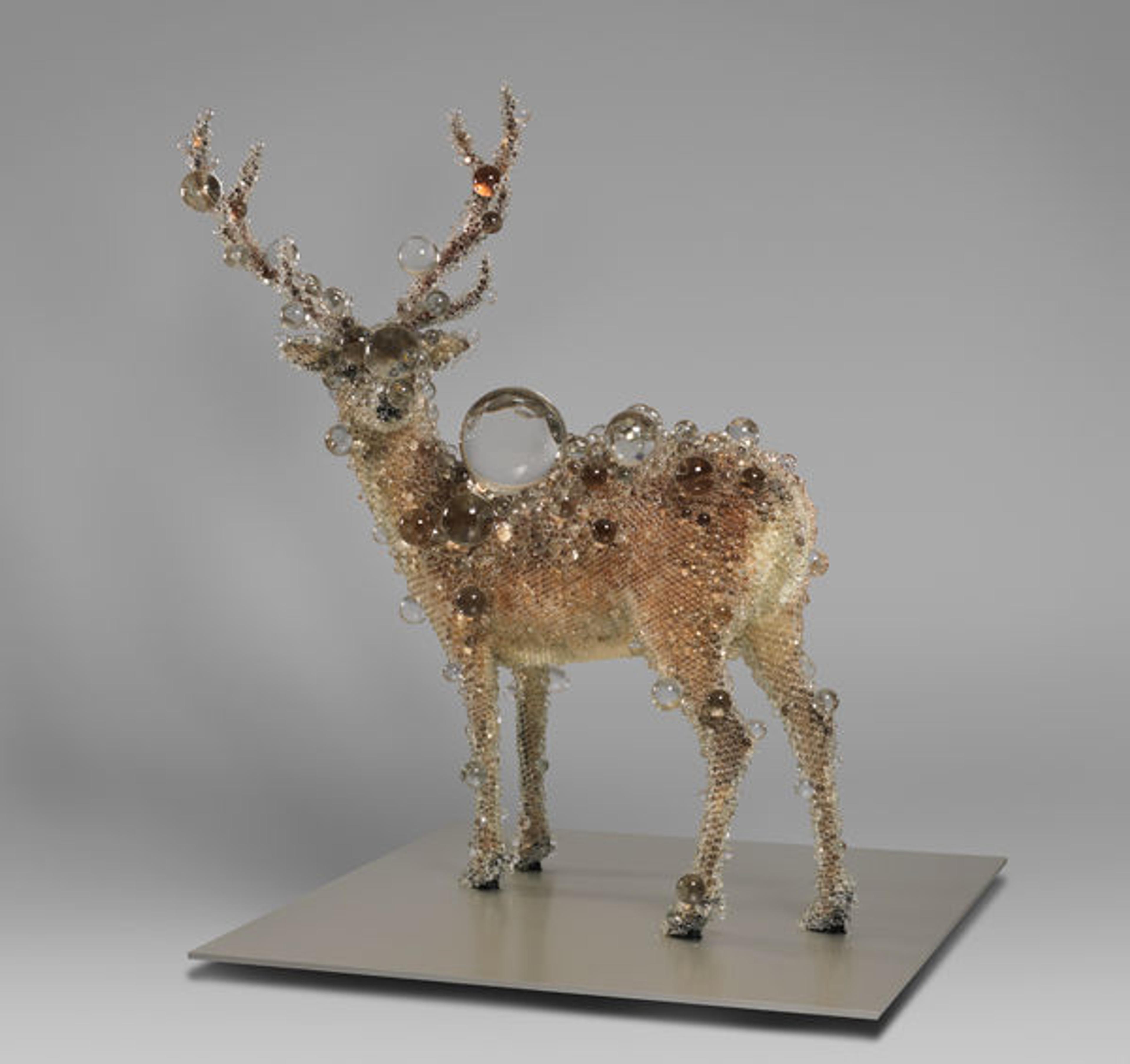
Kohei Nawa (Japanese, b. 1975). PixCell-Deer#24, 2011. Mixed media; taxidermied deer with artificial crystal glass. The Metropolitan Museum of Art, New York, Purchase, Acquisitions Fund and Peggy and Richard M. Danziger Gift, 2011 (2011.493a–j) © Kohei Nawa
«One of my favorite amusement park rides as a child was the funhouse. It wasn't just about the big revolving disks and undulating staircases; my obsession with funhouses came from the fact that I could be in control of my own experience, unlike in other rides where I would just have to sit passively.»
When I entered gallery 226 in the Asian Art Department, I did not expect to run into what I now conceive as a different version of my biggest childhood obsession. To me, Kohei Nawa's PixCell-Deer#24 is a funhouse. The glass beads on the taxidermied deer easily distort my perception, allowing me to go through the unique experience of trying to figure out what I'm really looking at.
When I look closely at the largest bead on the deer's back, I can see an upside-down reflection of Mori Tetsuzan's Deer and Maples, Cranes and Pine Sapling, a Japanese painting placed to the right of the PixCell-Deer. Whether or not this placement is intentional, looking through the glass bead at this Edo-period depiction of a herd of deer gives the impression that, at night, the PixCell-Deer would come to life, jump into the painting, and graze on the fields with its friends.
So what's this PixCell-Deer all about? Is it a reincarnation? Is it merely a carcass? Or is it Rudolph as a Christmas decoration?
When the clusters of crystal glass beads had completely beguiled my vision, a little boy entered the gallery with his mom. "Are they bubbles?" he asked. "Would it pop and disappear if I touched it?"
Maybe, I thought. Maybe it's just an illusion.
What do you think?