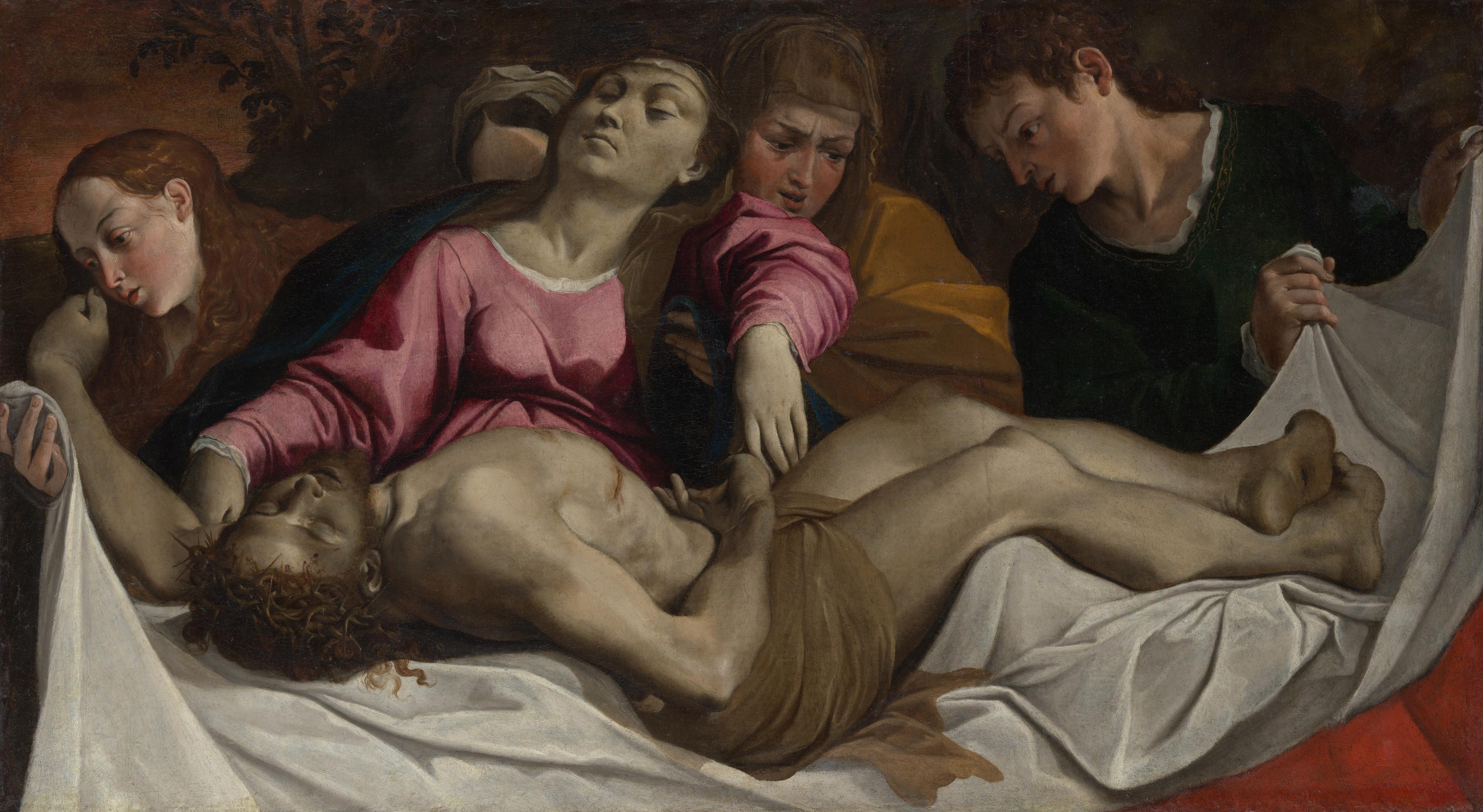
Ludovico Carracci (Italian, 1555–1619). The Lamentation, ca. 1582. Oil on canvas, 37 1/2 x 68 in. (95.3 x 172.7 cm). The Metropolitan Museum of Art, New York, Purchase, Lila Acheson Wallace and The Annenberg Foundation Gifts; Harris Brisbane Dick, Rogers, and Gwynne Andrews Funds; Pat and John Rosenwald, Mark Fisch and Rachel Davidson, and Jon and Barbara Landau Gifts; Gift of Mortimer D. Sackler, Theresa Sackler and Family; and Victor Wilbour Memorial, Marquand, The Alfred N. Punnett Endowment, and Charles B. Curtis Funds, 2000 (2000.68)
I'm John Currin. I'm a figurative oil painter.
I wasn't raised going to church, so I look at religious paintings just like any other painting. And they sometimes lead me into religious contemplation, but the great things lead you all over the place and lead you back into your own life. They're works of art, not works of religious philosophy. I think it's true of Carracci as well. Great paintings are very elastic that way.
There is a kind of backwards everything to this painting. Rules that are set up in one part of the painting are completely forgotten in another part. The living figures are very mannered and very stylized. If you actually tried to make a manneristic figure out of a human, you'd break their bones and twist them and kill them. And then Christ is absolutely real, but he's been sort of stylized by violence. This dead guy is the one that we relate to bodily and can feel in our gut. It's kind of like what's happening pictorially to Mary and everybody else really did happen to Christ in real life.
There's a lot of stuff that makes no sense. You have that weird forehead with no face: part of that magic world back there, but it's necessary. It gives you a relief from you having to embody Christ. So many conflicts that would have been easily resolved by moving something over... you start to realize that's the point: he likes those things. When you're painting sometimes you start to get into a little, slightly magical realm where it's kind of happening itself—instead of pushing it, you're riding it.
The rules that he follows in doing her face, I've always been interested in myself: lighting faces from slightly below, and the whiteness of the light, whether that is the whiteness of skin or the brightness of light. Also, the parallelogramming of the Virgin Mary's face, rather than it being a head in space—which he would have been perfectly capable of—it's sort of tipped back and tipped over. What he's doing is reminding you of the flatness of the painting and then obliterating it. That, to me, is the magic thing about any painting: it sets up rules and then contradicts them, and exists in a paradoxical state of real and unreal. Depth and flatness—all those kinds of things that became explicit and kind of tiresome, actually, with modernism, but have always been latent as part of the spectacle of painting.
I've never liked the idea of art that radically changes the language, although it's always spectacular when someone does it. As a figurative painter I've had to accept that I will never make a stylistically consistent work of art, so it's pleasurable to see the same situation occurring, you know, at the very height of the Baroque. He's making something that has a mysterious physical presence: it's neither flat nor real and, in a way, is dead and alive the way Christ is.