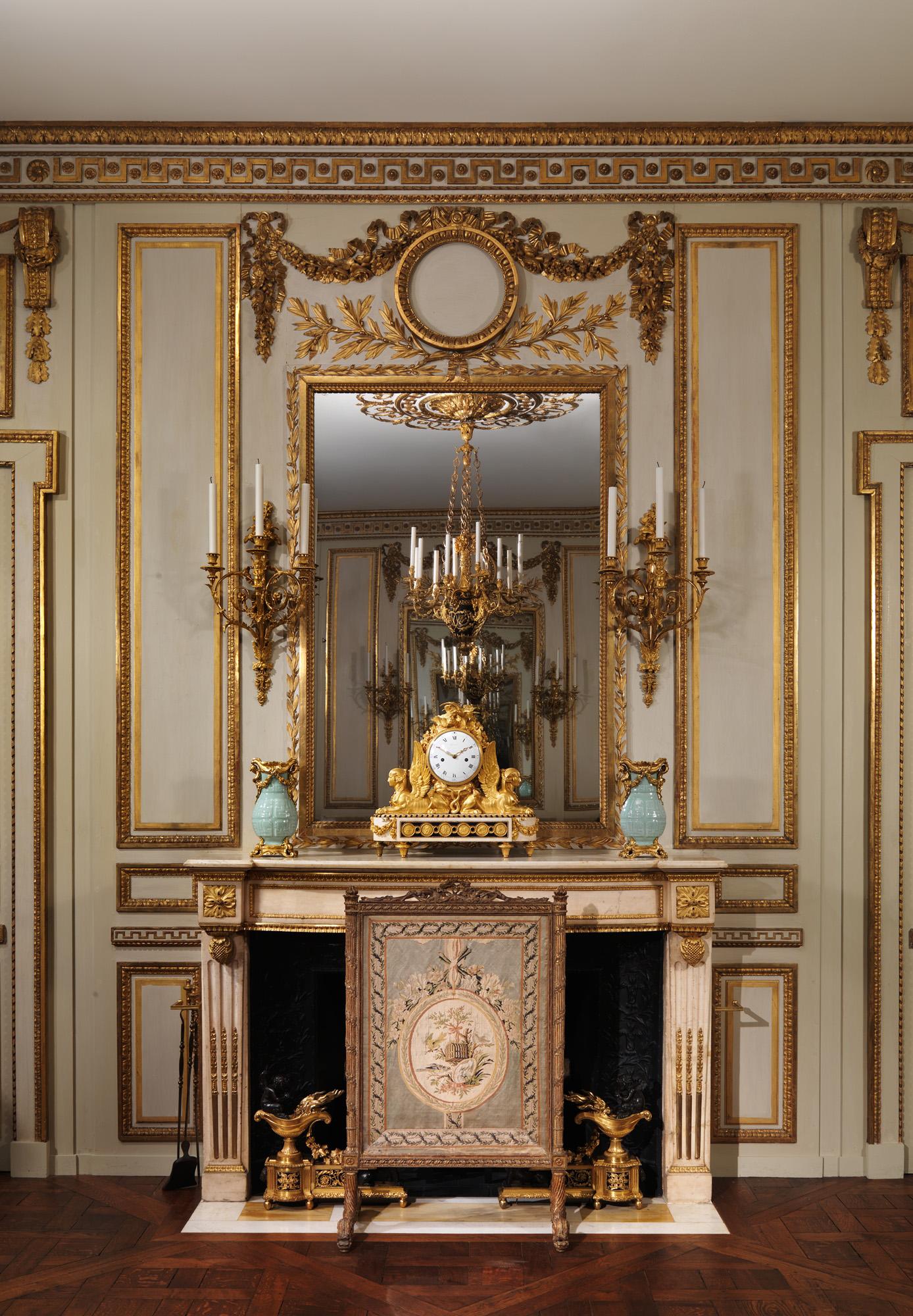
Boiserie from the Hôtel de Cabris, Grasse (detail), ca. 1774, with later additions. French, Paris. Carved, painted, and gilded oak, Overall: H. 140 1/2 x W. 274 1/2 x D. 306 in. (356.9 x 697.2 x 777.2 cm). The Metropolitan Museum of Art, New York, Purchase, Mr. and Mrs. Charles Wrightsman Gift, 1972 (1972.276.1)
My name is Katrín Sigurdardóttir.
I make sculptures. I have been interested for many years in segmentation and partition in sculpture. I have made works that function very much like a puzzle.
And this is what interests me about the period room because the period room is originally created as disparate parts made by different artisans—panels, furniture, drapery, fixtures, carpets—brought together into a composition that comes to represent a life of the people that make them, of the people that live in them. And then, like every other piece that is collected and that is brought into the museum, they are reassembled as a memory of their original function.
You start to make a distinction between the room that was and what this room is today. It is made originally for a very private, functional purpose. It is not made for the purpose of being looked at as an artifact.
The museum is a profoundly public experience. The period room always suggests a more embodied experience. You are let into a very intimate space, for one person or maybe two. It is like a dollhouse in full size. You pour your fantasy into these; they're kind of like compartments of imagination and memory. But of course the illusion is only as thick as the panels. Behind that you have the walls of not the building in France, you are not in Grasse, you are not in Paris, you are not in the eighteenth century, but you are in the museum.
And I don't think it's interesting in and of itself to simply deconstruct the idea of the period room and say you are having an inauthentic experience. That's not what I'm trying to do at all. We read history through the dominant culture. That's what ends up being preserved. There is so much history of what the life of most of the world has been like that we just don't have example of anymore.
You could say the lure or the romance or the dream of the period room is that you are actually transported in time and place. What I see as the purpose of art and the necessity of art is that we are able to get closer to a truth about our life, which we cannot necessarily see or frame through an ordinary experience.