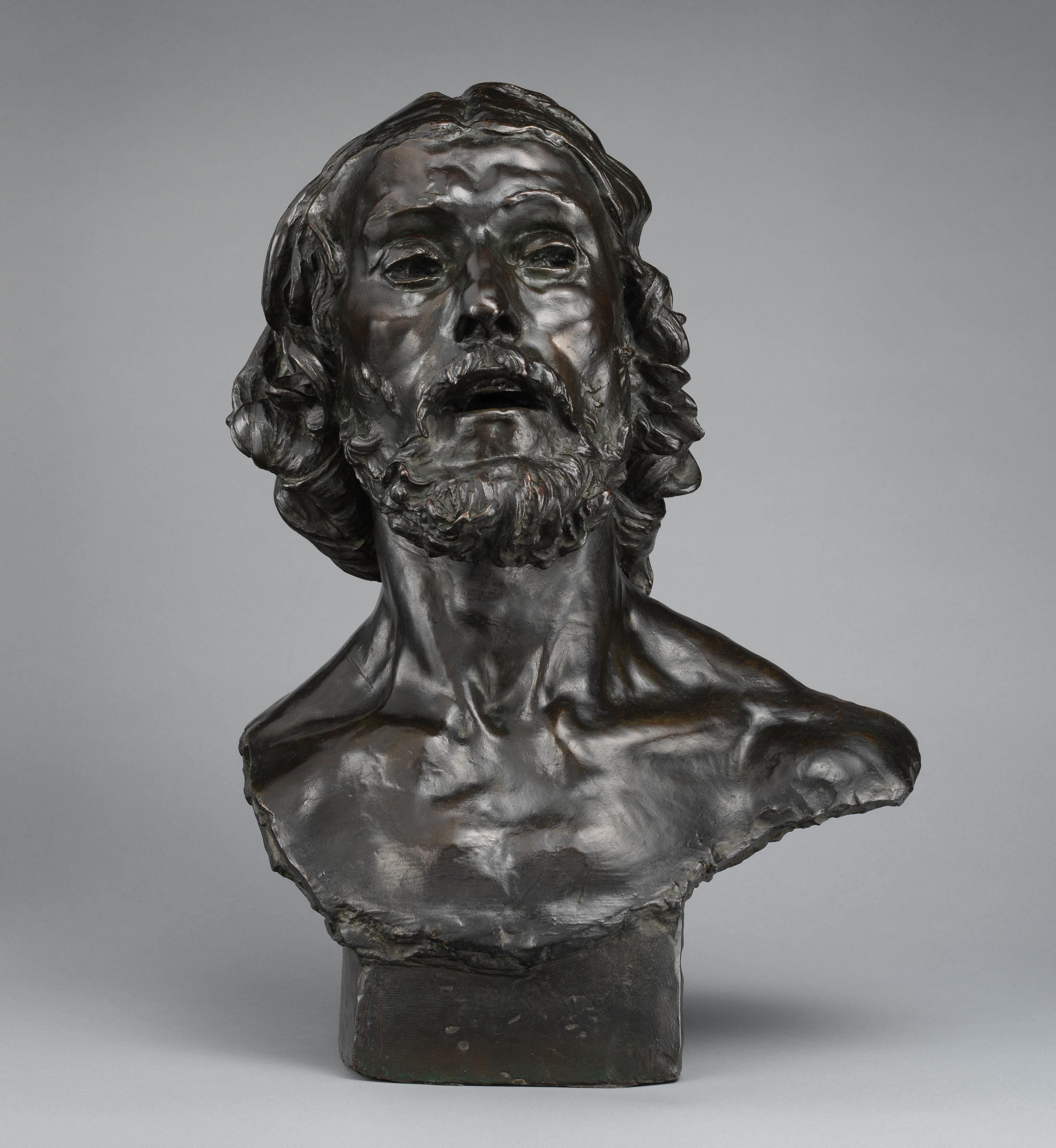
Auguste Rodin (French, 1840–1917). St. John the Baptist, original model 1880, cast 1883. Bronze, Overall (wt. confirmed): 21 3/8 × 15 3/4 × 11 in., 42.5 lb. (54.3 × 40 × 27.9 cm, 19.3 kg). The Metropolitan Museum of Art, New York, Gift of Samuel P. Avery, 1893 (93.11)
My name is Wilfredo Prieto. I am an artist.
Quando madurando tu trabajo— In trying to mature your work, you are constantly looking at your predecessors, to learn what the masters said before, and then try to bring your message.
Rodin is a revolutionary. It’s a challenge to appreciate it after some time because you start defining it as a certain style, but when I’m in a museum I usually have to do a process—kind of like Photoshop—where I have to eliminate everything else that’s around. Then you see the sensibility of each one.
And I know people think of The Thinker and other more known pieces, but I’m more interested not so much in the finished sculpture but all the different sketches and the experimental pieces leading to the final. As an artist I relate to that. That’s when you’re doing the translation of the idea as it’s coming to you into what it’s going to communicate.
I always remember it was such a challenge when I was eleven years old trying to create a hand. And I think it’s a problem or a conflict that all artists have. And then when you look at Rodin you kind of end up like, “Shit, I wish I was your student,” because he just had this enormous freedom with his expression.
What touches me most is the expression in the materials. You have to dominate the material, not let the material dominate you. I always thought of it as like a baseball player. He has to know the technique and the force that he has to hit, but beyond that you have to think further and imagine where you want to bring the ball to.
When he does his sculptures he changes certain proportions. But it's a modification based on the knowledge of the proportions, and that’s what expresses that proficiency, that control. I try to create those movements of Rodin's hands and I find it almost impossible. But they don’t look like they’re broken or done wrongly, they look real. I don’t think it was about getting to that perfection of like a mathematical equation, but to just get to the point where you understand and feel it. Something as simple as just a hand becomes the protagonist of some feeling that’s essential.
Compared to other mediums, sculpture is a representation that’s a lot closer to reality because of three-dimensional-ness. Rodin created a revolution in sculpture because his sculpture reflects something that was closer to living.