Snuffbox
The containers were usually of such luxurious nature that they were the ultimate fashion accessories in eighteenth-century Europe and were frequently given as presents. Beginning in the 1720s and continuing up to the French Revolution, snuff boxes were produced in significant quantities.
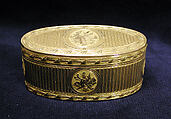
Typical of the gold snuffboxes of the 1770s is the combination of decorative elements drawn from the neo-classical vocabulary such as pilasters, husk garlands, guilloche motifs and medallions framed by laurel wreaths, as seen on this multi-colored gold box.
Boxes like this were sold by many marchands merciers or dealers in luxury goods. One of the foremost in Paris was Au petit Dunkerque, the emporium of Charles Raymond Granchez who became the bijoutier du Roi and subsequently de la Reine (jeweler to the king and queen). The Welsh author Hester Thrale recorded her visit on October 27, 1775: We went…to the Great Toy Shop called the Petit Dunkerque. I bought a trinket or two and longed for a Snuffbox of exquisite beauty.
Daughter of one of the founders of the Weyerhaeuser Timber Company, Catherine D. Wentworth (1865–1948) was an art student and painter who lived in France for thirty years. She became one of the most important American collectors of eighteenth-century French silver and on her death in 1948 bequeathed part of her significant collection of silver, gold boxes, French furniture and textiles to the Metropolitan Museum.
Artwork Details
- Title: Snuffbox
- Maker: Pierre-François-Mathis de Beaulieu (apprenticed 1752, master 1768, active until 1792)
- Date: 1773–74
- Culture: French, Paris
- Medium: Gold
- Dimensions: Overall: 1 1/16 × 2 3/8 × 1 7/8 in. (2.7 × 6 × 4.8 cm)
- Classification: Metalwork-Gold and Platinum
- Credit Line: Bequest of Catherine D. Wentworth, 1948
- Object Number: 48.187.463
- Curatorial Department: European Sculpture and Decorative Arts
More Artwork
Research Resources
The Met provides unparalleled resources for research and welcomes an international community of students and scholars. The Met's Open Access API is where creators and researchers can connect to the The Met collection. Open Access data and public domain images are available for unrestricted commercial and noncommercial use without permission or fee.
To request images under copyright and other restrictions, please use this Image Request form.
Feedback
We continue to research and examine historical and cultural context for objects in The Met collection. If you have comments or questions about this object record, please contact us using the form below. The Museum looks forward to receiving your comments.
Content Notice
The Metropolitan Museum of Art presents over 5,000 years of art from around the world, and our online collection reflects ongoing work conducted over the course of our more than 150-year history. You may encounter objects or images that may be inappropriate for some viewers or information that may be outdated.