Hunting Sword with Scabbard, Knife, and Fork
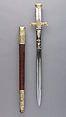
The straight, single-edged blade is hollow-ground at the sides and has a short back edge at its tip. The outer side of the blade is etched with two running deer and a rabbit, framed above and below with double lines which converge toward the point and are closed by a feather-like ornament surmounted by a large bird. The inner side of the blade has large stylized vase-shaped ornaments and includes an oval medallion enclosing the portrait of a bearded man and a rectangular cartouche with the date 1656. There is no cutler's mark. The simple scabbard of black leather is mounted with a bright steel chape. Near the top of the scabbard is a pocket, the front of which holds a shield-shaped suspension hook. The pocket now contains a small knife and fork of steel, their handles of spirally twisted silver engraved with flowers, the flat ends engraved with the letters D.A.G.N. (probably the owner's initials) and the date 1685.
Short curved hunting swords, known in Endland as "hangers" or "woodknives," were a sort of machete of peasant origin, but by the middle of the sixteenth century they had been adopted as practical tools of woodcraft by knights and nobles as part of their specialized hunting equipment. As the German name for these hunting swords––Hirschfänger––suggests, they were intended for the coup de grace of the downed stag, but at least in their studier examples they were also useful as all-purpose tools, such as for cutting a path through the underbrush, curring wood and kindling for the campfire, as well as chopping the joints of a deer's carcass.
The design for such weapons was traditional and changed very little over the centuries. The asymmetrical pommel is found on late fifteenth-century German hunting swords (for example, acc. no. 29.158.704), as is the down-turned shell on the outside of the guard; the knuckle guard, also a common feature on hunting swords, is already found on the so-called "woodknife" of Henry VIII, datable to about 1544, at Windsor Castle.
These swords were usually accompanied by utensils (knife, fork, and bodkin) as a camping set, carried in the pocket of the scabbard. The knife and fork associated with this hanger are not the original set belonging to it.
Artwork Details
- Title: Hunting Sword with Scabbard, Knife, and Fork
- Date: blade dated 1656
- Culture: German
- Medium: Steel, silver, ivory, leather
- Dimensions: L. 25 3/4 in. (65.4 cm); L. of blade 20 3/8 in. (51.7 cm); Wt. 1 lb. 9 oz. (708.7 g); Wt. of scabbard 4 oz. (113.4 g); knife (c); L. 5 3/4 in. (14.6 cm); Wt. 0.5 oz. (14.2 g); fork (d); L. 5 in. (12.7 cm); Wt. 0.5 oz. (14.2 g)
- Classification: Swords
- Credit Line: Gift of Jean Jacques Reubell, in memory of his mother, Julia C. Coster, and of his wife, Adeline E. Post, both of New York City, 1926
- Object Number: 26.145.256a–d
- Curatorial Department: Arms and Armor
More Artwork
Related Content
 Free to download
Research Resources
The Met provides unparalleled resources for research and welcomes an international community of students and scholars. The Met's Open Access API is where creators and researchers can connect to the The Met collection. Open Access data and public domain images are available for unrestricted commercial and noncommercial use without permission or fee.
To request images under copyright and other restrictions, please use this Image Request form.
Feedback
We continue to research and examine historical and cultural context for objects in The Met collection. If you have comments or questions about this object record, please contact us using the form below. The Museum looks forward to receiving your comments.
Content Notice
The Metropolitan Museum of Art presents over 5,000 years of art from around the world, and our online collection reflects ongoing work conducted over the course of our more than 150-year history. You may encounter objects or images that may be inappropriate for some viewers or information that may be outdated.