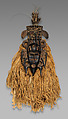
a-Mantsho-ña-Tshol (master of medicine) headdress
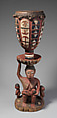
Among the Baga, a-Mantsho-ña-Tshol's form is considered mutable; he may materialize as a being with human attributes, or as a rainbow that "after having drunk, comes out again at the river sources." The Baga consider the rainbow both the source of rivers and the end of rains. The appearance of a-Mantsho-ña-Tshol at initiations was thus consistent with these associations with beginnings and conclusions, life and death, and, by extension, the perpetuation of lineages. The headdresses also appear to have served as emblems of a clan's identity and power, and were used in competitions between families. The headdresses could also be danced at any time to enliven the community. Despite their seemingly unwieldy size, these sculptural forms are manipulated during performances with astonishing dexterity and dynamism. In performance, the massive wood sculptural element would be set vertically on top of a conical framework of palm branches, which was covered with a palm fiber costume that fell to the ground. The ensemble was then placed over the dancer's head. Brilliantly colored textiles were wrapped directly below the base; and at the summit, feathers and cloth streamers flew in the air as the dancer moved. The performers, all strong young men, would take turns dancing to demonstrate varied styles and approaches to the choreography.
Among the Baga, public accessibility to the instruments of spiritual power like this mask was relatively restricted. They were linked with male esoteric knowledge, and their control lay in the hands of leaders of secret associations and family lineages. Following Guinea's independence from France in 1958, the continuity of regional artistic practices within the new nationally defined boundaries was radically disrupted, and masquerade traditions like a-Mantsho-ña-Tshol were discouraged and gradually abandoned. During the 1990s, the Baga experienced a popular revival of earlier art forms, including a-Mantsho-ña-Tshol.
Artwork Details
- Title: a-Mantsho-ña-Tshol (master of medicine) headdress
- Artist: Baga artist
- Date: 19th–first half of 20th century
- Geography: Guinea, Niger River region
- Culture: Baga peoples
- Medium: Wood (Pterocarpus erinaceus), pigment
- Dimensions: H. 54 7/16 × W. 7 × D. 32 in. (138.3 × 17.8 × 81.3 cm)
- Classification: Wood-Sculpture
- Credit Line: The Michael C. Rockefeller Memorial Collection, Gift of Nelson A. Rockefeller, 1964
- Object Number: 1978.412.339
- Curatorial Department: The Michael C. Rockefeller Wing
More Artwork
Related Content
 Free to download
Research Resources
The Met provides unparalleled resources for research and welcomes an international community of students and scholars. The Met's Open Access API is where creators and researchers can connect to the The Met collection. Open Access data and public domain images are available for unrestricted commercial and noncommercial use without permission or fee.
To request images under copyright and other restrictions, please use this Image Request form.
Feedback
We continue to research and examine historical and cultural context for objects in The Met collection. If you have comments or questions about this object record, please contact us using the form below. The Museum looks forward to receiving your comments.
Content Notice
The Metropolitan Museum of Art presents over 5,000 years of art from around the world, and our online collection reflects ongoing work conducted over the course of our more than 150-year history. You may encounter objects or images that may be inappropriate for some viewers or information that may be outdated.