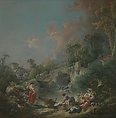
El aseo de Venus
Artwork Details
- Título: El aseo de Venus
- Artista: François Boucher, francés, 1703–1770
- Fecha: 1751
- Material: Óleo sobre lienzo
- Dimensiones: 108,3 x 85,1 cm
- Crédito: Legado de William K. Vanderbilt, 1920
- Número de inventario: 20.155.9
- Curatorial Department: European Paintings
Audio
5016. The Toilette of Venus
NARRATOR: Venus, goddess of love and beauty, is depicted in this painting by the French 18th century artist François Boucher. Katharine Baetjer:
KATHARINE BAETJER: In his own time, he was one of the most loved artists of the Royal Academy. And he was particularly loved by Madame de Pompadour, Louis XV's mistress. Royal mistresses had short careers. And so, while they were in power, they had to hurry. Madame de Pompadour was given, by the king, land for a château called Bellevue, not too far from Paris. The château was built quickly. It was small. It was a place where the king could come and be with the royal mistress in a relatively private environment.
NARRATOR: This painting hung in her bathing rooms. Fittingly, it shows Venus readying herself after her bath. A putto, or winged baby, decorates her hair with flowers and pearls – two of her emblems. And doves – another of her symbols – nestle close to her, their soft white feathers perfectly setting off the delicate warmth of her skin. Boucher surrounds Venus with the kind of luxurious trappings you might find in an elegant 18th century boudoir. She reclines on a sofa amid swathes of velvet and damask, beside a gilded oval mirror. Even her hair is a fashionable soft gray – a color achieved with powder by stylish young women of the time.
More Artwork
Related Content
Research Resources
The Met provides unparalleled resources for research and welcomes an international community of students and scholars. The Met's Open Access API is where creators and researchers can connect to the The Met collection. Open Access data and public domain images are available for unrestricted commercial and noncommercial use without permission or fee.
To request images under copyright and other restrictions, please use this Image Request form.
Feedback
We continue to research and examine historical and cultural context for objects in The Met collection. If you have comments or questions about this object record, please contact us using the form below. The Museum looks forward to receiving your comments.
Content Notice
The Metropolitan Museum of Art presents over 5,000 years of art from around the world, and our online collection reflects ongoing work conducted over the course of our more than 150-year history. You may encounter objects or images that may be inappropriate for some viewers or information that may be outdated.