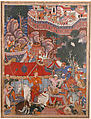
"The Spy Zambur Brings Mahiya to the City of Tawariq", Folio from a Hamzanama (Book of Hamza)
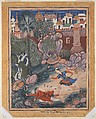
In this painting, Zambur, a spy, brings a maid named Mahiya to town on a donkey. The figures and animals, the trees along the arcaded street, and details such as the fruit borne in panniers by one donkey are carefully observed and rendered in a more naturalistic way than would be found in contemporary Iranian miniatures. Yet the extreme diagonal of the composition has resulted in an awkward jumble of buildings, particularly on the left, where rooftops tip precipitously and a staircase leads nowhere.
Artwork Details
- Title: "The Spy Zambur Brings Mahiya to the City of Tawariq", Folio from a Hamzanama (Book of Hamza)
- Artist: Attributed to Kesav Das (Indian, active ca. 1570–1604)
- Artist: Attributed to Mah Muhammad (active 1570s)
- Date: ca. 1570
- Geography: Attributed to India
- Medium: Ink, opaque watercolor, and gold on cloth; mounted on paper
- Dimensions: H. 29 1/8 in. (74 cm)
W. 22 1/2 in. (57.2 cm) - Classification: Codices
- Credit Line: Rogers Fund, 1923
- Object Number: 23.264.1
- Curatorial Department: Islamic Art
More Artwork
Related Content

 Free to download
Research Resources
The Met provides unparalleled resources for research and welcomes an international community of students and scholars. The Met's Open Access API is where creators and researchers can connect to the The Met collection. Open Access data and public domain images are available for unrestricted commercial and noncommercial use without permission or fee.
To request images under copyright and other restrictions, please use this Image Request form.
Feedback
We continue to research and examine historical and cultural context for objects in The Met collection. If you have comments or questions about this object record, please contact us using the form below. The Museum looks forward to receiving your comments.
Content Notice
The Metropolitan Museum of Art presents over 5,000 years of art from around the world, and our online collection reflects ongoing work conducted over the course of our more than 150-year history. You may encounter objects or images that may be inappropriate for some viewers or information that may be outdated.