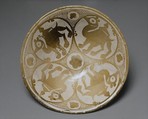
Luster Bowl with a Seated Figure and “Baraka” (Blessing) Written Under the Base
Luster likely elicited a sense of wonder in the viewer, as the metal particles of the paint would have shined and changed color according to the light cast upon them. The Arabic word baraka, or blessing, painted in luster on the bottom of the bowl adds an auspicious quality and enhances the desired everyday experience of handling such vessels, be it in their making, purchasing, gifting, display, or use in serving food.
The luster-technique of painting involves the use of metallic oxides and the firing of the object in a low oxygen kiln. In the first two centuries of its application (ninth–tenth century C.E.) luster is only known to have been produced in Iraq.
Artwork Details
- Title: Luster Bowl with a Seated Figure and “Baraka” (Blessing) Written Under the Base
- Date: 10th century
- Geography: Attributed to Iraq
- Medium: Earthenware; luster-painted on opaque white glaze
- Dimensions: H. 2 5/8 in. (6.7 cm)
Diam. 9 1/8 in. (23.2 cm)
Wt. 16.6 oz. (470.7 g) - Classification: Ceramics
- Credit Line: Gift of Ernest Erickson Foundation, 1988
- Object Number: 1988.114.2
- Curatorial Department: Islamic Art
More Artwork
Research Resources
The Met provides unparalleled resources for research and welcomes an international community of students and scholars. The Met's Open Access API is where creators and researchers can connect to the The Met collection. Open Access data and public domain images are available for unrestricted commercial and noncommercial use without permission or fee.
To request images under copyright and other restrictions, please use this Image Request form.
Feedback
We continue to research and examine historical and cultural context for objects in The Met collection. If you have comments or questions about this object record, please contact us using the form below. The Museum looks forward to receiving your comments.
Content Notice
The Metropolitan Museum of Art presents over 5,000 years of art from around the world, and our online collection reflects ongoing work conducted over the course of our more than 150-year history. You may encounter objects or images that may be inappropriate for some viewers or information that may be outdated.