Cittern
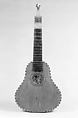
Citterns are plucked stringed instruments, related to lutes and guitars, but strung with metal strings which produce a brighter and louder sound than gut strings. The cittern also has inlaid metal frets, as opposed to tied gut frets on lutes and early guitars. Players of the cittern use a plectrum to pluck the five or six courses of strings. Primarily a folk instrument that continues to be used in traditional musical styles, the cittern was elevated to the position of an art instrument by aristocrats in the sixteenth and seventeenth century, one of whom probably originally owned this extravagant instrument.
Artwork Details
- Title: Cittern
- Maker: Joachim Tielke (German, 1641–1719)
- Date: ca. 1685
- Geography: Hamburg, Germany
- Culture: German
- Medium: Cypress, ivory, ebony, parchment, brass
- Dimensions: 24 7/8 × 9 5/16 × 2 in. (63.2 × 23.7 × 5.1 cm)
- Classification: Chordophone-Lute-plucked-fretted
- Credit Line: Purchase, The Vincent Astor Foundation Gift and Rogers Fund, 1985
- Object Number: 1985.124
- Curatorial Department: Musical Instruments
Audio
9306. Tielke Cittern
[SOUND OF A CITTERN BEING PLAYED]
Listen to more about this artwork
More Artwork
Related Content

Research Resources
The Met provides unparalleled resources for research and welcomes an international community of students and scholars. The Met's Open Access API is where creators and researchers can connect to the The Met collection. Open Access data and public domain images are available for unrestricted commercial and noncommercial use without permission or fee.
To request images under copyright and other restrictions, please use this Image Request form.
Feedback
We continue to research and examine historical and cultural context for objects in The Met collection. If you have comments or questions about this object record, please contact us using the form below. The Museum looks forward to receiving your comments.
Content Notice
The Metropolitan Museum of Art presents over 5,000 years of art from around the world, and our online collection reflects ongoing work conducted over the course of our more than 150-year history. You may encounter objects or images that may be inappropriate for some viewers or information that may be outdated.