Tunic
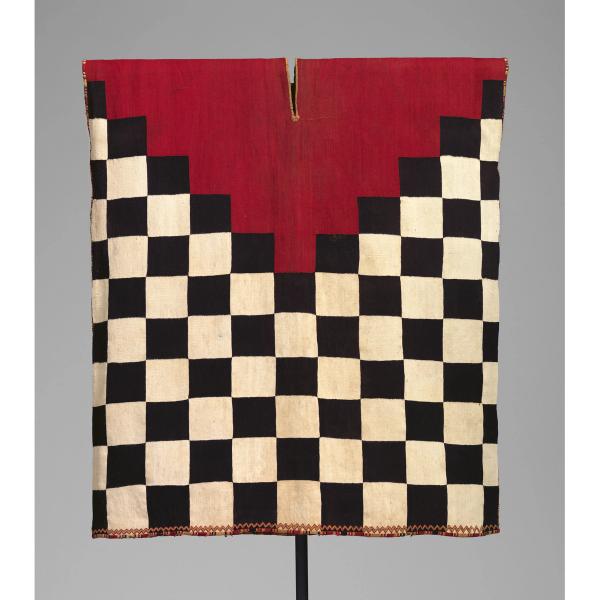
Cloth was of profound importance in Inca culture: no political, military, social, or religious event among the Inca was complete without textiles being exchanged or gifted, burned or sacrificed. Fine tapestry¬ woven tunics would have been bestowed on warriors who distinguished themselves on the battlefield, or given as diplomatic gifts by Inca rulers in their campaigns to expand their vast empire. Ownership and use of tapestry tunics would have been closely controlled by the Inca state, and only those upon whom such gifts were bestowed were allowed to wear them. The Inca also exerted tight control over the production of tapestry tunics, and surviving full-size examples display remarkably little variation in size.
Inca tapestry tunics were woven as a single panel with single-interlocking joins, with the neck slit held closed by a temporary weft yarn that was removed after the weaving was complete. Once the finished weaving was cut from the loom, all seams and selvage edges were completely covered with fine double¬ faced embroidery. The seams were concealed with a precisely repeated series of multicolored bands of different widths. Along the bottom, just above that embroidered edge, a zigzag line was created with similarly colored yarns. The precise meaning of this zigzag line is unknown, but it was of such importance that it was included in depictions of royal tunics in one of the earliest illustrated manuscripts concerning the Inca Empire (Guaman Poma de Ayala, 1615-1615).
References and Further Reading
Correa-Lau, Jacqueline, Carolina Agüero, Jeffrey Splitstoser, Ester Echenique, Tracy Martens, Calogero M. Santoro, “Inka Unku: Imperial or provincial? State-local relations.” PLoS ONE 18(2): e0280511. (2023).
Guaman Poma de Ayala, Felipe (1615). El primer nueva coronica y buen goberno. Det Kongeige Bibliotek, Copenhagen. The Guaman Poma website: A Digital Research Center of the Royal Library.
Jerez, Francisco de. (1534). True Account of the Conquest of Peru. Edited by Eván R. Reyna. Reprint, London: Peter Lang, 2013.
Pillsbury, Joanne. “Inka Unku: Strategy and Design in Colonial Peru.” Cleveland Studies in the History of Art 7 (2002):68-103.
Pillsbury, Joanne. “El uncu Inca: Tradición y transformación,” in Arte imperial Inca: Sus orígenes y transformaciones desde la conquista a la independencia (edited by Ramón Mujica), pp. 274-311. Lima: Banco de Crédito, 2020.
Rowe, Ann Pollard. “Technical Features of Inca Tapestry Tunics,” Textile Museum Journal 17 (1978), pp. 5-28.
Rowe, Ann Pollard. “Provincial Inca Tunics of the South Coast of Peru,” Textile Museum Journal 31 (1992), pp. 5-52.
Rowe, Anne Pollard, and John Howland Rowe. “Inca Tunics.” In Andean Art at Dumbarton Oaks Vol. 2, edited by Elizabeth Hill Boone, pp. 453-465. Washington, DC: Dumbarton Oaks Research Library and Collection, 1996.
Artwork Details
- Title: Tunic
- Artist: Inca artist(s)
- Date: 1400–1535 CE
- Geography: Argentina, Bolivia, Chile, or Peru
- Culture: Inca
- Medium: Camelid fiber
- Dimensions: H. 34 1/4 x W. 30 1/8 in. (87 x 76.5 cm)
- Classification: Textiles-Costumes
- Credit Line: Purchase, Fletcher Fund, Claudia Quentin Gift, and Harris Brisbane Dick Fund, 2017
- Object Number: 2017.674
- Curatorial Department: The Michael C. Rockefeller Wing
Audio
1653. Tunic, Inca artist(s)
Arabel Fernández López and Joanne Pillsbury
JOSÉ MARÍA YAZPIK (NARRATOR): This exquisite tunic is made of a type of cloth called cumbi—the highest-quality weaving known in the Andean region—some with over 600 threads per inch. Only the best weavers in the Inca Empire were permitted to make these textiles. They wove cumbi in specialized workshops at the heart of the empire and in distant outposts, spending an entire year on a single garment.
Arabel Fernández López is a Peruvian archaeologist who specializes in Andean textiles.
ARABEL FERNÁNDEZ LÓPEZ: These tunics or "unku" in Quechua language, that means a male garment. Really, the weavers have to spend a lot of time because they're very fine. The cumbi textile was very fine and was worn by the Inca elites and the official of the Empire.
JOSÉ MARÍA YAZPIK: Joanne Pillsbury, Metropolitan Museum of Art.
JOANNE PILLSBURY: There’s a very close relationship between identity and sense of self and sense of accomplishment with these garments. They were given as rewards to people who distinguished themselves on the battlefield. They would be gathered and kept in imperial storehouses. They were an important part of imperial state craft for the Inca.
At the time of the conquest, some of these textiles were burned, much to the dismay of Andeans. They couldn’t understand why the Spaniards were destroying the textiles and going after the gold. Because, for them, the textiles were far more valuable.
JOSÉ MARÍA YAZPIK: The highly valued textiles were traded or gifted across the vast expanse of the Inca Empire.
JOANNE PILLSBURY: Inca tunics have been found on high mountain peaks in Argentina, in Chile, on the coast of Peru. They’ve been found in Bolivia. So it reminds us about the extraordinary saturation of Inca visual culture in the last century before the Spanish conquest.
More Artwork
Related Content


Research Resources
The Met provides unparalleled resources for research and welcomes an international community of students and scholars. The Met's Open Access API is where creators and researchers can connect to the The Met collection. Open Access data and public domain images are available for unrestricted commercial and noncommercial use without permission or fee.
To request images under copyright and other restrictions, please use this Image Request form.
Feedback
We continue to research and examine historical and cultural context for objects in The Met collection. If you have comments or questions about this object record, please contact us using the form below. The Museum looks forward to receiving your comments.
Content Notice
The Metropolitan Museum of Art presents over 5,000 years of art from around the world, and our online collection reflects ongoing work conducted over the course of our more than 150-year history. You may encounter objects or images that may be inappropriate for some viewers or information that may be outdated.