Letter to Shunkin
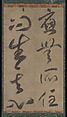
Gykudō—born to a high-ranking samurai family but determined to pursue the career of a painter, musician, and composer—is one of the most important and idiosyncratic artists to emerge from the “second flowering” of the Nanga school in the late eighteenth century. After resigning from his post in the household of the daimyo (warlord) of Okayama, he traveled extensively, giving instruction on the zitherlike qin, before settling in Kyoto with Shunkin and concentrating on the art of landscape painting. An element of the compelling style that characterizes his paintings is visible in his calligraphy, with its rhythmic movement of the brush and contrast between thick and thin brush lines.
Artwork Details
- 浦上玉堂筆 春琴宛書状
- Title: Letter to Shunkin
- Artist: Urakami (Uragami) Gyokudō (Japanese, 1745–1820)
- Period: Edo period (1615–1868)
- Date: late 18th–early 19th century
- Culture: Japan
- Medium: Hanging scroll; ink on paper
- Dimensions: Image: 8 3/8 × 10 1/4 in. (21.2 × 26 cm)
Overall with mounting: 38 9/16 × 16 9/16 in. (98 × 42 cm) - Classification: Calligraphy
- Credit Line: Mary and Cheney Cowles Collection, Gift of Mary and Cheney Cowles, 2019
- Object Number: 2019.420.27
- Curatorial Department: Asian Art
More Artwork
Research Resources
The Met provides unparalleled resources for research and welcomes an international community of students and scholars. The Met's Open Access API is where creators and researchers can connect to the The Met collection. Open Access data and public domain images are available for unrestricted commercial and noncommercial use without permission or fee.
To request images under copyright and other restrictions, please use this Image Request form.
Feedback
We continue to research and examine historical and cultural context for objects in The Met collection. If you have comments or questions about this object record, please contact us using the form below. The Museum looks forward to receiving your comments.
Content Notice
The Metropolitan Museum of Art presents over 5,000 years of art from around the world, and our online collection reflects ongoing work conducted over the course of our more than 150-year history. You may encounter objects or images that may be inappropriate for some viewers or information that may be outdated.