English
DonateMembershipTickets

Bornage de Barbizon

1860s
Not on view
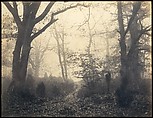
A well-travelled path invites viewers to follow the deep double ruts left by countless wagons that traversed the boundary between the town of Barbizon (on the left) and the forest of Fontainebleau (on the right). Beginning in the 1860s, Cuvelier joined other artists in the pursuit of a creative existence along this very border, living with friends and family in town while venturing out by day to interpret the famous woodlands with his camera. In this deceptively bucolic scene, Cuvelier dramatizes the primordial power of the forest, which threatens to burst forth from the path’s makeshift retaining walls while the shadows of its mighty oaks menace the flimsy fence around Barbizon; in response, the younger trees in the town appear to retreat, their slender trunks swaying backward as if in the face of a forceful wind.

Artwork Details

Object Information
  • Title: Bornage de Barbizon
  • Artist: Eugène Cuvelier (French, 1837–1900)
  • Date: 1860s
  • Medium: Salted paper print from paper negative
  • Dimensions: Sheet: 10 in. × 13 5/16 in. (25.4 × 33.8 cm)
    Mount: 21 7/8 × 27 15/16 in. (55.5 × 71 cm)
  • Classification: Photographs
  • Credit Line: Gift of W. Bruce and Delaney H. Lundberg, 2021
  • Object Number: 2021.389
  • Curatorial Department: Photographs
More Artwork
[Fontainebleau Forest], Eugène Cuvelier  French, Salted paper print from paper negative
Eugène Cuvelier
early 1860s
Ceramic Horn, Glazed pottery, French
French
late 18th or early 19th century
American Barque "Jane Tudor," Conway Bay, David Johnson  British, Salted paper print from glass negative
David Johnson
ca. 1855
Près de la Caverne, Terrain Brûlé, Eugène Cuvelier  French, Salted paper print from paper negative
Eugène Cuvelier
early 1860s
Édouard Manet, Seated, Holding His Hat, Edgar Degas  French, Graphite and black chalk
Edgar Degas
Sitter Edouard Manet
ca. 1868

Research Resources

The Met provides unparalleled resources for research and welcomes an international community of students and scholars. The Met's Open Access API is where creators and researchers can connect to the The Met collection. Open Access data and public domain images are available for unrestricted commercial and noncommercial use without permission or fee.

To request images under copyright and other restrictions, please use this Image Request form.

Feedback

We continue to research and examine historical and cultural context for objects in The Met collection. If you have comments or questions about this object record, please contact us using the form below. The Museum looks forward to receiving your comments.

Send feedback

Content Notice

The Metropolitan Museum of Art presents over 5,000 years of art from around the world, and our online collection reflects ongoing work conducted over the course of our more than 150-year history. You may encounter objects or images that may be inappropriate for some viewers or information that may be outdated.