Mount Emei
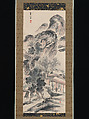
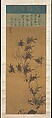
Mount Emei is a suitable painting topic for a literati artist like Kinkoku since it was topic of several famous poems by the Tang poet Li Bai (701–762); for example see the set of screens by Shiokawa Bunrin memorializing the moonlit mountain (1998.189.1, .2). It is also connected to the dangerous, ancient “Road to Shu” (Shudao) planks, immortalized by Li Bai as being harder to ascend than the path to heaven. Kinkoku painted other versions of this painting, including one dated to the artist’s seventieth year, 1730, near the end of his life.
Kinkoku was a multifaceted artist; not only a painter and poet, but was skilled as a sculptor, seal engraver, potter, and practitioner of martial arts—one of few Japanese literati painters whose lifestyle was actually close to the free and untrammeled Chinese ideal of the scholar-artist. Born in Ōtsu, just to the east of Kyoto, he trained as a monk of the Pure Land (Jōdo) sect and in the 1780 served as the abbot of Gokurakuji on Mount Kinkoku in Kyoto (from which he took one of his art names), but then became a wandering artist-ascetic. He was strongly influenced by the work of Yosa Buson, but developed his own rougher, individual style, influenced by other Bunjin painters.
Kinkoku was also an enthusiastic adherent of the Shugendō mountain-climbing religious sect, and was earlier awarded the ecclesiastical rank of Hōin (“Seal of the Law”)—used in the signature of this painting—in 1804 (or 1809 according to some sources), which Kinkoku received from the Imperial Court after serving in the ceremonial axe-bearer role (On-ono-yaku) during the 1804 pilgrimage led by Kōen 高演 (1765–1848), a Shingon monk with relatives active in the palace. This painting may be obliquely referring to the rigors of mountain climbing that was part of Shugendō practice.
Artwork Details
- 横井金谷筆 蛾[峨]眉積雪図
- Title: Mount Emei
- Artist: Yokoi Kinkoku (Japanese, 1761–1832)
- Period: Edo period (1615–1868)
- Date: ca. 1830
- Culture: Japan
- Medium: Hanging scroll; ink and color on silk
- Dimensions: Image: 54 5/8 × 36 7/8 in. (138.7 × 93.7 cm)
Overall with mounting: 79 × 41 3/8 in. (200.7 × 105.1 cm)
Overall with knobs: 79 × 45 3/8 in. (200.7 × 115.3 cm) - Classification: Paintings
- Credit Line: Mary and Cheney Cowles Collection, Gift of Mary and Cheney Cowles, 2023
- Object Number: 2023.583.24
- Curatorial Department: Asian Art
More Artwork
Research Resources
The Met provides unparalleled resources for research and welcomes an international community of students and scholars. The Met's Open Access API is where creators and researchers can connect to the The Met collection. Open Access data and public domain images are available for unrestricted commercial and noncommercial use without permission or fee.
To request images under copyright and other restrictions, please use this Image Request form.
Feedback
We continue to research and examine historical and cultural context for objects in The Met collection. If you have comments or questions about this object record, please contact us using the form below. The Museum looks forward to receiving your comments.
Content Notice
The Metropolitan Museum of Art presents over 5,000 years of art from around the world, and our online collection reflects ongoing work conducted over the course of our more than 150-year history. You may encounter objects or images that may be inappropriate for some viewers or information that may be outdated.