This essay is part of La Fin du monde: A Modernist Book, a research project from the Leonard A. Lauder Research Center for Modern Art.
“The cinema made my head spin,” the artist Fernand Léger said in 1954, the year before his death, reflecting on his work of the early 1920s. “I was hanging out with friends who were in film, and I was so taken by the cinema that I almost gave up painting.” One such friend was the writer Blaise Cendrars, whom Léger met as early as 1912; they became reacquainted after returning to Paris from the front in August 1916. Cendrars would become deeply involved in French cinema as a writer of screenplays and synopses, a producer of short films, and an assistant director on silent productions by Abel Gance, including J’Accuse (1919) and La Roue (1923). The latter sparked Léger’s turn away from his primary medium toward film: a diversion that, while temporary, would nonetheless provoke a career-long engagement with film and cinematographic projects.
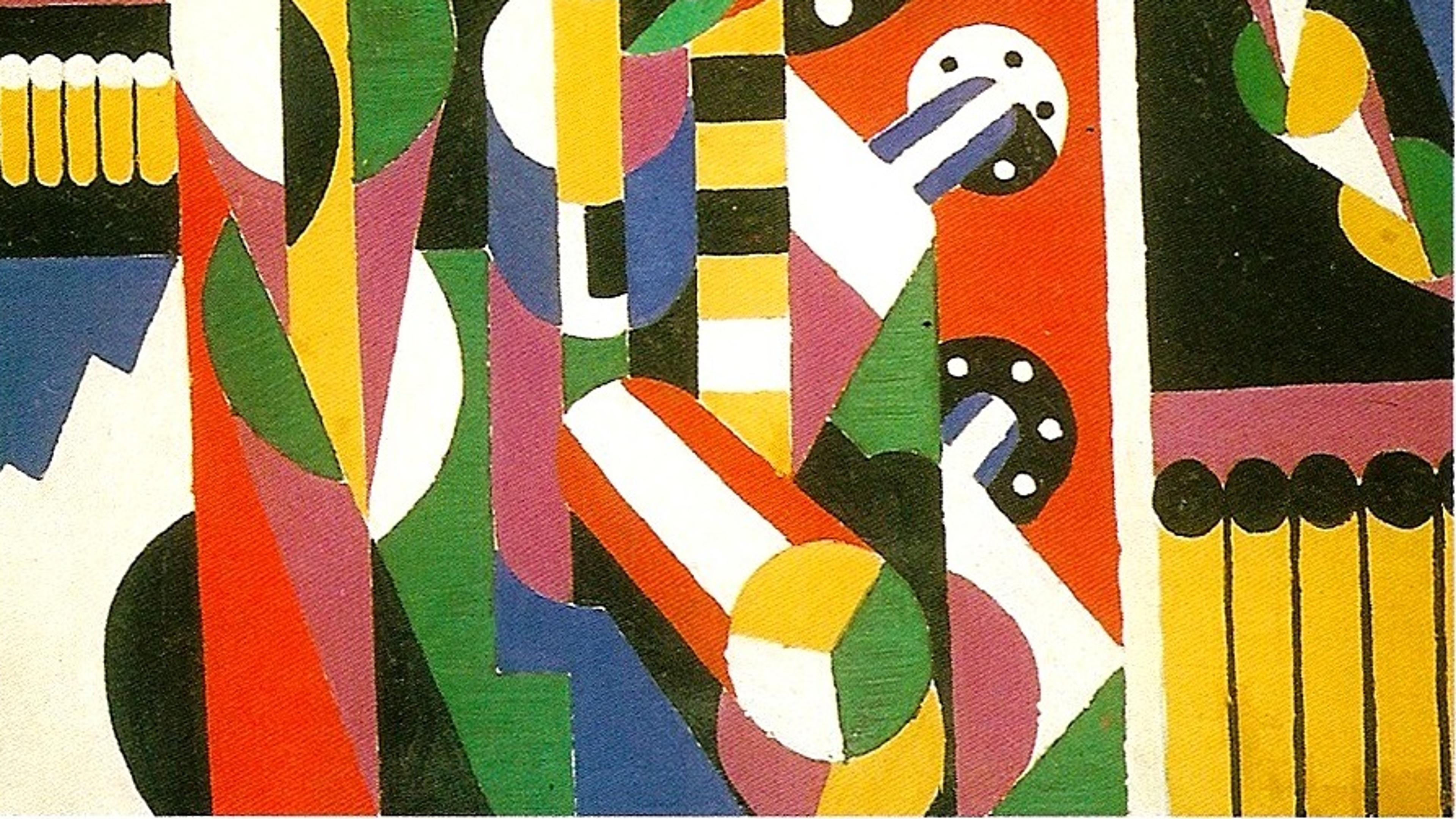
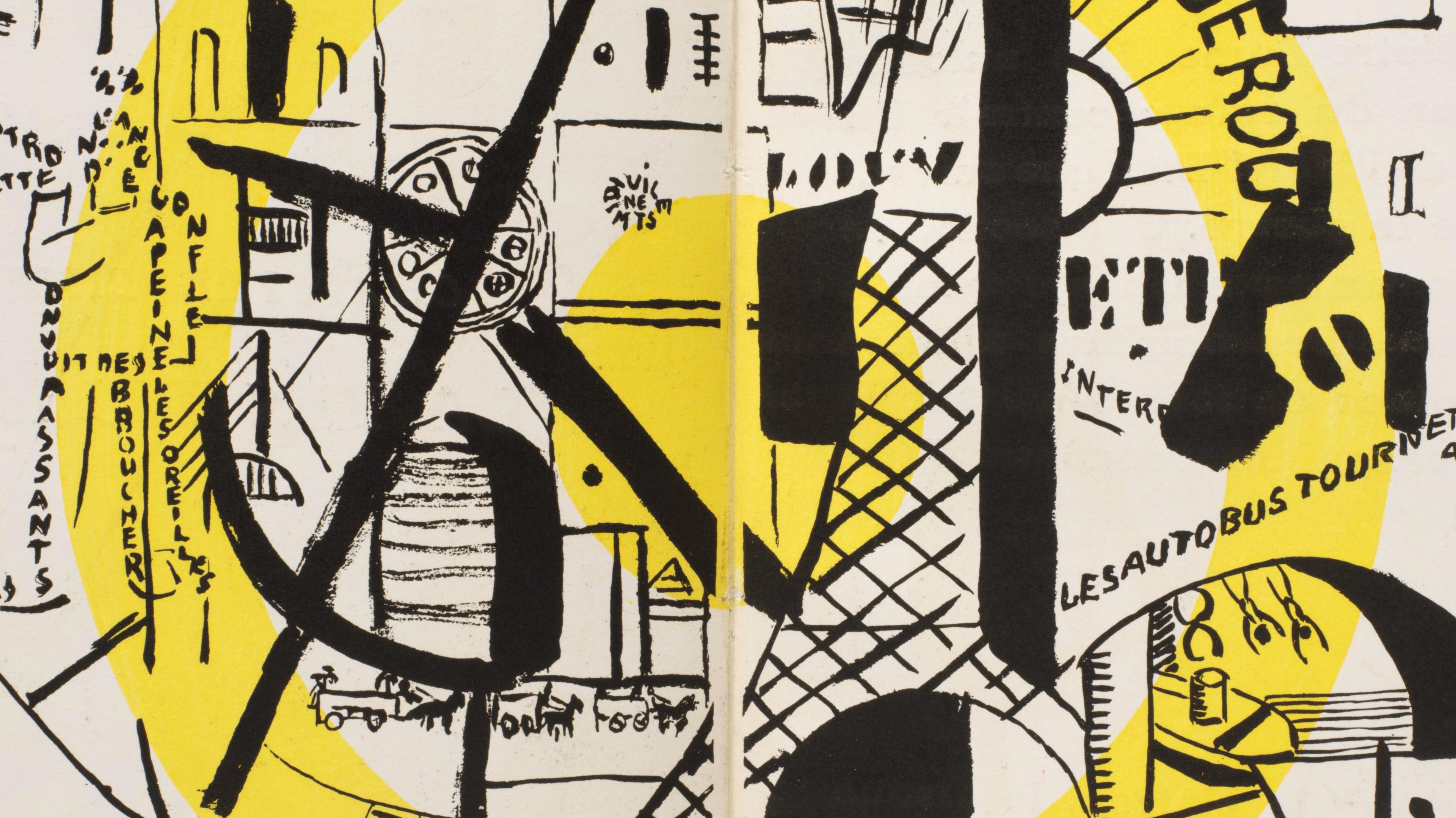
A writer and theorist on French cinema, Léger also worked on film productions in a variety of roles, from set and poster designer to credit animator, actor, producer, and finally director. His complete filmography includes participation in several feature-length films and numerous unfinished projects intended for celluloid produced between 1923 and 1947. To these I would add a paracinematic work not typically considered part of Léger’s filmic oeuvre: the artist book entitled La Fin du monde filmée par l'ange de N.-D. (The End of the World Filmed by the Angel of Notre-Dame), written by Cendrars in 1917, illustrated by Léger in 1919, and published that year. Within it, the artist’s dynamic drawings and pochoirs (color illustrations created using stencils) perform not only as printed designs but also as substitutes for moving images—as paper cinema—with the reader-as-projectionist advancing the “film strip” by turning the book’s pages. Proceeding from that premise, this essay examines the visual program of La Fin du monde in the context of Léger’s and Cendrars’s broader engagement with film and cinematic space in the early 1920s.
Léger and the cinema
In 1916, Léger went to the movies. Still stunned by the trauma of World War I and reluctant to experience the spectacle of cinema, he relented at the encouragement of his friend, the poet and playwright Guillaume Apollinaire. The two saw a film by Charlie Chaplin—Charlot, as he was then known in France—perhaps, as Jennifer Wild has speculated, Charlot au music-hall (A Night in the Show) of 1915. The encounter proved transformative for Léger, who saw in Chaplin’s comic style and plastic form a shocking departure from the affected performativity of film d’art and from the living horrors of the war. In the actor, Léger later wrote, he found a “living object” and a “mobile image”—a personification of cinema itself.
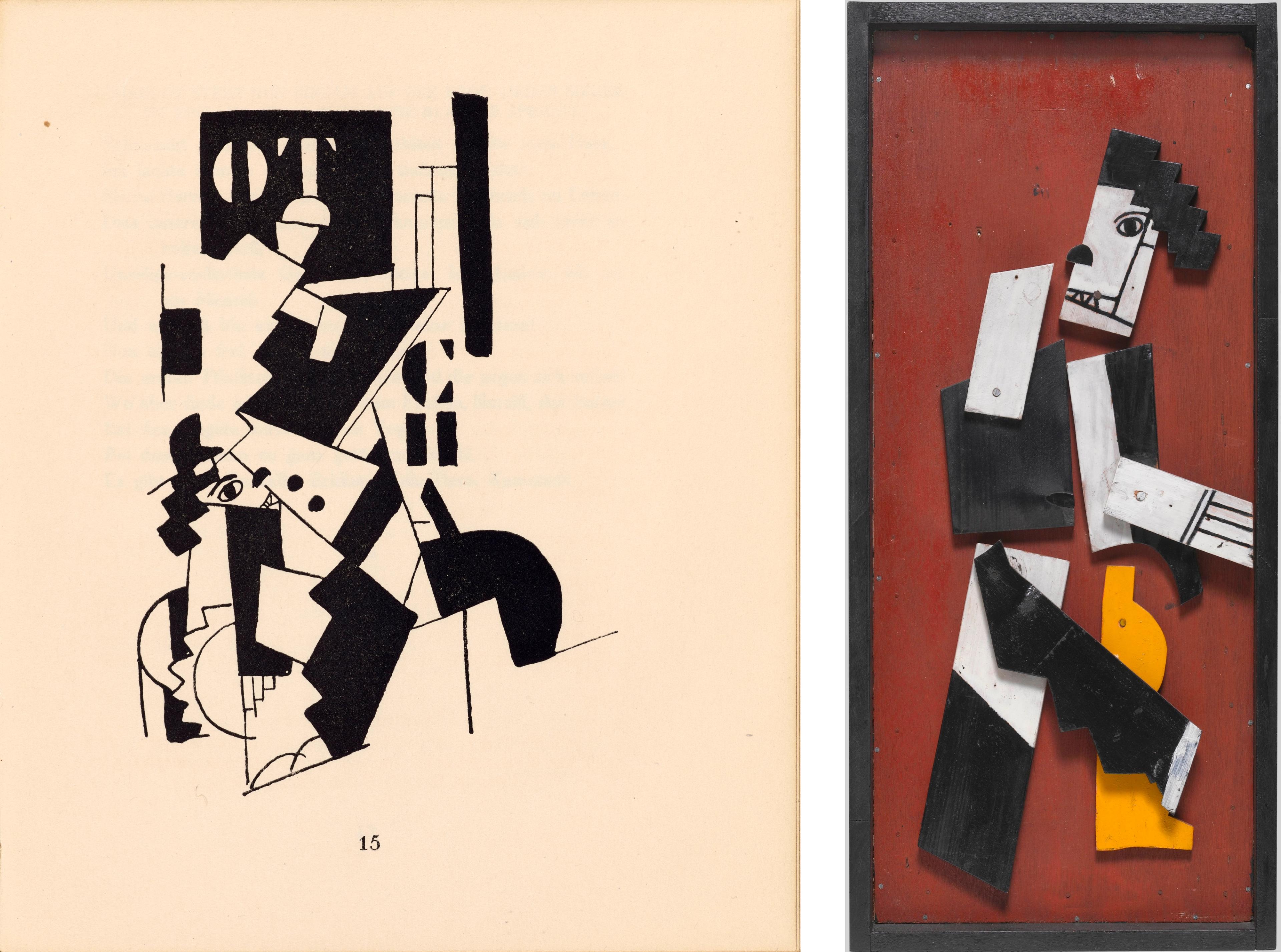
Left: Fernand Léger (French, 1881–1955). Illustration for the ciné-poem Die Chapliniade by Yvan Goll. Dresden: Rudolf Kaemmerer Verlag, 1920, p. 15. 9 x 7 1/2 in. (22.7 x 19 cm). Photo © François Fernandez © RMN-Grand Palais / Art Resource, NY. Right: Fernand Léger (French, 1881–1955). Charlot cubiste, 1924. Painted wooden elements, nailed on plywood, 29 x 13 1/4 2 3/8 in. (73.6 x 33.4 x 6 cm). Centre Pompidou, Musée national d’art moderne, AM 1985-402. Photo: Georges Meguerditchian. © 2026 Artists Rights Society (ARS), New York
Chaplin would later feature as the protagonist in several of Léger’s projects of the early 1920s, beginning with the illustrations for the ciné-poem Die Chaplinade (1920) by Yvan Goll, for which Léger developed a visual character he called Charlot Cubiste, the actor’s tell-tale mustache, bowler hat, and cane disrupting the planar cubist geometry of Léger’s drawings. The artist also wrote five scripts for animated films in which Charlot Cubiste was to star, though none were completed. The only cinematic record we have of Léger’s character serves to bookend Ballet Méchanique,the artist’s celebrated 1924 experimental film, co-directed with the American filmmaker Dudley Murphy. In it, the stop-motion wooden figure tips his hat to open and close the film—a mechanized man to match the rhythms of the new century. These short sequences prove that Léger was not merely content to engage with cinematic formats and effects by adapting kinetic methods like montage and close-ups to the printed medium, but rather aspired to produce works for the cinema.
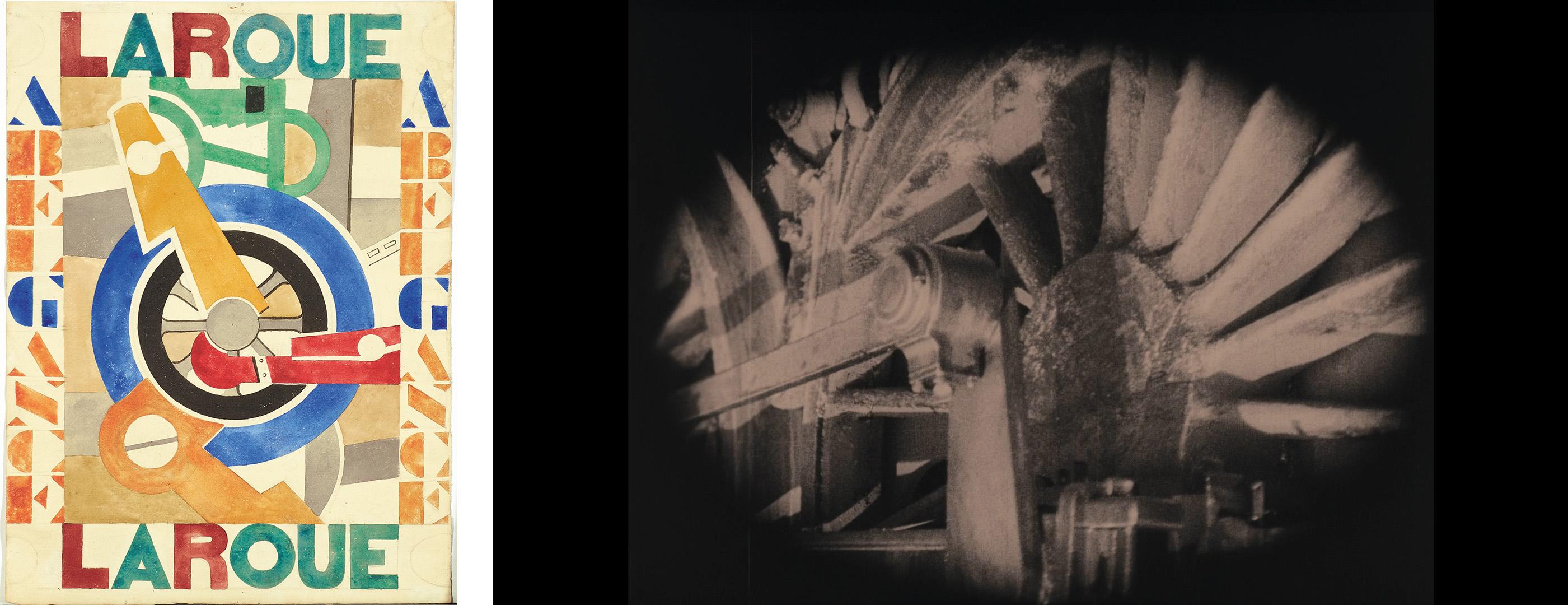
Left: Fernand Léger (French, 1881–1955). La Roue (Projet d'affiche pour La Roue D'Abel Gance), 1920. Gouache, watercolor and graphite on paper, 16 5/8 x 12 3/8 in. (42.2 x 31.4 cm). © 2026 Artists Rights Society (ARS), New York. Photo © Phillips Auctioneers LLC. Right: Film still from Abel Gance, La Roue, 1923. © Fondation Jérôme Seydoux-Pathé. 4K restoration made in 2019 by the Fondation Jérôme Seydoux-Pathé, in collaboration with the Cinémathèque française and Cinémathèque suisse, with support from the CNC
By 1922, Léger had followed Cendrars to the film set for Gance’s La Roue, a nearly nine-hour tragedy for which the poet served as assistant director. He helped manage details of the complex production, assembling a montage sequence of a train in motion and shooting a behind-the-scenes documentary, Autour de la roue (1923). Léger created the dynamic design for the film’s poster, with the stenciled name of the director and film title surrounding a schematic wheel driven by radiating rods and cranks. Similar circular disks and industrial mechanisms had populated Léger’s paintings and drawings in 1919, when he and Cendrars worked together on La Fin du monde. The boldly colored motifs found themselves incorporated into a new “machine aesthetic” in the period of his collaboration with Gance. Cendrars recognized this in 1919: in an article on Léger’s work, he described the artist’s paintings as containing “fleets of machines, instruments and implements.” If the fragmented perception and pulsating urban landscape of modern life seemed particularly suited for Léger’s art of the immediate postwar moment, so did cinema, with the roving eye of the camera mechanism a stand-in for the wheels, disks, and gears of Léger’s abstract machines. The artist himself agreed, writing simply in 1931 that “the cinema is the machine age.” Léger’s role in La Roue extended to the title credit sequence for the film, which Gance purportedly gave him free rein to design and edit. The result is a cinematic tableau of dreamy superimpositions, extreme close-ups, crops, and high-contrast shots of steam trains—including their wheels in motion.
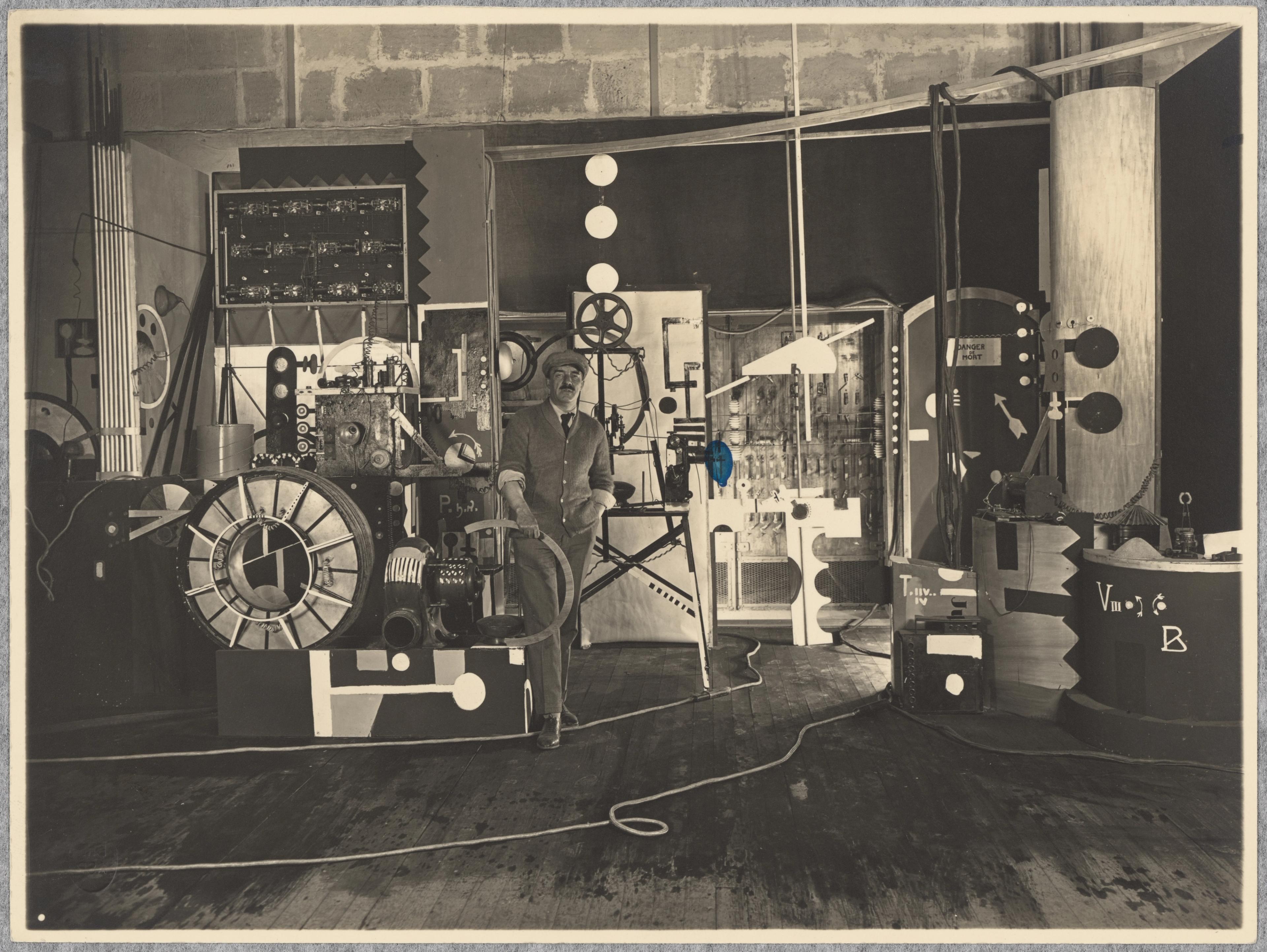
Production photograph from L'Inhumaine, 1922, directed by Marcel L'Herbier, showing Fernand Léger in the set he designed. Bibliothèque nationale de France, département des Arts du spectacle, 4 col 198 219_a
Léger immediately followed La Roue with work on the 1924 science-fiction film L’Inhumaine, directed by Marcel L’Herbier, for which he not only designed the poster and opening animation but also created sets for the laboratories featured in the film, which he imagined as “a forest of mechanisms.” Léger had previously designed the scenography and costumes for two stage productions for the Ballets Suédois, Skating Rink (1922) and La Création du monde (1923), but L’Inhumaine marked his first foray into film sets. His version of a science laboratory explodes the painterly vocabulary he had developed in 1918–19 into three dimensions with mechanical forms, geometric patterns, and typographic glyphs overlaid on a dense visual field populated by beakers, levers, and cogs. A production photograph shows Léger standing inside the set: the artist-designer amidst his mad creation.
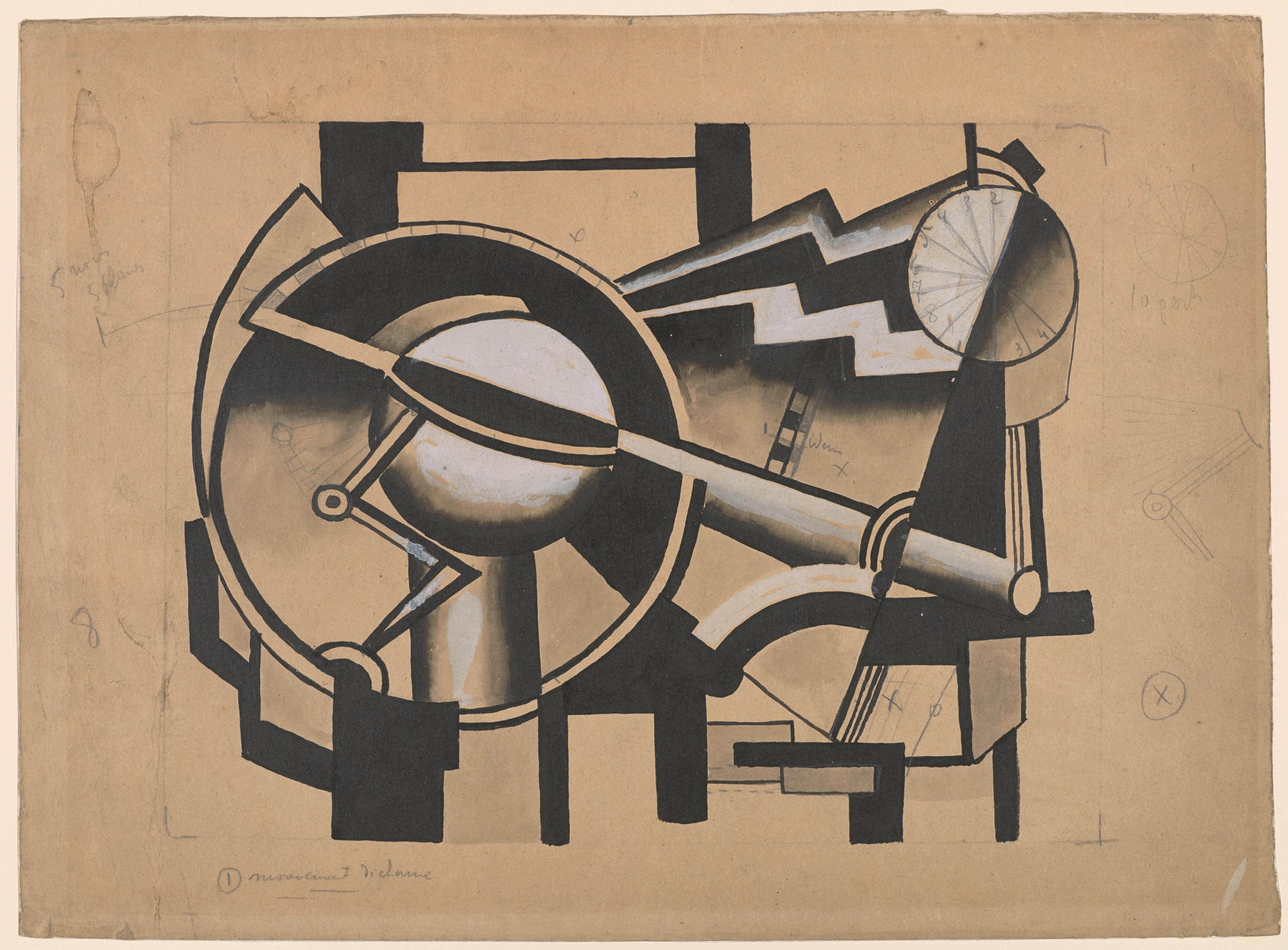
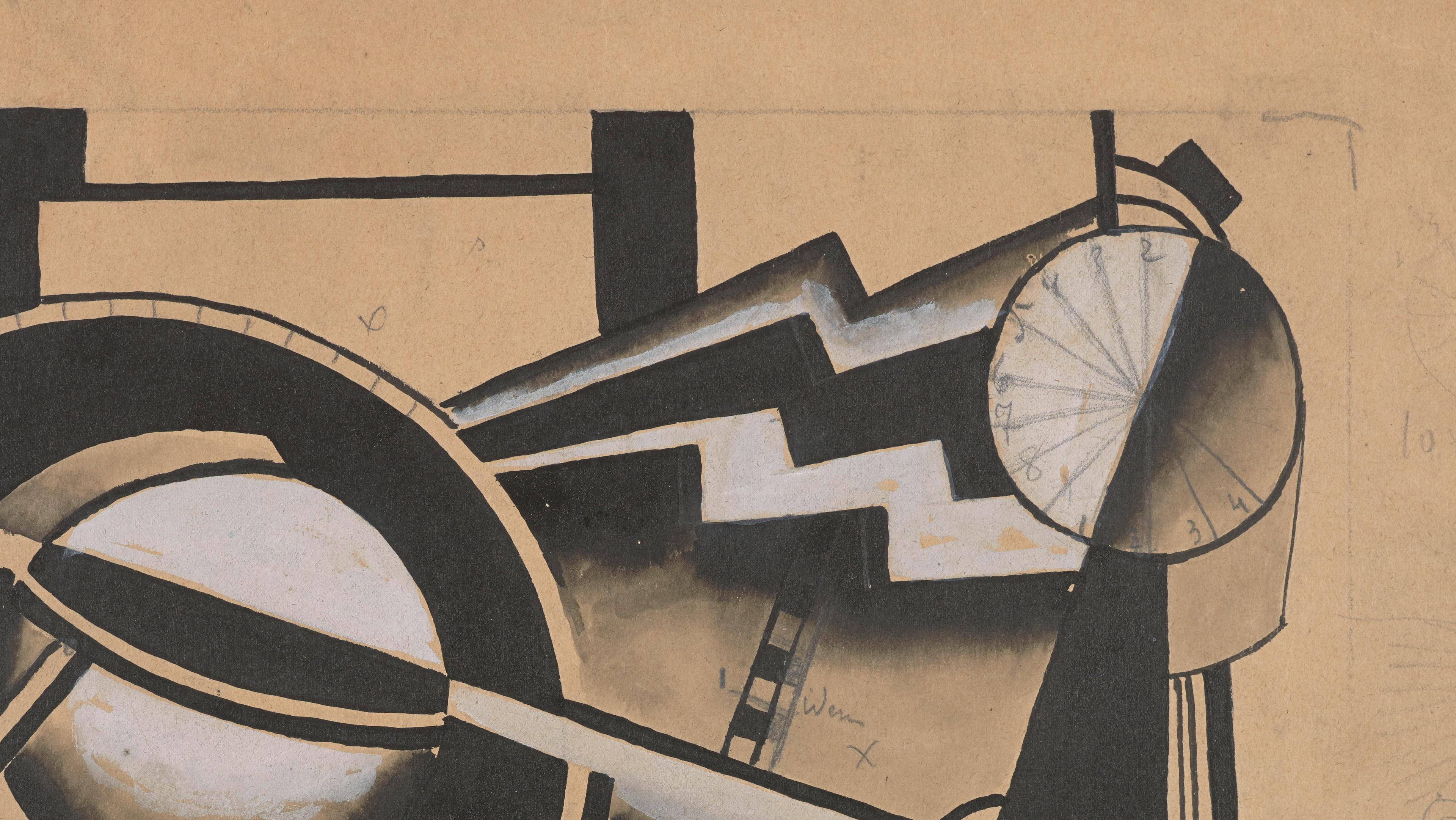
Fernand Léger (French, 1881–1955). Mechanical Composition, ca. 1918–20. Gouache and India ink on paper, 13 3/8 x 17 3/4 in. (34 x 45 cm). Photo © Adrien Didierjean © RMN-Grand Palais / Art Resource, NY
For the title credits, Léger animated his 1918 drawing Mechanical Composition, a jumble of black-and-white disks and tubes whose contrasted geometries lend them the glint of steel. While the abstracted forms on Léger’s sheet do not cohere spatially—with interrupted mechanical elements sitting within a fractured container—they snap into focus when made to move. For example, the darkened circle at upper right becomes a spinning film reel and the checkered stripe near the composition’s center a filmstrip running through a projector. That Léger made the sketch six years before his work on Gance’s film suggests that he understood his drawn and painted works, especially of that moment, could be applied to filmmaking. As early as 1913, he had praised the perceptual and pictorial revolution of the cinema and declared that it had supplanted static forms of art-making: “I maintain that modern mechanical achievements such as color photography, the motion-picture camera [etc.] … have effectively replaced and henceforth rendered superfluous the development of visual, sentimental, representational and popular subject matter in pictorial art.” Of course, Léger continued to produce paintings and drawings, but his comments offer a road map for understanding his productions of the late 1910s and early 1920s in the context of the cinema—or, going further, to register his visual artworks of this period as paracinematic. Intended for the cinema without being bound to the materials or technologies of film, Léger’s drawing for L’Inhumaine and its retrospective animation offer a paradigm for reading Léger’s illustrations in La Fin du monde as moving images.
La Fin du monde as film
Cendrars wrote La Fin du monde on the night of his thirtieth birthday, September 1, 1917, in a single burst of creative energy—appropriate for a writer who likened the act of filmmaking to the creation of the universe. By this time, Cendrars claimed to have already written several synopses and (rejected) scripts for Pathé and Gaumont, and to have filmed several shorts and documentaries. La Fin du monde emerged as a screenplay that he also intended to include in an ambitious proposed anthology on the cinema with a preface by Charlie Chaplin and contributions from leading avant-garde artists and authors. Cendrars clearly had the connections and background in film to execute his project but—it seems—not the funding or production support. Two months after he drafted the text, La Fin du monde appeared as an unillustrated film script in the literary journal Mercure de France; it was published the following year with illustrations by Léger.
A commentary on La Fin du monde is given by Christopher Green, and the text is offered in English translation for the first time by Mark Polizzotti as part of this resource, but it is worth summarizing here. Cendrars’s mise-en-abyme screenplay chronicles an apocalyptic scenario filmed—at God’s request—by a statue atop the famed cathedral of Notre-Dame de Paris who serves as both cameraman and eyewitness to the earth’s destruction. When the ensuing documentation is screened, the projector breaks down, and the film unspools wildly in its reel; the cataclysmic end of days captured on film also proves to be its own undoing.
Depicting a film-within-a-film, and replete with references to celluloid and cinema technologies, La Fin du monde’s narrative framework also follows the formal structures of cinema. Cendrars sequentially numbers his paragraphs like scenes in a film script and incorporates action lines to describe the setting, characters, activities, and mood of each section. The text falls into concise segments whose varying lengths simulate different linguistic speeds, forming a lexical montage.
For Cendrars, the advent of cinema depended on the invention of a new language, a fragmentary poetics born from the breakdown of conventional linguistic structures. Gance shared this belief, ascribing to the act of filmmaking a kind of biblical creation myth: “The process of constructing a film script is the opposite of a novel or play. Here everything comes from the outside. At first everything is hazy; then an atmosphere comes into focus that stops you cold, from which the drama is born; the earth has already formed, but there are not yet any creatures. Kaleidoscopes appear.” La Fin du monde allegorizes this cycle of formation and eschatological annihilation: for cinema to exist, the old world needs to be destroyed.
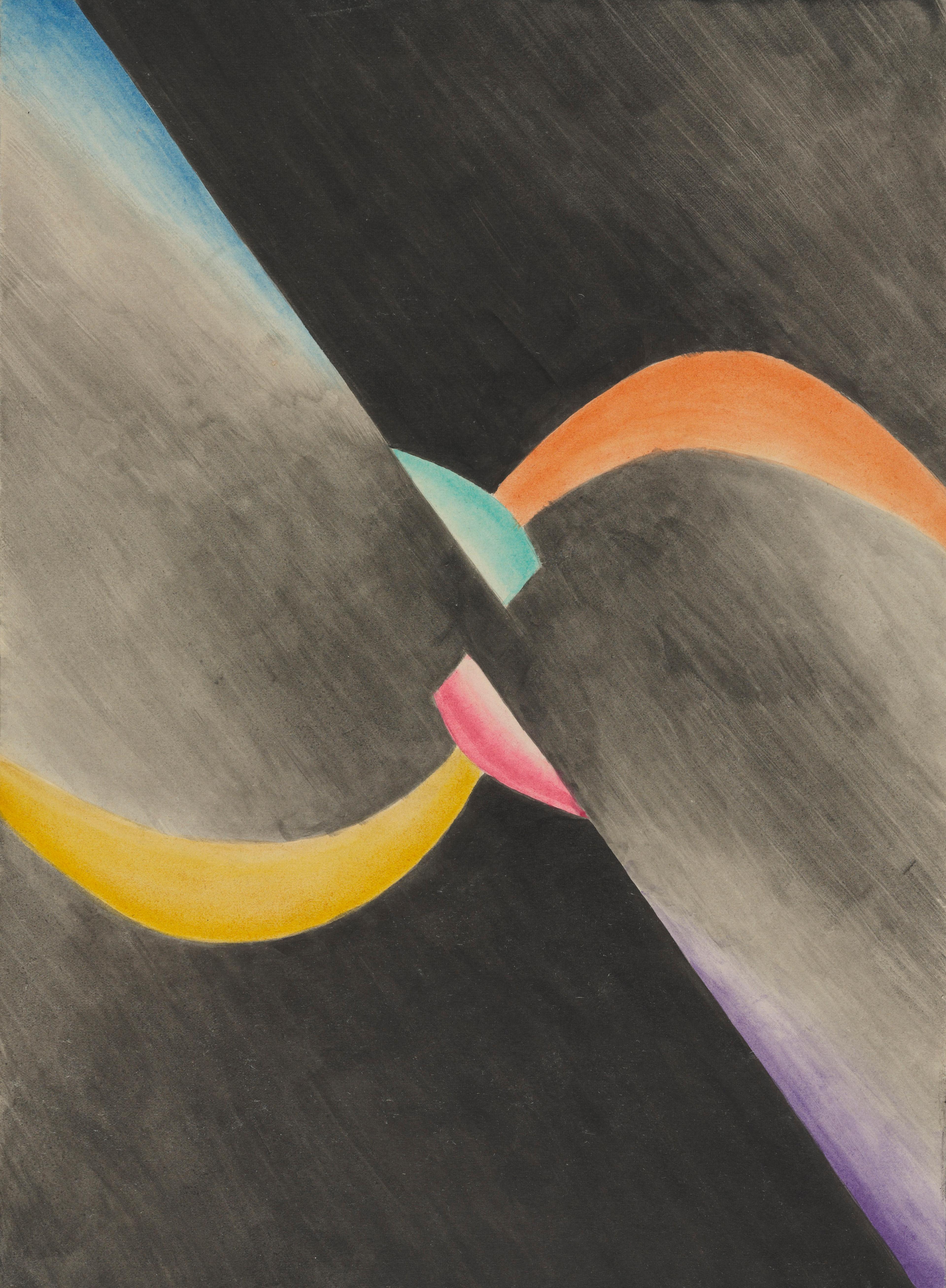
Léopold Survage (Finnish, 1879–1968). Colored Rhythm: Study for the Film, 1913. Watercolor and ink on paper on black paper-faced board, 14 3/16 x 10 1/2 in. (36 x 26.6 cm). Museum of Modern Art, New York. Purchase. 661.1939.10. © 2026 Artists Rights Society (ARS), New York / ADAGP, Paris; Digital Image © The Museum of Modern Art/Licensed by SCALA /Art Resource, NY
Cendrars seems to have had in mind a clear direction for the visual program of the printed volume. In June 1919, contemporaneously with Léger’s work on the book’s illustrations, he published an essay on an unfinished 1914 film project by the artist Léopold Survage, of which he would have seen a description that year in the pages of Les Soirées de Paris. Survage intended to animate a series of his paintings into an abstract color film, an ambitious proposition given the technologies available at the time. The artist’s ability to capture the rhythmic flow and orbital movement of colors captivated Cendrars. “You would think you were present at the actual creation of the world,” he wrote.
Léger’s drawings similarly convey the universe of La Fin du monde through bold hues and revolving forms. Chapter 1 ends with three white circles nestled within rays of primary colors, likely depictions of the “powerful spotlights” or “lit signals” referred to in the text that precedes it, while Chapter 2 concludes with a representation of Cendrars’s “bronze robots” descending on the masses, their overlapping spheroid bodies poised to run off the page. Other spreads impressionistically convey chapter themes using strategies derived from filmmaking, such as the opening of Chapter 4, a close-up of the Notre-Dame angel and the stenciled words “l’ange,” “operateur,” and “notre dame” arranged like blaring advertising signs successively framed by the camera. The text-image introducing Chapter 6, titled “Cinema, Fast-Forward and Slow-Motion,” comprises a compact spiral of letters rotating around a small white circle, like the focus point of a lens as the shutter closes.
Cendrars’s poem “Construction,” written concurrently with La Fin du monde, provides perhaps the clearest language linking Léger’s illustrations to both the cinema and the world’s end. The text describes a universe of color with Léger as the metaphorical sun. The earth calcifies then dissolves before everything falls into darkness. Then, “painting becomes this great thing that moves / The wheel / Life / The machine.” Compare this to the page spread introducing Chapter 5, where an urban landscape rendered entirely in black ink, including a steamboat, building, and line of horse-drawn carts, competes with fragments of language kinetically arrayed across the pages. The Eiffel Tower falls into the scene, its tip broken off in a sign of the impending catastrophe. Over this chaos, Léger superimposes a thick yellow target onto which he has inscribed the words “la grand roue”—the big wheel—a reference to the enormous Ferris wheel from the 1900 Exposition Universelle that was still the tower’s companion when La Fin du monde was published. Read now, this “full circle” phrase and its attendant form return the reader to Gance and La Roue while connoting the round mechanisms of cinema—the film reel, the camera eye, the projector beam—and the great cycle of birth and death witnessed by cinema’s captive vision.
Coda
Despite their success in creating a film on paper, Léger and Cendrars never gave up hope that La Fin du monde would be realized on the silver screen. In 1948, Cendrars recalled a conversation with French theater director Louis Jouvet, during which he elaborated on his plans for a complex film set approximating a post-apocalyptic landscape in a “Paris seaport, in an industrial backwater, [with] a graveyard of machines, smashed gasometers, shattered tar barrels piled in teetering pyramids, floating floodgates, trails of ash, a stretch of broken bottles, mounds of shredded cans, embankments riddled with mattress springs and other nameless debris of civilization.” Léger, too, continued to network with the goal of producing the film. In 1927, while in Paris, he met the artist and director Hans Richter, with whom he would later collaborate on a sequence for the 1947 film Dreams that Money Can Buy. According to Richter, Léger pitched an idea for a film version of the book, letting himself “be carried away by his visions and an excellent wine and sketched film sequences on the paper tablecloth. I took the sketches with me for later use. Since we planned the film in color, we contacted one of the inventors of German color film.” Unfortunately, Richter continued, “Nothing came of our project and the sketches were lost.” Absent a realization of La Fin du monde on film, the printed volume of the screenplay stands as a form of paper cinema, offering through its pages a dystopian fantasy as seen through the lens of a camera.
Notes
“Le cinéma m’a fait tourner la tête. En 1923, je fréquentais des copains qui étaient dans le cinéma et j’ai été tellement pris par le cinéma que j’ai failli lâcher la peinture” (my translation). Fernand Léger, interview with Dora Vallier, “La vie dans l’oeuvre de Léger,” Cahiers d’art 2 (1954), 160.
He claimed to have made short films, though these have never been found. See Mikhail Iampolski, “Cinematic Language as Quotation: Cendrars and Léger,” in The Memory of Tiresias: Intertextuality and Film (Berkeley: University of California Press, 1998), 129.
“It was Apollinaire who took me to see Charlie Chaplin during one of our leaves. We were of the opinion that everything was happening ‘over there’ —that life was collected on the [front] ‘lines,’ that the civilian zone was boredom and death. ‘All the same,’ Apollinaire said to me, ‘there is something here. Come see.” Fernand Léger, “Témoignage,” Chroniques du Jour, December 16–31, 1926, 243–44; republished as “On Charlie Chaplin,” in Léger: Modern Art and the Metropolis, ed.Anna Vallye,trans. Liesl Yamaguchi (Philadelphia Museum of Art, 2013), 153.
Wild reasons that Apollinaire and Léger would have visited a movie theater in Montmartre or Montparnasse near the artist’s studio, likely the Raspail Palace or Cinéma des Mille Colonnes. See Jennifer Wild, “What Léger Saw: The Cinematic Spectacle and the Meteor of the Machine Age,” in Vallye, Léger: Modern Art and the Metropolis, 145–50.
“I saw Charlot and it was unquestionably something, because it held my attention in spite of the massive spectacle I had just behind for seven days.” Léger, “On Charlie Chaplin,” 153.
Léger, “On Charlie Chaplin,” 153.
The ciné-poem, combining poetry with the structure of film scripts, flourished as a literary genre in the 1920s.
According to Gordon Hughes, Léger was present during the filming of key scenes in Nice and the French Alps. See Hughes, “Fernand Léger’s Cinema of Pictorial Equivalence (and the Return to Disorder),” Oxford Art Journal 44, no. 1 (2021), 70.
The year of the film’s release, Léger also published a review of sorts: “La Roue: Sa valeur plastique,” Comoedia, December 16, 1922, 5; republished as Léger, “A Critical Essay on the Plastic Quality of Abel Gance’s Film The Wheel,” in Functions of Painting, ed. Edward F. Fry, trans. Alexandra Anderson(New York: The Viking Press, 1965), 20–23.
“Des parcs d’engins, d’instruments, d’outils” (my translation). Blaise Cendrars, “Fernand Léger,” in La rose rouge,no. 10 (July 3, 1919), 155.
Art historian Maria Gough dates Léger’s painterly expression of film to his earlier Orphic period of 1912–13, writing that his use of black and white volumes “interrupts the surface of the sheet, animating it with an insistent flicker” to create a “cinematic effect.” See Gough, “Ciné-graphie: On Fernand Léger’s Drawings, 1912–14,” in Fernand Léger: Contrasts of Forms, ed. Matthew Affron (Charlottesville: University of Virginia Art Museum, 2007), 23.
Fernand Léger, “À propos du cinéma,” Plans, no. 1 (January 1931), 80–84, translated in Léger, Functions of Painting, 100–101.
Léger quoted in Standish D. Lawder, The Cubist Cinema (New York: New York University Press, 1975), 101.
Fernand Léger, “The Origins of Painting,” in Functions of Painting (New York: The Viking Press, 1965), 9.
Blaise Cendrars, “Le Film de la fin du monde,” Mercure de France 130, no. 491 (December 1, 1918), 419–30.
“La processus de construction d’un scénario est à l’inverse du roman ou du drame de théâtre. Là tout surgit de l’extérieur. D’abord des brumes flottent, puis une ambiance se précise qui vous arête et d’où viendra le drame; la terre est formée, les êtres ne le sont pas encore. Des kaléïdoscopes s’établissent” (my translation). Abel Gance, “Le Temps de l’image est venu!” in L’Art cinématographie, vol. 2 (Paris: Librairie Félix Alcan, 1927), 93.
“On croirait assister à la création même du monde” (my translation). Blaise Cendrars, “De la parturition des couleurs,” in La rose rouge,no. 12 (July 17, 1919), 188.
“La peinture deviant cette chose énorme qui bouge / la roue / la vie / la machine” (my translation). Blaise Cendrars, “Construction,” in Tout autour d’aujourd’hui, Poésies complètes, vol. 1 (Paris: Denoël, 2001), 92.
“PARIS, PORT-DE-MER, dans un décor de bled industriel, un cimetière de machines, des gazomètres défoncés, des pyramides dégringolantes de tonneaux de goudron éventrés, des vannes flottantes, des pistes de cendré, une étendue de tessons de bouteilles, des monticules de bidons déchiquetés, des remblais criblés de ressorts à matelas et autres débris sans nom de la civilisation” (my translation). Blaise Cendrars, Bourlinguer (Paris: Denoël, 1948), 306.
“Léger, der das Buch schon illustriert hatte, liess sich von seinen Visionen und einem vorzüglichen Wein weitertragen und skizzierte Film-Sequenzen auf das Papiertischtuch. Ich nahm die Skizzen zum späteren Gebrauch mit. Da wir den Film in Farbe planten, setzten wir uns mit einem der Erfinder des deutschen Farbfilms in Verbindung…Aus unserem Projekt wurde nichts, und die Skizzen gingen verloren” (my translation). Hans Richter, “Fernand Léger,” Begegnungen von Dada bis heute (Cologne: DuMont Verlag, 1973), 196.