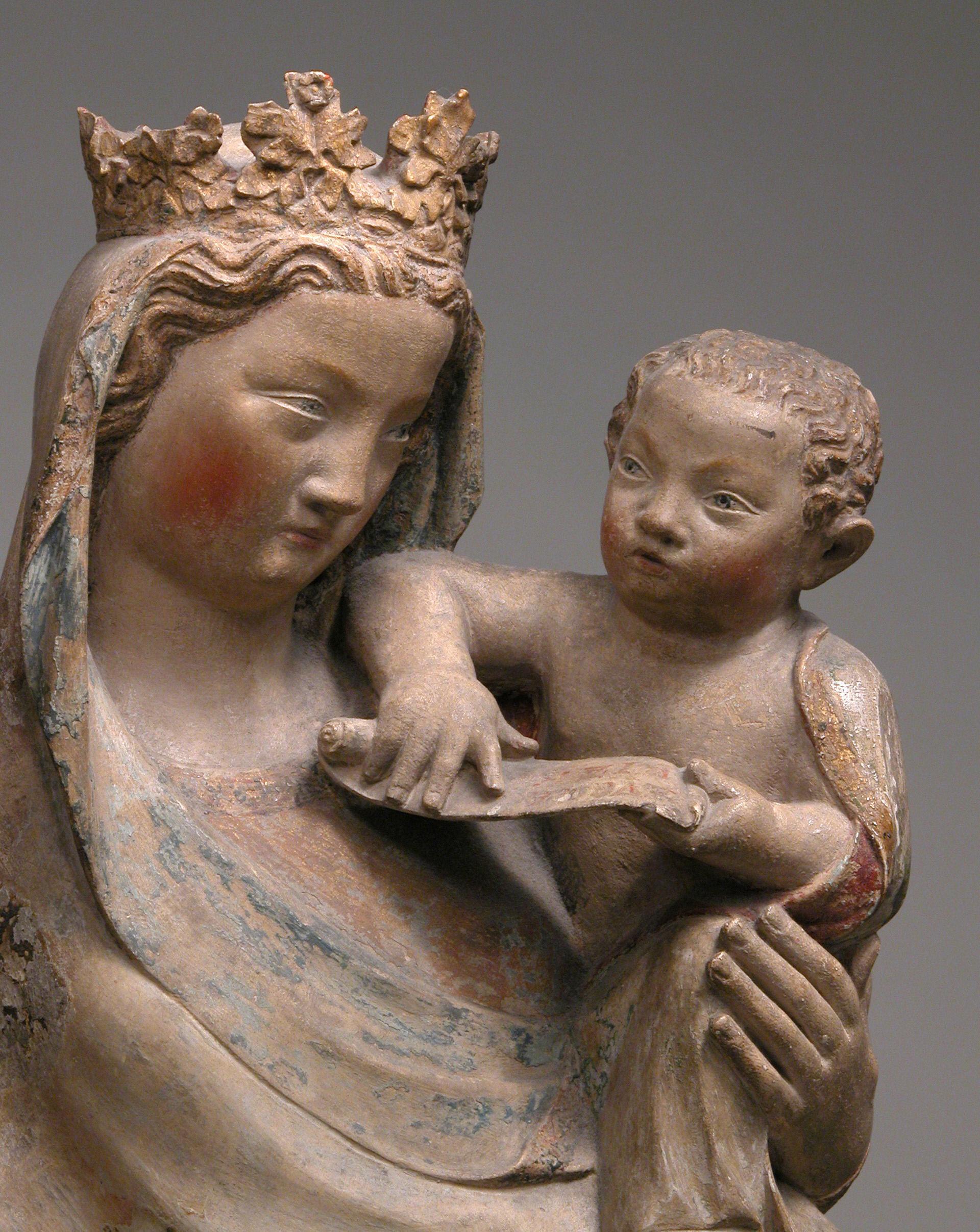
Virgin and Child, ca. 1310–20. French. Paris limestone, polychromed, gilded, 34 1/4 x 11 7/8 x 8 5/8 in. (87 x 30.2 x 21.9 cm). The Metropolitan Museum of Art, New York, The Friedsam Collection, Bequest of Michael Friedsam, 1931 (32.100.406)
My name is Cecily Brown and I’m a painter.
Art has always been my religion, in a way. I think it fulfills a role in my life that other people might find that religion fills. I often think looking at art... it's the ultimate escapism. You’re in this total and complete world. I love the room of medieval sculpture as a total environment. The atmosphere feels completely outside of time. Not that it feels old fashioned, but it’s a world unto itself.
When I make a painting, I’ve always liked the fact that I know what my limitations are. I mean, there’s something very reassuring but also exciting about knowing you’ve got your rectangle and it’s flat and it’s got these edges, and then, within that, that’s where you can be inventive. And one does get the feeling that these Madonna and Child sculptures were probably commissioned for specific places. So that, yes, they’re all the same subject, but there is such a range within that. There’s a playfulness and an invention and imagination to them, whether Christ is playing with a little bird, or stroking her cheek, or chucking her chin, and you’ve got to deal with the Christ Child’s feet. In some they’ll be covered by the drapery, in another there’ll be these little toes peeping out.
There’s no definitive Madonna and Child. It’s always the Madonna, but you can’t quite pin her down to just one reading. And part of this dreamy feeling of the room, I think, is the feeling that each Madonna has the others inside it. And they carry this whole range of emotions. They’ve really got personality. Some of them seem surprisingly coquettish, almost sassy. You feel this strong, interesting, complex woman giving this provocative gaze. And I’m very conscious of them being very sensual, of the body beneath the drapery, almost in a taboo way. So the child is the only thing keeping her chaste. The artist must have been trying to tread a fine line between showing feminine beauty without making her overly sexual.
They have this playfulness, but at the same time this great gravity and seriousness. And I think probably age has enhanced that. I almost always prefer the ones that are a little more beaten up. The traces of paint add this poignancy. I think it’s a contemporary sensibility that prefers the broken and the fragmented. They’ve got this in-built sweetness and sadness, this sense of loss. They embody flux, a sense of time having passed, and that makes you feel how fast and slow it all is.