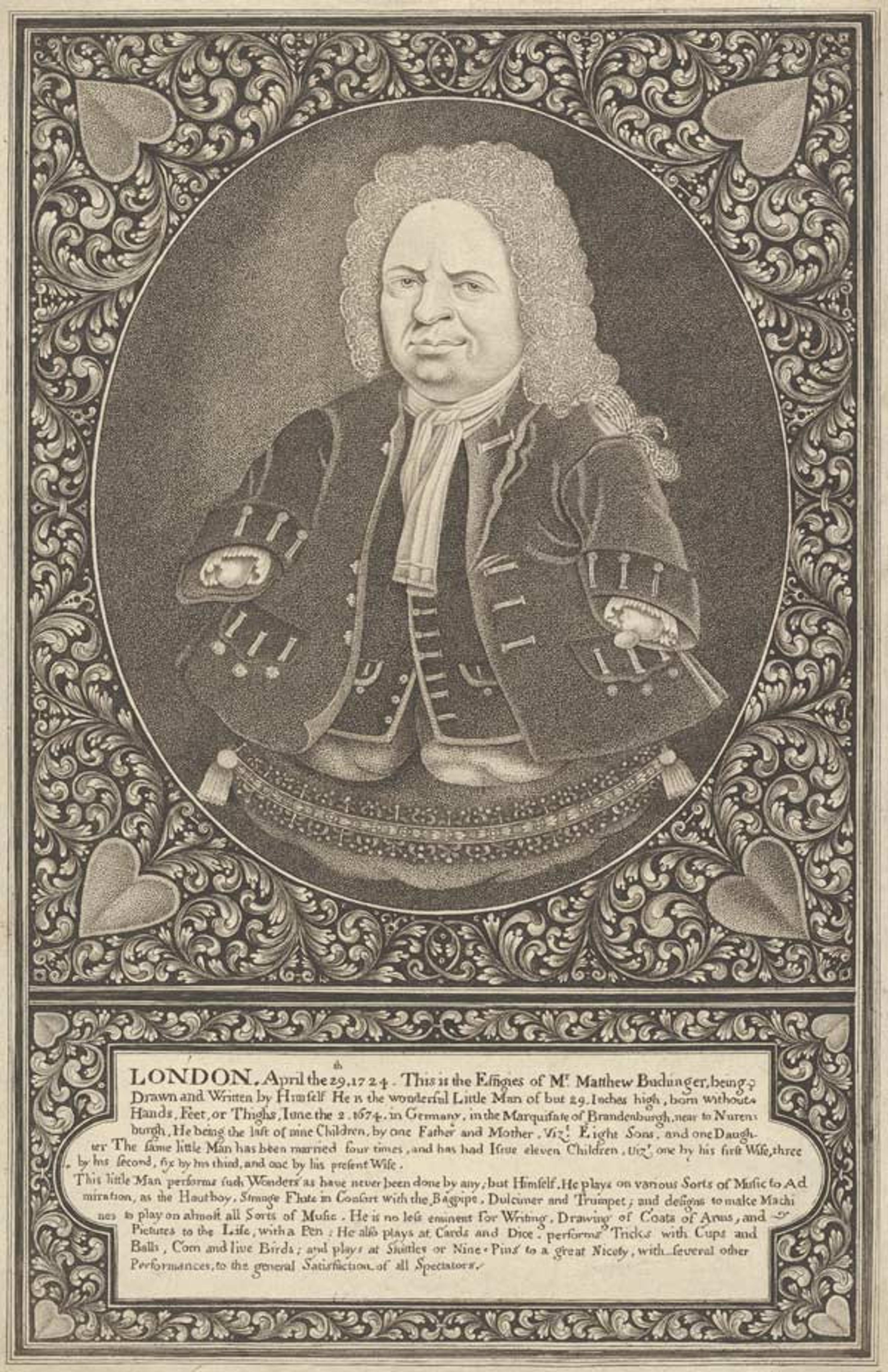
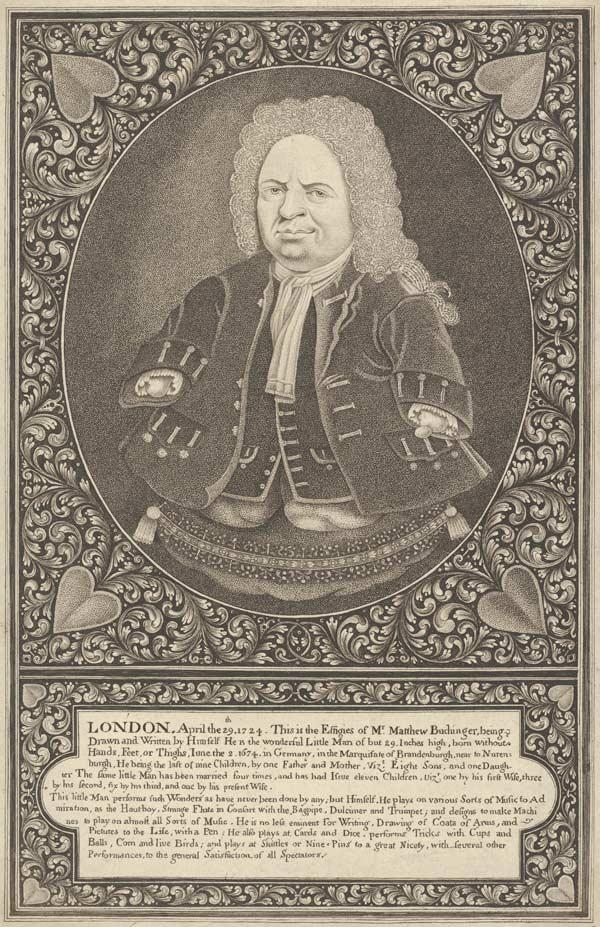
Anonymous (British, 18th century). Portrait of Matthias Buchinger, 1724. Engraving; Sheet: 12 1/8 in. x 8 in. (30.8 × 20.3 cm). Collection of Ricky Jay
«A longtime interest of renowned conjurer and collector Ricky Jay, Matthias Buchinger (1674–1739) was a master of calligraphy and micrography—a traditional art form dating to the late ninth century, in which minute lines of text are used to shape patterns or forms. However, what initially drew Jay to Buchinger was the latter's unparalleled legerdemain. As a magician of the sleight-of-hand variety himself, Jay was fascinated by Buchinger's range of unusual entertainments and his ability, despite having no hands, to grip and manipulate objects between his two appendages. The exhibition Wordplay: Matthias Buchinger's Drawings from the Collection of Ricky Jay, draws primarily from Ricky Jay's collection, and explores for the first time the work of the "Little Man of Nuremberg."»
Celebrated as the "Greatest German Living," Buchinger's praises were sung across Europe, in everything from local advertisements to poetic broadsides. Buchinger described himself in the following way:
Although publicity prints such as the one that carried this inscription often exaggerated a performer's talents, Buchinger was highly accomplished: he fashioned himself a gentleman, performed before countless audiences, married four times, had fourteen children, and left behind a body of work that demonstrates an almost magical dexterity, despite his physical limitations.
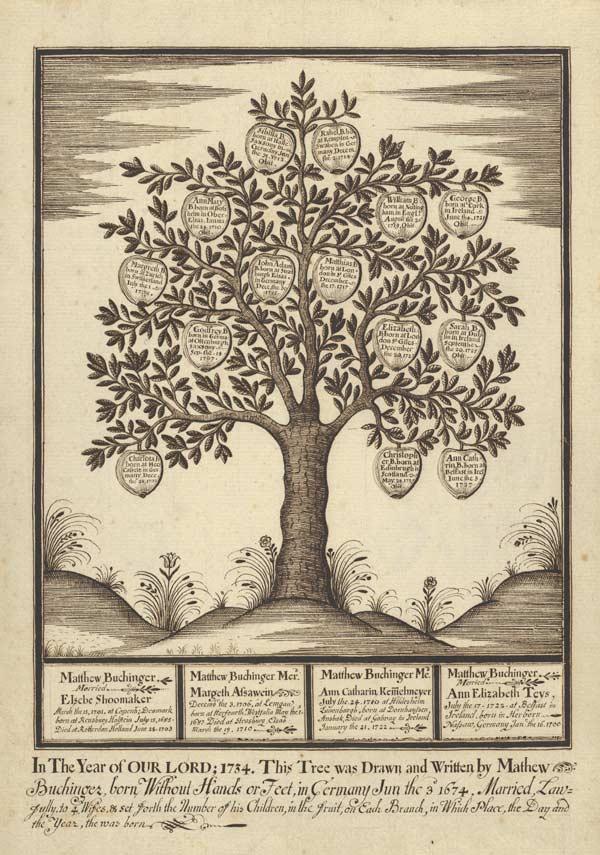
Matthias Buchinger (German, 1674–1739). Buchinger Family Tree, May 28, 1729. Pen and ink on paper with cutouts; Sheet: 10 1/4 x 7 3/4 in. (26 x 19.7 cm). Collection of Ricky Jay
Born in the vicinity of Nuremberg, Germany, Buchinger lived a nomadic existence, traveling between Augsburg, Stuttgart, Winterthur, Amsterdam, Paris, Zurich, and Copenhagen. In 1717, Buchinger "goes British," according to Ricky Jay, first using London as his base while performing in Oxford, Bath, and Edinburgh, among many other places, before finally settling in Ireland. As an artist and a performer, Buchinger boasted a clientele that included noblemen, kings, and emperors, along with members of the public who visited him at inns and fairs. He left behind a substantial number of wondrously executed drawings; some were commissioned, but many were executed on small pieces of vellum customized by Buchinger—likely on the spot—with the date and his calligraphic signature. His main subjects included family trees, coats of arms, the Ten Commandments, and portraits.
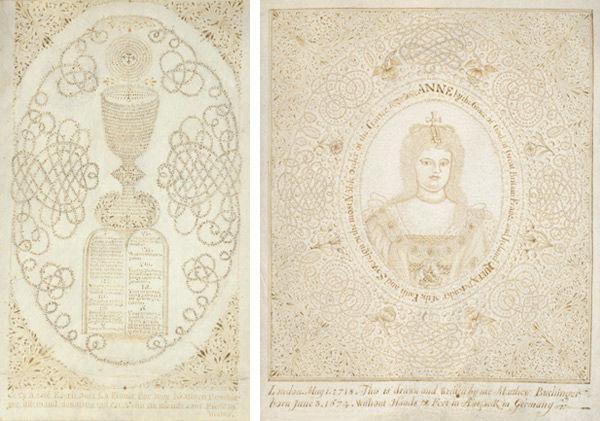
Left: Matthias Buchinger (German, 1674–1739). Ten Commandments and Selections from the Gospel of John. Pen and ink on vellum; Sheet: 3 7/16 x 4 3/8 in. (8.8 x 11.1 cm). Collection of Ricky Jay. Right: Matthias Buchinger (German, 1674–1739). Portrait of Queen Anne, 1718. Pen and ink on vellum; Framed: 7 1/2 x 8 3/4 in. (19.1 x 22.2 cm). Collection of Ricky Jay
Wordplay places Buchinger in the context of works on paper, from the late Middle Ages to the present day, that artfully play with words or typography. The exhibition is on view through April 11, 2016.
Related Links
Wordplay: Matthias Buchinger's Drawings from the Collection of Ricky Jay, on view January 8–April 11, 2016