我们正在努力尽快翻译此页面。感谢您的理解。
Painting of a woman holding a naked child holding a cross
Exhibition

Raphael: Sublime Poetry
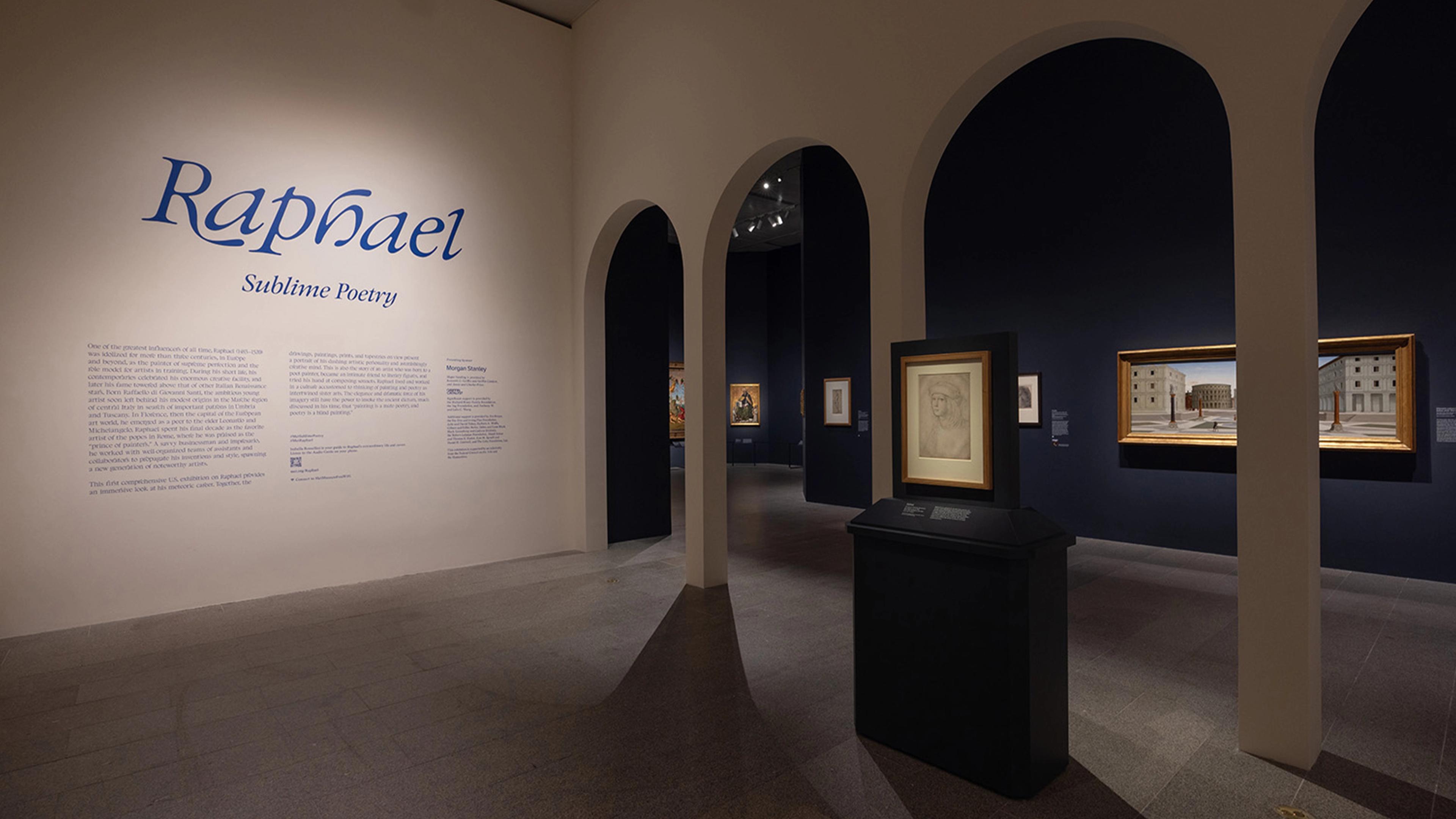
Raphael: Sublime Poetry

Exhibition room with a wall reading "Raphael: Sublime Poetry." Dim lighting highlights framed artworks

One of the greatest influencers of all time, Raphael (1483 –1520) was idolized for more than three centuries, in Europe and beyond, as the painter of supreme perfection and the role model for artists in training. During his short life, his contemporaries celebrated his enormous creative facility, and later his fame towered above that of other Italian Renaissance stars. Born Raffaello di Giovanni Santi, the ambitious young artist soon left behind his modest origins in the Marche region of central Italy in search of important patrons in Umbria and Tuscany. In Florence, then the capital of the European art world, he emerged as a peer to the elder Leonardo and Michelangelo. Raphael spent his final decade as the favorite artist of the popes in Rome, where he was praised as the “prince of painters.” A savvy businessman and impresario, he worked with well-organized teams of assistants and collaborators to propagate his inventions and style, spawning a new generation of noteworthy artists.

This first comprehensive U.S. exhibition on Raphael provides an immersive look at his meteoric career. Together, the drawings, paintings, prints, and tapestries on view present a portrait of his dashing artistic personality and astonishingly creative mind. This is also the story of an artist who was born to a poet-painter, became an intimate friend to literary figures, and tried his hand at composing sonnets. Raphael lived and worked in a culture accustomed to thinking of painting and poetry as intertwined sister arts. The elegance and dramatic force of his imagery still have the power to invoke the ancient dictum, much discussed in his time, that “painting is a mute poetry, and poetry is a blind painting.”

A slider containing 1 items.
Press the down key to skip to the last item.
Portrait of a Young Boy (Presumed to be a Self-Portrait), Raphael (Raffaello Sanzio or Santi)  Italian, Grayish black chalk, highlighted with white (now lost), on laid paper
On loan to The Met
Raphael (Raffaello Sanzio or Santi)
ca. 1500

Raphael of Urbino

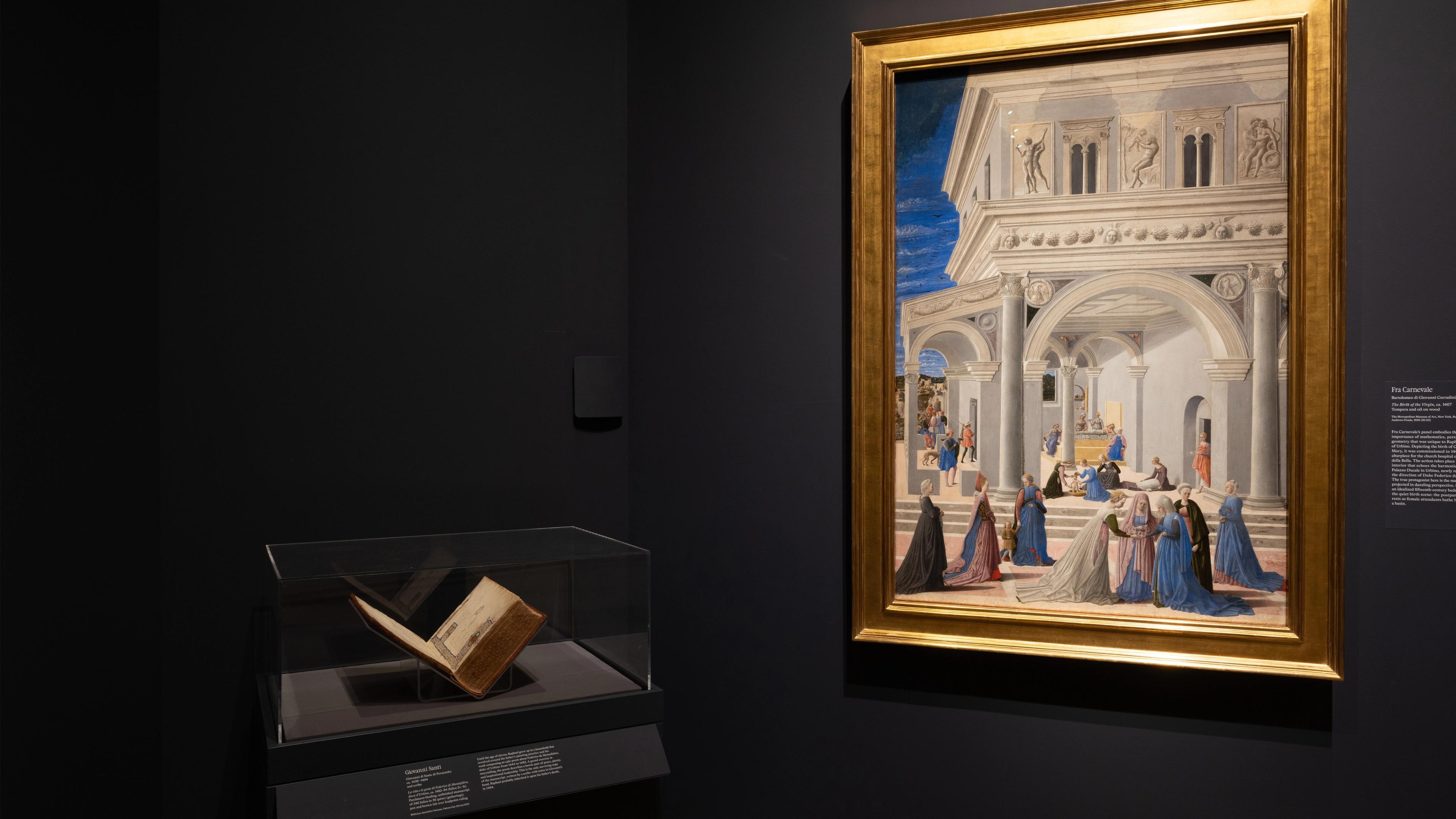
A dimly lit gallery displays a framed sketch, an illuminated manuscript in a glass case, and a vibrant painting of classical architectural scene

Raphael was born on April 6, 1483, in Urbino, a hill town set in a spectacular, rugged landscape in the Marche region, in east central Italy. The artist’s roots in Urbino, with its refined court life and unique intellectual heritage, played a defining role in his life and career. He proudly identified with his birthplace and signed his paintings “RAPHAEL VRBINAS” to the end of his days.

Raphael received his earliest training from his father, Giovanni Santi (ca. 1439–1494), a court painter and prolific poet. During Raphael’s childhood, Giovanni was busy composing an epic poem on Federico III da Montefeltro (1422–1482), the famous ruler who had brought peace, wealth, and fame to the Duchy of Urbino. A formidable general, scholar, and patron of art and architecture, Federico transformed his court into an internationally celebrated center for the arts and humanist learning. He founded a fabled library and rebuilt Urbino’s imposing Palazzo Ducale, whose rhythmic arcades and harmonic geometry embodied the humanist dedication to mathematics that distinguished the culture of Urbino. Those same ideals are evident in the vibrant architectural visions—enlivened with perspectival effects and classical references—created by Urbino painters.

A slider containing 8 items.
Press the down key to skip to the last item.
The Birth of the Virgin, Fra Carnevale (Bartolomeo di Giovanni Corradini)  Italian, Tempera and oil on wood
Fra Carnevale (Bartolomeo di Giovanni Corradini)
1467
Female Martyr-Saint Standing in a Landscape (Probably Saint Ursula), Giovanni Santi  Italian, Oil and tempera grassa on wood
On loan to The Met
Giovanni Santi
ca. 1490-94
Sepulcrum Christi (Dead Christ with Joseph of Arimathea and Nicodemus), Perugino (Pietro di Cristoforo Vannucci)  Italian, Oil and tempera grassa on wood, transferred to canvas and mounted on wood
On loan to The Met
Perugino (Pietro di Cristoforo Vannucci)
ca. 1495-98
A Woman Standing Before Rocks (The Muse Clio), Giovanni Santi  Italian, Off-green gouache preparation, stylus underdrawing, pen and iron gall ink, iron gall wash, lead white gouache, on paper
On loan to The Met
Giovanni Santi
ca. 1490-94
Bacchus with Satyr, Perugino (Pietro di Cristoforo Vannucci)  Italian, Black chalk, partly reworked in pen and dark brown ink, with some brush and brown wash, highlighted with white gouache, over preliminary stylus underdrawing, on paper very lightly washed pale gray-beige
On loan to The Met
Perugino (Pietro di Cristoforo Vannucci)
ca. 1495-1500
Bust of a Bearded Man (Cartoon Fragment for Joseph of Arimathea in the Altarpiece of Santa Chiara), Perugino (Pietro di Cristoforo Vannucci)  Italian, Black chalk, pricked for transfer, and squared, a second piece of paper (original) joined below, irregularly cut and roughly made up above
On loan to The Met
Perugino (Pietro di Cristoforo Vannucci)
ca. 1495
The Ideal City (Città Ideale), Central Italian artist for an Urbino patron  Italian, Oil and tempera on panel
On loan to The Met
Central Italian artist for an Urbino patron
ca. 1475-90
La vita e le gesta di Federico di Montefeltro, Duca di Urbino, Giovanni Santi  Italian, Parchment bining, unfinished manuscript of 346 folios in 36 quires (or gatherings); Pen and brown ink, over leadpoint ruling
On loan to The Met
Giovanni Santi
ca. 1482-1494

Becoming an Artist

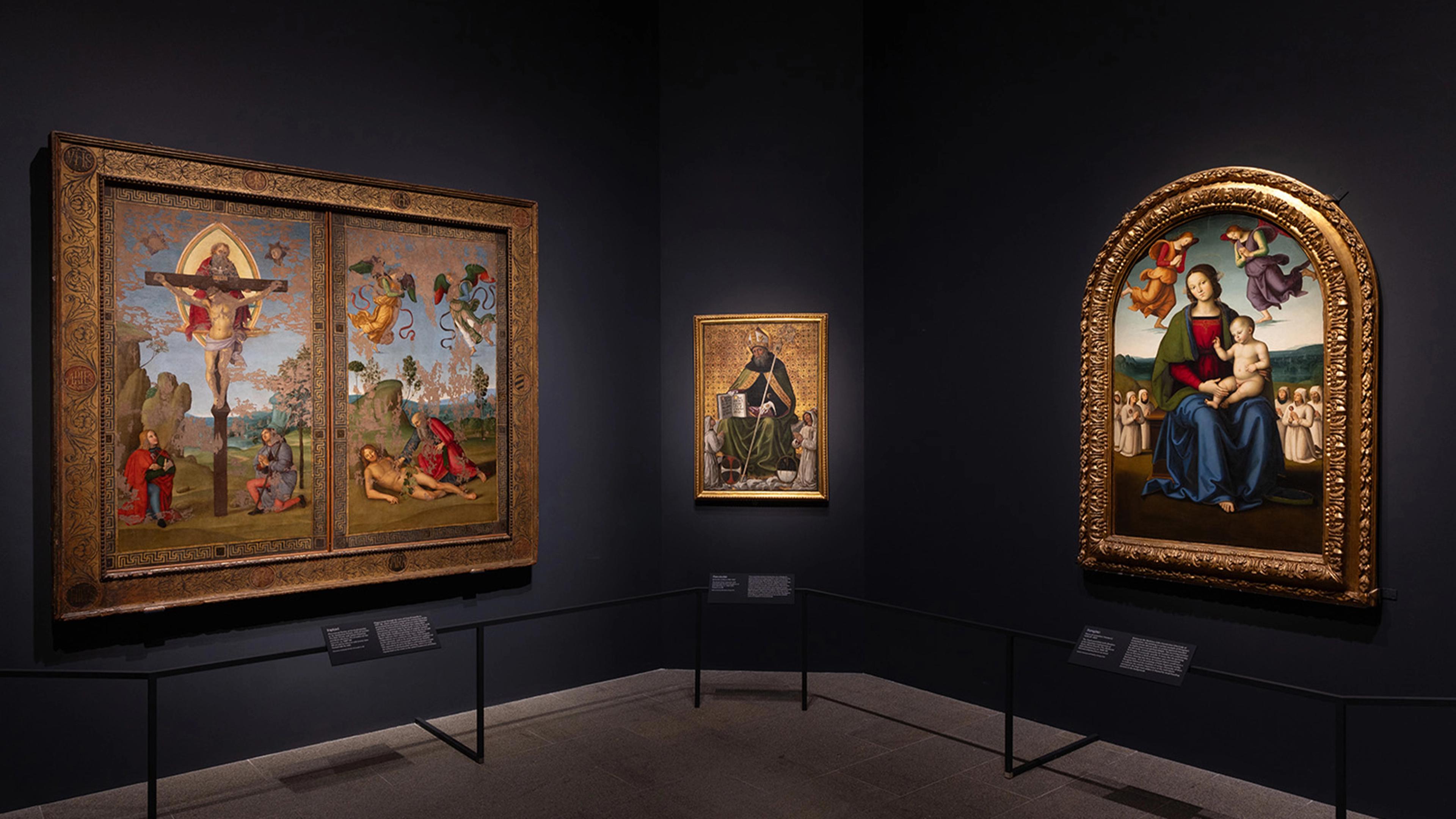
A dimly lit art gallery features three framed Renaissance paintings on dark walls.

Raphael’s father soon brought his precocious son to study with Pietro Perugino (1446/50–1523), an artist he likely knew through local projects. A brilliant, prolific painter and draftsman with active workshops in Perugia and Florence, Perugino relied heavily on collaboration with assistants to meet the demands of patrons all over Italy. Raphael coursed quickly through the stages of pupil and apprentice to become first a collaborator to Perugino and then an independent artist. Perugino’s elegant figures, breathtaking command of technique, and efficient methods for reproducing designs left their mark on the younger artist.

Ambitious, studious, and disciplined, the young Raphael first sought to establish himself as an independent professional in Città di Castello, a small, wealthy town near Perugia, where he painted notable church altarpieces. Confraternities, religious institutions for regular citizens devoted to works of charity, were also major sources of patronage for artists in Umbria and the Marche. Gathered here are paintings and related studies done for confraternities by Perugino and the young Raphael—including the first painting fully in Raphael’s hand, as confirmed by its recent conservation treatment.

A slider containing 10 items.
Press the down key to skip to the last item.
Study of a Kneeling Youth and of the Head of Another, Perugino (Pietro di Cristoforo Vannucci)  Italian, Metalpoint on pale pink-beige prepared paper
Perugino (Pietro di Cristoforo Vannucci)
1500
Landscape (recto); Landscape (verso), Perugino (Pietro di Cristoforo Vannucci)  Italian, Brush and brown wash, highlighted with white gouache, on gray-green prepared paper (recto); pen and brown ink on unprepared off-white paper (verso)
Perugino (Pietro di Cristoforo Vannucci)
1489–90
The Virgin and Child with the Infant Saint John the Baptist, Perugino (Pietro di Cristoforo Vannucci)  Italian, Oil and tempera grassa on poplar
On loan to The Met
Perugino (Pietro di Cristoforo Vannucci)
ca. 1495-1500
The Seated Saint Augustine (Cartoon for a Painting), Perugino (Pietro di Cristoforo Vannucci)  Italian, Pen and brown ink, brush and pale brown wash, with underdrawing and overdrawing in black chalk; traces of a vertical axis line in black chalk; outlines pricked and rubbed with pouncing dust for transfer, silhouetted closely along the figure and mounted on secondary paper support
On loan to The Met
Perugino (Pietro di Cristoforo Vannucci)
ca. 1500
Martyrdom of Saint Sebastian, Perugino (Pietro di Cristoforo Vannucci)  Italian, Point of brush, gouache, watercolor, and ink, highlighted and signed in gold, on parchment (flesh side and burnished)
On loan to The Met
Perugino (Pietro di Cristoforo Vannucci)
ca. 1500-1505
Studies for Kneeling Youths, Perugino (Pietro di Cristoforo Vannucci)  Italian, Metalpoint on paper prepared pale pink-cream
On loan to The Met
Perugino (Pietro di Cristoforo Vannucci)
ca. 1495-1500
The Virgin and Child with Members of the Flagellant Confraternity of Santa Maria Novella (The Madonna della Consolazione), Perugino (Pietro di Cristoforo Vannucci)  Italian, Oil and tempera grassa on wood
On loan to The Met
Perugino (Pietro di Cristoforo Vannucci)
ca. 1496-99
The Seated Saint Augustine with Confraternity Brothers (Gonfalone di Sant’Agostino), Pinturicchio  Italian, Tempera on silk
On loan to The Met
Pinturicchio
ca. 1499-1500
Saint Augustine with Members of an Augustinian Confraternity, Perugino (Pietro di Cristoforo Vannucci)  Italian, Oil on wood
On loan to The Met
Perugino (Pietro di Cristoforo Vannucci)
ca. 1500
On loan to The Met
Raphael (Raffaello Sanzio or Santi)
ca. 1497-99

Finding Patrons

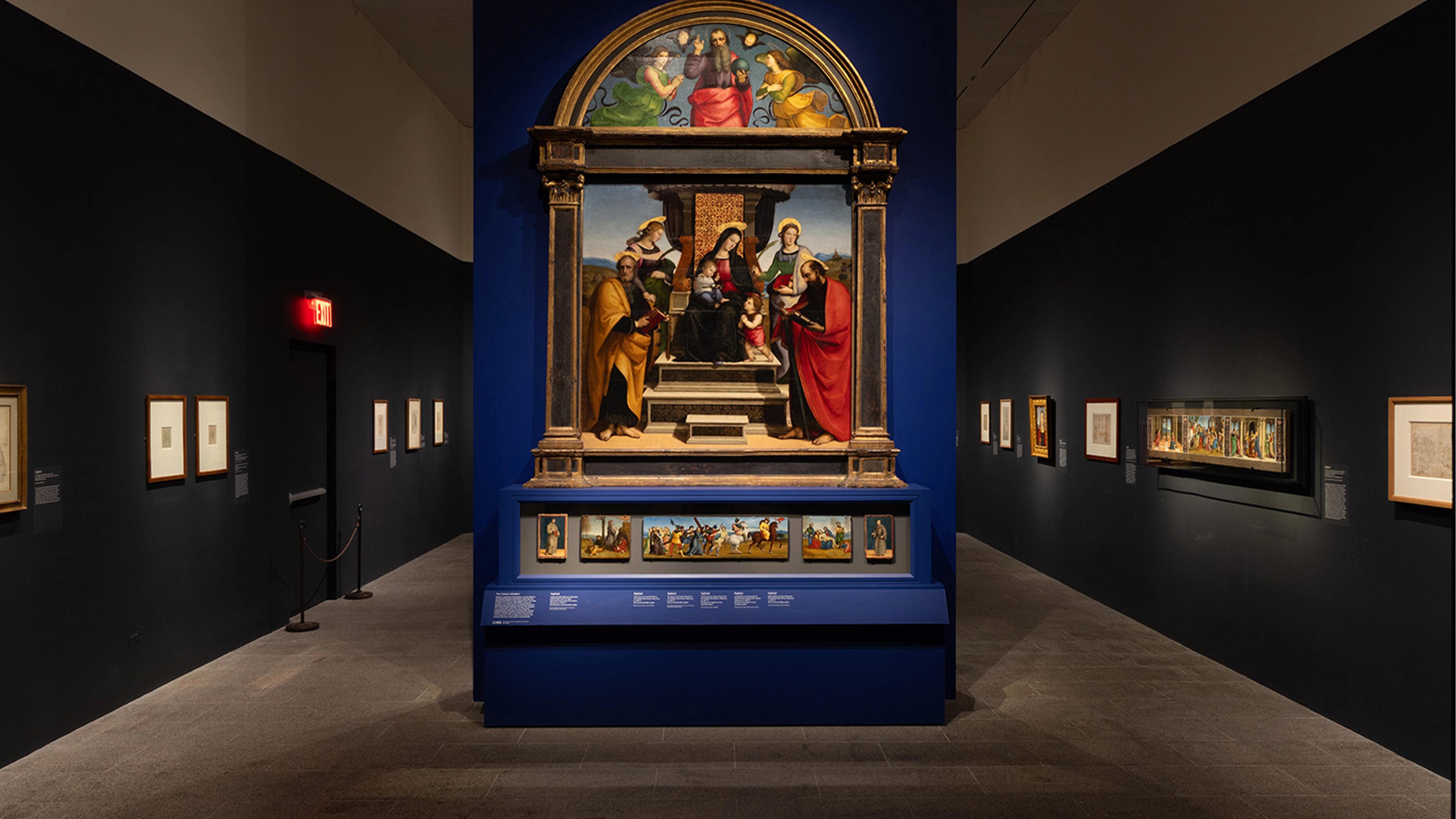
A dimly lit museum room displaying a religious painting on a blue wall. Framed artworks line the dark walls.

From 1500 to 1507, the young Raphael endeavored to cultivate patrons by painting both monumental altarpieces and small-scale devotional works in the regions of the Marche, Umbria, and Tuscany. An iconic example is the large, multipart painting at the center of this gallery, made for nuns in Perugia and now known as the Colonna Altarpiece (after a later owner). The full ensemble is reunited here as a complete work for the first time since it was dismembered around 1663 and the individual paintings dispersed. Other notable projects include a mammoth altarpiece for the Baronci family chapel in Città di Castello, which was later destroyed in an earthquake and survives only in fragments and preliminary drawings, and a remarkable altarpiece for the Oddi family chapel in Perugia, represented here by studies and the painting that provided its base.

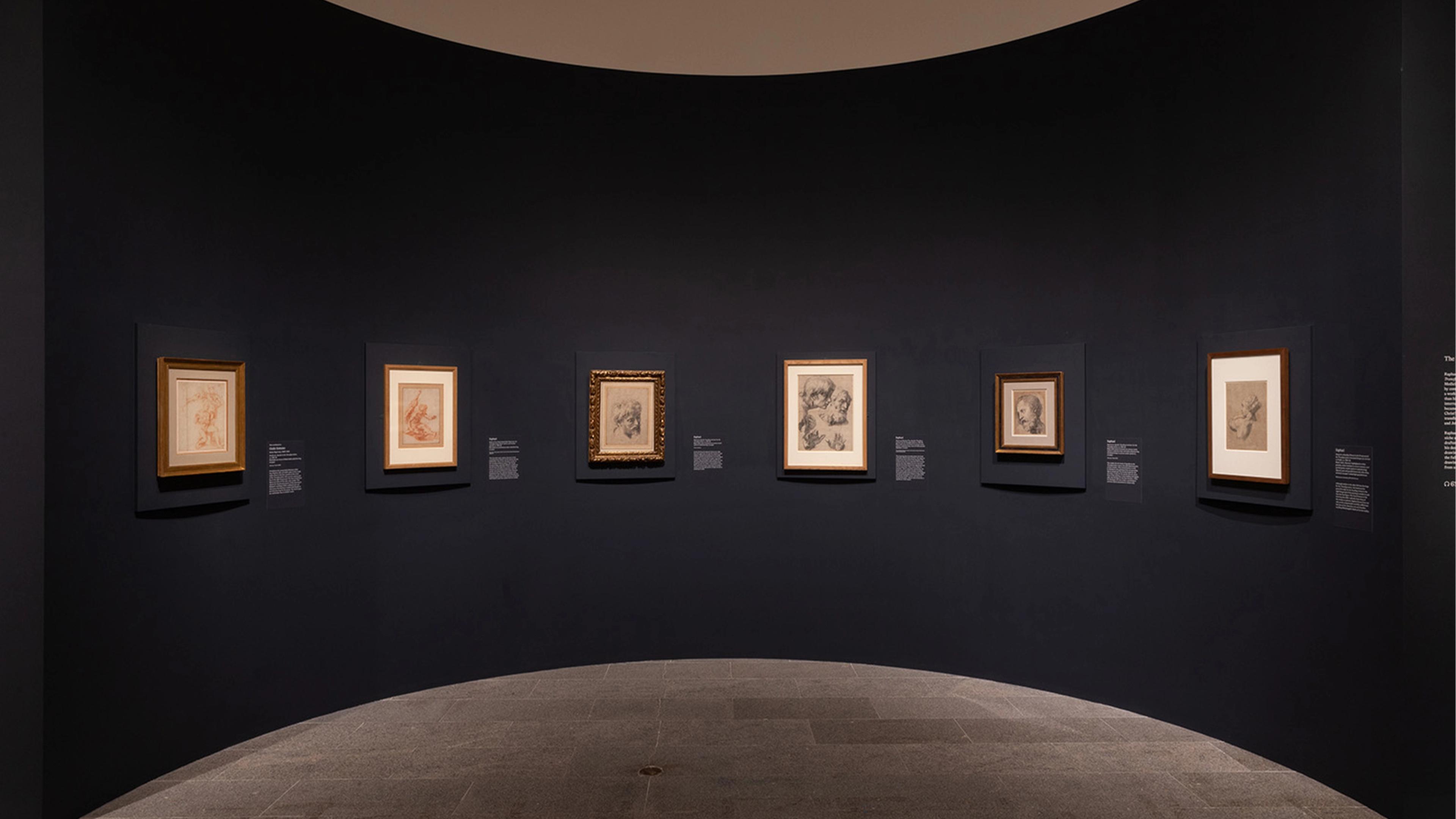
Full-scale drawings for the Oddi Altarpiece reveal the workshop practices that Raphael had absorbed during his training and collaboration with Perugino. Dazzling studies on paper also show how he worked in a variety of media—black chalk, pen and ink, and metalpoint on prepared paper—often with a virtuosic command of technique. Drawings such as these likely served as his calling card and undoubtedly impressed his patrons.

A slider containing 34 items.
Press the down key to skip to the last item.
Madonna and Child Enthroned with Saints, Raphael (Raffaello Sanzio or Santi)  Italian, Oil and gold on wood
Raphael (Raffaello Sanzio or Santi)
ca. 1504
The Virgin and Child in a Landscape (The Madonna of the Pomegranate), Raphael (Raffaello Sanzio or Santi)  Italian, Black chalk on paper
On loan to The Met
Raphael (Raffaello Sanzio or Santi)
ca. 1503-4
The Seated Virgin and Child, Raphael (Raffaello Sanzio or Santi)  Italian, Pen and brown ink, over abundant, soft grayish-black chalk underdrawing on paper
On loan to The Met
Raphael (Raffaello Sanzio or Santi)
ca. 1501-1503
Composition Study for an Enthroned Virgin and Child with Saint Nicholas of Tolentino, Raphael (Raffaello Sanzio or Santi)  Italian, Pen and brown ink over preliminary stylus underdrawing, with some overdrawn corrections in black chalk and stylus-incised construction, on paper
On loan to The Met
Raphael (Raffaello Sanzio or Santi)
ca. 1503-5
Bust of a Seated Young Woman in Profile (verso), Fragment of a Profile (recto), Raphael (Raffaello Sanzio or Santi)  Italian, Black chalk, over preliminary stylus underdrawing, slight retouching by another hand in pen and brown ink, traces of white gouache highlights (recto); pen and brown ink (verso); upper left corner cropped
On loan to The Met
Raphael (Raffaello Sanzio or Santi)
ca. 1503
Head of a Young Man (Study for the Apostle Thomas in the Oddi Altarpiece) (recto); Two Drapery Studies; Thumbnail Sketch of a Soldier on Horseback (verso), Raphael (Raffaello Sanzio or Santi)  Italian, Leadpoint (recto and verso) on paper
On loan to The Met
Raphael (Raffaello Sanzio or Santi)
ca. 1503-4
Head and Hands of a Young Man (Study for the Apostle Thomas in the Oddi Altarpiece) (recto; by Raphael); Study of Two Seated Young Men for the Same Altarpiece (verso; by the workshop), Raphael (Raffaello Sanzio or Santi)  Italian, Leadpoint on paper prepared pale gray (recto); pen and brown ink, over black chalk, and traces of stylus underdrawing (verso)
On loan to The Met
Raphael (Raffaello Sanzio or Santi)
ca. 1503-4
The Head of a Bearded Apostle (Saint Andrew) and Silhouettes of Two Other Heads of Apostles (“Auxiliary Cartoon” for the Oddi Altarpiece), Raphael (Raffaello Sanzio or Santi)  Italian, Black chalk, drawn freehand over pounce marks (spolvero underdrawing) and stylus underdrawing, with further outlines for the heads of two figures in pounce marks (spolvero), on paper
On loan to The Met
Raphael (Raffaello Sanzio or Santi)
ca. 1503-4
Workshop Assistant Posing for Studies of the Seated Virgin, Marginal Sketches (The Norton Simon Madonna) (recto; by Raphael); Two Archers (verso; by workshop of Raphael), Raphael (Raffaello Sanzio or Santi)  Italian, Two hues of metalpoint, over preliminary stylus underdrawing and construction (recto), pen and brown ink, over preliminary stylus underdrawing (verso), on paper
On loan to The Met
Raphael (Raffaello Sanzio or Santi)
ca. 1502-3
Head of a Young Man, Raphael (Raffaello Sanzio or Santi)  Italian, Black chalk over preliminary stylus underdrawing, highlighted with traces of white gouache, on paper
On loan to The Met
Raphael (Raffaello Sanzio or Santi)
ca. 1503-4
Head of a Man Wearing a Turban in Frontal View, Raphael (Raffaello Sanzio or Santi)  Italian, Two types of metalpoint on paper prepared greenish gray
On loan to The Met
Raphael (Raffaello Sanzio or Santi)
ca. 1504-5
Head of a Bald Man in Three-Quarter View, Facing Right, Raphael (Raffaello Sanzio or Santi)  Italian, Metalpoint, highlighted with white gouache, on paper prepared greenish gray
On loan to The Met
Raphael (Raffaello Sanzio or Santi)
ca. 1504-5
Cartoon for Saint Mary Magdalene, Raphael (Raffaello Sanzio or Santi)  Italian, Pen and brown ink, brush and brown wash, over black chalk or leadpoint underdrawing; squared in black chalk, with framing outlines in black chalk, and one in red chalk; outlines finely pricked for transfer; verso rubbed heavily with black chalk pouncing dust, on paper
On loan to The Met
Raphael (Raffaello Sanzio or Santi)
ca. 1503
Two Roundels with the Mater Dolorosa and Saint Peter, Raphael (Raffaello Sanzio or Santi)  Italian, Pen and brown ink, over leadpoint underdrawing; incised compass construction for the drawn framing circular framing outlines; outlines finely pricked for transfer of the design; verso rubbed with black chalk pouncing dust, with an equilateral triangle drawn in pen and brown ink, and an unintelligible, cropped design in black chalk, on paper
On loan to The Met
Raphael (Raffaello Sanzio or Santi)
ca. 1501-1503
The Annunciation (Cartoon for the Left Scene in the Predella of the Oddi Altarpiece), Raphael (Raffaello Sanzio or Santi)  Italian, Pen and brown ink, brush and brown wash, ruling in pen and brown ink and stylus; stylus-incised compass work, some leadpoint or black-chalk axis lines, some preliminary stylus underdrawing on figures and traces of black-chalk underdrawing on two sheets of paper glued with overlapping seams (original paper support); pricked outlines for transfer of the design; glued onto a secondary paper support
On loan to The Met
Raphael (Raffaello Sanzio or Santi)
ca. 1503-4
Saint Sebastian in Half Length, Raphael (Raffaello Sanzio or Santi)  Italian, Tempera grassa and oil, with gold highlights, on wood
On loan to The Met
Raphael (Raffaello Sanzio or Santi)
ca. 1502-3
Angel in Bust-Length (Fragment from the Baronci Altarpiece), Raphael (Raffaello Sanzio or Santi)  Italian, Oil with gold highlights on canvas (transferred from wood)
On loan to The Met
Raphael (Raffaello Sanzio or Santi)
ca. 1500-1501
Christ Blessing with the Stigmata in a Landscape, Raphael (Raffaello Sanzio or Santi)  Italian, Oil on wood
On loan to The Met
Raphael (Raffaello Sanzio or Santi)
ca. 1504-5
Head of an Apostle (Saint James; “Auxiliary Cartoon” for the Oddi Altarpiece), Raphael (Raffaello Sanzio or Santi)  Italian, Black chalk drawn freehand over pounce marks (spolvero underdrawing) on paper
On loan to The Met
Raphael (Raffaello Sanzio or Santi)
ca. 1503-4
Study of a Female Saint in Half-Length (Saint Catherine?), Raphael (Raffaello Sanzio or Santi)  Italian, Black chalk, over preliminary stylus underdrawing, on paper
On loan to The Met
Raphael (Raffaello Sanzio or Santi)
ca. 1504
Heads of Two Apostles (“Auxiliary Cartoon” for the Oddi Altarpiece), Raphael (Raffaello Sanzio or Santi)  Italian, Black chalk drawn freehand over pounce marks (spolvero underdrawing) with unrelated design in pounce marks (spolvero), on paper
On loan to The Met
Raphael (Raffaello Sanzio or Santi)
ca. 1503-4
The Virgin and Child with a book in a Landscape; a Landscape (Sketches for the Norton Simon Madonna) (recto); Seated Infant Holding a Book (Sketch for the Christ Child in the Norton Simon Madonna) (verso), Raphael (Raffaello Sanzio or Santi)  Italian, Pen and brown ink, over preliminary stylus underdrawing (recto); pen and brown ink, over preliminary stylus underdrawing (verso), on paper
On loan to The Met
Raphael (Raffaello Sanzio or Santi)
ca. 1502-3
On loan to The Met
Raphael (Raffaello Sanzio or Santi)
ca. 1502-3
Saint Francis of Assisi (Panel from the Predella of the Colonna Altarpiece), Raphael (Raffaello Sanzio or Santi)  Italian, Oil on wood (probably poplar)
On loan to The Met
Raphael (Raffaello Sanzio or Santi)
ca. 1504-5
Saint Mary Magdalene (obverse); Fictive Colored Marble with Inscription (reverse), Raphael (Raffaello Sanzio or Santi)  Italian, Tempera grassa and oil, with touches of gold, on wood
On loan to The Met
Raphael (Raffaello Sanzio or Santi)
ca. 1503
The Agony in the Garden, Raphael (Raffaello Sanzio or Santi)  Italian, Oil on wood
Raphael (Raffaello Sanzio or Santi)
ca. 1504
Saint Catherine (obverse); Fictive Colored Marble with Inscription (reverse), Raphael (Raffaello Sanzio or Santi)  Italian, Tempera grassa and oil, with touches of gold, on wood
On loan to The Met
Raphael (Raffaello Sanzio or Santi)
ca. 1503
The Procession to Calvary (Panel from the Predella of the Colonna Altarpiece), Raphael (Raffaello Sanzio or Santi)  Italian, Oil and traces of gold on wood (probably poplar)
On loan to The Met
Raphael (Raffaello Sanzio or Santi)
ca. 1504-5
Lamentation Over the Dead Christ (Panel from the Predella of the Colonna Altarpiece), Raphael (Raffaello Sanzio or Santi)  Italian, Oil and traces of gold on wood (probably poplar)
On loan to The Met
Raphael (Raffaello Sanzio or Santi)
ca. 1504-5
Saint Anthony of Padua (Panel from the Predella of the Colonna Altarpiece), Raphael (Raffaello Sanzio or Santi)  Italian, Oil on wood (probably poplar)
On loan to The Met
Raphael (Raffaello Sanzio or Santi)
ca. 1504-5
The Adoration of the Magi (Full-Scale Composition Study for the Central Scene in the Predella of the Oddi Altarpiece), Raphael (Raffaello Sanzio or Santi)  Italian, Pen and brown ink over extensive preliminary stylus and leadpoint underdrawing, pen and brown ink (recto); partly blackened with charcoal or black chalk (verso)
On loan to The Met
Raphael (Raffaello Sanzio or Santi)
ca. 1503-4
The Annunciation; The Adoration of the Magi; The Circumcision (Predella Panel of the Oddi Altarpiece), Raphael (Raffaello Sanzio or Santi)  Italian, Tempera grassa on poplar wood
On loan to The Met
Raphael (Raffaello Sanzio or Santi)
ca. 1503-4
Processional Cross with the Crucified Christ and Roundels depicting the Virgin and Saints Peter, John the Evangelist, and Mary Magdalene (obverse); Crucified Christ and Roundels Depicting Saints Francis of Assisi, Louis of Toulouse, Claire, and Anthony of Padua (reverse), Raphael (Raffaello Sanzio or Santi)  Italian, Tempera and gold on wood
On loan to The Met
Raphael (Raffaello Sanzio or Santi)
ca. 1500-3
Composition Study for the Coronation of Saint Nicholas of Tolentino (The Baronci Altarpiece); Sketch of Dragon (recto); Study for the Head of Saint Nicholas of Tolentino and Drapery Studies for the Angels in the Baronci Altarpiece, Birds (Swans, Heron with a Snake, Falcon), Architectural Sketch after Perugino’s Ranieri Annunciation (verso), Raphael (Raffaello Sanzio or Santi)  Italian, Black chalk, over preliminary stylus underdrawing, with a construction of numerous overlapping circles incised with the compass, squared (recto), black chalk, over preliminary stylus underdrawing (verso), on paper
On loan to The Met
Raphael (Raffaello Sanzio or Santi)
ca. 1500-1501

Responding to Leonardo and Michelangelo
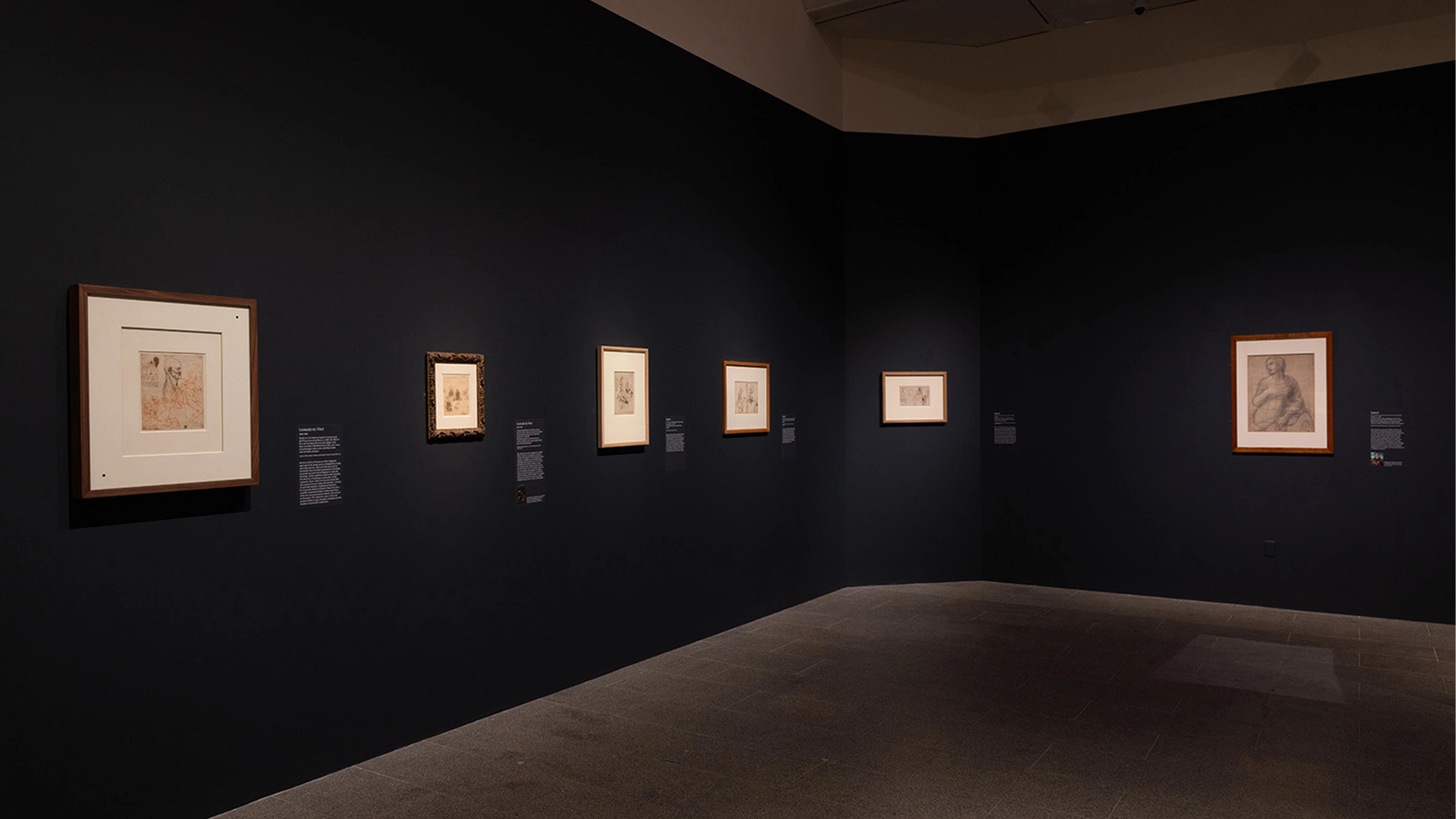
Dimly lit art gallery with a dark blue wall showcasing six framed sketches.

Raphael may have been drawn to Florence after hearing fellow painters rave about rival full-scale designs (cartoons) for spectacular murals there by Leonardo and Michelangelo. Related works in this gallery convey the electrifying novelty and arresting sculptural power of those unrealized projects. While in Florence between 1504 and 1508, Raphael also studied Michelangelo’s sculptures and Leonardo’s paintings and drawings, promptly and seamlessly adapting aspects of their styles and techniques in his work.

Raphael also learned from his peers’ revolutionary approaches to inventing compositions. Leonardo’s theories about “sketching quickly,” in the fervor of artistic inspiration, transformed Raphael’s methods. Asserting that the effort to finish drawings and puzzle out details could dry up fresh ideas, Leonardo advised working out concepts in “rough sketches,” like a poet scrawling the first draft of a verse in messy handwriting with crossed-out words. Before Florence, Raphael had tended to develop compositions in a more artisanal way, figure by detailed figure, as he had learned from Perugino. Now, spontaneous sketching led him to more organic compositions pulsating with movement and vivid expression.

A slider containing 8 items.
Press the down key to skip to the last item.

Composing Monumental Paintings

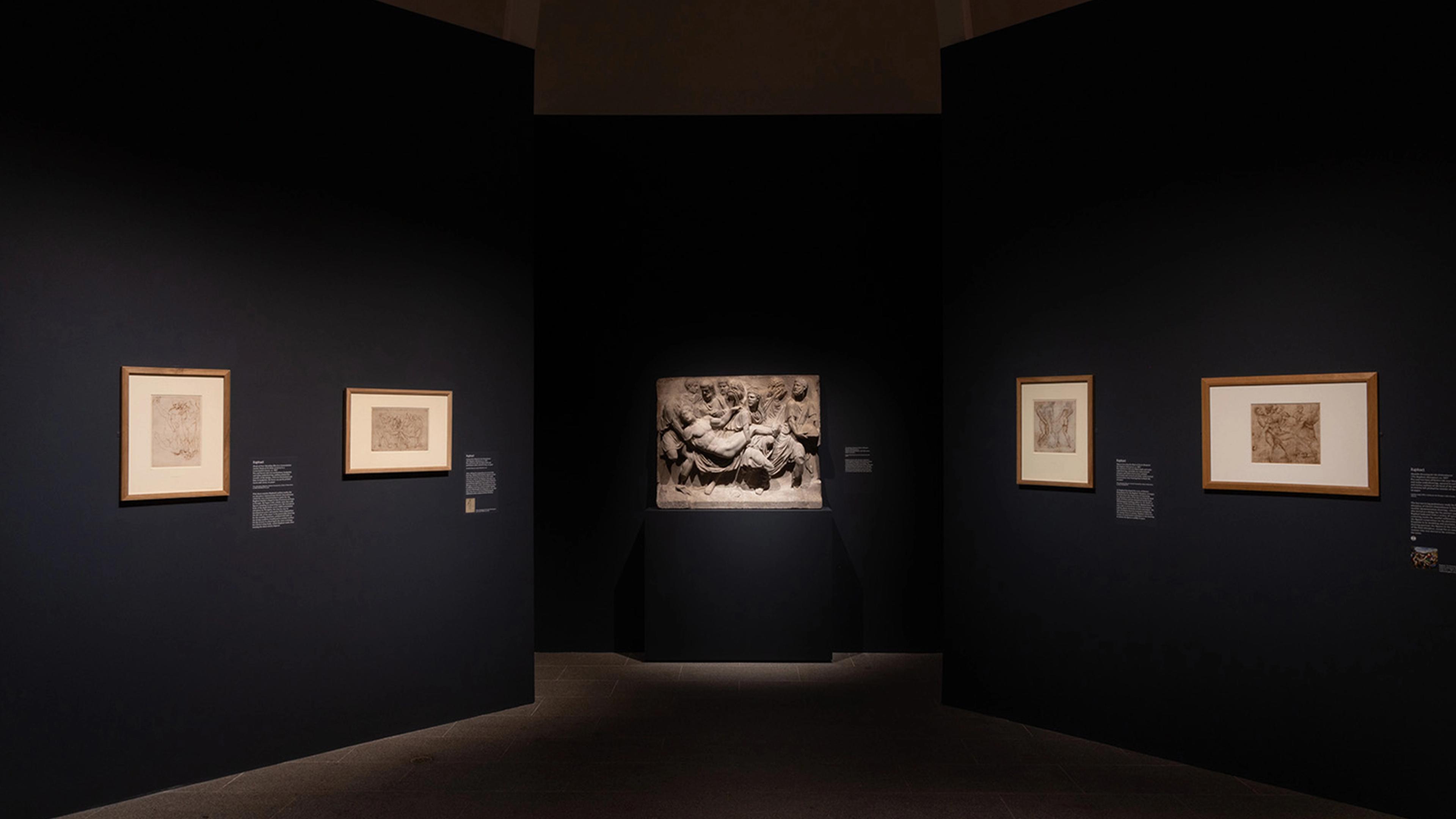
Dimly lit art gallery with dark walls features three framed sketches and a centered illuminated stone relief.

The exposure to Leonardo’s and Michelangelo’s art infused Raphael’s compositions with a sense of space, sculptural monumentality, and expressive force. This was the result of an enormous amount of experimentation on paper. Sequences of drawings—from a sheet of sketches to studies of an arrangement based on three-dimensional clay or wax models—reveal Raphael’s increasingly disciplined approach to the design process. Working in orderly steps, for example, he gradually animated a pyramidal composition (favored by Leonardo), which could seem static, by building a dynamic interplay of gestures and gazes among the figures.

In 1507 the twenty-four-year-old Raphael painted his most significant work before his move to Rome, an altarpiece of Christ’s entombment for the Baglioni family chapel in Perugia. The preliminary drawings show him in full command of his powers as a storyteller, and demonstrate how he constructed a dramatic composition with a climactic narrative. Through arduous study, aided by his knowledge of classical sculpture, the artist evolved a static arrangement of figures into an emotionally arresting action scene. Raphael had absorbed Leonardo’s principle that the physical gestures of the body express the “motions” of the mind and soul.

A slider containing 11 items.
Press the down key to skip to the last item.
Marble sarcophagus fragment, Marble, Luni and Pentelic, Roman
Roman
mid-2nd century CE
Madonna and Child with the Infant Saint John the Baptist; upper left, Study for the Right Arm of the Infant Saint John; upper right, Study for Drapery (recto); Study of a Nude Male Figure (verso), Raphael (Raffaello Sanzio or Santi)  Italian, Red chalk (recto); pen and brown ink (verso)
Raphael (Raffaello Sanzio or Santi)
ca. 1506–7
The Virgin and Child with the Infant Saint John the Baptist (Studies for the Madonna of the Meadow) (recto and verso), Raphael (Raffaello Sanzio or Santi)  Italian, Pen and brown ink (recto and verso) on paper
On loan to The Met
Raphael (Raffaello Sanzio or Santi)
ca. 1506
The Virgin and Child with the Infant Saint John the Baptist (Cartoon for La Belle Jardinière), Raphael (Raffaello Sanzio or Santi)  Italian, Black chalk, charcoal, highlighted with white gouache on light brown paper, outlines pricked for transfer of the design and rubbed with pouncing dust; heavily retouched by early modern restorers
On loan to The Met
Raphael (Raffaello Sanzio or Santi)
ca. 1507
The Entombment (Composition Study for the Baglioni Altarpiece) (recto); Study after Michelangelo’s Marble Saint Matthew (verso), Raphael (Raffaello Sanzio or Santi)  Italian, Pen and brown ink over black chalk and preliminary stylus underdrawing (recto), pen and brown ink (verso), on paper
On loan to The Met
Raphael (Raffaello Sanzio or Santi)
ca. 1507
Modello Drawing for the Baglioni Altarpiece (The Entombment), Raphael (Raffaello Sanzio or Santi)  Italian, Pen and two hues of brown ink over black-chalk and stylus underdrawing, squared in red chalk and stylus; outlines of the head of the male bearer at extreme left pricked for transfer of the design, on paper
On loan to The Met
Raphael (Raffaello Sanzio or Santi)
ca. 1507
The Virgin and Child with the Infant Saint John the Baptist (Studies for the Madonna of the Meadow) (recto), Raphael (Raffaello Sanzio or Santi)  Italian, Brush and brown wash, highlighted with white gouache (partly oxidized), over preliminary stylus underdrawing, red chalk (sketch on upper left), possibly indented for transfer (selectively on the main group of the Virgin and Child) over a faint grid marked with compass or caliper points (recto), on paper
On loan to The Met
Raphael (Raffaello Sanzio or Santi)
ca. 1506
Sketches of a Standing Infant (Study for the Christ Child in the Belle Jardinière) (recto), Sketches Including a Skeleton (verso), Raphael (Raffaello Sanzio or Santi)  Italian, Pen and brown ink over leadpoint, on laid paper (recto); pen and brown ink over leadpoint, with red chalk (verso)
On loan to The Met
Raphael (Raffaello Sanzio or Santi)
ca. 1507
Study of Four Standing Men in a Lamentatio (recto), Study of the Body of Christ in a Lamentation (verso), Raphael (Raffaello Sanzio or Santi)  Italian, Pen and brown ink over preliminary leadpoint and stylus underdrawing, outlines pricked for transfer of the design, two horizontal axis lines in leadpoint, the lower one partly pricked; recto); pen and brown ink (verso), on paper
On loan to The Met
Raphael (Raffaello Sanzio or Santi)
ca. 1507
Figures Carrying the Body of Christ (Study for the Baglioni Altarpiece of the Entombment; The Borghese Entombment), Raphael (Raffaello Sanzio or Santi)  Italian, Pen and brown ink over black chalk and stylus underdrawing, red chalk over stylus-incised compass and ruled construction, pricked horizontal and vertical axis lines,, stylus-incised construction, later framing lines in black ink, glued onto a secondary paper support
On loan to The Met
Raphael (Raffaello Sanzio or Santi)
ca. 1506-7
Head of a Child (Study for the Christ Child in the Ansidei Altarpiece) (recto); Design for an Oil Lamp or Incense Burner (verso), Raphael (Raffaello Sanzio or Santi)  Italian, Red chalk, over preliminary stylus underdrawing
On loan to The Met
Raphael (Raffaello Sanzio or Santi)
ca. 1505

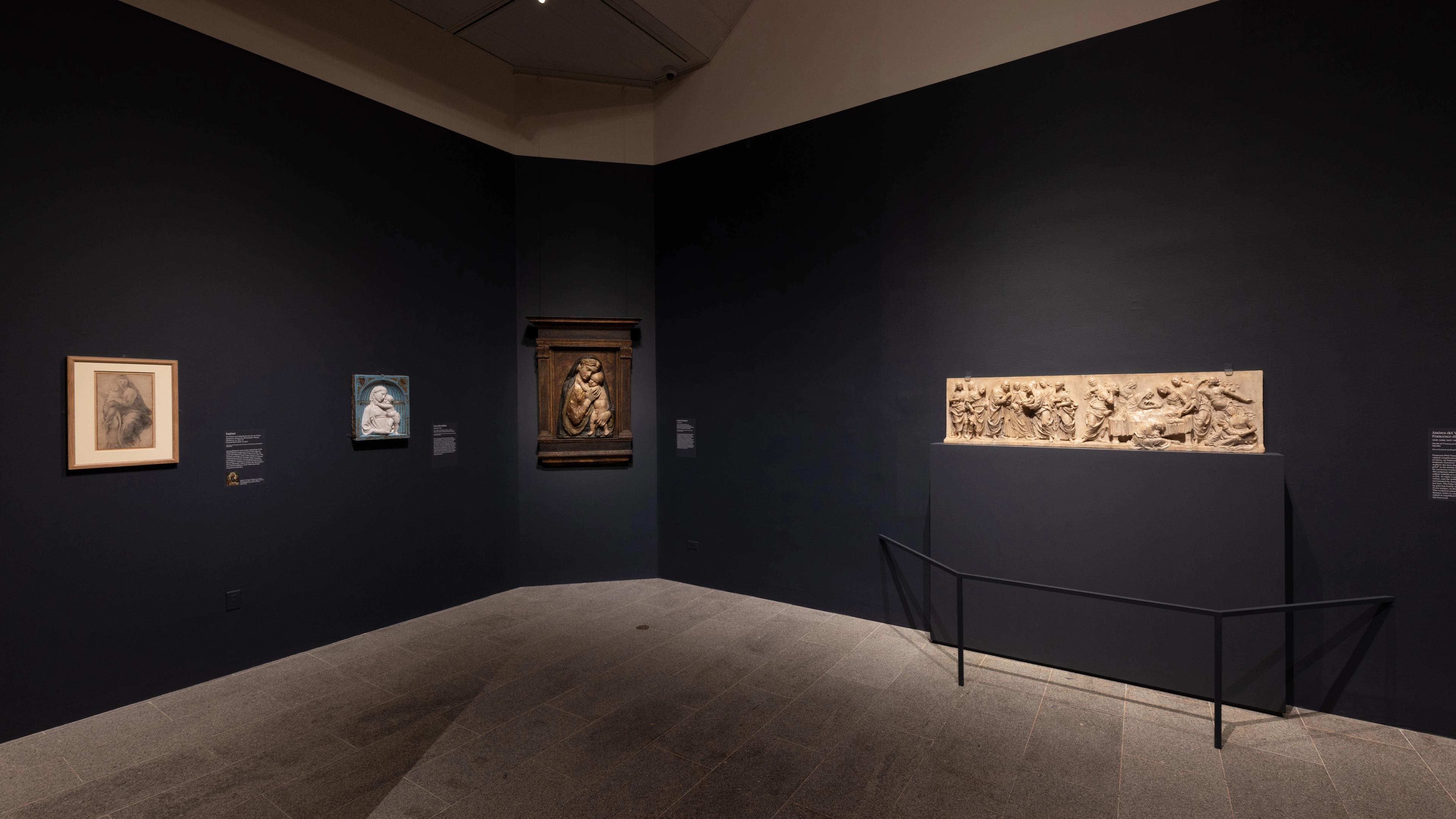
Mother and Child

Dimly lit art gallery with dark walls showcasing framed sketches and a central intricate artwork.

For centuries Raphael has been widely admired for Madonna and Child paintings that include a display of tenderness. From about 1300, Byzantine icons of the Eastern Orthodox faith had featured a form of the Madonna known as the Virgin Eleousa, from the Greek for “compassionate,” in which Mary embraces the Christ Child as he touches his cheek to hers. Disseminated widely, the imagery inspired numerous medieval and Renaissance artists, including Italian sculptors and painters. Raphael drew upon this model and thoroughly transformed it.

Raphael’s ability to capture a mood of vitality and innocent playfulness, especially while maintaining a superior command of anatomical realism, is striking in light of the historical realities of childbirth, infancy, and parenthood in his time. The rare account book displayed here records funerary expenses for Raphael’s mother, who died of childbirth-related complications in 1491, and for two of his siblings who died in infancy. Knowledge of gynecology and obstetrics was scarce, pregnancy and childbirth extremely dangerous, and infant mortality rates astronomically high. These facts, along with a desire among Renaissance artists to humanize religious subjects, all contributed to the appeal of the tender Madonna and Child as votive figures and subjects in art.

A slider containing 7 items.
Press the down key to skip to the last item.
Madonna and Child, Donatello  Italian, Figures: terracotta, polychromed and gilded; later background: wood, painted to represent brocade; frame: carved and painted, mouldings gilt, Italian
School of Donatello
15th century
Virgin and Child in a niche, Luca della Robbia  Italian, Glazed terracotta with gilt and painted details, Italian, Florence
Luca della Robbia
ca. 1460
Death of Francesca Pitti Tornabuoni, Andrea del Verrocchio  Italian, Marble
On loan to The Met
Andrea del Verrocchio
Francesco di Simone Ferrucci
ca. 1480
The Virgin and Child (Early Idea for the Sistine Madonna, Inspired by Michelangelo’s Bruges Madonna), Raphael (Raffaello Sanzio or Santi)  Italian, Grayish black chalk
On loan to The Met
Raphael (Raffaello Sanzio or Santi)
ca. 1512-14
Sagrestia, Libro delle Cere, Libro di Entrate e Uscite, Parchment binding. Manuscript on paper, fols.
On loan to The Met
1485-97 (fols. 1r-58r); 1520-21 (fols. 59r-76r)
Fasciculus medicinae, Johannes de Ketham  German, Book with woodcut and hand-colored illustrations in watercolor and gouache; dark brown calf's-leather binding
On loan to The Met
Johannes de Ketham
1491
Portable Icon with the Virgin Eleousa, Miniature mosaic set in wax on wood panel, with gold, multicolored stones, and gilded copper, Byzantine
Byzantine
early 1300s

Painting the Madonna for Private Patrons
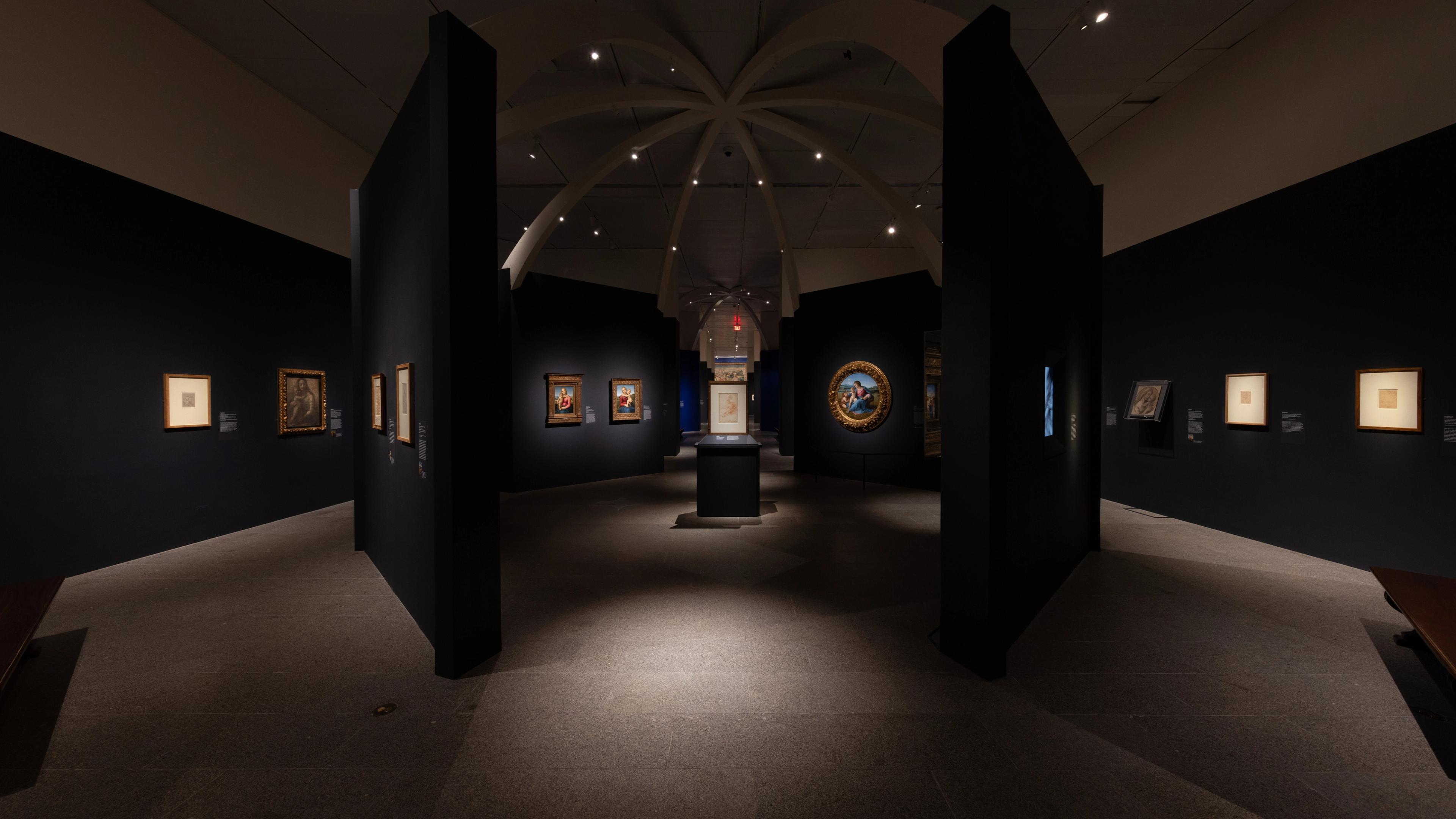
A dimly lit art gallery showcases framed artwork on dark walls

Despite his great ambitions, Raphael was largely thwarted in his attempts to break into the competitive art market in Florence. He found his most feasible source of patronage among the city’s wealthy merchants, who commissioned portraits and tender devotional paintings, mainly of the Madonna and Child. Raphael continued to produce works on this subject for private patrons well after his move to Rome in 1508, and many of his collaborators followed his example.

Raphael sought to bring the lauded ethereal physical beauty of the Madonna into radiant being. He was not immune to the convention, sung by poets both within and beyond his circle, that favored an elegant, aristocratic lady with dainty facial features and golden hair, but he also strove for long-established Christian ideals. Sermons, prayers, songs, and poetry inspired by early church writings had praised the Virgin’s beauty and grace as mirrors of her unique spiritual perfection. He infused his representations with a humanity and psychological presence revealed through gestures and reactions. Raphael’s paintings display an arresting command of light, color, space, and geometry, and his renderings of infants are more naturalistic in their proportions, poses, and expressions than those of many of his peers.

A slider containing 24 items.
Press the down key to skip to the last item.
The Virgin and Child with the Infant Saint John the Baptist in a Landscape (The Alba Madonna), Raphael (Raffaello Sanzio or Santi)  Italian, Oil on canvas, transferred from wood
On loan to The Met
Raphael (Raffaello Sanzio or Santi)
ca. 1509-11
Madonna and Child, Luca Signorelli (Luca d'Egidio di Luca di Ventura)  Italian, Oil and gold on wood
Luca Signorelli (Luca d'Egidio di Luca di Ventura)
ca. 1505–7
The Virgin and Child with and without the Infant Saint John the Baptist; An Idea Resembling the Northbrook Madonna (recto); Three Male Nudes in Battle Poses for an Unrealized Painting of the Siege of Perugia (verso), Raphael (Raffaello Sanzio or Santi)  Italian, Pen and brown ink (recto and verso) on paper
On loan to The Met
Raphael (Raffaello Sanzio or Santi)
ca. 1504-5
The Virgin and Child (Study for the Bridgewater Madonna; recto); Ideas for the Virgin and Child Studied from Mannequins or Lay Figures, Some Relating to the Niccolini-Cowper Madonna and Colonna Madonna (verso), Raphael (Raffaello Sanzio or Santi)  Italian, Metalpoint (leadpoint?), partly reworked by the artist in pen and brown ink, on paper prepared brownish pink (recto); pen and brown ink, red chalk (verso)
On loan to The Met
Raphael (Raffaello Sanzio or Santi)
ca. 1507-8
The Virgin and Child with the Infant Saint John the Baptist in a Landscape (The Esterházy Madonna), unfinished, Raphael (Raffaello Sanzio or Santi)  Italian, Tempera and oil on wood
On loan to The Met
Raphael (Raffaello Sanzio or Santi)
ca. 1508
Studies for the Virgin and Child and the Infant Saint John the Baptist (Sheet from the “Pink Sketchbook”), Raphael (Raffaello Sanzio or Santi)  Italian, Metalpoint on pink prepared paper
On loan to The Met
Raphael (Raffaello Sanzio or Santi)
ca. 1509-10
Figural Studies for a Composition of the Virgin and Child with the Infant Saint John the Baptist (Sheet from the “Pink Sketchbook”), Raphael (Raffaello Sanzio or Santi)  Italian, Metalpoint on paper prepared pink
On loan to The Met
Raphael (Raffaello Sanzio or Santi)
ca. 1507-11
Studies for the Virgin and Child; Architectural Studies (recto); The Virgin and Child (verso) (Sheet from the “Pink Sketchbook”), Raphael (Raffaello Sanzio or Santi)  Italian, Two types of metalpoint on paper prepared pink (recto); pen and brown ink, framing outline in leadpoint by the artist, on unprepared, off-white paper (verso)
On loan to The Met
Raphael (Raffaello Sanzio or Santi)
ca. 1507-11
Studies of a Seated Female Nude and a Child (Sheet from the “Pink Sketchbook”), Raphael (Raffaello Sanzio or Santi)  Italian, Metalpoint on prepared pink paper
On loan to The Met
Raphael (Raffaello Sanzio or Santi)
ca. 1507-11
The Virgin and Child (The Niccolini-Cowper Madonna; or, The Large Cowper Madonna), Raphael (Raffaello Sanzio or Santi)  Italian, Oil on wood, likely poplar
On loan to The Met
Raphael (Raffaello Sanzio or Santi)
1508
The Virgin and Child in a Landscape (The Small Cowper Madonna), Raphael (Raffaello Sanzio or Santi)  Italian, Oil on wood
On loan to The Met
Raphael (Raffaello Sanzio or Santi)
ca. 1505
The Heads of the Virgin and Child (Sheet from the “Pink Sketchbook”), Raphael (Raffaello Sanzio or Santi)  Italian, Metalpoint on paper prepared pink
On loan to The Met
Raphael (Raffaello Sanzio or Santi)
ca. 1509
The Virgin and Child (Cartoon for the Mackintosh Madonna), Raphael (Raffaello Sanzio or Santi)  Italian, Black chalk, charcoal, highlighted with touches of white chalk, with incised compass arcs and a vertical axis line; outlines incised and pricked for transfer of the design, and rubbed with pouncing dust; on two sheets glued with overlapping seams (original paper support); retouching and integrations by early restorers
On loan to The Met
Raphael (Raffaello Sanzio or Santi)
ca. 1509-11
Composition Study for the Virgin and Child with Saint Elizabeth and the Infant Saint John the Baptist, Raphael (Raffaello Sanzio or Santi)  Italian, Pen and brown ink, on some black chalk underdrawing, very slight retouches in black-brown ink, on paper
On loan to The Met
Raphael (Raffaello Sanzio or Santi)
ca. 1507
The Virgin and Child in an Interior (The Madonna of the Pinks), Raphael (Raffaello Sanzio or Santi)  Italian, Oil on wood (yew)
On loan to The Met
Raphael (Raffaello Sanzio or Santi)
ca. 1506-7
The Virgin and Child in a Landscape within a Circle (Study for the Madonna del Gran Duca), Raphael (Raffaello Sanzio or Santi)  Italian, Black chalk, some traces of pen and brown ink(?), over preliminary stylus underdrawing, with compass-incised outlines for the tondo, stylus-indented outlines for the figures, on buff paper (now darkened)
On loan to The Met
Raphael (Raffaello Sanzio or Santi)
ca. 1505
The Virgin and Child (Study for the Madonna del Cardellino) (recto); Architectural Studies (verso), Raphael (Raffaello Sanzio or Santi)  Italian, Pen and brown ink, over preliminary stylus underdrawing, with some traces of lead or chalk, on paper
On loan to The Met
Raphael (Raffaello Sanzio or Santi)
ca. 1505
Mother and Child (Study for the Madonna della Seggiola), Raphael (Raffaello Sanzio or Santi)  Italian, Metalpoint, highlighted in white gouache, on paper prepared gray; outlines stylus-incised by a later hand
On loan to The Met
Raphael (Raffaello Sanzio or Santi)
ca. 1512-16
The Virgin and Child in a Landscape (The Northbrook Madonna), Timoteo Viti  Italian, Oil on wood
On loan to The Met
Timoteo Viti
Raphael (Raffaello Sanzio or Santi)
ca. 1504-5
The Holy Family with Young Saint John the Baptist and Figure in a Landscape, Raphael (Raffaello Sanzio or Santi)  Italian, Two hues of metalpoint (one being leadpoint), some pen and brown ink, highlighted with white gouache, on paper prepared pinkish buff
On loan to The Met
Raphael (Raffaello Sanzio or Santi)
ca. 1510
The Virgin and Child with Angels (The Madonna of the Candelabra), Raphael (Raffaello Sanzio or Santi)  Italian, Oil on poplar wood (two members; thickness reduced, panel cradled, size cut down)
On loan to The Met
Raphael (Raffaello Sanzio or Santi)
Giulio Romano
ca. 1514-16
Composition Study for the Holy Family with Saints and a Pomegranate (recto); Letter to Domenico Alfani (verso), Raphael (Raffaello Sanzio or Santi)  Italian, Pen and brown ink, over leadpoint underdrawing, squared in red chalk; upper portion of the sheet outlined like an arch with the field colored in blue gouache (recto); pen and brown ink (verso), on paper
On loan to The Met
Raphael (Raffaello Sanzio or Santi)
ca. 1507-8
Composition Study for the Alba Madonna; Two Sketches of the Virgin and Child for the Tempi Madonna; Façade and Plan of a Building; Sketch of a Recumbent Child (recto); Study of a Male Model Posing for the Virgin in the Alba Madonna (verso), Raphael (Raffaello Sanzio or Santi)  Italian, Red chalk, pen and brown ink, over preliminary stylus underdrawing, stylus-incised compass work (recto); red chalk, over preliminary stylus underdrawing (verso), on paper
On loan to The Met
Raphael (Raffaello Sanzio or Santi)
ca. 1509-11
The Virgin and Child (Cartoon for the Tempi Madonna), Raphael (Raffaello Sanzio or Santi)  Italian, Black chalk, charcoal, highlighted with white gouache, with preliminary stylus underdrawing by the artist and some outlines of the design pricked for transfer of the design; originally on six fragmentary glued sheets of off-white paper; retouched by early modern restorers; matted onto cardboard, glued onto canvas, glued onto further cardboard.
On loan to The Met
Raphael (Raffaello Sanzio or Santi)
ca. 1507

Portraiture and the Artifice of Self-Presentation
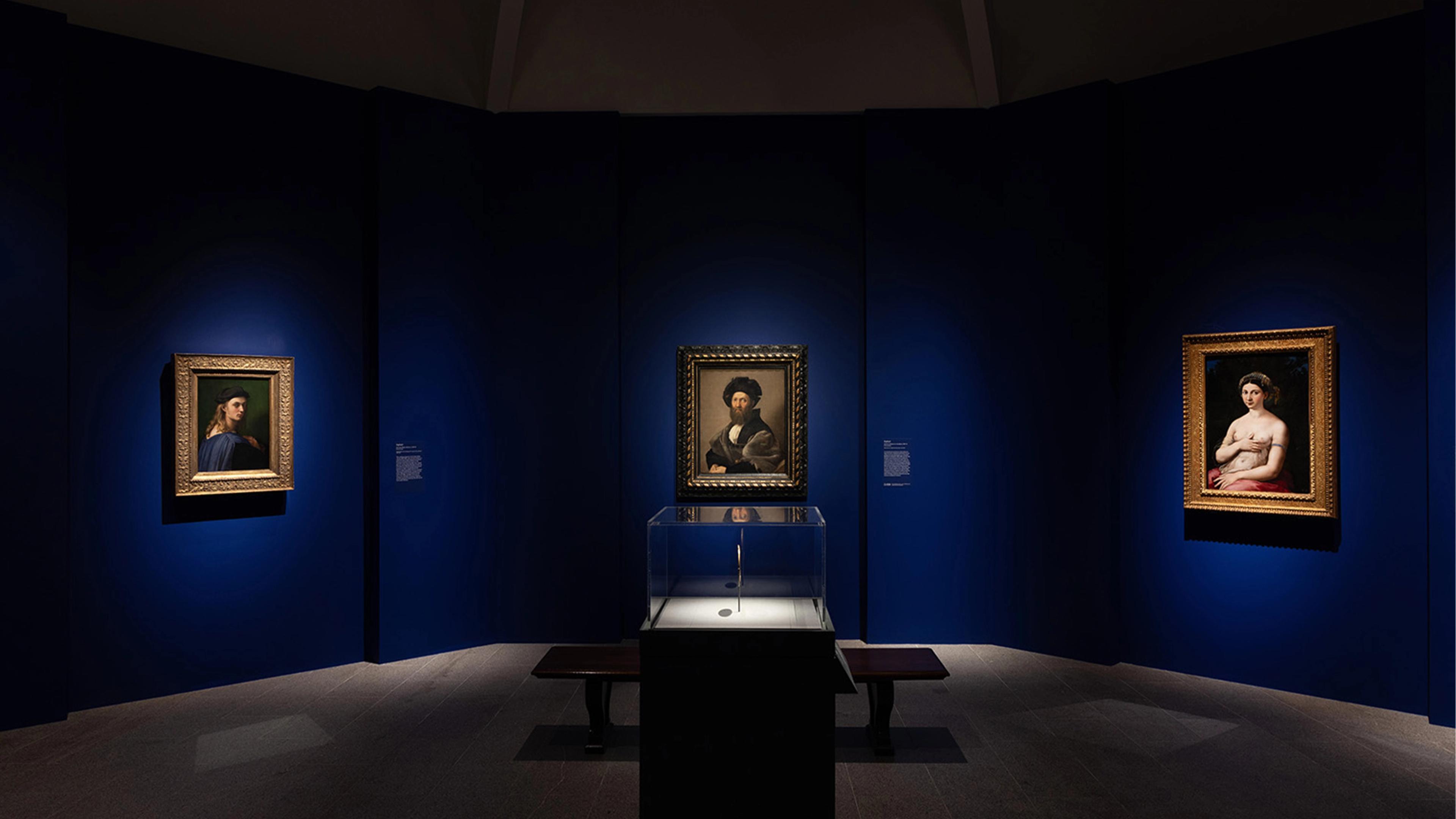
A dimly lit art gallery with deep blue walls displays three framed portraits.

Raphael’s portraits communicate a profound empathy and reflect years of exercising his hand in drawings to achieve an intimate, concerted contemplation of the sitter. The regal pose of Leonardo’s Mona Lisa, begun in 1503, offered a revolutionary model for the likeness of a luxuriously dressed person: a three-quarter view, head turned to the left, torso erect, and hands resting gracefully at the waist. The elegance of the poses here also suggests a striving for the cultivated manners of the Italian Renaissance courts and the ideals of beauty celebrated by famous poets. Raphael was an intimate friend of Baldassarre Castiglione (1478–1529), whose book on fashionable behavior at court promoted a model of comportment and grace that prized sprezzatura, a studied nonchalance or insouciance.

Many Renaissance portraits of women were painted at the time of betrothal and marriage, a financial-dynastic arrangement in which romantic love had no place. Elegant fashion and jewelry were meant to impress the future husband’s family, as dowries and property were negotiated. Overt appraisals of women’s appearances by poets and artists also contributed to a culture in which young women could become innamorate—platonic beloveds or actual mistresses—of a male aristocracy.

A slider containing 8 items.
Press the down key to skip to the last item.
Portrait of Young Woman in Three-Quarter View, Inspired by Leonardo’s Mona Lisa, Raphael (Raffaello Sanzio or Santi)  Italian, Two types of metalpoint on paper prepared greenish gray
On loan to The Met
Raphael (Raffaello Sanzio or Santi)
ca. 1504-5
Portrait of Baldassarre Castiglione, Raphael (Raffaello Sanzio or Santi)  Italian, Oil on canvas
On loan to The Met
Raphael (Raffaello Sanzio or Santi)
1514-16
Portrait of a Young Woman with a Unicorn (Laura Orsini della Rovere?), Raphael (Raffaello Sanzio or Santi)  Italian, Oil on wood panel, transferred to canvas, glued to a wood support
On loan to The Met
Raphael (Raffaello Sanzio or Santi)
1505-1506
Portrait of Bindo Altoviti, Raphael (Raffaello Sanzio or Santi)  Italian, Oil on wood (the original panel, presumed to be of poplar wood, was shaved off and replaced with masonite, then cradled)
On loan to The Met
Raphael (Raffaello Sanzio or Santi)
ca. 1515-16
Portrait of a Woman in Three-Quarter Length (La Muta), Raphael (Raffaello Sanzio or Santi)  Italian, Oil on limewood
On loan to The Met
Raphael (Raffaello Sanzio or Santi)
ca. 1503-5
Portrait of the Nude Fornarina (La Fornarina), Raphael (Raffaello Sanzio or Santi)  Italian, Oil on wood
On loan to The Met
Raphael (Raffaello Sanzio or Santi)
Giulio Romano
ca. 1520
Young Woman in Half-Length, Raphael (Raffaello Sanzio or Santi)  Italian, Black chalk on paper
On loan to The Met
Raphael (Raffaello Sanzio or Santi)
ca. 1503-5
Portrait of Valerio Belli, Raphael (Raffaello Sanzio or Santi)  Italian, Oil on wood
On loan to The Met
Raphael (Raffaello Sanzio or Santi)
1517

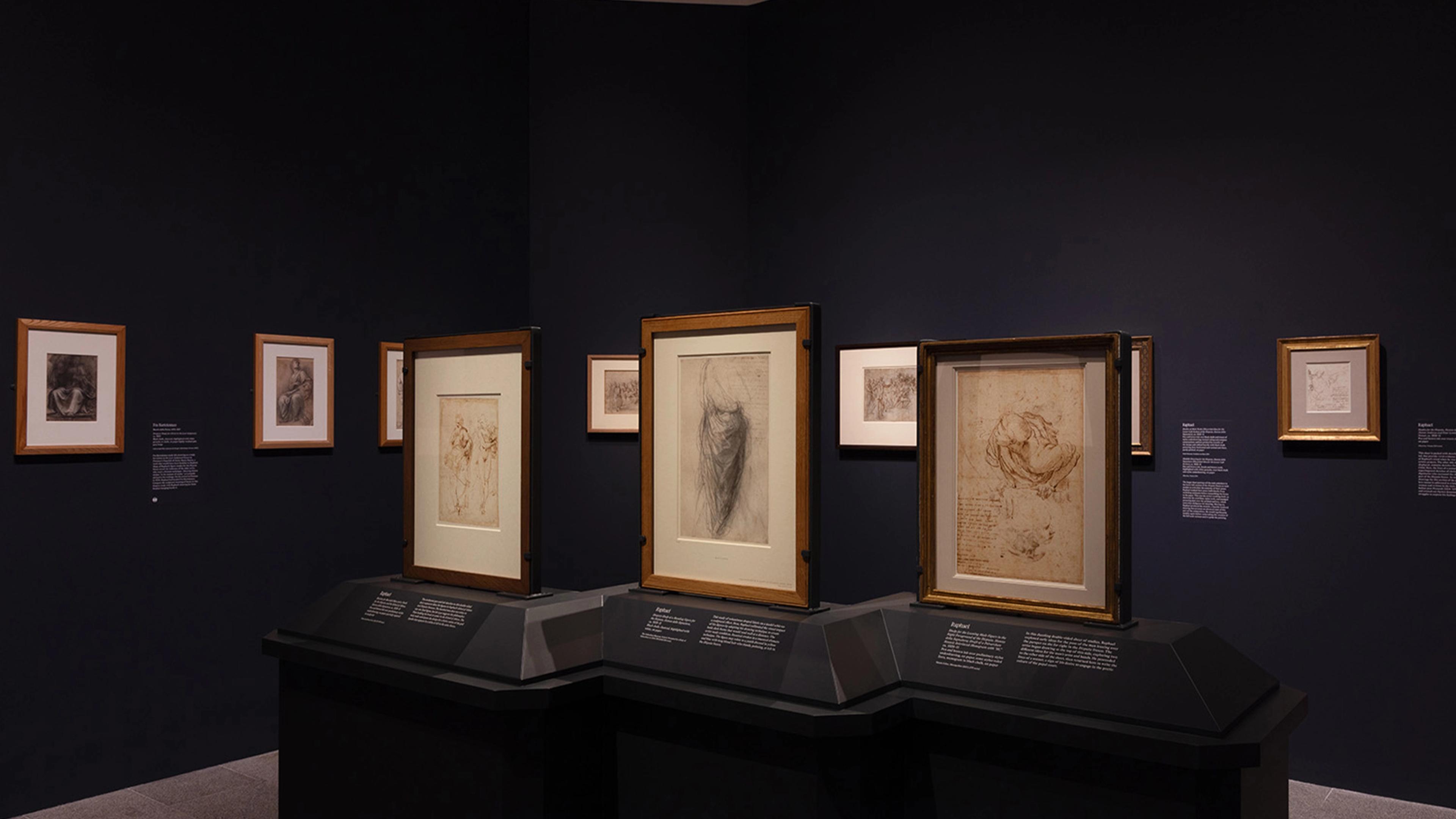
Drawings for the Vatican Palace

An art gallery displays framed sketches and drawings on dark walls.

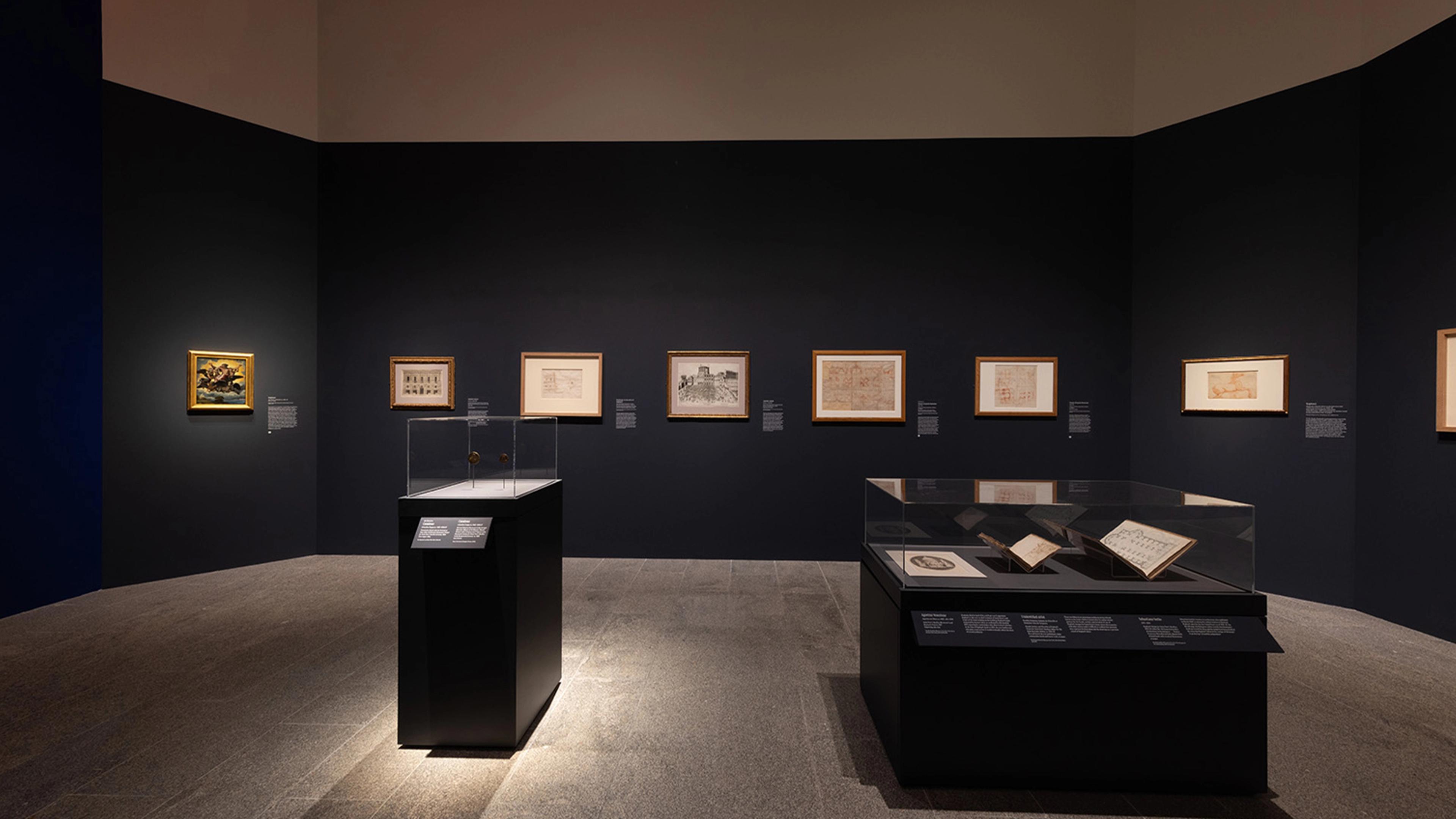
At some point in 1508, Raphael arrived in Rome, where he would become the favorite court artist of Popes Julius II (r. 1503–13) and Leo X (r. 1513–21). An intriguing question is how exactly the twenty-five-year-old Raphael managed to supersede an earlier generation of painters working in the Vatican Palace and take control of the fresco decoration of the most important of the rooms, the Stanza della Segnatura. Surely artistic genius and personal savvy were key factors, but research shows that networks of political influence between Rome and his hometown of Urbino also paved the way, including support from his friend and countryman Donato Bramante (1444–1514), the pope’s favorite architect.

Gathered here are Raphael’s studies for those Vatican frescoes: the School of Athens, with its gathering of philosophers, and the Disputa, representing Roman Catholic theology. These works show an artist in full command of the expressive potential of different drawing media. Rapidly sketched pen-and-ink sheets teem with the energy of ideas in the making, while studies in black chalk appear monumental despite their small size. In the next gallery, a digital video conveys the power of Raphael’s finished frescoes in four rooms of the Vatican Palace.

A slider containing 16 items.
Press the down key to skip to the last item.
Modello Drawing for the Disputa, Stanza della Segnatura (Discarded Idea for the Lower Left Section), Raphael (Raffaello Sanzio or Santi)  Italian, Pen and brown ink, brush and brown wash, highlighted with white gouache, over black chalk and metalpoint underdrawing, on paper
On loan to The Met
Raphael (Raffaello Sanzio or Santi)
ca. 1509-11
Studies of Pythagoras and His Disciples for the School of Athens, Stanza de la Segnatura, Raphael (Raffaello Sanzio or Santi)  Italian, Metalpoint, highlighted with white gouache, on paper prepared gray
On loan to The Met
Raphael (Raffaello Sanzio or Santi)
ca. 1508-10
Studies of Male Nudes (Discarded Idea for the Lower Left Section in the Fresco of the Disputa, Stanza della Segnatura), Raphael (Raffaello Sanzio or Santi)  Italian, Pen and brown ink over black chalk and traces of stylus underdrawing, stylus-incised ruling and compass construction, outlines pricked for transfer of the design and rubbed heavily with black-chalk pouncing dust; two horizontal axis lines and two vertical axis lines, partly pricked, on paper
On loan to The Met
Raphael (Raffaello Sanzio or Santi)
ca. 1509-11
Study for Diogenes in The School of Athens, Stanza de la Segnatura, Raphael (Raffaello Sanzio or Santi)  Italian, Metalpoint (silverpoint?), on paper prepared pink
On loan to The Met
Raphael (Raffaello Sanzio or Santi)
ca. 1508-10
Seated Male Nude (Study for Adam in the Disputa, Stanza della Segnatura); Sketch for the Segnatura vault (lower left), Raphael (Raffaello Sanzio or Santi)  Italian, Black chalk and white highlights on yellowed white paper
On loan to The Met
Raphael (Raffaello Sanzio or Santi)
ca. 1509-11
Study of a Seated Clothed Figure (Saint Stephen in the Disputa, Stanza della Segnatura), Raphael (Raffaello Sanzio or Santi)  Italian, Black chalk, traces of white chalk highlights, on paper washed light brown
On loan to The Met
Raphael (Raffaello Sanzio or Santi)
ca. 1509-11
Drapery on a Seated Mannequin or Lay Figure (Study for Christ in the Disputa, Stanza della Segnatura) (recto); Two Male Figures (Studies for the Seated Saints at Right in the Disputa) (verso), Raphael (Raffaello Sanzio or Santi)  Italian, Brush and brown wash, highlighted with white gouache, over leadpoint and stylus underdrawing, with a construction of numerous overlapping circles incised with the compass, figure squared in leadpoint or black chalk (recto); pen and brown ink, over leadpoint underdrawing, framing outlines in leadpoint (verso), on paper
On loan to The Met
Raphael (Raffaello Sanzio or Santi)
ca. 1509-11
The Head, Neck, and Hands of a Man (Bramante); Drapery for a Standing Man (Studies for the Disputa, Stanza della Segnatura), Raphael (Raffaello Sanzio or Santi)  Italian, Metalpoint on paper prepared greenish gray
On loan to The Met
Raphael (Raffaello Sanzio or Santi)
ca. 1509-11
Sketches for Figures on the Lower Left Section of the Disputa, Stanza della Segnatura (recto and verso), Raphael (Raffaello Sanzio or Santi)  Italian, Pen and brown ink over traces of preliminary stylus underdrawing (recto and verso), on paper
On loan to The Met
Raphael (Raffaello Sanzio or Santi)
ca. 1509-11
Composition Study for the Disputa, Stanza della Segnatura (Discarded Idea for the Lower Left Section), Raphael (Raffaello Sanzio or Santi)  Italian, Pen and brown ink, brush and brown wash, highlighted with white gouache, over traces of stylus underdrawing, on paper
On loan to The Met
Raphael (Raffaello Sanzio or Santi)
ca. 1509-11
Drapery Study for Christ in the Last Judgment, Fra Bartolomeo (Bartolomeo di Paolo del Fattorino)  Italian, Black chalk, charcoal, highlighted with white gouache or chalk, on paper lightly washed pale gray-beige
On loan to The Met
Fra Bartolomeo (Bartolomeo di Paolo del Fattorino)
ca. 1500
Figural Studies for Minerva and Other Niche Statues in the School of Athens, Stanza de la Segnatura, Raphael (Raffaello Sanzio or Santi)  Italian, Metalpoint, highlightes with wuite gouache, pink paper prepared, laid down
On loan to The Met
Raphael (Raffaello Sanzio or Santi)
ca. 1508-10
The Virgin Reading to the Christ Child in a Landscape with Two Figures (The Madonna of Humility) (recto); Studies for the Disputa, Stanza della Segnatura (Saints Ambrose and Peter Lombard); Sonnet (verso), Raphael (Raffaello Sanzio or Santi)  Italian, Pen and brown ink over traces of leadpoint (recto and verso), on paper
On loan to The Met
Raphael (Raffaello Sanzio or Santi)
ca. 1509-11
Sketches for Bearded Man and Youth for the Disputa and the School of Athens, Stanza della Segnatura (recto); Figure Studies (verso), Raphael (Raffaello Sanzio or Santi)  Italian, Pen and brown ink, over preliminary stylus underdrawing (recto); pen and brown ink (verso), on paper partially squared in leadpoint
On loan to The Met
Raphael (Raffaello Sanzio or Santi)
ca. 1509-11
Study for the Leaning Male Figure on the Right Foreground in the Disputa, Stanza della Segnatura; Draft of a Petrarchan Sonnet; an Interlaced Monogram with “M” (recto); Two Further Studies for the Same Figure (verso), Raphael (Raffaello Sanzio or Santi)  Italian, Pen and brown ink over preliminary stylus underdrawing on cream colored paper, some stylus-ruled lines, monogram in black chalk (recto); pen and brown ink over preliminary stylus underdrawing, some stylus-ruled lines (verso)
On loan to The Met
Raphael (Raffaello Sanzio or Santi)
ca. 1509-11
Drapery Study of a Standing Figure for the Disputa, Stanza della Segnatura (recto); Figure Studies and a Draft of a Petrarchan Sonnet (verso), Raphael (Raffaello Sanzio or Santi)  Italian, Black chalk, charcoal, highlighted with white (recto); Black chalk, pen and black ink (verso)
On loan to The Met
Raphael (Raffaello Sanzio or Santi)
ca. 1509-11

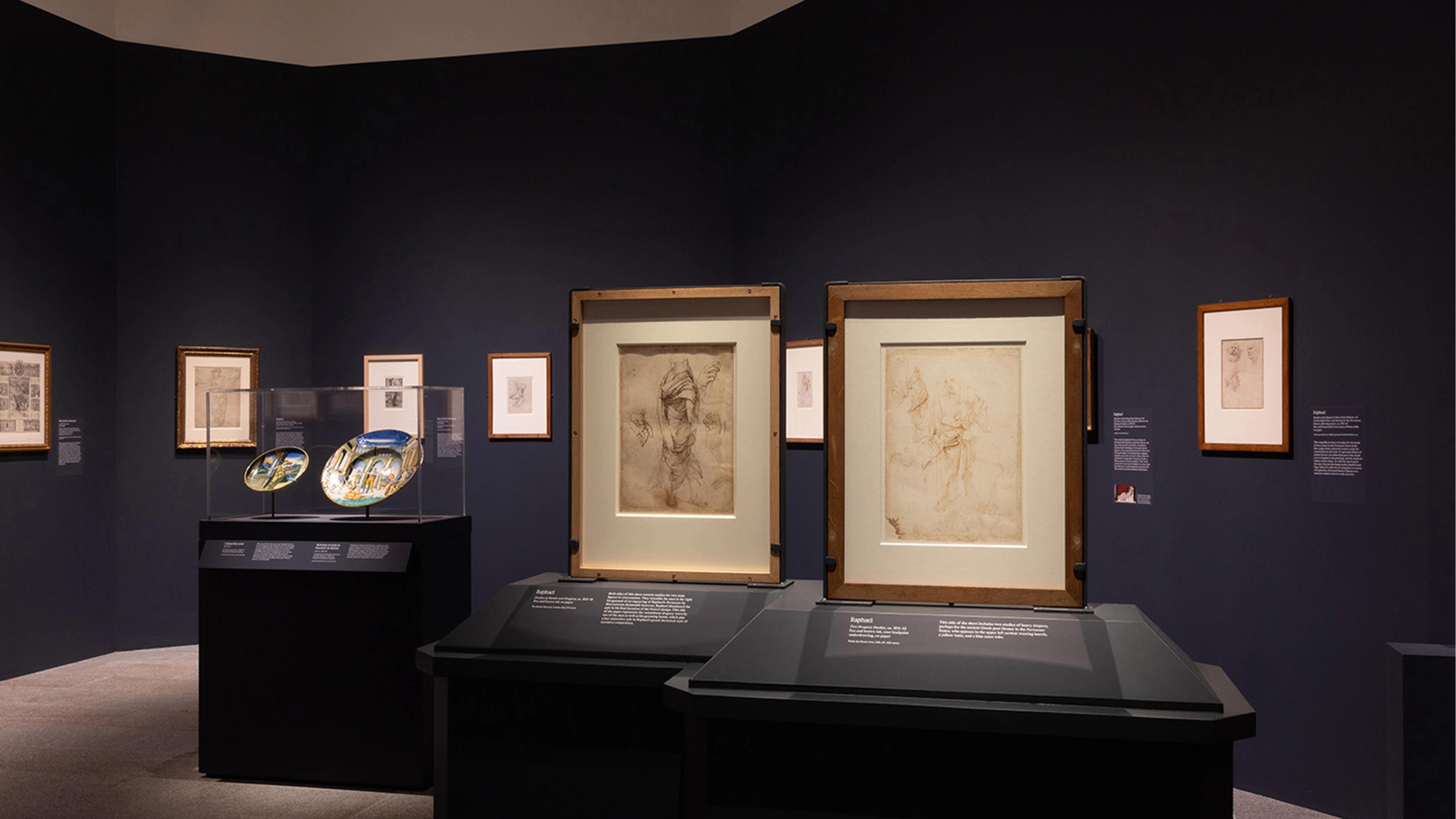
The Multitasking Artist

The gallery room features framed sketches on dark walls, illuminated under soft lighting.

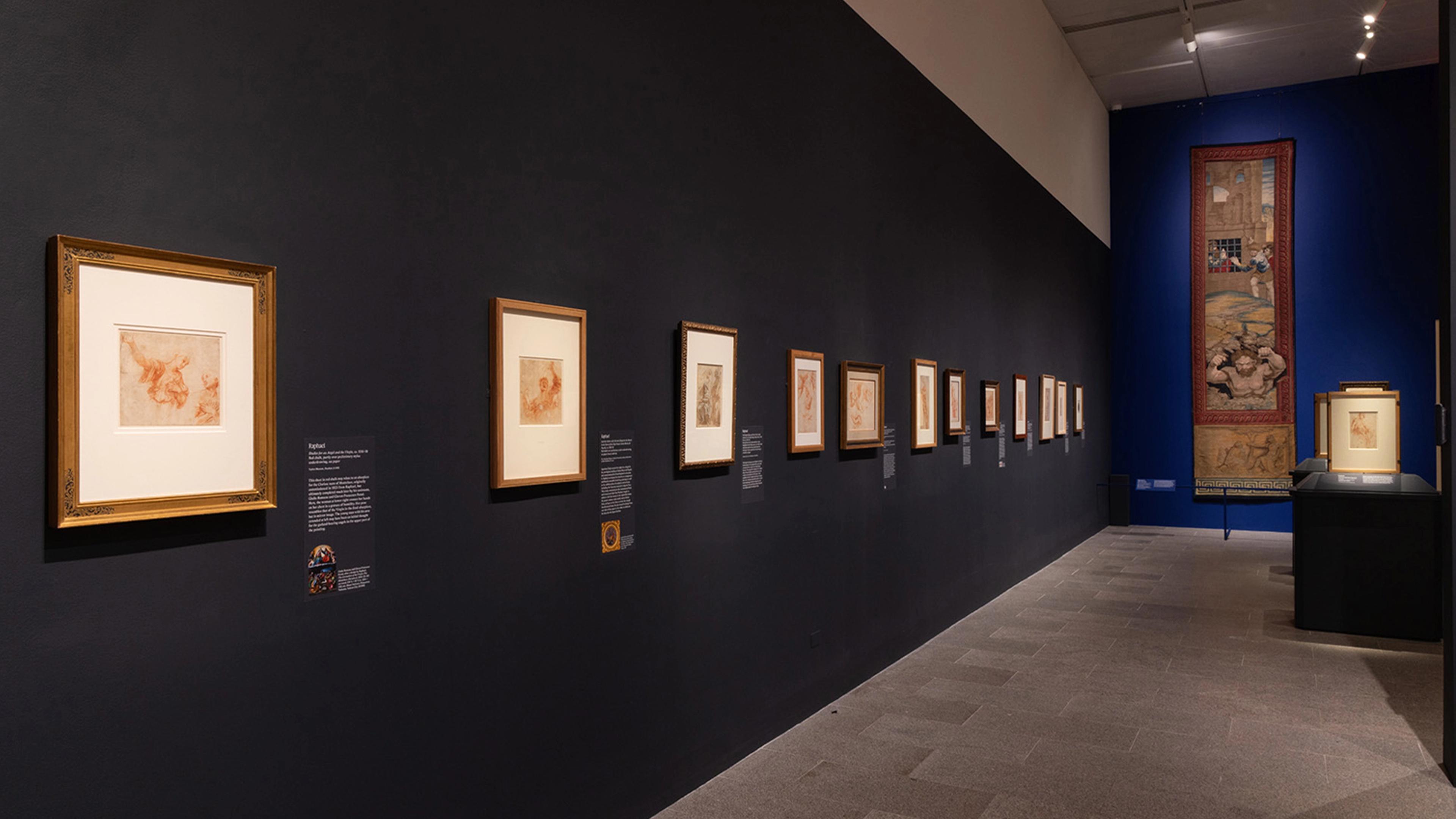
By about 1510 Raphael was collecting accolades as the most visible and prolific painter at the papal court in Rome; meanwhile, shut away in the Sistine Chapel, the secretive Michelangelo labored to paint his ceiling frescoes, which would deeply influence the younger artist, who snuck in to see them. Drawings here relate to projects that occupied Raphael as he concluded his first series of frescoes in the Vatican Palace and began the second, in the Stanza di Eliodoro, which communicate with greater monumentality and dramatic force. After Pope Julius II died in 1513 and Leo X ascended to the throne, some learned imagery vanished in favor of blunter papal messaging.

Other drawings and prints illustrate Raphael’s collaboration with Marcantonio Raimondi (ca. 1480–1534), a Bolognese printmaker and close friend. In their fruitful partnership, beginning in 1510, they created engravings of tremendous technical skill and artistic power. This medium enabled the reproduction of imagery in multiples and ensured a long afterlife for Raphael’s compositions. The prints were copied by artists well into the late 1800s and repurposed in other media, such as the maiolica plates in a nearby case.

A slider containing 26 items.
Press the down key to skip to the last item.
A plague scene at right, a man at left holding a torch illuminating part of the scene at left, sick people at the right, Marcantonio Raimondi  Italian, Engraving (heavily reworked)
Marcantonio Raimondi
After Raphael (Raffaello Sanzio or Santi)
ca. 1515–16
Neptune calming the tempest which Aeolus raised against Aeneas' fleet, from Book I of the Aeneid, Marcantonio Raimondi  Italian, Engraving
Marcantonio Raimondi
After Raphael (Raffaello Sanzio or Santi)
ca. 1515–16
The Judgment of Paris: he is sitting at left with Venus, Juno and Pallas Athena, a winged victory above. In the upper section the Sun in his chariot preceeded by Castor and Pollux on horseback, at lower right two river gods and a naiad above whom Jupiter, an eagle, Ganymede, Diana and another goddess, Marcantonio Raimondi  Italian, Engraving
Marcantonio Raimondi
After Raphael (Raffaello Sanzio or Santi)
ca. 1510–20
The Massacre of the Innocents, Marcantonio Raimondi  Italian, Engraving
Marcantonio Raimondi
After Raphael (Raffaello Sanzio or Santi)
ca. 1512–13
Lucretia, Raphael (Raffaello Sanzio or Santi)  Italian, Pen and brown ink over black chalk, partially incised with a stylus (recto); rubbed with black chalk for transfer (verso)
Raphael (Raffaello Sanzio or Santi)
1508–10
Study for the Reclining Muse Euterpe in the Parnassus, Stanza della Segnatura (based on the Sleeping Ariadne) (recto); Drapery of a Muse Seen from the Rear (verso), Raphael (Raffaello Sanzio or Santi)  Italian, Pen and brown ink on paper, bottom corners restored
On loan to The Met
Raphael (Raffaello Sanzio or Santi)
ca. 1511-12
Studies for the Massacre of the Innocents (recto); Study for the Figure of Astronomy, Stanza della Segnatura Vault (verso), Raphael (Raffaello Sanzio or Santi)  Italian, Red chalk (recto); pen ad brown ink over traces of leadpoint underdrawing and compass work (verso), on paper
On loan to The Met
Raphael (Raffaello Sanzio or Santi)
ca. 1510-12
Studies for the Judgment of Solomon (recto); Study of the Executioner in the Judgment of Solomon (verso), Raphael (Raffaello Sanzio or Santi)  Italian, Pen and brown ink, black chalk, over preliminary stylus underdrawing (recto and verso) on paper
On loan to The Met
Raphael (Raffaello Sanzio or Santi)
ca. 1510
Composition Study for the Massacre of the Innocents, Raphael (Raffaello Sanzio or Santi)  Italian, Pen and brown ink, with some later retouching, highlighted with white gouache, over preliminary pounce marks (spolvero underdrawing), reworked freehand by the artist in black chalk, on paper
On loan to The Met
Raphael (Raffaello Sanzio or Santi)
ca. 1510-12
The Death of Lucretia, Marcantonio Raimondi  Italian, Engraving
On loan to The Met
Marcantonio Raimondi
ca. 1510-12
Study of Flying Infant Angel with Body Turning to the Right, Raphael (Raffaello Sanzio or Santi)  Italian, Black chalk, over preliminary stylus underdrawing, squared in black chalk, on paper
On loan to The Met
Raphael (Raffaello Sanzio or Santi)
ca. 1510
Study of a Flying Infant Angel Holding a Tablet (Figure to the Right of Theology in the vault of the Stanza della Segnatura) (recto); Sketch of a Standing Figure (verso), Raphael (Raffaello Sanzio or Santi)  Italian, Grayish black chalk over traces of stylus underdrawing, incised compass arcs (recto); black chalk (verso), on paper
On loan to The Met
Raphael (Raffaello Sanzio or Santi)
ca. 1510
Standing Youth in Three-Quarter View, Facing Left (Study for the Bronze Tondo Relief of Christ’s Descent into Limbo, Chigi Chapel, Santa Maria della Pace), Raphael (Raffaello Sanzio or Santi)  Italian, Pen and brown ink over leadpoint and stylus underdrawing on paper
On loan to The Met
Raphael (Raffaello Sanzio or Santi)
ca. 1511-14
Saints Peter and John the Baptist in a Landscape (Cartoon for a Painting?), Baldassarre Tommaso Peruzzi  Italian, Pen and brown ink, brush and light brown wash, over extensive black-chalk underdrawing; stylus-incised outlines of the arch-shaped composition (arch incised with compass); outlines of the figures and silhouetted framing lines pricked for transfer of the design
On loan to The Met
Baldassarre Tommaso Peruzzi
ca. 1510-15
God the Father in Bust Length (Cartoon Fragment for the Disputa, Stanza della Segnatura), Raphael (Raffaello Sanzio or Santi)  Italian, Charcoal, black chalk, originally highlighted with white gouache (now lost), shadows deepened in brush and brown wash, over preliminary stylus underdrawing, outlines pricked for transfer of the design, on three sheets glued with overlapping seams (original paper support); figural design silhouetted along the shape of a giornata, mounted onto secondary paper support
On loan to The Met
Raphael (Raffaello Sanzio or Santi)
ca. 1509-11
Head of an Angel in Profile View (Cartoon Fragment for the Expulsion of Heliodorus from the Temple, Stanza di Eliodoro), Raphael (Raffaello Sanzio or Santi)  Italian, Charcoal, black chalk, traces of white gouache highlights, outlines pricked for transfer of the design on two glued sheets of paper; with numerous integrations of the original support; small bits of the drawn outlines reinforced by restorers (back of ear, underside of the nose, fulcrum and upper lip, which are all part of a long horizontal band extending from the lower cheek to the back of the neck, then along bits of the chin, underside of jaw, upper right and lower left corners); glued onto a Mariette mount (secondary paper support)
On loan to The Met
Raphael (Raffaello Sanzio or Santi)
ca. 1512
Composition Sketch for the Massacre of the Innocents, Raphael (Raffaello Sanzio or Santi)  Italian, Pen and brown ink, corrections in red chalk (figures at right), stylus-ruled construction and compass work, vertical axis line (partly pricked); outlines pricked for transfer of the design (except for the corrected figures), on paper
On loan to The Met
Raphael (Raffaello Sanzio or Santi)
ca. 1510-12
Studies of the Heads of the Three Poets (Homer, Unidentified Poet, and Dante) in the Parnassus, Stanza della Segnatura (recto); Drapery Study (verso), Raphael (Raffaello Sanzio or Santi)  Italian, Pen and brown ink, (?) on traces of black chalk underdrawing, on paper
On loan to The Met
Raphael (Raffaello Sanzio or Santi)
ca. 1511-12
Sketch for the Figure of Theology in the Vault of the Stanza della Segnatura (recto); Composition Sketches for the Assumption of the Virgin (verso), Raphael (Raffaello Sanzio or Santi)  Italian, Pen and brown ink over leadpoint underdrawing; (recto); pen and brown ink (verso), on paper
On loan to The Met
Raphael (Raffaello Sanzio or Santi)
ca. 1510
The Head of a Horse (Cartoon Fragment for the Expulsion of Heliodorus from the Temple, Stanza di Eliodoro), Raphael (Raffaello Sanzio or Santi)  Italian, Charcoal, black chalk, outlines pricked for transfer of the design, on light brown discolored paper (on six sheets glued with overlapping seams, original paper support); the cropping of the right border at top and bottom possibly conforms to the shape of a giornata; heavily restored, varnished, and numerous losses made up
On loan to The Met
Raphael (Raffaello Sanzio or Santi)
ca. 1512
The Annunciation (recto); Coronation of the Virgin Adored by Angels (verso), Raphael (Raffaello Sanzio or Santi)  Italian, Black chalk, pen and brown ink, over preliminary stylus underdrawing (recto); pen and brown ink (verso), on cream-colored, laid paper
On loan to The Met
Raphael (Raffaello Sanzio or Santi)
ca. 1506-10
The Death of Lucretia before a Concourse of Roman Citizens, Guido de Merlino  Italian, Tin-glazed earthenware (maiolica)
On loan to The Met
Workshop of Guido de Merlino
ca. 1540-45
Study for a Standing Figure of a Poet (Horace?) in the Parnassus, Stanza della Segnatura (recto); Studies of Hands and Drapery (verso), Raphael (Raffaello Sanzio or Santi)  Italian, Pen and brown ink
On loan to The Met
Raphael (Raffaello Sanzio or Santi)
ca. 1511-12
The Head of the Muse Polyhymnia (“Auxiliary Cartoon” for the Parnassus, Stanza della Segnatura), Raphael (Raffaello Sanzio or Santi)  Italian, Black chalk drawn freehand over pounce marks (spolvero underdrawing), traces of stylus underdrawing, and partly unrelated design in pounce marks (spolvero)
On loan to The Met
Raphael (Raffaello Sanzio or Santi)
ca. 1511-12
The Death of Lucretia, F. R. (painter), Tin-glazed earthenware (maiolica)
On loan to The Met
F. R. (painter)
ca. 1525-27
Seated Male Model in Frontal View and a Lyre (Study for Apollo in the Parnassus, Stanza della Segnatura) (recto); Two Drapery Studies (verso), Raphael (Raffaello Sanzio or Santi)  Italian, Pen and brown ink (recto and verso), on paper
On loan to The Met
Raphael (Raffaello Sanzio or Santi)
ca. 1511-12

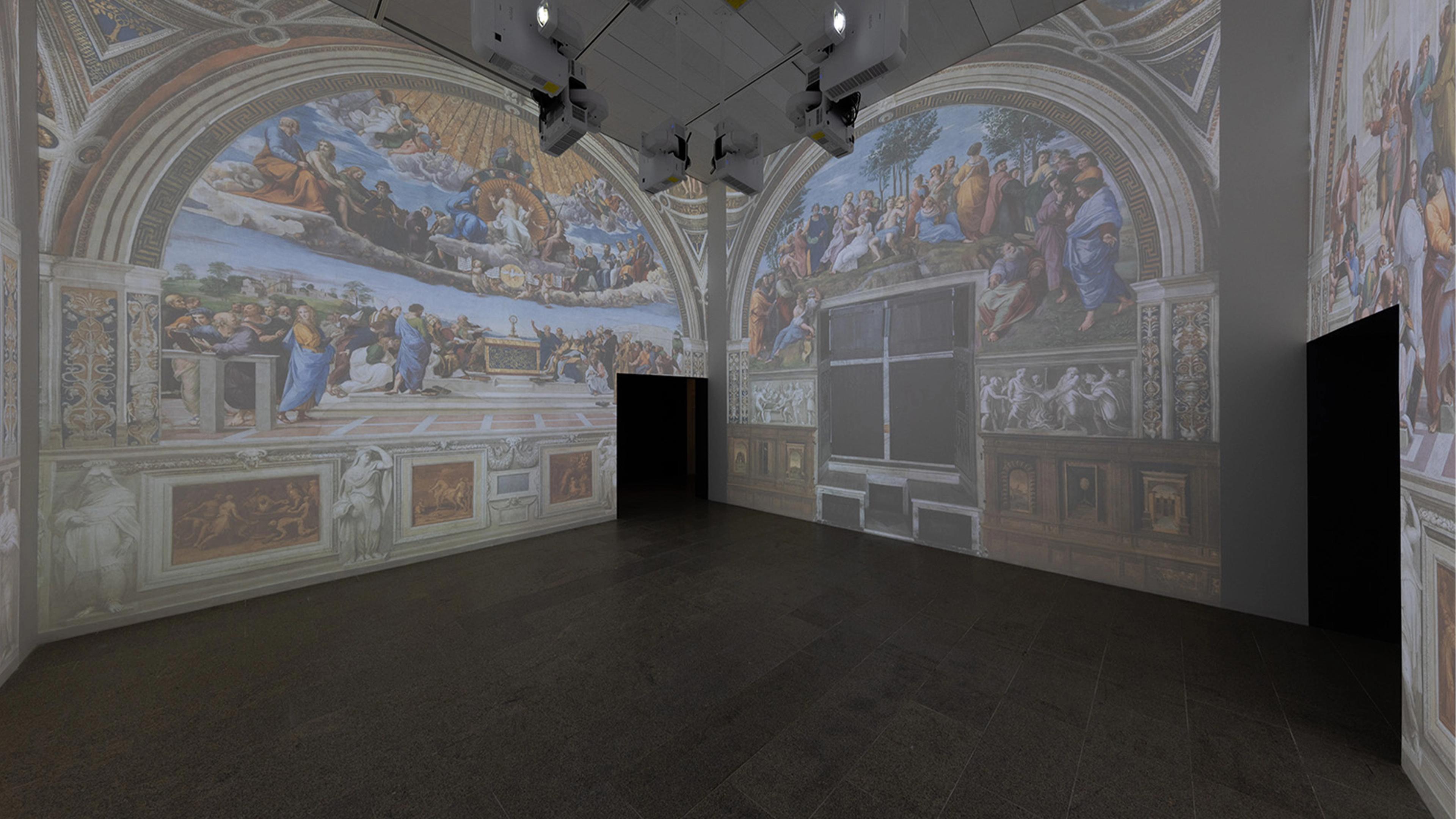
Raphael's Vatican Frescoes

A large room displays wall projections of renaissance-style frescoes featuring figures in dynamic poses and vivid colors.

In the next gallery is a digital video showing Raphael’s monumental fresco cycles in four rooms of the Vatican Palace. The display provides a sense of scale and context for the many related drawings in this exhibition. Between 1508 and 1524, the frescoes were painted by Raphael and his workshop in the nearly square rooms now known as the Stanza della Segnatura, Stanza di Eliodoro, and Stanza dell’Incendio, and in the gargantuan oblong Sala di Costantino (completed by his assistants after his death in 1520).

The durable but difficult fresco technique requires expertise, the use of full-scale drawings (cartoons), and a willingness to anticipate challenges. Water-based colors applied to moist surface plaster (intonaco) dry and carbonate in a chemical process, permanently bonding the colors to the wall. Executed primarily by Raphael between 1508 and 1512, the frescoes in the Stanza della Segnatura are the most famous and include the School of Athens, the Disputa, the personifications of Justice, and the Parnassus. In the following three rooms Raphael worked with a greater involvement of collaborators who followed his designs closely.

Toward a Grand Roman Manner
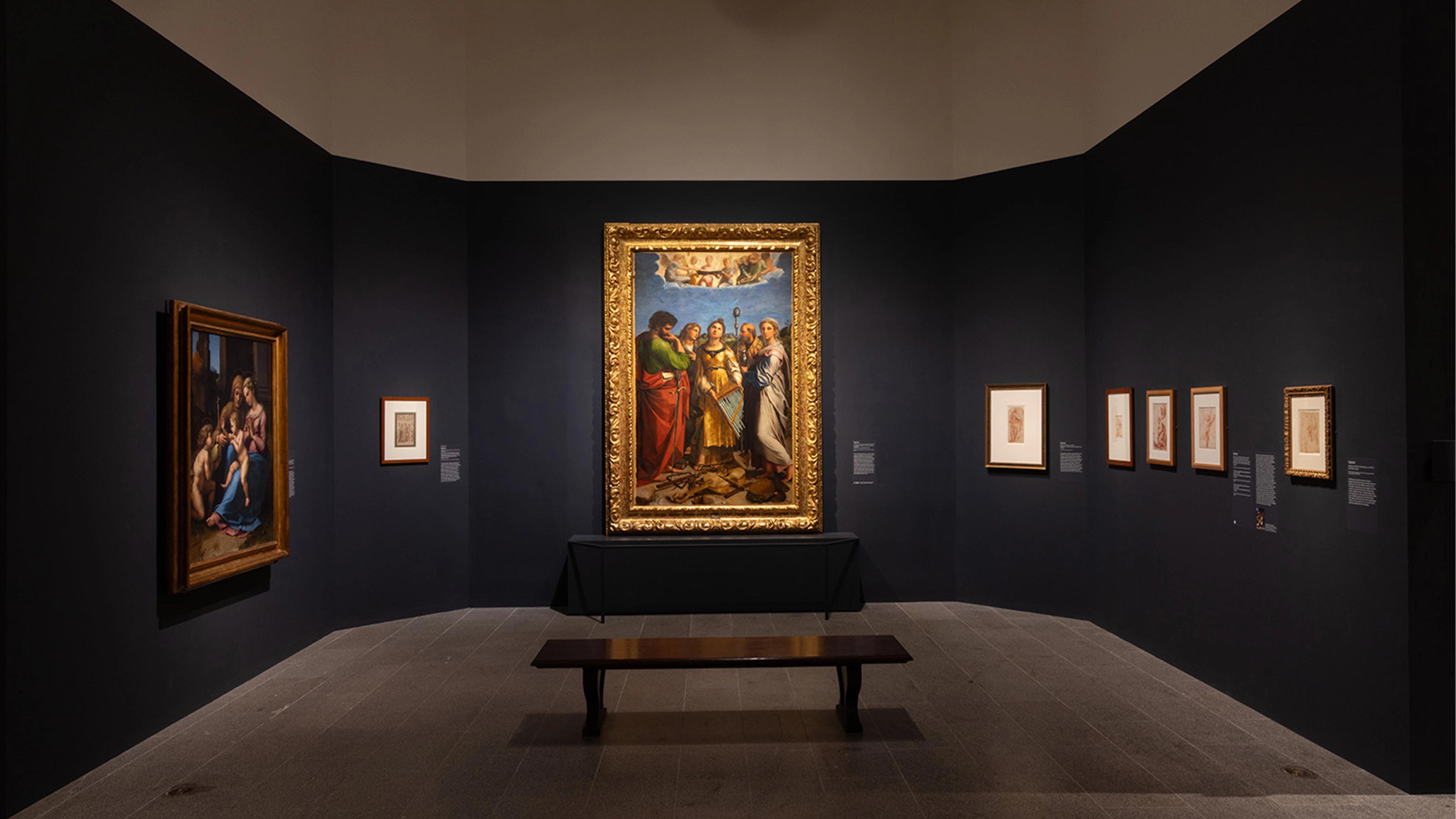
Museum gallery with dim lighting features a central large, ornate framed painting surrounded by smaller artworks on dark walls.

The paintings here represent the breathtaking visual eloquence of Raphael’s later years. New harmonies of color are transformed by a dark chiaroscuro reminiscent of Leonardo. Sculptural forms seem to project from dense compositions. Charged gazes, poses, and gestures communicate a sense of impending drama.

Between 1514 and 1520, the demanding Pope Leo X rained project after project upon Raphael. He produced few paintings independently; using his drawings as a guide, skilled assistants painted most of the frescoes in the Vatican’s Stanza dell’Incendio. He was often disparaged for this practice by rivals, including his fierce enemy Michelangelo. But Raphael and his well-organized workshop completed an astonishing number of large-scale projects in his final six years. Executive help freed the artist to concentrate his creative energies on inventing new designs and exploring new forms. The involvement of workshop assistants in paintings and in certain types of drawings has inevitably led to debates about authorship. Labels in this exhibition attempt to indicate instances of their likely intervention, and a nearby display allows comparison of studies by Raphael and his fellow artists in an effort to characterize their individual styles.

A slider containing 23 items.
Press the down key to skip to the last item.
Studies of the Christ Child, Raphael (Raffaello Sanzio or Santi)  Italian, Red chalk
Raphael (Raffaello Sanzio or Santi)
1513–14
Study of a Nude Child for the Holy Family of Francis I, Raphael (Raffaello Sanzio or Santi)  Italian, Red chalk, over traces of stylus underdrawing on ivory paper
On loan to The Met
Raphael (Raffaello Sanzio or Santi)
1518
The Virgin and Child (Study for the Holy Family of Francis I), Raphael (Raffaello Sanzio or Santi)  Italian, Red chalk over preliminary stylus underdrawing on paper
On loan to The Met
Raphael (Raffaello Sanzio or Santi)
1518
Study of a Nude Male Figure for the Adlocutio and Vision of the Cross, Sala di Costantino, Raphael (Raffaello Sanzio or Santi)  Italian, Black chalk with traces of stylus underdrawing, on paper
On loan to The Met
Raphael (Raffaello Sanzio or Santi)
ca. 1519-20
The  Virgin and Child with Raphael, Tobias, and Saint Jerome (The Madonna del Pesce), Raphael (Raffaello Sanzio or Santi)  Italian, Oil on canvas, transferred from wood
On loan to The Met
Raphael (Raffaello Sanzio or Santi)
ca. 1512-14
The Holy Family with Infant Saint John the Baptist (The Madonna of the Rose), Raphael (Raffaello Sanzio or Santi)  Italian, Oil on canvas, transferred from wood
On loan to The Met
Raphael (Raffaello Sanzio or Santi)
ca. 1517-18
Modello Drawing for the Virgin and Child with Raphael, Tobias, and Saint Jerome (The Madonna del Pesce), Raphael (Raffaello Sanzio or Santi)  Italian, Brush and brown wash, highlighted with white gouache (some oxidized), over extensive black-chalk under- and overdrawing, on paper
On loan to The Met
Raphael (Raffaello Sanzio or Santi)
ca. 1512-14
Study of Putto with the Impresa of Pope Leo X de’ Medici, Raphael (Raffaello Sanzio or Santi)  Italian, Black chalk, heightened with white chalk, with later framing lines in black
On loan to The Met
Raphael (Raffaello Sanzio or Santi)
ca. 1513-14
Study for Saint Paul (recto), Drapery Study (verso), Raphael (Raffaello Sanzio or Santi)  Italian, Red chalk, over preliminary stylus underdrawing (recto); red chalk over traces of preliminary stylus underdrawing (verso), on paper
On loan to The Met
Raphael (Raffaello Sanzio or Santi)
ca. 1515-16
Modello Drawing for the Altarpiece of the Ecstasy of Saint Cecilia, Raphael (Raffaello Sanzio or Santi)  Italian, Pen and brown ink, brush and brown wash, over soft grayish black-chalk underdrawing; vertical and horizontal axes in black chalk, framing outlines constructed and measured with pinpricks; laid down
On loan to The Met
Raphael (Raffaello Sanzio or Santi)
ca. 1515-1516
The Virgin and Child with Infant Saint John the Baptist, and Saints Elizabeth and Joseph (The Madonna del Divino Amore), Raphael (Raffaello Sanzio or Santi)  Italian, Oil on wood
On loan to The Met
Raphael (Raffaello Sanzio or Santi)
ca. 1516-18
Study of a Young Woman from Life, with the Figure of a Child Drawn in Reserve (Possibly for the Holy Family of Francis I), Raphael (Raffaello Sanzio or Santi)  Italian, Pale, slightly orange red chalk over traces of stylus underdrawing, glued onto secondary paper support; fragmentary watermark at upper right
On loan to The Met
Raphael (Raffaello Sanzio or Santi)
ca. 1518
The Head of a Young Woman in Three-Quarter View Looking Down (Study for Charity in the Sala di Costantino), Raphael (Raffaello Sanzio or Santi)  Italian, Charcoal, soft grayish black chalk and denser black chalk; slight accenting of shaows with wetted black chalk; minor accenting in black wash by a restorer (on the hair at the left and the iris of the eye); traces of white gouache highlights (now sunken); finely stylus-incised outlines; on beige paper, glued onto a secondary paper support
On loan to The Met
Raphael (Raffaello Sanzio or Santi)
ca. 1519-20
Composition Sketch for Moses Receiving the Tablets of the Law, Raphael (Raffaello Sanzio or Santi)  Italian, Pen and brown ink, brush and brown wash, highlighted with white gouache, over grayish black chalk, squared on top of all layers of design in grayish black chalk, on paper
On loan to The Met
Raphael (Raffaello Sanzio or Santi)
ca. 1518-20
Modello Drawing for the Battle of the Milvian Bridge, Sala di Costantino; An Eagle and the Drapery of a Caryatid; An Arm holding a Tablet and a Leg (for the Figure of Virtue?), Raphael (Raffaello Sanzio or Santi)  Italian, Pen and brown ink, brush and brown wash, highlighted with white gouache, ver extensive black-chalk underdrawing, squared in black chalk, on many glued sheets of paper washed beige; lined with a secondary support; with early restorations
On loan to The Met
Raphael (Raffaello Sanzio or Santi)
Giovanni Francesco Penni
ca. 1519-20
Head of a Bishop (“Auxiliary Cartoon” for the Coronation of Charlemagne, Stanza dell’Incendio), Raphael (Raffaello Sanzio or Santi)  Italian, Black chalk, highlighted with white gouache (partly now lost), drawn freehand over pounce marks (spolvero underdrawing), partly unrelated design in pounce marks (spolvero), on light brown paper
On loan to The Met
Raphael (Raffaello Sanzio or Santi)
ca. 1515-16
Modello Drawing with an Early Idea for the Enthroned Pope Urban I in a Niche with Virtues, Angels, and Other Figures, Sala di Costantino, Giovanni Francesco Penni  Italian, Pen and brown ink, brush and brown wash, over leadpoint underdrawing, with leadpoint and pen-and-ink ruling, compass work (arcs, points), and a lightly stylus-incised vertical axis line (running through the figure of the pope); extensively highlighted with white gouache; on paper washed pale brown
On loan to The Met
Giovanni Francesco Penni
ca. 1519-20
Modello Drawing for the Coronation of Charlemagne, Stanza dell’Incendio, Giovanni Francesco Penni  Italian, Pen and brown ink, brush and brown wash, highlighted with white gouache, traces of red-chalk corrections, over stylus-incised ruled and compass construction, and black chalk underdrawing, on several glued sheets of paper
On loan to The Met
Giovanni Francesco Penni
Giulio Romano
ca. 1515-16
Composition Study with Workshop Assistants Posing for the  Virgin and Child with Raphael, Tobias, and Saint Jerome (The Madonna del Pesce), Raphael (Raffaello Sanzio or Santi)  Italian, Slightly orangeish red chalk, over underdrawing sketched in leadpoint (?) or fine black chalk, on paper
On loan to The Met
Raphael (Raffaello Sanzio or Santi)
ca. 1512-14
The Ecstasy of Saint Cecilia with Saints Paul, John the Evangelist, Augustine, and Mary Magdalene, Raphael (Raffaello Sanzio or Santi)  Italian, Oil on canvas, transferred from wood
On loan to The Met
Raphael (Raffaello Sanzio or Santi)
ca. 1515-16
Standing Putto Bearing a Garland on a Curved Plaster Surface, Raphael (Raffaello Sanzio or Santi)  Italian, Detached fresco fragment with a layer of surface plaster, adhered to cork and anchored to a cadorite slab with aluminum brackets
On loan to The Met
Raphael (Raffaello Sanzio or Santi)
ca. 1512
Two Male Nudes Drawn from the Same Model (Study the Battle of the Milvian Bridge, Sala di Costantino) (recto), Two Studies of an Elderly Man (verso; not by Raphael), Raphael (Raffaello Sanzio or Santi)  Italian, Black chalk, highlighted with white gouache, over preliminary stylus underdrawing, with slight retouching of contours (recto); black chalk, some contours reinforced in pen and brown ink (verso)
On loan to The Met
Raphael (Raffaello Sanzio or Santi)
ca. 1519-20
Pope Sylvester I in a Sedia Gestatoria and Saint Helen (Modello Drawing for the Donation of Constantine, Sala di Costantino), Giulio Romano  Italian, Pen and two hues of brown ink, brush and brown wash, highlighted with white gouache, over leadpoint and grayish blaack-chalk underdrawing; pinpricks for measurements, ruling in pen and ink, and stylus construction; some pounce marks (spolvero underdrawing) in some architectural motifs; on two sheets of paper glued with overlapping seams (original paper support)
On loan to The Met
Giulio Romano
ca. 1520-24

The Sistine Tapestries

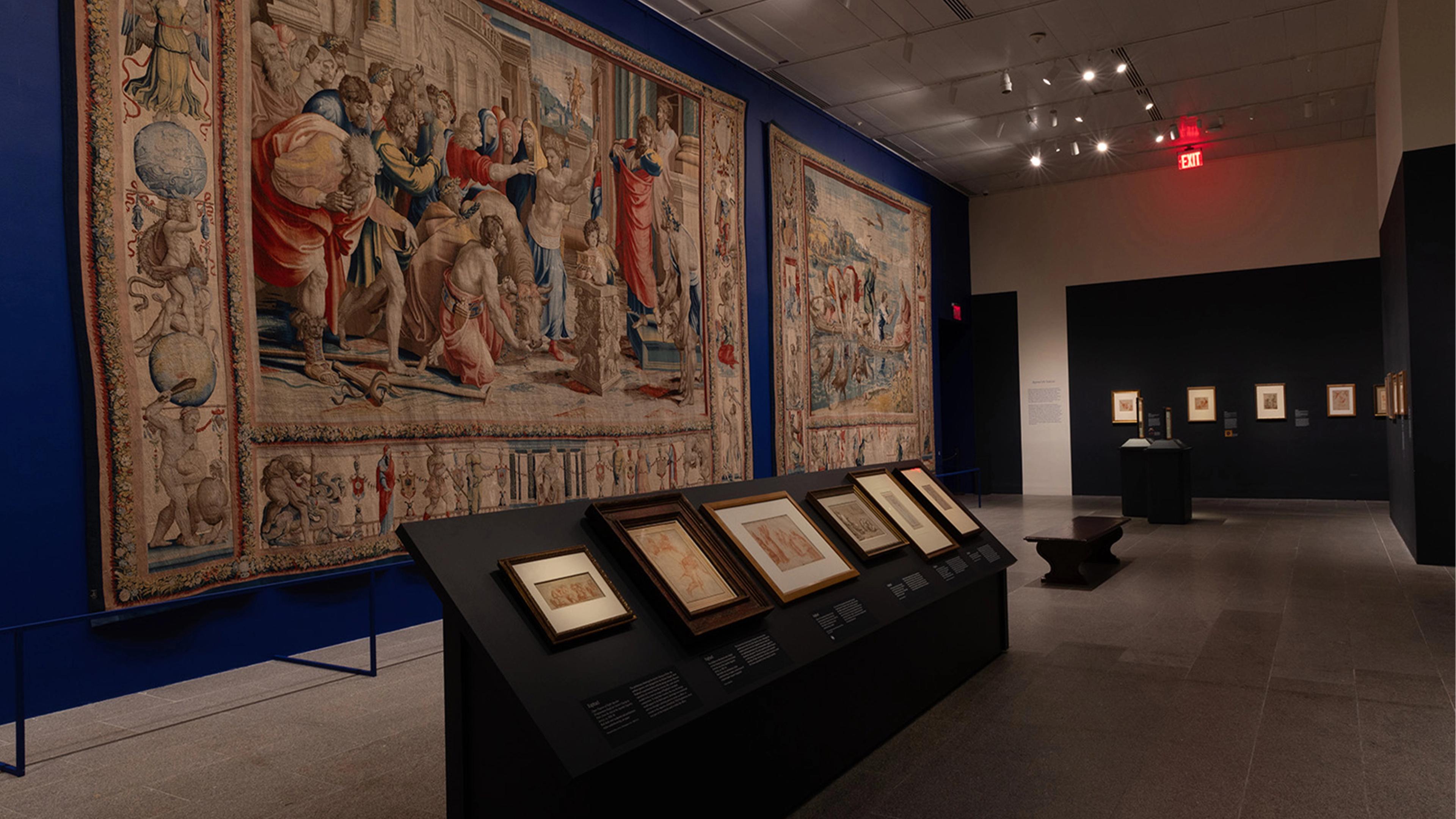
Museum gallery with large, intricate tapestries featuring historical scenes on the walls.

The imperious Pope Leo X charged Raphael with the daunting task of designing a set of monumental tapestries to hang in the Sistine Chapel during special occasions—a project that put Raphael in direct competition with Michelangelo and his ceiling frescoes above. Starting in 1515, Raphael began drawing small preliminary studies. Aided by workshop assistants, he then painted in color gouaches on paper the enormous full-scale cartoons that would guide the weavers. Woven in Brussels using rich materials, the stratospherically expensive tapestries contributed to the bankruptcy of Leo’s papacy. With their inventive compositions, striking color harmonies, and monumental scale, they were soon the envy of monarchs across Europe. Kings commissioned second editions woven from Raphael’s cartoons, and the set owned by King Philip II of Spain (1527–1598) is represented here by three stunning examples.

As the tapestry designs progressed, the Raphael team largely took over the fresco work in the Vatican Palace, endeavoring to complete the Stanza dell’Incendio and assisting Raphael as he began to conceive decorations for the final space. Giulio Romano (1499?–1546) acted as his studio foreman and went on to enjoy a brilliant independent career.

A slider containing 18 items.
Press the down key to skip to the last item.
Two Women and a Child (Study for the Fire in the Borgo, Stanza dell’Incendio), Raphael (Raffaello Sanzio or Santi)  Italian, Red chalk over traces of black-chalk underdrawing, on paper
On loan to The Met
Raphael (Raffaello Sanzio or Santi)
ca. 1514-15
Man Carrying His Father (“Aeneas and Anchises”; Study for the Fire in the Borgo, Stanza dell’Incendio), Raphael (Raffaello Sanzio or Santi)  Italian, Red chalk on paper
On loan to The Met
Raphael (Raffaello Sanzio or Santi)
ca. 1514-15
Studies of Two Male Nudes for the Naval Battle of Ostia, Stanza dell'Incendio, Raphael (Raffaello Sanzio or Santi)  Italian, Red chalk over preliminary stylus underdrawing, on paper
On loan to The Met
Raphael (Raffaello Sanzio or Santi)
1515
Three Male Figures, Two Kneeling, One Standing (Study for the Apostles in the Monteluce Altarpiece [The Coronation of the Virgin]), Raphael (Raffaello Sanzio or Santi)  Italian, Soft black chalk, with traces of highlights in brush and white gouache (now partly faded), unrelated design in pounce marks (spolvero), on paper
On loan to The Met
Raphael (Raffaello Sanzio or Santi)
ca. 1516-18
Dëesis (Christ in Glory with the Virgin Mary and Saints John the Baptist, Catherine, and Paul), Giulio Romano  Italian, Tempera grassa and oil on wood
On loan to The Met
Giulio Romano
ca. 1520
Seated Christ in Glory (Study for Giulio Romano’s Dëesis), Raphael (Raffaello Sanzio or Santi)  Italian, Black chalk, brush and gray wash, highlighted with white chalk, on paper washed pale gray wash; original support cut down on the left and right borders and made up with toned-in strips
On loan to The Met
Raphael (Raffaello Sanzio or Santi)
ca. 1519-20
The Virgin (Cartoon Fragment for Giulio Romano’s Deësis), Raphael (Raffaello Sanzio or Santi)  Italian, Charcoal, black chalk, highlighted with white gouache, on three fragmentary sheets glued with overlapping seams (original paper support); the paper lightly washed pale gray-beige, outlines of the figure and draperies stylus-incised for transfer; original paper support silhouetted
On loan to The Met
Raphael (Raffaello Sanzio or Santi)
ca. 1519-20
Portrait of Pope Leo X de’ Medici (Cartoon Fragment for the Figure of Pope Clement I in the Sala di Costantino), Giulio Romano  Italian, Black chalk, with stumping, highlighted extensively in white chalk, outlines stylus-incised for transfer of the design; the irregular shape of the original paper support partly conformed to the silhouetting necessary for a giornata in the fresco; glued onto secondary paper support making up the losses. Original  drawing surface abraded, and partial redrawing of the design by early restorers on the secondary support.
On loan to The Met
Giulio Romano
ca. 1520
Saint Paul and Saint Barnabas at Lystra (from the Second Edition of the Acts of the Apostles Tapestry Series), Jan van Tieghem  Flemish, Wap: wool, 7-8 per cm; weft: wool and silk, lined on the reverse, 34-38 per cm
On loan to The Met
Jan van Tieghem
Frans Gheteels
after Raphael (Raffaello Sanzio or Santi)
Late 1540s or early 1550s
The Miraculous Draft of the Fishes (from the Second Edition of the Acts of the Apostles Tapestry Series), Jan van Tieghem  Flemish, Warp: wool, 7-8 per cm; weft: wool and silk, lined on the reverse, 34-38 per cm
On loan to The Met
Jan van Tieghem
Frans Gheteels
after Raphael (Raffaello Sanzio or Santi)
Late 1540s or early 1550s
Christ’s Charge to Peter (from the Second Edition of the Acts of the Apostles Tapetry Series), Jan van Tieghem  Flemish, Wap: wool, 7-8 per cm; weft: wool and silk, lined on the reverse, 34-38 per cm
On loan to The Met
Jan van Tieghem
Frans Gheteels
after Raphael (Raffaello Sanzio or Santi)
Late 1540s or early 1550s
Head of a Soldier (Cartoon Fragment for the Resurrection, Scuola Nuova Tapestry Series), Giulio Romano  Italian, Brush and color gouache on paper, mounted on canvas
On loan to The Met
Giulio Romano
ca. 1521-23
Study of a Soldier on Horseback, Raphael (Raffaello Sanzio or Santi)  Italian, Metalpoint, highlighted with white gouache, on paper prepared brownish gray
On loan to The Met
Raphael (Raffaello Sanzio or Santi)
ca. 1514-15
Saint Paul Rending His Garments (Study for the Sacrifice of Lystra, from the Acts of the Apostles Tapestry Series), Raphael (Raffaello Sanzio or Santi)  Italian, Metalpoint, highlighted with white gouache, on paper prepared gray-violet
On loan to The Met
Raphael (Raffaello Sanzio or Santi)
ca. 1515-1516
Figures in Composition (Studies for Saint Paul Preaching in Athens, from the Acts of the Apostles Tapestry Series), Raphael (Raffaello Sanzio or Santi)  Italian, Red chalk, over preliminary stylus underdrawing, on paper
On loan to The Met
Raphael (Raffaello Sanzio or Santi)
ca. 1515-16
The Upper Figures of Eight Apostles (Fragmentary Study for Christ’s Charge to Peter, from the Acts of the Apostles Tapestry Series), Raphael (Raffaello Sanzio or Santi)  Italian, Red chalk, over leadpoint and preliminary stylus underdrawing (recto); verso bears blind imprints from Marcantonio’s copper plate of the Massacre of the Innocents
On loan to The Met
Raphael (Raffaello Sanzio or Santi)
ca. 1515-16
Two Soldiers on Horseback and A Soldier on Foot (Study for the Conversion of Saul from the Acts of the Apostles Tapestry Series), Raphael (Raffaello Sanzio or Santi)  Italian, Red chalk over preliminary stylus underdrawing on paper; corner losses of original paper support integrated
On loan to The Met
Raphael (Raffaello Sanzio or Santi)
ca. 1515-16
The Miraculous Draft of the Fishes with a Crowd in the Foreground (recto); The Miraculous Draft of the Fishes (verso), Raphael (Raffaello Sanzio or Santi)  Italian, Pen and brown ink, brown wash, highlighted with white, over black-chalk underdrawing (recto); pen and brown ink over a preliminary black-chalk underdrawing (verso), on paper
On loan to The Met
Raphael (Raffaello Sanzio or Santi)
ca. 1515-16

The Transfiguration

A curved gallery wall displays six framed sketches, evenly spaced, on a dark background.

Raphael’s last and largest altarpiece is the enormous Transfiguration, commissioned by Cardinal Giulio de’ Medici (the future Pope Clement VII) around 1517. Spurred by competition with artistic rivals, Raphael produced a work markedly more dramatic, ambitious, and complex than his earlier altarpieces. Although its execution was interrupted by his untimely death in 1520, the Transfiguration became Raphael’s artistic testament. The main event is Christ’s Transfiguration on Mount Tabor, during which he transformed before the stunned apostles Peter, James, and John to reveal his divinity.

Raphael’s studies for the Transfiguration, displayed in the niche at left, represent the culmination of his career as a draftsman. They are reunited here to show the range of his design process. Raphael used red chalk primarily when drawing nude models from life. He reserved black chalk for the full-scale studies of apostles’ heads and hands, a type of drawing called an “auxiliary cartoon” because the design starts from a dotted chalk outline transferred from another sheet.

A slider containing 7 items.
Press the down key to skip to the last item.
Studies for Apostles in the Transfiguration, Giulio Romano  Italian, Red chalk over traces of black-chalk underdrawing on paper
On loan to The Met
Giulio Romano
Raphael (Raffaello Sanzio or Santi)
ca. 1518-19
The Head of an Apostle (“Auxiliary Cartoon” for the Transfiguration), Raphael (Raffaello Sanzio or Santi)  Italian, Black chalk, drawn freehand over pounce marks (spolvero underdrawing) and stylus underdrawing, unrelated design in pounce marks (spolvero) on paper
On loan to The Met
Raphael (Raffaello Sanzio or Santi)
ca. 1519-20
Heads and Hands of Two Apostles (“Auxiliary Cartoon” for the Transfiguration), Raphael (Raffaello Sanzio or Santi)  Italian, Black chalk drawn freehand over pounce marks (spolvero underdrawing),  traces of white gouache highlights, on laid paper
On loan to The Met
Raphael (Raffaello Sanzio or Santi)
ca. 1519-20
The Head of an Apostle (“Auxiliary Cartoon” for the Transfiguration), Raphael (Raffaello Sanzio or Santi)  Italian, Black chalk, drawn freehand over pounce marks (spolvero underdrawing)
On loan to The Met
Raphael (Raffaello Sanzio or Santi)
ca. 1519-20
Study for a Kneeling Woman in the Foreground of the Transfiguration;Unrelated Design of a Cornice in Profile, Raphael (Raffaello Sanzio or Santi)  Italian, Soft black chalk, charcoal, highlighted in brush and white gouache, some reworking of dark shadows in brush and diluted black chalk and stylus incisions to correct contours, over partial pounce marks, on off-white paper washed light grayish brown (figures); pen and grayish brown ink with ruling; verso is blank and severely abraded (cornice)
On loan to The Met
Raphael (Raffaello Sanzio or Santi)
ca. 1519-20
Study of Two Nude Seated Male Figures for the Transfiguration (St. Andrew and Another Apostle), Raphael (Raffaello Sanzio or Santi)  Italian, Red chalk over preliminary stylus underdrawing
On loan to The Met
Raphael (Raffaello Sanzio or Santi)
ca. 1518-1519
Study for Seated Apostle in the Transfiguration (recto); Sketches for the Plan of Saint Peter's (verso), Raphael (Raffaello Sanzio or Santi)  Italian, Red chalk, over preliminary stylus underdrawing and squaring in stylus (recto); red chalk, pen and brown ink (verso)
On loan to The Met
Raphael (Raffaello Sanzio or Santi)
ca. 1518-19

Beyond the Vatican

Dimly lit art gallery with dark walls displays framed sketches in a row. A vertical tapestry hangs in the background

Raphael rarely interrupted his projects for Popes Julius II and Leo X to make room for other commissions. The notable exception was his powerful friend Agostino Chigi (1466–1520), whom he met in about 1510. Born in Siena, Chigi became the richest banker in Europe, and his legendary wealth financed the popes’ cultural and military enterprises. Raphael’s work for Chigi included fresco paintings, as well as designs for his remodeled stables and the multimedia ensembles of his two chapels.

Displayed here are a variety of Raphael’s preparatory drawings for Chigi’s projects. In chalk studies of nude figures, Michelangelo’s language of contorted poses and powerful muscularity is transformed with an effortless grace and the sensuality of living flesh. The drawings also allude to the legacy of Raphael’s approach to the human figure, which led to the style known as Mannerism after his death. Male and female forms here anticipate prototypical Mannerist poses—as with Raphael’s primeval personification of an earthquake in a Sistine Chapel tapestry design, which spawned the figural vocabulary that his former assistant Giulio Romano would exploit to spectacular effect in his later frescoes.

A slider containing 17 items.
Press the down key to skip to the last item.
The Cumean Sibyl (Study for the Chigi Chapel, Santa Maria della Pace), Raphael (Raffaello Sanzio or Santi)  Italian, Red chalk, traces of pen and brown ink, over preliminary stylus underdrawing, on paper
On loan to The Met
Raphael (Raffaello Sanzio or Santi)
ca. 1511-13
Standing Nude Woman Studied from Life (Venus Pudica), Raphael (Raffaello Sanzio or Santi)  Italian, Metalpoint, highlighted with white gouache, on paper prepared pale brown
On loan to The Met
Raphael (Raffaello Sanzio or Santi)
ca. 1511-14
Studies for a Kneeling Woman (Probably for the Toilette of Psyche, Loggia di Psiche, Villa Farnesina), Raphael (Raffaello Sanzio or Santi)  Italian, Red chalk, over preliminary stylus underdrawing, with some ver slight later retouching in black chalk, on paper
On loan to The Met
Raphael (Raffaello Sanzio or Santi)
ca. 1517-18
Studies for an Angel and the Virgin, Raphael (Raffaello Sanzio or Santi)  Italian, Red chalk, partly over preliminary stylus underdrawing, on paper
On loan to The Met
Raphael (Raffaello Sanzio or Santi)
ca. 1516-18
Study for the Right Half of the Council of the Gods (Venus and Cupid before Jupiter), Loggia di Psiche, Villa Farnesina, Raphael (Raffaello Sanzio or Santi)  Italian, Red chalk, selective deepening of tone with pen or brush with brownish-red in wash, over extensive preliminary stylus underdrawing; slight, unrelayed stylis-incised underdrawing at center; stylus-ruled horizontal and vertical axis lines, sheets glued onto a secondary support
On loan to The Met
Raphael (Raffaello Sanzio or Santi)
ca. 1517-18
Psyche Presenting the Phial of Water to Venus (Study for a Pendentive in the Loggia di Psiche, Villa Farnesina), Raphael (Raffaello Sanzio or Santi)  Italian, Slightly purplish red chalk, over extensive stylus underdrawing on paper
On loan to The Met
Raphael (Raffaello Sanzio or Santi)
ca. 1517-18
Tthe Prophets Hoseas and Jonah with an Angel (Studies for the Chigi Chapel, Santa Maria della Pace), Raphael (Raffaello Sanzio or Santi)  Italian, Pen and brown ink, brush and brown wash, highlighted with white gouache, over black chalk and stylus underdrawing, squared under the drawing in stylus, squared over the drawing in red chalk, on paper
On loan to The Met
Raphael (Raffaello Sanzio or Santi)
ca. 1511-13
A Seated Male Nude and a Right Leg (Studies for the Resurrection, Chigi Chapel, Santa Maria della Pace), Raphael (Raffaello Sanzio or Santi)  Italian, Black chalk on paper
On loan to The Met
Raphael (Raffaello Sanzio or Santi)
ca. 1511-14
Prophets and Angels (Studies for the Chigi Chapel, Santa Maria della Pace), Raphael (Raffaello Sanzio or Santi)  Italian, Red chalk on paper
On loan to The Met
Raphael (Raffaello Sanzio or Santi)
ca. 1511-1513
Three Reclining Male Nudes (Studies for the Resurrection, Chigi Chapel, Santa Maria della Pace), Raphael (Raffaello Sanzio or Santi)  Italian, Black chalk on paper
On loan to The Met
Raphael (Raffaello Sanzio or Santi)
ca. 1511-14
On loan to The Met
Raphael (Raffaello Sanzio or Santi)
ca. 1515-16
The Phrygian Sibyl (Early Idea for the Chigi Chapel Frescoes, Santa Maria della Pace), Raphael (Raffaello Sanzio or Santi)  Italian, Red chalk over preliminary stylus underdrawing, some black chalk, laid down
On loan to The Met
Raphael (Raffaello Sanzio or Santi)
ca. 1511-13
Male Nude Figures and an Angel (Composition sketches for the Resurrection oin the Chigi Chapel, Santa Maria della Pace) (recto); A Geometrical Study (verso), Raphael (Raffaello Sanzio or Santi)  Italian, Pen and brown ink,over traces of stylus underdrawing; faint circle bleeding through from the verso (recto); pen and brown ink over geometric indications in compass (verso) on laid paper
On loan to The Met
Raphael (Raffaello Sanzio or Santi)
ca. 1511-14
Reclining Male Nude with Shield and Sword (Study for a Soldier for the Resurrection, Chigi Chapel, Santa Maria della Pace), Raphael (Raffaello Sanzio or Santi)  Italian, Black chalk, laid down
On loan to The Met
Raphael (Raffaello Sanzio or Santi)
ca. 1511-1514
Flying Angel (Study for the Chigi Chapel, Santa Maria della Pace), Raphael (Raffaello Sanzio or Santi)  Italian, Red chalk over preliminary stylus underdrawing
On loan to The Met
Raphael (Raffaello Sanzio or Santi)
ca. 1511-13
Saint Paul in Prison, Pieter van Aelst  Flemish, Warp: wool, 72-74 per dm; weft: wool, 20-22 per cm; silk, 21-23 per cm; gilt-metal-wrapped thread, 20-22 per cm
On loan to The Met
Workshop of, or for Pieter van Aelst
ca. 1517-21
The Phrygian Sibyl (Second Idea for the Chigi Chapel Frescoes, Santa Maria della Pace) (recto), Drapery Study for the Lower Half of a Seated Figure (verso), Raphael (Raffaello Sanzio or Santi)  Italian, Red chalk, over preliminary stylus underdrawing, on paper
On loan to The Met
Raphael (Raffaello Sanzio or Santi)
ca. 1511–13

The Eternal City

A dimly lit museum gallery displays framed artworks on dark walls and books in glass cases.

Rome and its ancient monuments transformed Raphael’s art, and his work likewise changed the face of Rome. Following his arrival in the Eternal City in 1508, he threw himself into archaeological studies and made drawings of monuments that demonstrate a nearly scientific rigor. Pope Leo X tasked Raphael with creating an enormous drawing of ancient Rome, “making those members that are entirely ruined and are completely invisible correspond with those that are still standing and can be seen.” A letter to Leo, written on Raphael’s behalf, attests to the artist’s deep archaeological knowledge and technical skill, including a highly original method for using a magnetic compass in conducting surveys of ruins.

Around 1503 Pope Julius II had charged Bramante, Raphael’s mentor and close friend from Urbino, to design a new Saint Peter’s Basilica that would convey the majesty of the papacy in the aesthetic language of ancient Rome. Drawings and prints here illuminate Raphael’s career as an architect after he took over this massive project upon Bramante’s death. In 1517 Raphael bought the Palazzo Caprini, designed by Bramante and now destroyed but pictured in two works here, where he lived out his final years in Rome as the “prince of painters.”

A slider containing 18 items.
Press the down key to skip to the last item.
Statues of the Dioscuri at the Quirinal, Rome, Anonymous, Engraving
Anonymous
Publisher Antonio Lafreri
1546
House of Raphael, from "Speculum Romanae Magnificentiae", Anonymous, Engraving
Anonymous
Publisher Antonio Lafreri
1549
Papal Benediction, from "Speculum Romanae Magnificentiae", Anonymous, Engraving and etching
Anonymous
Publisher Antonio Lafreri
16th century
Reconstruction of the Pantheon in Rome, seen from the side, cut away to reveal the interior, Anonymous, Engraving
Anonymous
Publisher Antonio Lafreri
1553
Study of a Marble Horse on the Quirinal Hill (“OPVS PRAXITELIS”), Raphael (Raffaello Sanzio or Santi)  Italian, Red chalk, over leadpoint and stylus underdrawing, with annotations in pen and brown ink, on laid paper
On loan to The Met
Raphael (Raffaello Sanzio or Santi)
ca. 1515-16
Allegorical Personification of an Earthquake (Il Terremoto) (Study for Saint Paul in Prison, from the Acts of the Apostles Tapestry Series), Raphael (Raffaello Sanzio or Santi)  Italian, Metalpoint, highlighted with white gouache, on paper prepared gray
On loan to The Met
Raphael (Raffaello Sanzio or Santi)
ca. 1515-1516
Study for Saint Peter's Basilica (recto and verso), Donato d'Agnolo Bramante  Italian, Red chalk, compass work, stylus-ruling, incised squaring grids (recto and verso), on paper
On loan to The Met
Donato d'Agnolo Bramante
1505-6
Studies for the Plan of Saint Peter’s Basilica (recto and verso), Donato d'Agnolo Bramante  Italian, Pen and brown ink, brush and brown wash, with ruling in black chalk, pen and brown ink, and direct stylus-incised ruling and compass work (recto); red chalk (verso), on paper
On loan to The Met
Donato d'Agnolo Bramante
Giuliano da Sangallo
1505-1506
The Entablature of the Pantheon (recto); Architectural Details of the Window Zone of the Pantheon (verso), Raphael (Raffaello Sanzio or Santi)  Italian, Pen and brown ink, traces of black chalk (recto); pen and brown ink, red chalk (verso)
On loan to The Met
Raphael (Raffaello Sanzio or Santi)
ca. 1512-15
View of the Palazzo Caprini from a Corner; Detail of the Opening of One Bay, Raphael (Raffaello Sanzio or Santi)  Italian, Pen and brown ink, over leadpoint or black chalk, some ruling and compass work
On loan to The Met
Collaborator of Raphael (Raffaello Sanzio or Santi)
ca. 1510-50
A Giant Crushed beneath A Rock (Study for the Fall of the Giants in the Sala dei Giganti, Palazzo Te, Mantua), Giulio Romano  Italian, Black chalk, pen and brown ink, brown wash, heightened with white gouache, original support made up toward the left of the design
On loan to The Met
Giulio Romano
ca. 1532–34
Saint Peter's Basilica, Agostino Veneziano (Agostino dei Musi)  Italian, Engraving
Agostino Veneziano (Agostino dei Musi)
1517
Il terzo libro di Sabastiano Serlio Bolognese, Sebastiano Serlio  Italian, Printed book with woodcut illustrations
Author Sebastiano Serlio
Publisher Francesco Marcolini da Forli
Dedicatee François I, King of France
1540
Façade, Section, and Elevation of Raphael’s Project for Saint Peter’s Basilica (as recorded in the Codex Mellon), Anonymous, Italian  Italian, Pen and brown ink over preliminary stylus construction, some brush and brown wash; paper text block, with a binding made from pasteboard (laminated paper) covered in parchment manuscript waste; other binding elements made from alum-tawed animal skin and vegetable fiber (thread)
On loan to The Met
Anonymous, Italian
ca. 1514-20
The Vision of Ezekiel, Raphael (Raffaello Sanzio or Santi)  Italian, Oil on wood
Raphael (Raffaello Sanzio or Santi)
ca. 1515-16
Portrait Medal of Bramante in Bust Length (obverse); Allegory of Architecture (Seated Woman with a Compass and T-Square) with Bramante's Design for Saint Peter's in the Background (reverse), Caradosso (Cristoforo Caradosso Foppa), Cast bronze
On loan to The Met
Caradosso (Cristoforo Caradosso Foppa)
ca. 1505
Commemorative Medal with the Portrait of Pope Julius II (obverse); Bramante's Project for Saint Peter's Basilica(reverse), Caradosso (Cristoforo Caradosso Foppa), Copper alloy (cast)
On loan to The Met
Caradosso (Cristoforo Caradosso Foppa)
1506
A Green Parrot and Small Sketches of Parrots and Mantids (recto); Studies of Parrots and Other Birds (verso), Giovanni da Udine (Giovanni dei Ricamatori)  Italian, Brush and color gouache over red-chalk underdrawing (parrots), oen and dark brown ink over black-chalk underdrawing (small sketches) (recto and verso)
On loan to The Met
Giovanni da Udine (Giovanni dei Ricamatori)
ca. 1515-18