
Raphael: Sublime Poetry
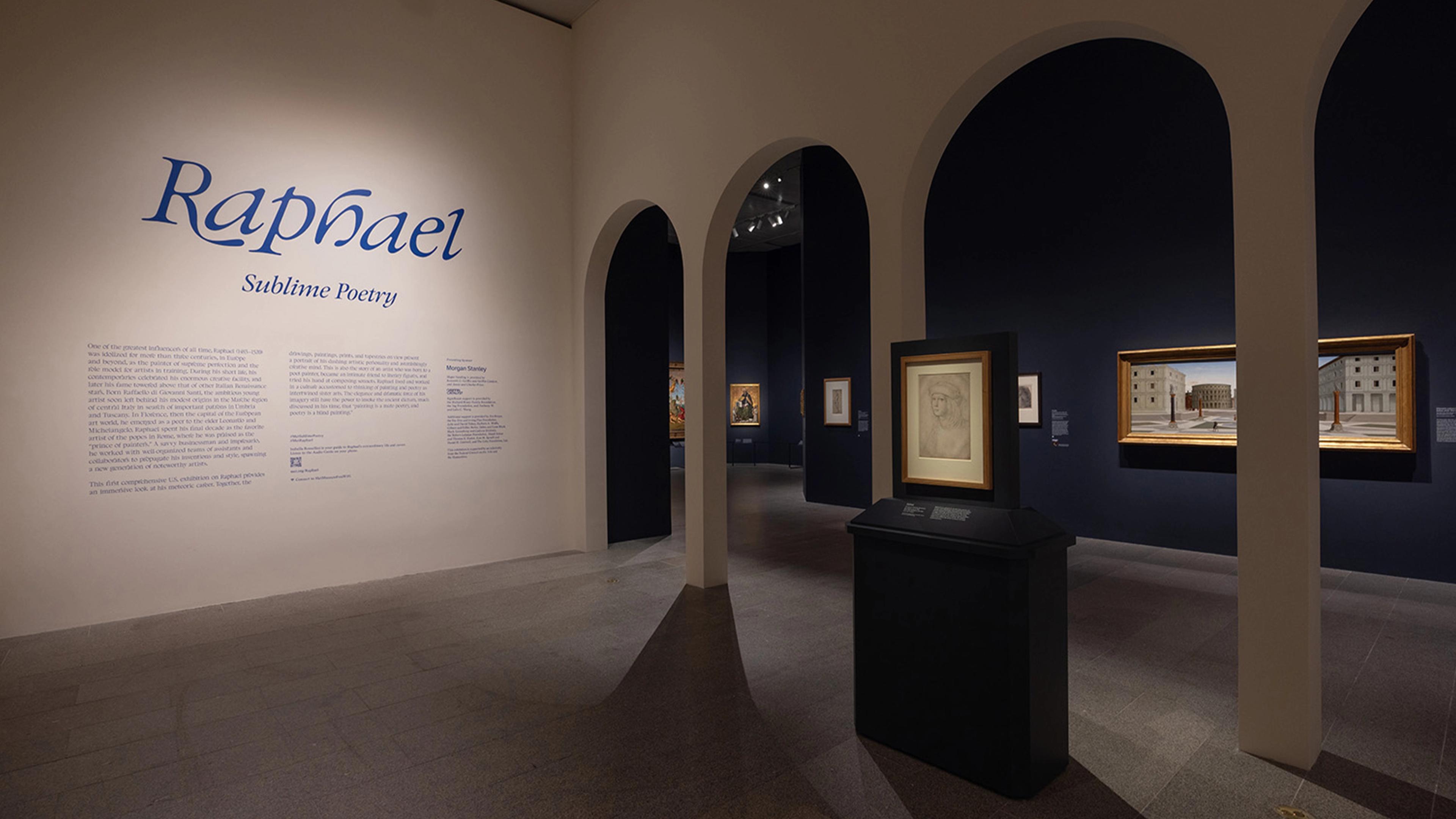
One of the greatest influencers of all time, Raphael (1483 –1520) was idolized for more than three centuries, in Europe and beyond, as the painter of supreme perfection and the role model for artists in training. During his short life, his contemporaries celebrated his enormous creative facility, and later his fame towered above that of other Italian Renaissance stars. Born Raffaello di Giovanni Santi, the ambitious young artist soon left behind his modest origins in the Marche region of central Italy in search of important patrons in Umbria and Tuscany. In Florence, then the capital of the European art world, he emerged as a peer to the elder Leonardo and Michelangelo. Raphael spent his final decade as the favorite artist of the popes in Rome, where he was praised as the “prince of painters.” A savvy businessman and impresario, he worked with well-organized teams of assistants and collaborators to propagate his inventions and style, spawning a new generation of noteworthy artists.
This first comprehensive U.S. exhibition on Raphael provides an immersive look at his meteoric career. Together, the drawings, paintings, prints, and tapestries on view present a portrait of his dashing artistic personality and astonishingly creative mind. This is also the story of an artist who was born to a poet-painter, became an intimate friend to literary figures, and tried his hand at composing sonnets. Raphael lived and worked in a culture accustomed to thinking of painting and poetry as intertwined sister arts. The elegance and dramatic force of his imagery still have the power to invoke the ancient dictum, much discussed in his time, that “painting is a mute poetry, and poetry is a blind painting.”
Selected Artworks
Raphael of Urbino
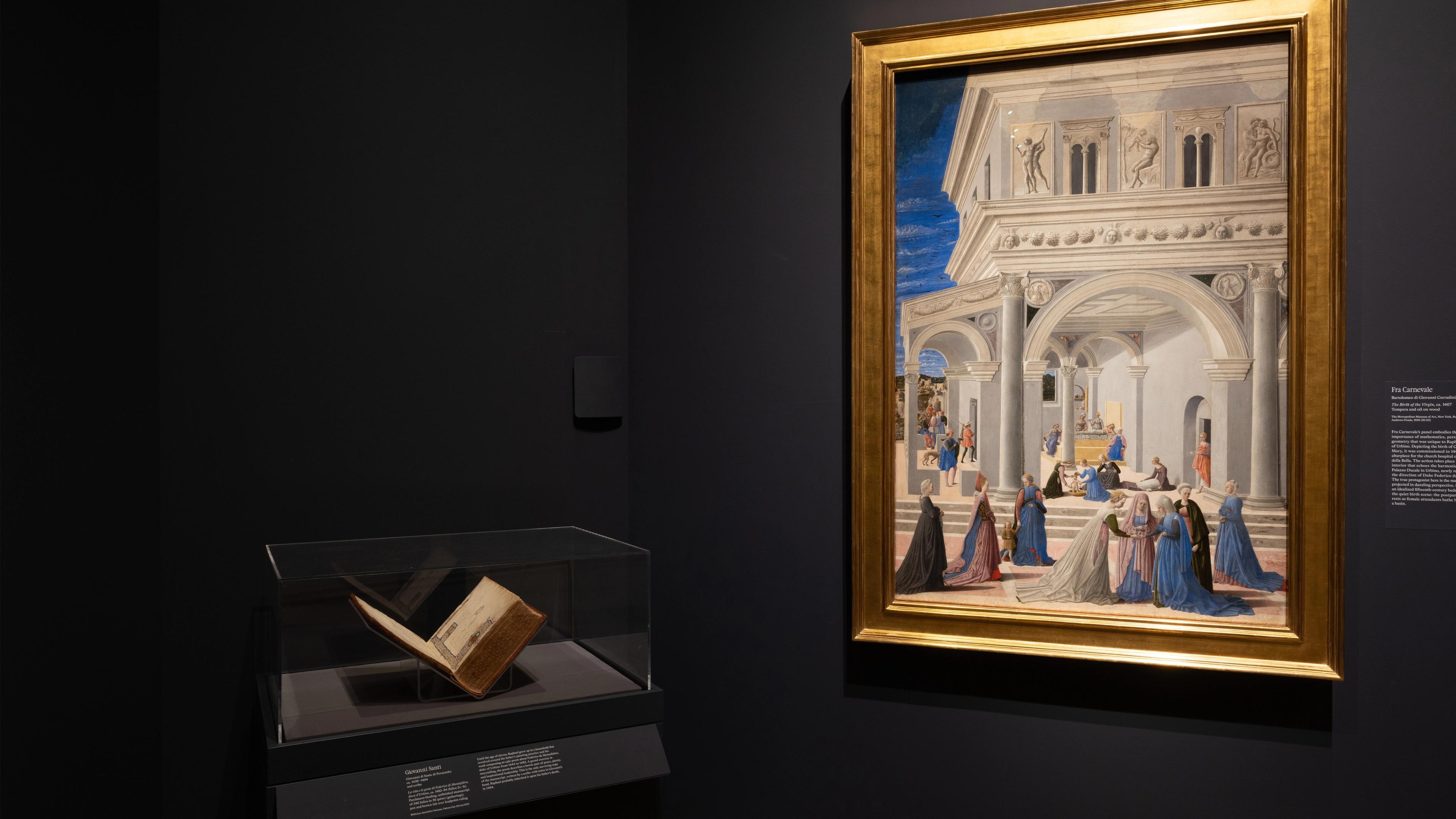
Raphael was born on April 6, 1483, in Urbino, a hill town set in a spectacular, rugged landscape in the Marche region, in east central Italy. The artist’s roots in Urbino, with its refined court life and unique intellectual heritage, played a defining role in his life and career. He proudly identified with his birthplace and signed his paintings “RAPHAEL VRBINAS” to the end of his days.
Raphael received his earliest training from his father, Giovanni Santi (ca. 1439–1494), a court painter and prolific poet. During Raphael’s childhood, Giovanni was busy composing an epic poem on Federico III da Montefeltro (1422–1482), the famous ruler who had brought peace, wealth, and fame to the Duchy of Urbino. A formidable general, scholar, and patron of art and architecture, Federico transformed his court into an internationally celebrated center for the arts and humanist learning. He founded a fabled library and rebuilt Urbino’s imposing Palazzo Ducale, whose rhythmic arcades and harmonic geometry embodied the humanist dedication to mathematics that distinguished the culture of Urbino. Those same ideals are evident in the vibrant architectural visions—enlivened with perspectival effects and classical references—created by Urbino painters.
Selected Artworks
Becoming an Artist
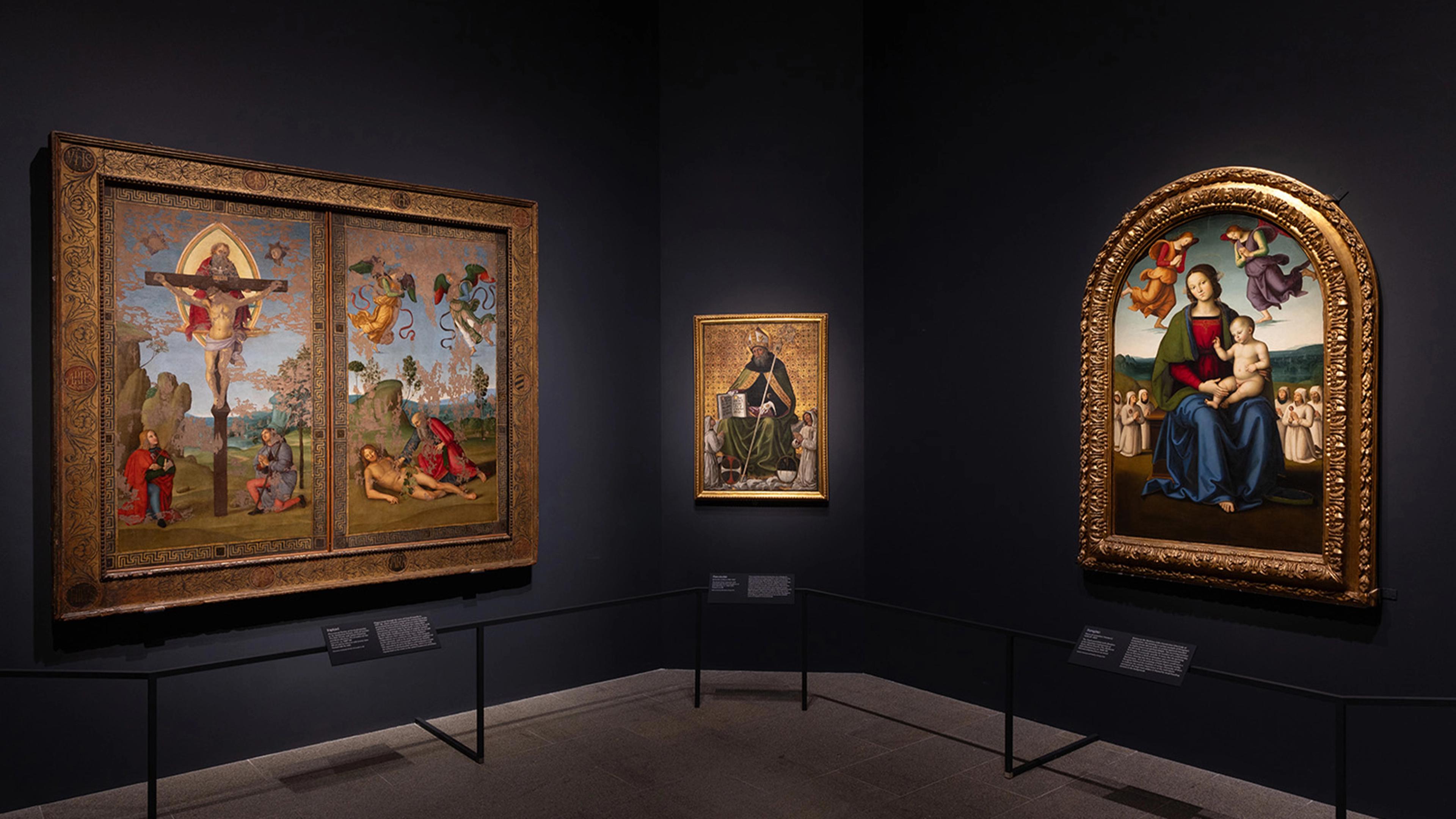
Raphael’s father soon brought his precocious son to study with Pietro Perugino (1446/50–1523), an artist he likely knew through local projects. A brilliant, prolific painter and draftsman with active workshops in Perugia and Florence, Perugino relied heavily on collaboration with assistants to meet the demands of patrons all over Italy. Raphael coursed quickly through the stages of pupil and apprentice to become first a collaborator to Perugino and then an independent artist. Perugino’s elegant figures, breathtaking command of technique, and efficient methods for reproducing designs left their mark on the younger artist.
Ambitious, studious, and disciplined, the young Raphael first sought to establish himself as an independent professional in Città di Castello, a small, wealthy town near Perugia, where he painted notable church altarpieces. Confraternities, religious institutions for regular citizens devoted to works of charity, were also major sources of patronage for artists in Umbria and the Marche. Gathered here are paintings and related studies done for confraternities by Perugino and the young Raphael—including the first painting fully in Raphael’s hand, as confirmed by its recent conservation treatment.
Selected Artworks
Finding Patrons
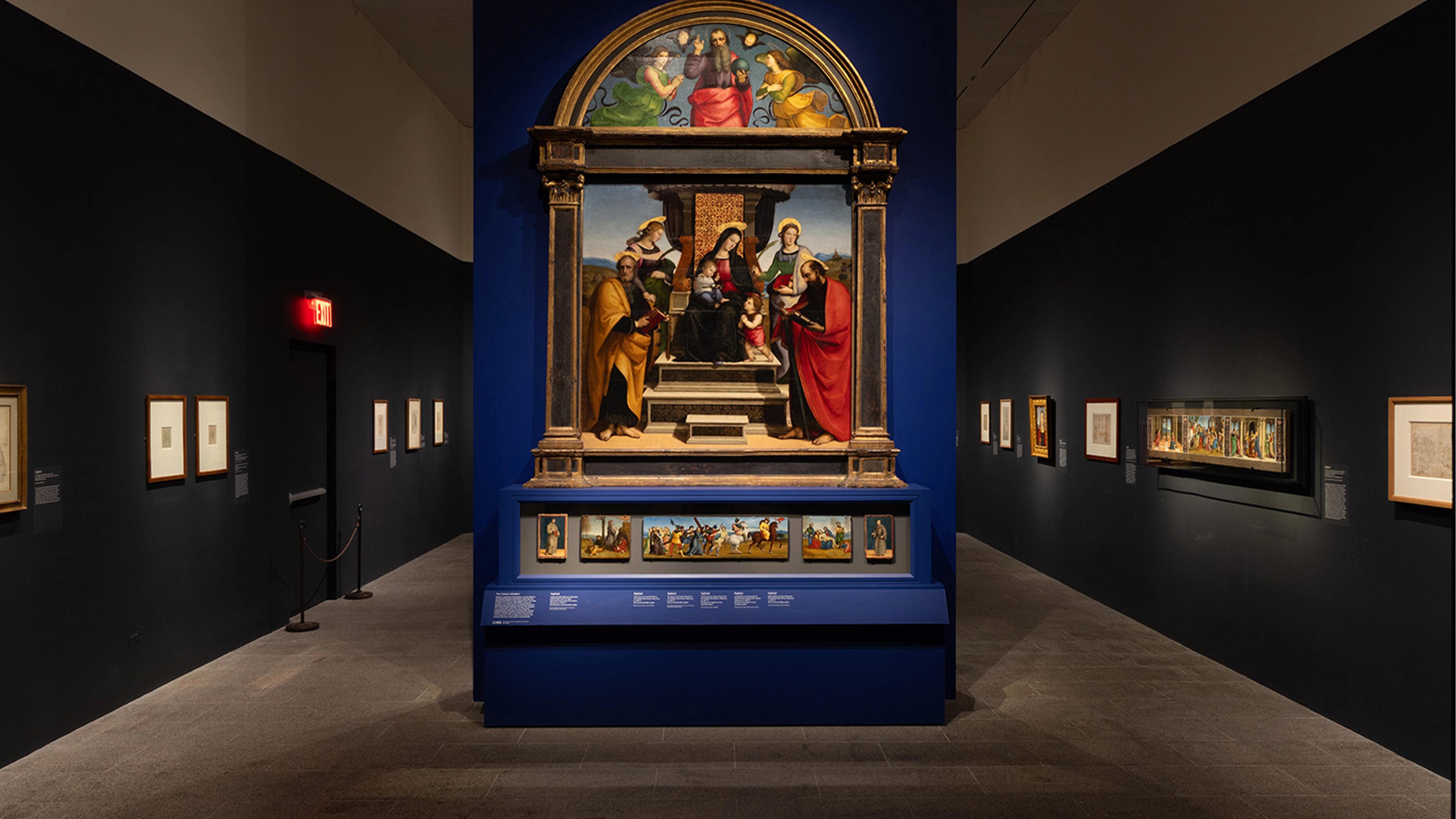
From 1500 to 1507, the young Raphael endeavored to cultivate patrons by painting both monumental altarpieces and small-scale devotional works in the regions of the Marche, Umbria, and Tuscany. An iconic example is the large, multipart painting at the center of this gallery, made for nuns in Perugia and now known as the Colonna Altarpiece (after a later owner). The full ensemble is reunited here as a complete work for the first time since it was dismembered around 1663 and the individual paintings dispersed. Other notable projects include a mammoth altarpiece for the Baronci family chapel in Città di Castello, which was later destroyed in an earthquake and survives only in fragments and preliminary drawings, and a remarkable altarpiece for the Oddi family chapel in Perugia, represented here by studies and the painting that provided its base.
Full-scale drawings for the Oddi Altarpiece reveal the workshop practices that Raphael had absorbed during his training and collaboration with Perugino. Dazzling studies on paper also show how he worked in a variety of media—black chalk, pen and ink, and metalpoint on prepared paper—often with a virtuosic command of technique. Drawings such as these likely served as his calling card and undoubtedly impressed his patrons.
Selected Artworks
Responding to Leonardo and Michelangelo
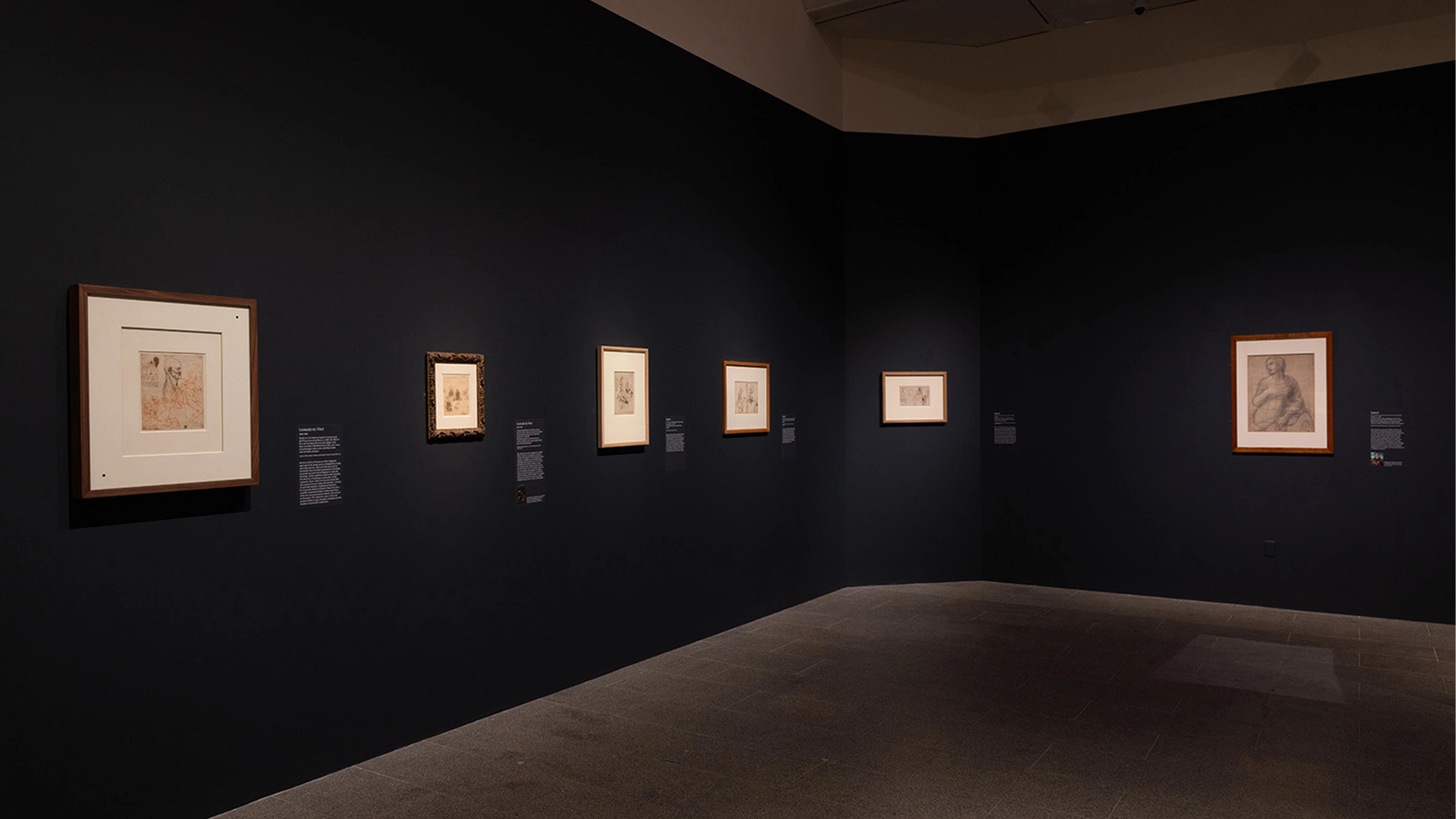
Raphael may have been drawn to Florence after hearing fellow painters rave about rival full-scale designs (cartoons) for spectacular murals there by Leonardo and Michelangelo. Related works in this gallery convey the electrifying novelty and arresting sculptural power of those unrealized projects. While in Florence between 1504 and 1508, Raphael also studied Michelangelo’s sculptures and Leonardo’s paintings and drawings, promptly and seamlessly adapting aspects of their styles and techniques in his work.
Raphael also learned from his peers’ revolutionary approaches to inventing compositions. Leonardo’s theories about “sketching quickly,” in the fervor of artistic inspiration, transformed Raphael’s methods. Asserting that the effort to finish drawings and puzzle out details could dry up fresh ideas, Leonardo advised working out concepts in “rough sketches,” like a poet scrawling the first draft of a verse in messy handwriting with crossed-out words. Before Florence, Raphael had tended to develop compositions in a more artisanal way, figure by detailed figure, as he had learned from Perugino. Now, spontaneous sketching led him to more organic compositions pulsating with movement and vivid expression.
Selected Artworks
Composing Monumental Paintings
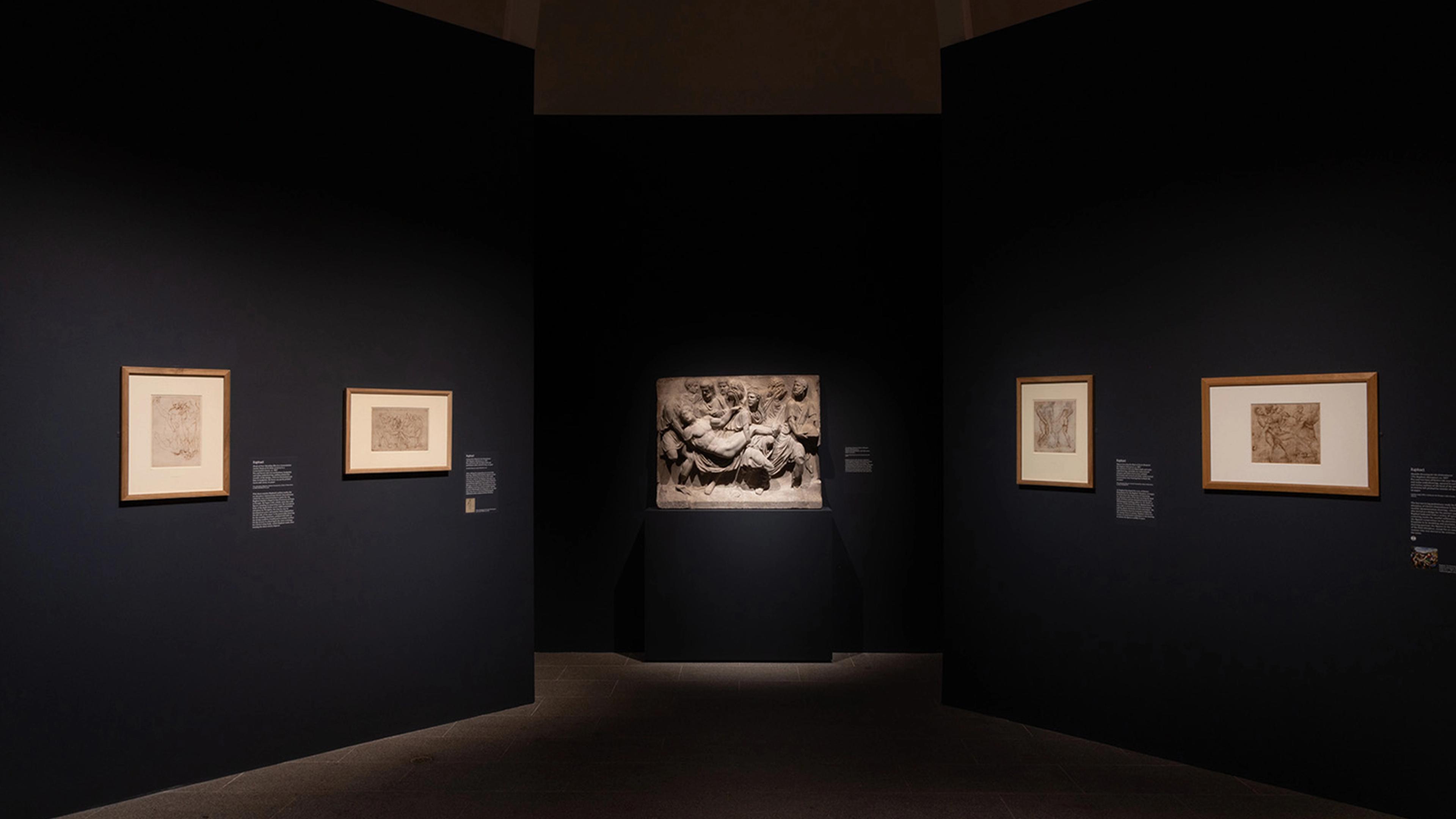
The exposure to Leonardo’s and Michelangelo’s art infused Raphael’s compositions with a sense of space, sculptural monumentality, and expressive force. This was the result of an enormous amount of experimentation on paper. Sequences of drawings—from a sheet of sketches to studies of an arrangement based on three-dimensional clay or wax models—reveal Raphael’s increasingly disciplined approach to the design process. Working in orderly steps, for example, he gradually animated a pyramidal composition (favored by Leonardo), which could seem static, by building a dynamic interplay of gestures and gazes among the figures.
In 1507 the twenty-four-year-old Raphael painted his most significant work before his move to Rome, an altarpiece of Christ’s entombment for the Baglioni family chapel in Perugia. The preliminary drawings show him in full command of his powers as a storyteller, and demonstrate how he constructed a dramatic composition with a climactic narrative. Through arduous study, aided by his knowledge of classical sculpture, the artist evolved a static arrangement of figures into an emotionally arresting action scene. Raphael had absorbed Leonardo’s principle that the physical gestures of the body express the “motions” of the mind and soul.
Selected Artworks
Mother and Child
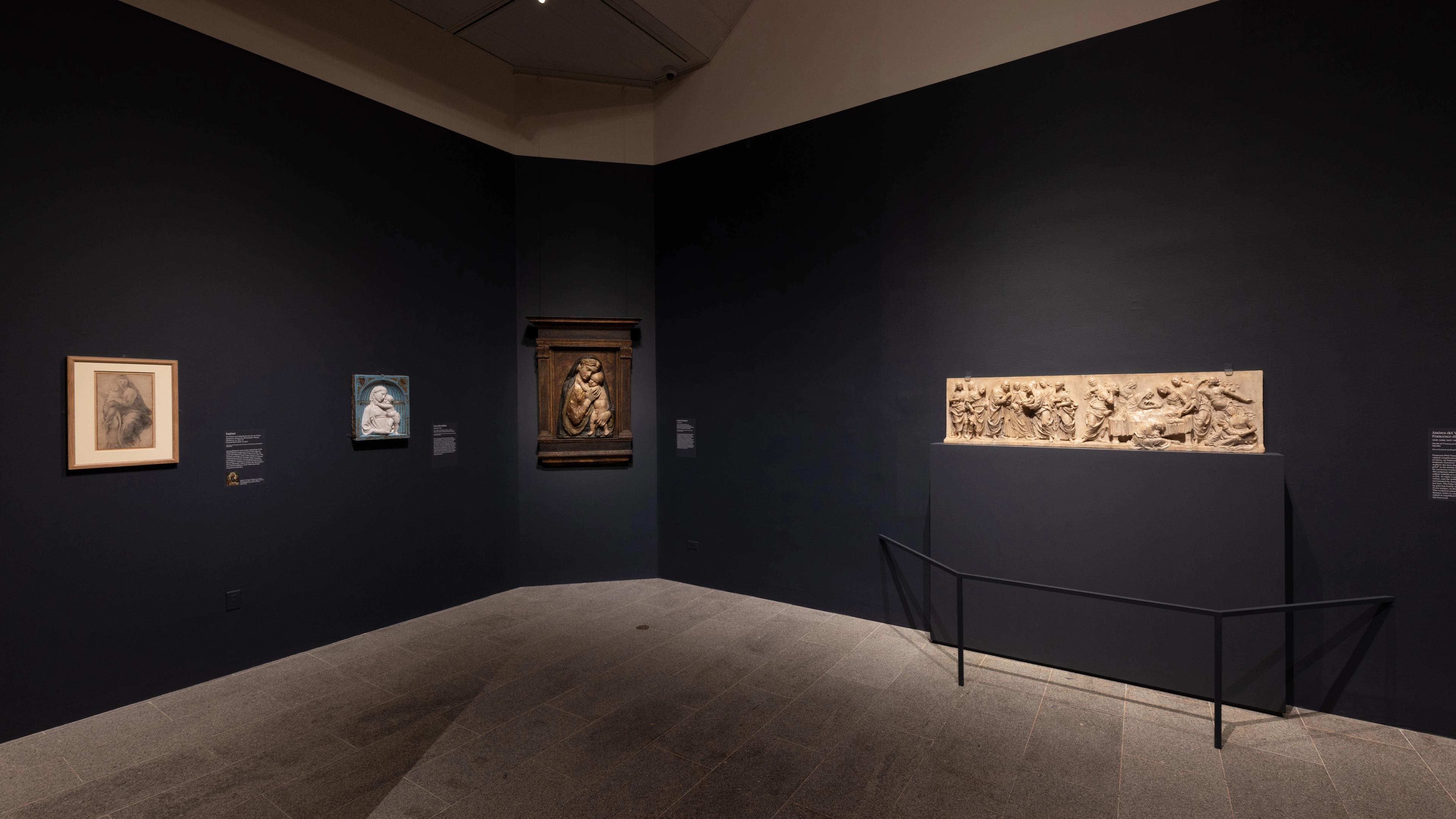
For centuries Raphael has been widely admired for Madonna and Child paintings that include a display of tenderness. From about 1300, Byzantine icons of the Eastern Orthodox faith had featured a form of the Madonna known as the Virgin Eleousa, from the Greek for “compassionate,” in which Mary embraces the Christ Child as he touches his cheek to hers. Disseminated widely, the imagery inspired numerous medieval and Renaissance artists, including Italian sculptors and painters. Raphael drew upon this model and thoroughly transformed it.
Raphael’s ability to capture a mood of vitality and innocent playfulness, especially while maintaining a superior command of anatomical realism, is striking in light of the historical realities of childbirth, infancy, and parenthood in his time. The rare account book displayed here records funerary expenses for Raphael’s mother, who died of childbirth-related complications in 1491, and for two of his siblings who died in infancy. Knowledge of gynecology and obstetrics was scarce, pregnancy and childbirth extremely dangerous, and infant mortality rates astronomically high. These facts, along with a desire among Renaissance artists to humanize religious subjects, all contributed to the appeal of the tender Madonna and Child as votive figures and subjects in art.
Selected Artworks
Painting the Madonna for Private Patrons
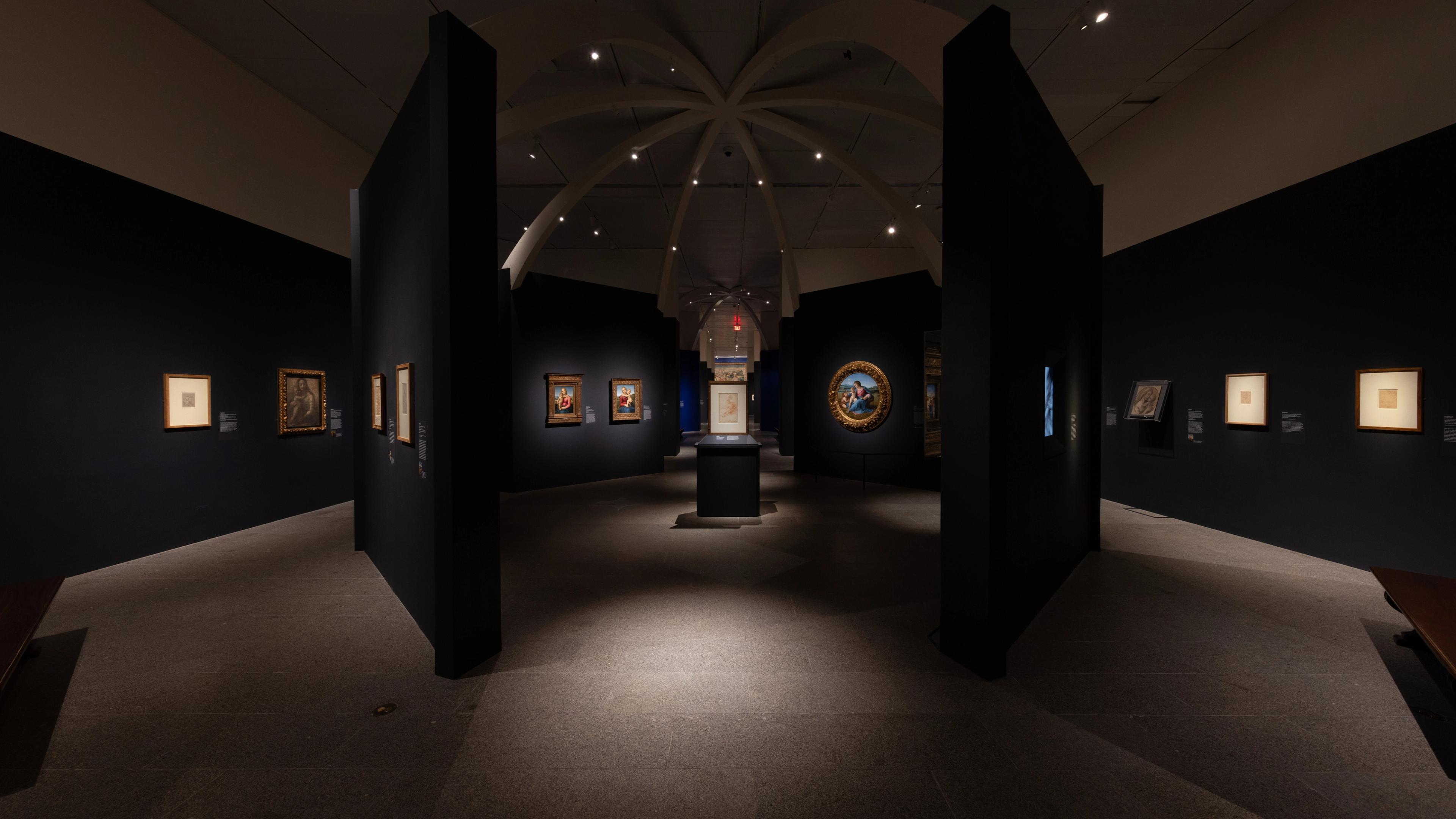
Despite his great ambitions, Raphael was largely thwarted in his attempts to break into the competitive art market in Florence. He found his most feasible source of patronage among the city’s wealthy merchants, who commissioned portraits and tender devotional paintings, mainly of the Madonna and Child. Raphael continued to produce works on this subject for private patrons well after his move to Rome in 1508, and many of his collaborators followed his example.
Raphael sought to bring the lauded ethereal physical beauty of the Madonna into radiant being. He was not immune to the convention, sung by poets both within and beyond his circle, that favored an elegant, aristocratic lady with dainty facial features and golden hair, but he also strove for long-established Christian ideals. Sermons, prayers, songs, and poetry inspired by early church writings had praised the Virgin’s beauty and grace as mirrors of her unique spiritual perfection. He infused his representations with a humanity and psychological presence revealed through gestures and reactions. Raphael’s paintings display an arresting command of light, color, space, and geometry, and his renderings of infants are more naturalistic in their proportions, poses, and expressions than those of many of his peers.
Selected Artworks
Portraiture and the Artifice of Self-Presentation
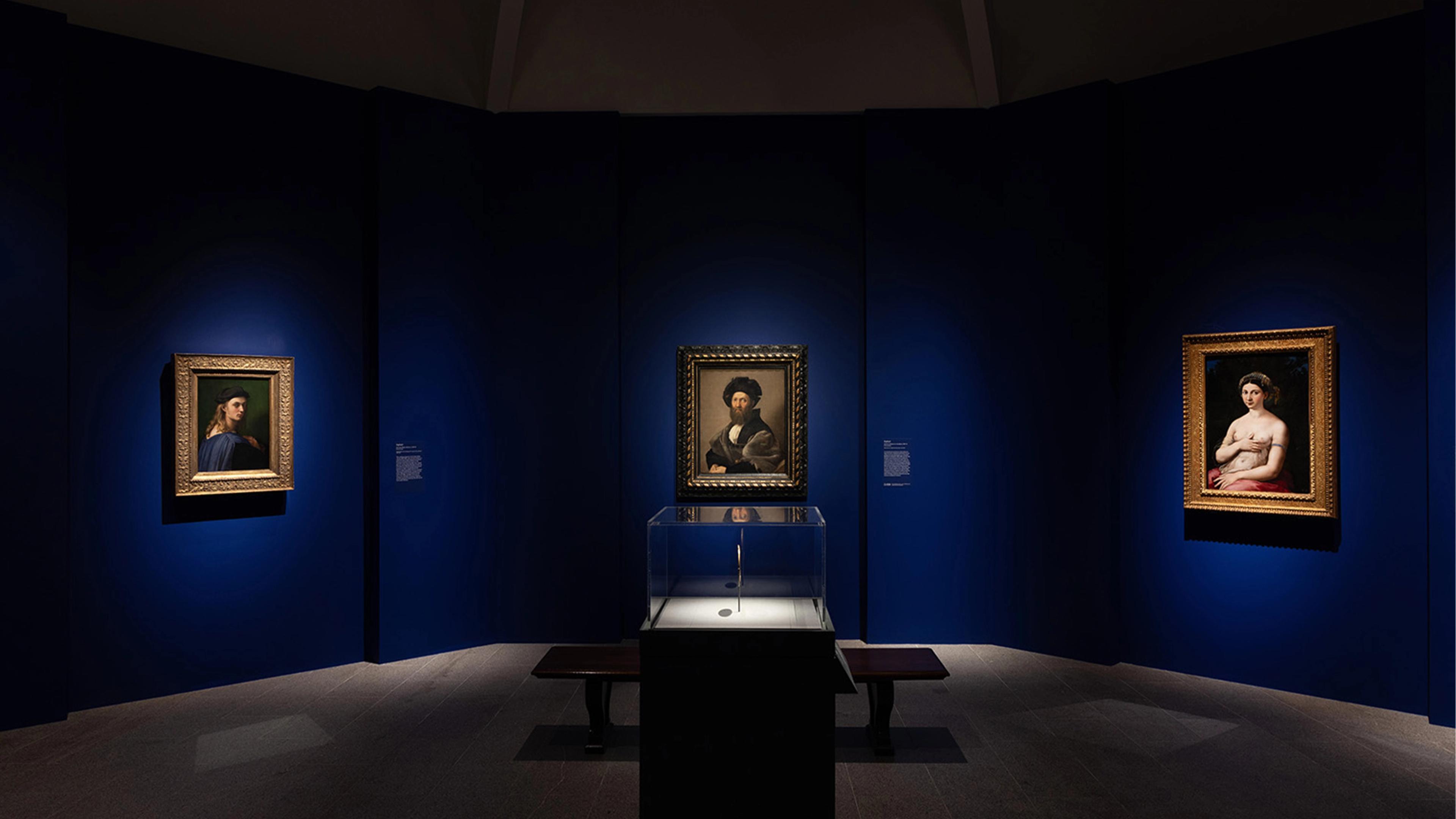
Raphael’s portraits communicate a profound empathy and reflect years of exercising his hand in drawings to achieve an intimate, concerted contemplation of the sitter. The regal pose of Leonardo’s Mona Lisa, begun in 1503, offered a revolutionary model for the likeness of a luxuriously dressed person: a three-quarter view, head turned to the left, torso erect, and hands resting gracefully at the waist. The elegance of the poses here also suggests a striving for the cultivated manners of the Italian Renaissance courts and the ideals of beauty celebrated by famous poets. Raphael was an intimate friend of Baldassarre Castiglione (1478–1529), whose book on fashionable behavior at court promoted a model of comportment and grace that prized sprezzatura, a studied nonchalance or insouciance.
Many Renaissance portraits of women were painted at the time of betrothal and marriage, a financial-dynastic arrangement in which romantic love had no place. Elegant fashion and jewelry were meant to impress the future husband’s family, as dowries and property were negotiated. Overt appraisals of women’s appearances by poets and artists also contributed to a culture in which young women could become innamorate—platonic beloveds or actual mistresses—of a male aristocracy.
Selected Artworks
Drawings for the Vatican Palace
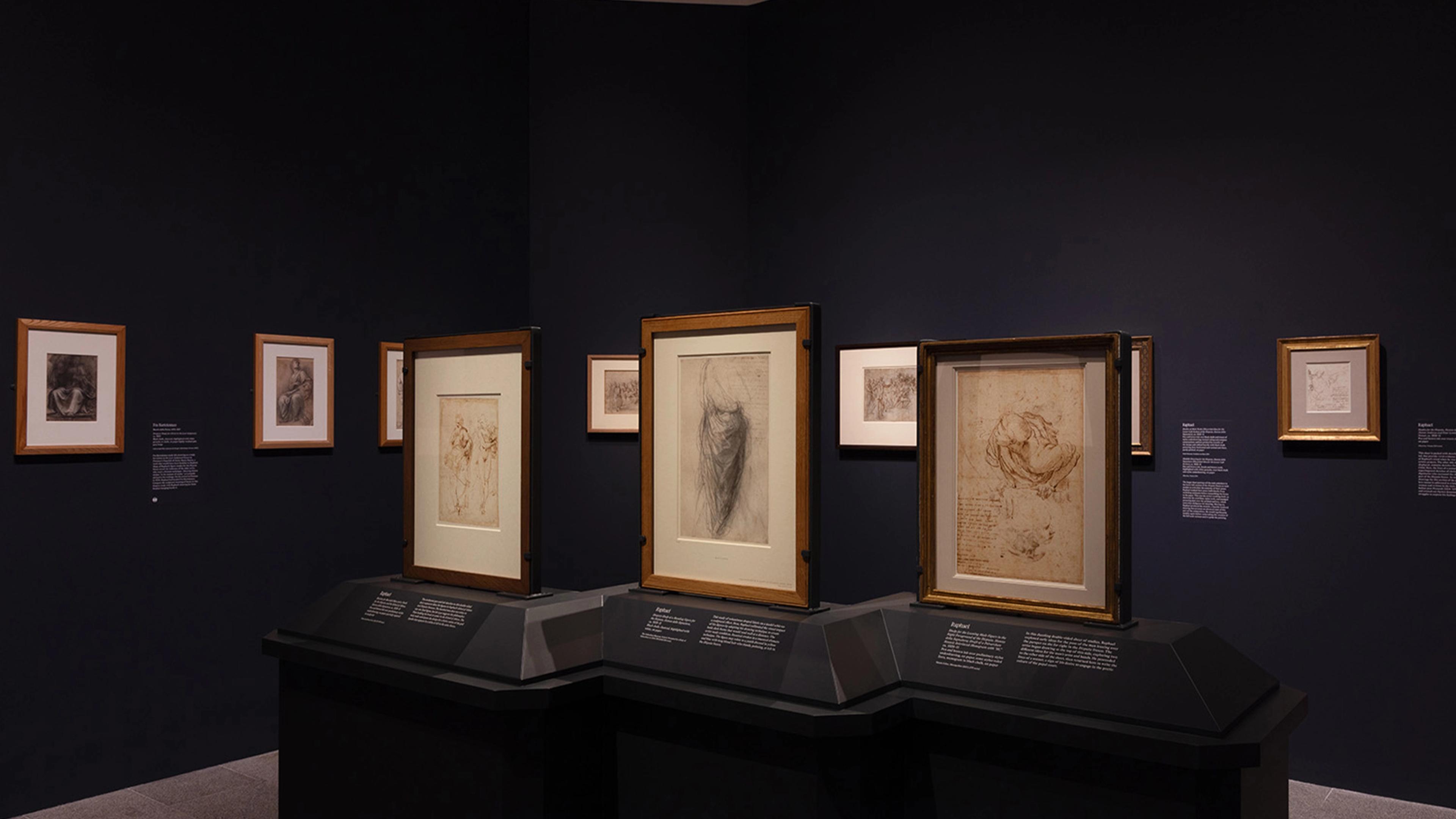
At some point in 1508, Raphael arrived in Rome, where he would become the favorite court artist of Popes Julius II (r. 1503–13) and Leo X (r. 1513–21). An intriguing question is how exactly the twenty-five-year-old Raphael managed to supersede an earlier generation of painters working in the Vatican Palace and take control of the fresco decoration of the most important of the rooms, the Stanza della Segnatura. Surely artistic genius and personal savvy were key factors, but research shows that networks of political influence between Rome and his hometown of Urbino also paved the way, including support from his friend and countryman Donato Bramante (1444–1514), the pope’s favorite architect.
Gathered here are Raphael’s studies for those Vatican frescoes: the School of Athens, with its gathering of philosophers, and the Disputa, representing Roman Catholic theology. These works show an artist in full command of the expressive potential of different drawing media. Rapidly sketched pen-and-ink sheets teem with the energy of ideas in the making, while studies in black chalk appear monumental despite their small size. In the next gallery, a digital video conveys the power of Raphael’s finished frescoes in four rooms of the Vatican Palace.
Selected Artworks
The Multitasking Artist
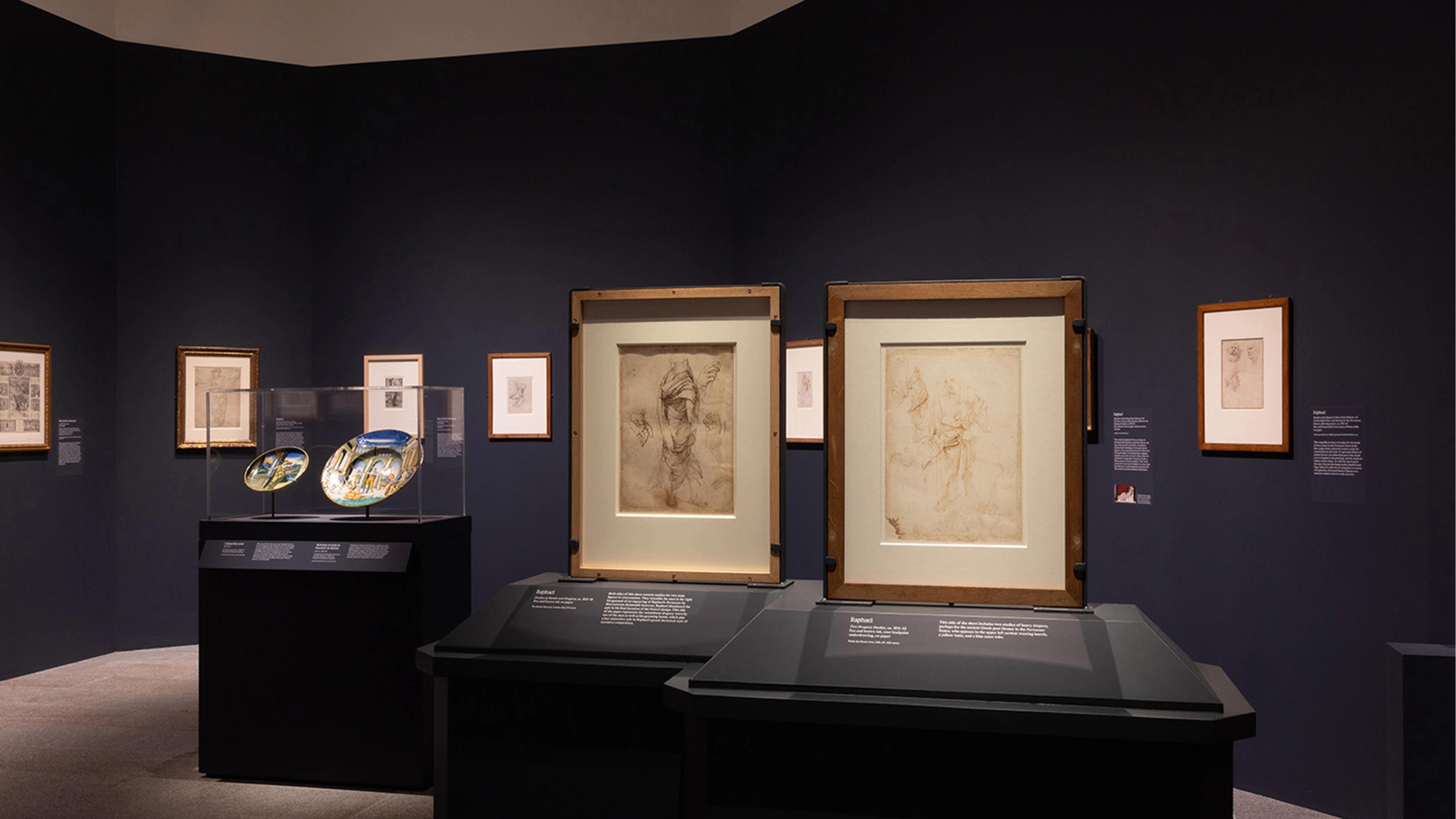
By about 1510 Raphael was collecting accolades as the most visible and prolific painter at the papal court in Rome; meanwhile, shut away in the Sistine Chapel, the secretive Michelangelo labored to paint his ceiling frescoes, which would deeply influence the younger artist, who snuck in to see them. Drawings here relate to projects that occupied Raphael as he concluded his first series of frescoes in the Vatican Palace and began the second, in the Stanza di Eliodoro, which communicate with greater monumentality and dramatic force. After Pope Julius II died in 1513 and Leo X ascended to the throne, some learned imagery vanished in favor of blunter papal messaging.
Other drawings and prints illustrate Raphael’s collaboration with Marcantonio Raimondi (ca. 1480–1534), a Bolognese printmaker and close friend. In their fruitful partnership, beginning in 1510, they created engravings of tremendous technical skill and artistic power. This medium enabled the reproduction of imagery in multiples and ensured a long afterlife for Raphael’s compositions. The prints were copied by artists well into the late 1800s and repurposed in other media, such as the maiolica plates in a nearby case.
Selected Artworks
Raphael's Vatican Frescoes
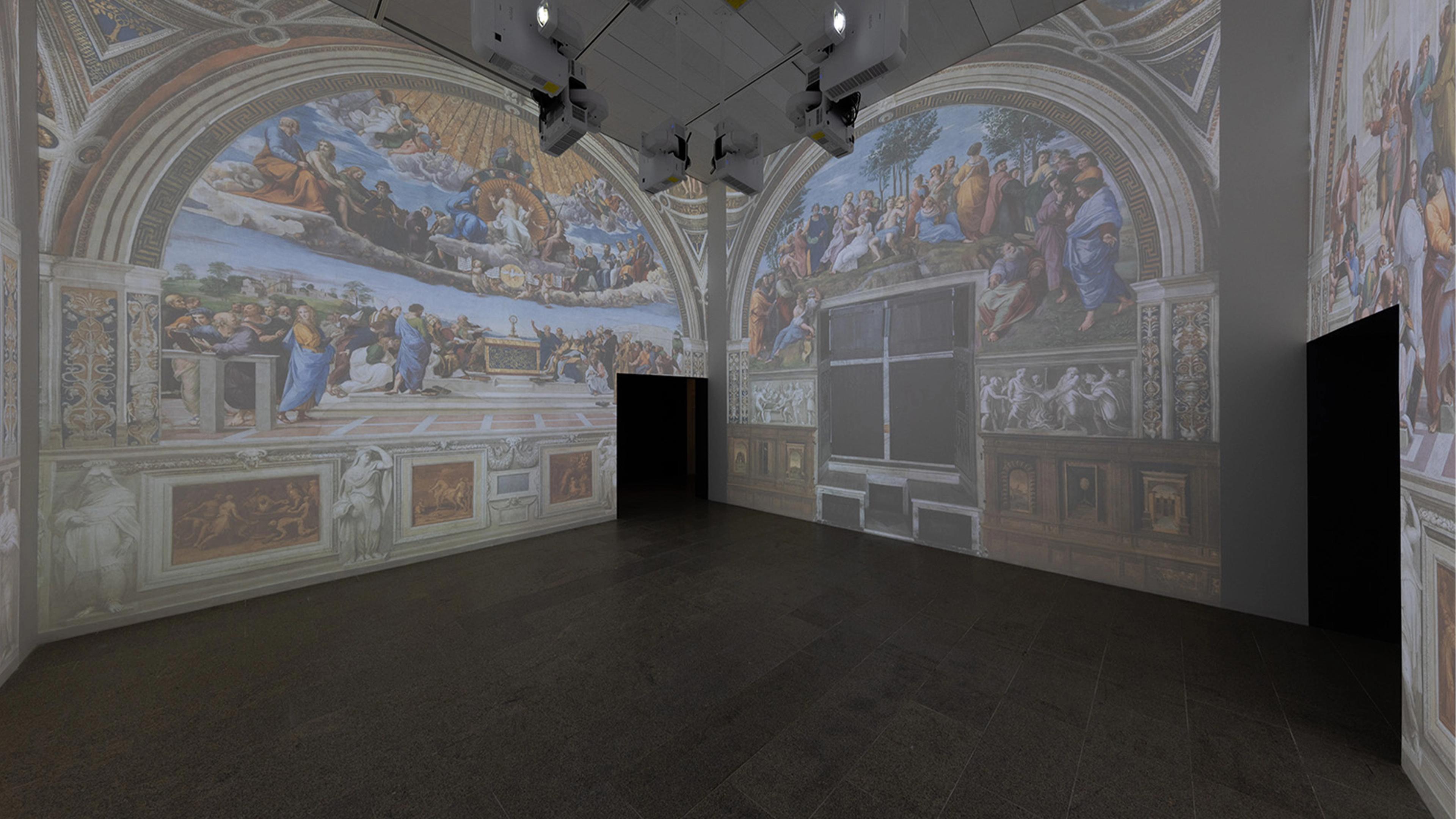
In the next gallery is a digital video showing Raphael’s monumental fresco cycles in four rooms of the Vatican Palace. The display provides a sense of scale and context for the many related drawings in this exhibition. Between 1508 and 1524, the frescoes were painted by Raphael and his workshop in the nearly square rooms now known as the Stanza della Segnatura, Stanza di Eliodoro, and Stanza dell’Incendio, and in the gargantuan oblong Sala di Costantino (completed by his assistants after his death in 1520).
The durable but difficult fresco technique requires expertise, the use of full-scale drawings (cartoons), and a willingness to anticipate challenges. Water-based colors applied to moist surface plaster (intonaco) dry and carbonate in a chemical process, permanently bonding the colors to the wall. Executed primarily by Raphael between 1508 and 1512, the frescoes in the Stanza della Segnatura are the most famous and include the School of Athens, the Disputa, the personifications of Justice, and the Parnassus. In the following three rooms Raphael worked with a greater involvement of collaborators who followed his designs closely.
Toward a Grand Roman Manner
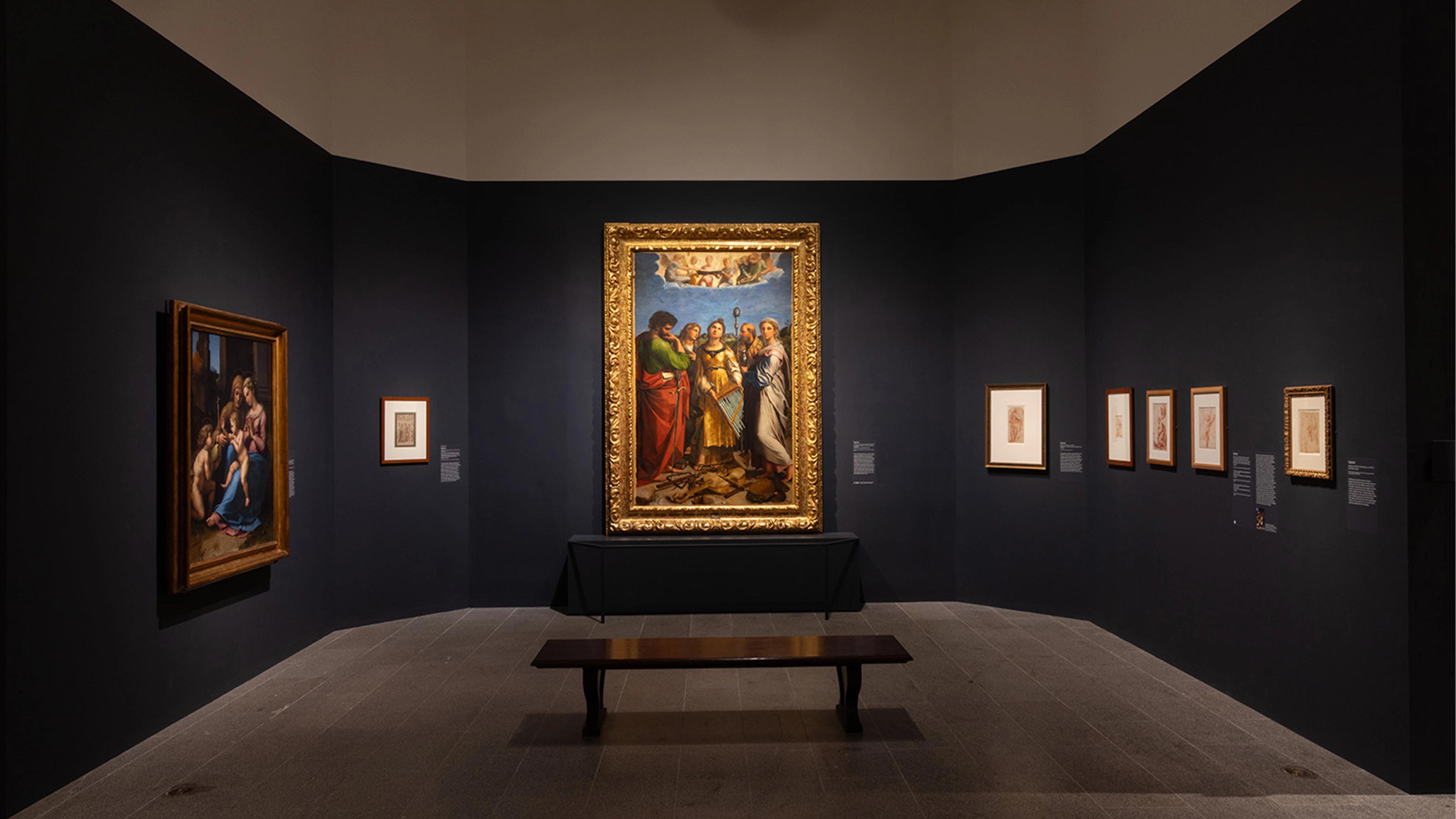
The paintings here represent the breathtaking visual eloquence of Raphael’s later years. New harmonies of color are transformed by a dark chiaroscuro reminiscent of Leonardo. Sculptural forms seem to project from dense compositions. Charged gazes, poses, and gestures communicate a sense of impending drama.
Between 1514 and 1520, the demanding Pope Leo X rained project after project upon Raphael. He produced few paintings independently; using his drawings as a guide, skilled assistants painted most of the frescoes in the Vatican’s Stanza dell’Incendio. He was often disparaged for this practice by rivals, including his fierce enemy Michelangelo. But Raphael and his well-organized workshop completed an astonishing number of large-scale projects in his final six years. Executive help freed the artist to concentrate his creative energies on inventing new designs and exploring new forms. The involvement of workshop assistants in paintings and in certain types of drawings has inevitably led to debates about authorship. Labels in this exhibition attempt to indicate instances of their likely intervention, and a nearby display allows comparison of studies by Raphael and his fellow artists in an effort to characterize their individual styles.
Selected Artworks
The Sistine Tapestries
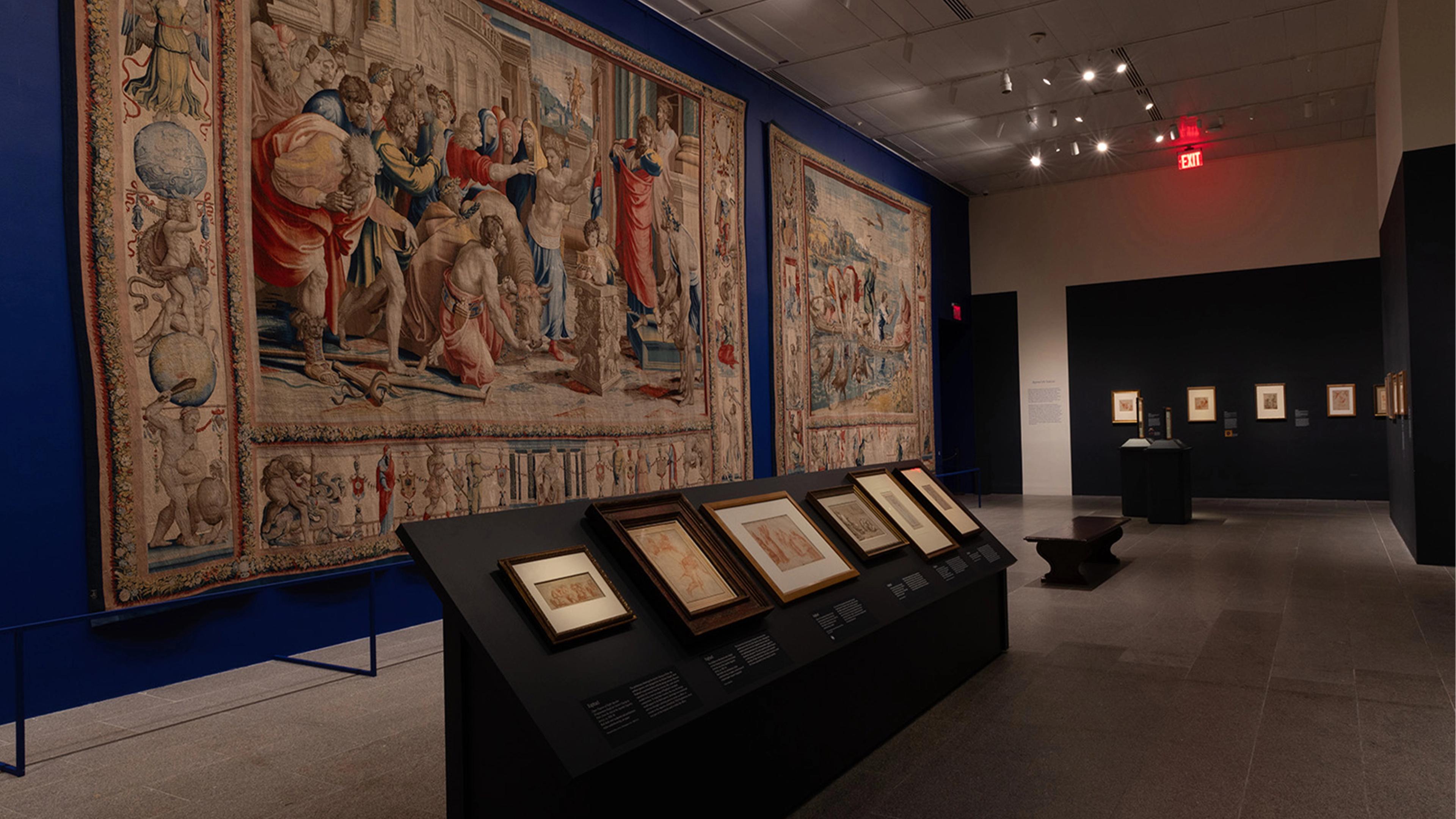
The imperious Pope Leo X charged Raphael with the daunting task of designing a set of monumental tapestries to hang in the Sistine Chapel during special occasions—a project that put Raphael in direct competition with Michelangelo and his ceiling frescoes above. Starting in 1515, Raphael began drawing small preliminary studies. Aided by workshop assistants, he then painted in color gouaches on paper the enormous full-scale cartoons that would guide the weavers. Woven in Brussels using rich materials, the stratospherically expensive tapestries contributed to the bankruptcy of Leo’s papacy. With their inventive compositions, striking color harmonies, and monumental scale, they were soon the envy of monarchs across Europe. Kings commissioned second editions woven from Raphael’s cartoons, and the set owned by King Philip II of Spain (1527–1598) is represented here by three stunning examples.
As the tapestry designs progressed, the Raphael team largely took over the fresco work in the Vatican Palace, endeavoring to complete the Stanza dell’Incendio and assisting Raphael as he began to conceive decorations for the final space. Giulio Romano (1499?–1546) acted as his studio foreman and went on to enjoy a brilliant independent career.
Selected Artworks
The Transfiguration
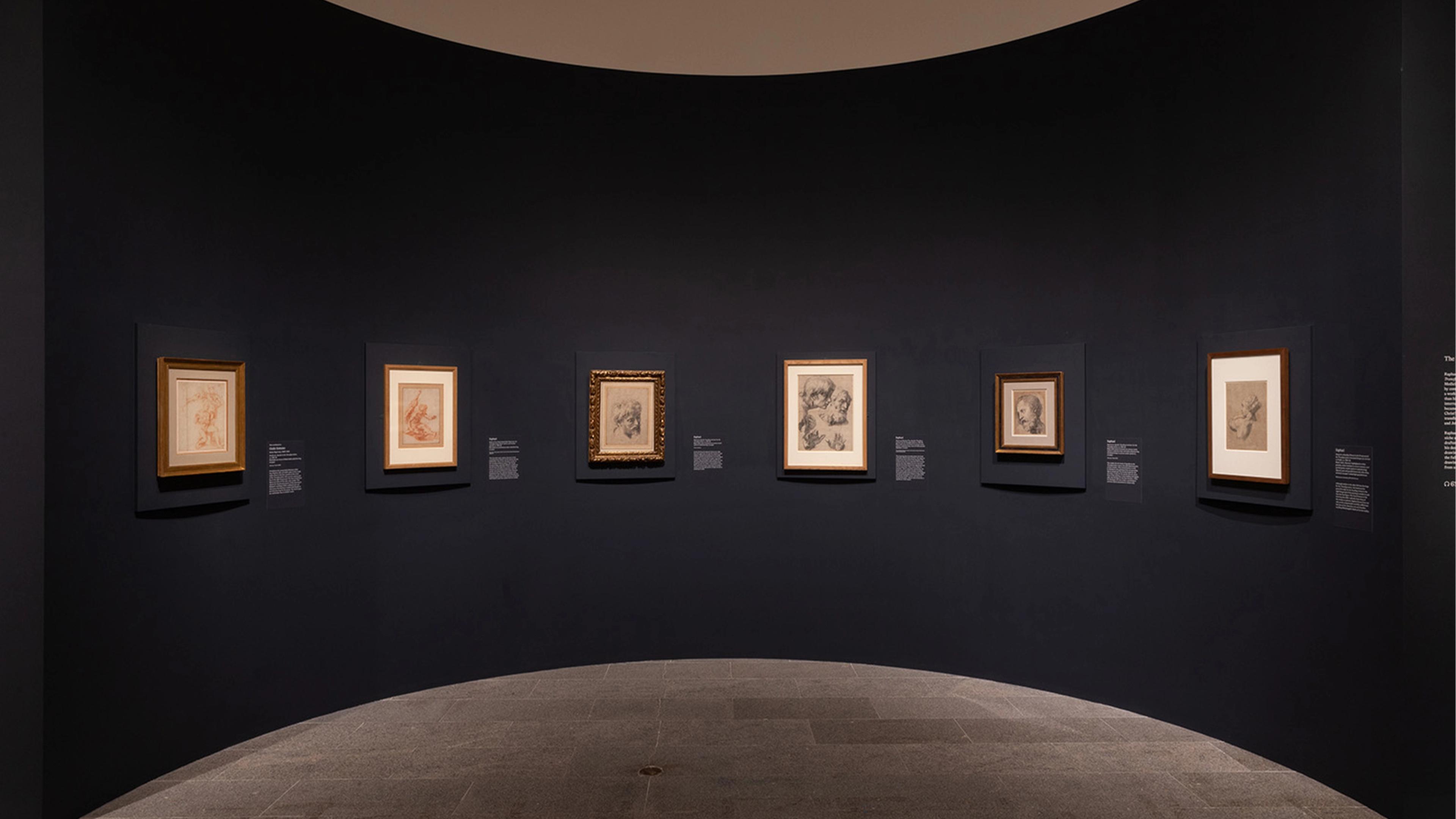
Raphael’s last and largest altarpiece is the enormous Transfiguration, commissioned by Cardinal Giulio de’ Medici (the future Pope Clement VII) around 1517. Spurred by competition with artistic rivals, Raphael produced a work markedly more dramatic, ambitious, and complex than his earlier altarpieces. Although its execution was interrupted by his untimely death in 1520, the Transfiguration became Raphael’s artistic testament. The main event is Christ’s Transfiguration on Mount Tabor, during which he transformed before the stunned apostles Peter, James, and John to reveal his divinity.
Raphael’s studies for the Transfiguration, displayed in the niche at left, represent the culmination of his career as a draftsman. They are reunited here to show the range of his design process. Raphael used red chalk primarily when drawing nude models from life. He reserved black chalk for the full-scale studies of apostles’ heads and hands, a type of drawing called an “auxiliary cartoon” because the design starts from a dotted chalk outline transferred from another sheet.
Selected Artworks
Beyond the Vatican
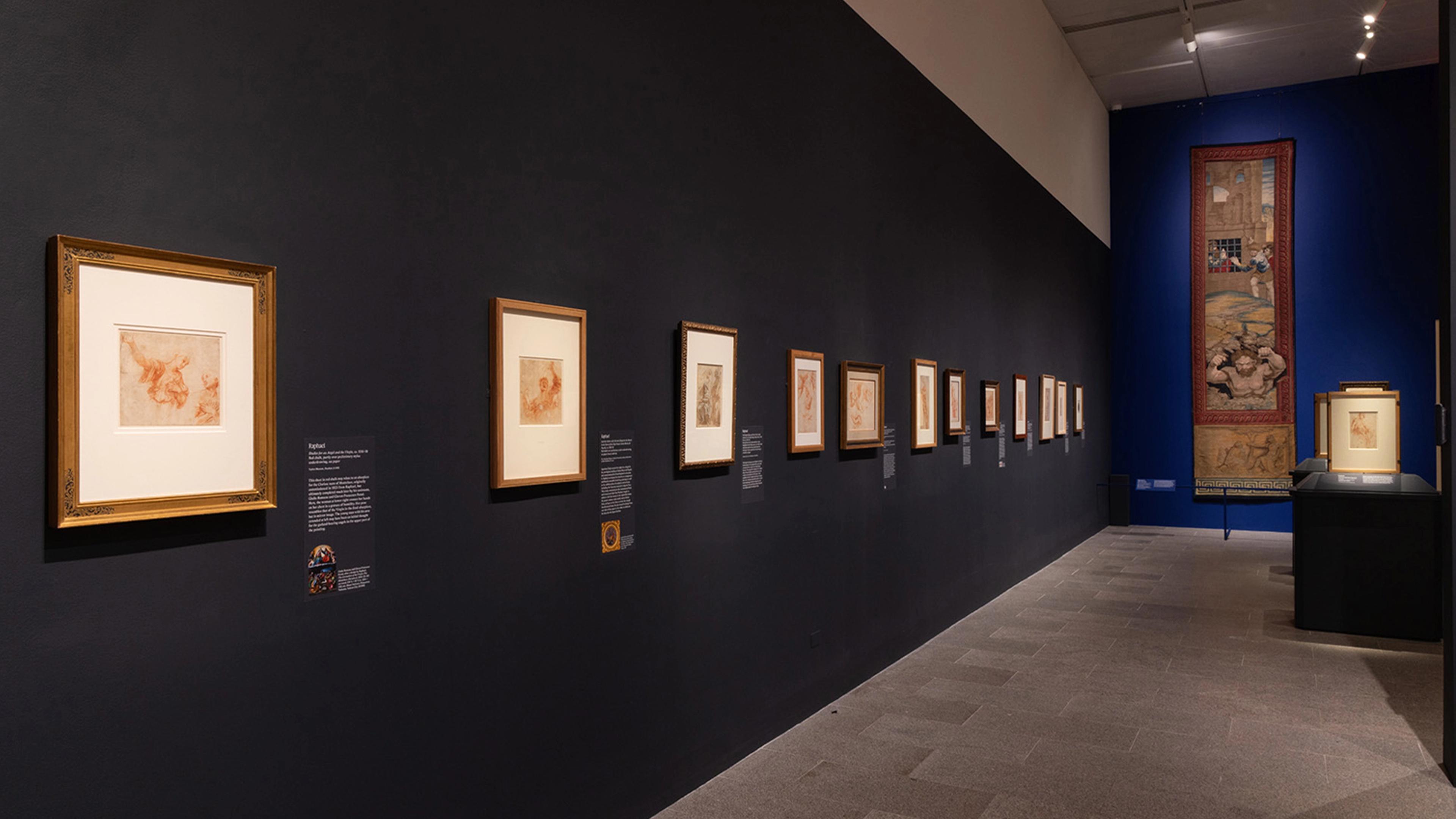
Raphael rarely interrupted his projects for Popes Julius II and Leo X to make room for other commissions. The notable exception was his powerful friend Agostino Chigi (1466–1520), whom he met in about 1510. Born in Siena, Chigi became the richest banker in Europe, and his legendary wealth financed the popes’ cultural and military enterprises. Raphael’s work for Chigi included fresco paintings, as well as designs for his remodeled stables and the multimedia ensembles of his two chapels.
Displayed here are a variety of Raphael’s preparatory drawings for Chigi’s projects. In chalk studies of nude figures, Michelangelo’s language of contorted poses and powerful muscularity is transformed with an effortless grace and the sensuality of living flesh. The drawings also allude to the legacy of Raphael’s approach to the human figure, which led to the style known as Mannerism after his death. Male and female forms here anticipate prototypical Mannerist poses—as with Raphael’s primeval personification of an earthquake in a Sistine Chapel tapestry design, which spawned the figural vocabulary that his former assistant Giulio Romano would exploit to spectacular effect in his later frescoes.
Selected Artworks
The Eternal City
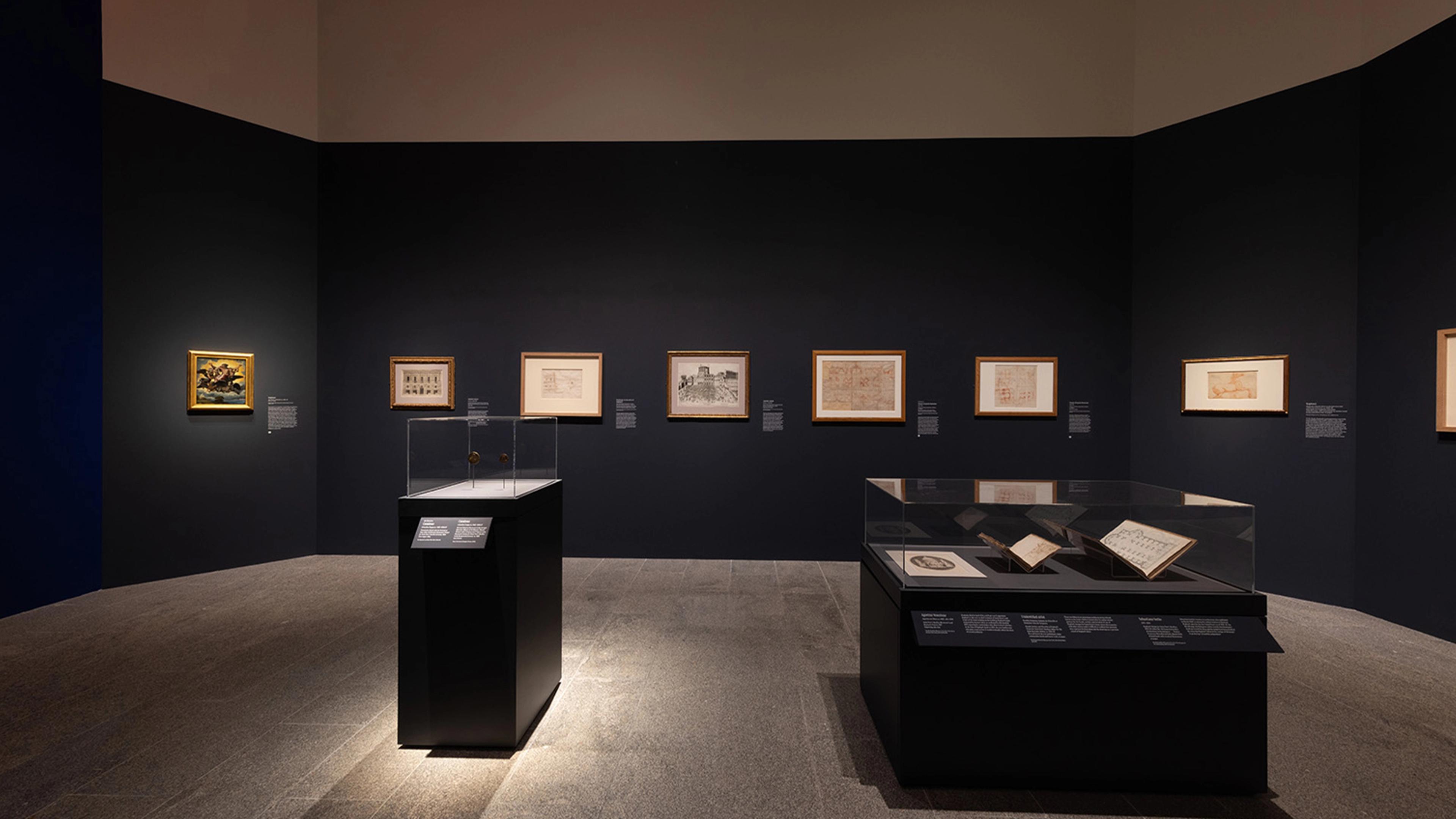
Rome and its ancient monuments transformed Raphael’s art, and his work likewise changed the face of Rome. Following his arrival in the Eternal City in 1508, he threw himself into archaeological studies and made drawings of monuments that demonstrate a nearly scientific rigor. Pope Leo X tasked Raphael with creating an enormous drawing of ancient Rome, “making those members that are entirely ruined and are completely invisible correspond with those that are still standing and can be seen.” A letter to Leo, written on Raphael’s behalf, attests to the artist’s deep archaeological knowledge and technical skill, including a highly original method for using a magnetic compass in conducting surveys of ruins.
Around 1503 Pope Julius II had charged Bramante, Raphael’s mentor and close friend from Urbino, to design a new Saint Peter’s Basilica that would convey the majesty of the papacy in the aesthetic language of ancient Rome. Drawings and prints here illuminate Raphael’s career as an architect after he took over this massive project upon Bramante’s death. In 1517 Raphael bought the Palazzo Caprini, designed by Bramante and now destroyed but pictured in two works here, where he lived out his final years in Rome as the “prince of painters.”