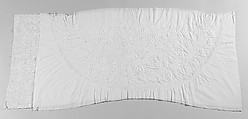
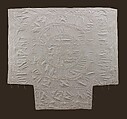
Wholecloth whitework quilt
The quilt came to us with no provenance. While researching it, we saw photos of a whitework quilt that seemed to be almost identical to our piece. It is owned by the Stamford Historical Society in Connecticut. According to the Society's records, that quilt was made by Lucy Foot Bradford (1800?-1875) while she was a young woman living in Colchester, New London County,Connecticut. After comparing the two quilts face-to-face, it became apparent that, although they were not made by the same person, they originated from a very similar pattern. Patterns, either homemade or professionally printed, were available at the time for this type of fancywork. The similarities were so great that it seemed conclusive that the two pieces had both been made in Colchester, possibly under the tutelage of the same person.
Artwork Details
- Title: Wholecloth whitework quilt
- Date: ca. 1815
- Geography: Probably made in Colchester, Connecticut, United States
- Culture: American
- Medium: Cotton
- Dimensions: 102 3/4 x 103 in. (261 x 261.6 cm)
- Credit Line: Bequest of Flora E. Whiting, 1971
- Object Number: 1971.180.124
- Curatorial Department: The American Wing
More Artwork
Related Content
 Free to download
Research Resources
The Met provides unparalleled resources for research and welcomes an international community of students and scholars. The Met's Open Access API is where creators and researchers can connect to the The Met collection. Open Access data and public domain images are available for unrestricted commercial and noncommercial use without permission or fee.
To request images under copyright and other restrictions, please use this Image Request form.
Feedback
We continue to research and examine historical and cultural context for objects in The Met collection. If you have comments or questions about this object record, please contact us using the form below. The Museum looks forward to receiving your comments.
Content Notice
The Metropolitan Museum of Art presents over 5,000 years of art from around the world, and our online collection reflects ongoing work conducted over the course of our more than 150-year history. You may encounter objects or images that may be inappropriate for some viewers or information that may be outdated.