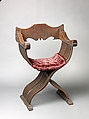
Armchair with the cipher of James II and Mary of Modena
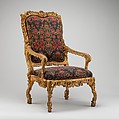
The chair has experienced some changes throughout its history. The back was originally upholstered and the seat caned. When acquired in 1918, it had casters, and there was evidence that it had originally been painted black and gilded. Today no such evidence remains. Chairs of this type usually have an elaborately carved and pierced front stretcher, for which the present turned stretcher must be a replacement.
This armchair came to the Museum together with twenty-three other pieces of English furniture from the collection of George S. Palmer, a serious collector, though little known today. It has been published several times, most soberly by Joseph Breck in 1918 [1] and most passionately in 1983 by Humphry Wakefield: "The sense of live movement in this carving is as powerful and emotionally satisfying as that any tree or human form could provide. The snarling lion masks at the arms, with their wild manes, menace anyone who approaches the personage they guard." [2]
Footnotes
1. Breck 1918, pp. 274, 277, fig. 2
2. Wakefield 1983, p. 116
Artwork Details
- Title: Armchair with the cipher of James II and Mary of Modena
- Date: ca. 1685–88
- Culture: British
- Medium: Walnut; modern velvet
- Dimensions: Overall: 57 × 30 3/4 × 19 3/4 in. (144.8 × 78.1 × 50.2 cm)
- Classification: Woodwork-Furniture
- Credit Line: John Stewart Kennedy Fund, 1918
- Object Number: 18.110.18
- Curatorial Department: European Sculpture and Decorative Arts
More Artwork
Related Content
 Free to download
Research Resources
The Met provides unparalleled resources for research and welcomes an international community of students and scholars. The Met's Open Access API is where creators and researchers can connect to the The Met collection. Open Access data and public domain images are available for unrestricted commercial and noncommercial use without permission or fee.
To request images under copyright and other restrictions, please use this Image Request form.
Feedback
We continue to research and examine historical and cultural context for objects in The Met collection. If you have comments or questions about this object record, please contact us using the form below. The Museum looks forward to receiving your comments.
Content Notice
The Metropolitan Museum of Art presents over 5,000 years of art from around the world, and our online collection reflects ongoing work conducted over the course of our more than 150-year history. You may encounter objects or images that may be inappropriate for some viewers or information that may be outdated.