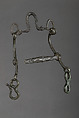
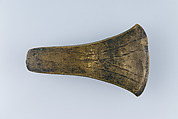
Cavesson (Psálion)
The use of the cavesson (psálion in Greek) was widely known in the Ancient Near East and Greece, and is described in the equestrian treaty of Xenophon (ca. 430–355 B.C.). There he also indicates not to lead the horse with one rein, because the bit, pulled in a wrong way, would spoil the mouth, and advises to use the cavesson instead.
These cavessons are often found in western Europe, up to Hadrian’s wall, because of the presence of Eastern cavalrymen, particularly Thracians, in the Roman army (Thracians were considered the best cavalrymen of the Ancient world).
Artwork Details
- Title: Cavesson (Psálion)
- Date: 1st–2nd century
- Culture: Roman or Thracian
- Medium: Copper alloy (bronze)
- Dimensions: H. 6 1/4 in. (15.9 cm); W. 5 in. (12.7 cm); Wt. 10.2 oz. (289.2 g)
- Classification: Equestrian Equipment-Bits
- Credit Line: Gift of Stephen V. Grancsay, 1942
- Object Number: 42.50.527
- Curatorial Department: Arms and Armor
More Artwork
Research Resources
The Met provides unparalleled resources for research and welcomes an international community of students and scholars. The Met's Open Access API is where creators and researchers can connect to the The Met collection. Open Access data and public domain images are available for unrestricted commercial and noncommercial use without permission or fee.
To request images under copyright and other restrictions, please use this Image Request form.
Feedback
We continue to research and examine historical and cultural context for objects in The Met collection. If you have comments or questions about this object record, please contact us using the form below. The Museum looks forward to receiving your comments.
Content Notice
The Metropolitan Museum of Art presents over 5,000 years of art from around the world, and our online collection reflects ongoing work conducted over the course of our more than 150-year history. You may encounter objects or images that may be inappropriate for some viewers or information that may be outdated.