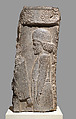
Relief: two servants bearing food and drink
Most characteristic of Achaemenid sculpture are the slabs carved in low relief that decorate the various stairways leading to the ceremonial buildings. Representations of hundreds of alternating Persian and Median servants bringing food and drink for a royal feast are on the walls of several palace stairways at Persepolis. This relief fragment depicts a Persian mounting a stairway and holding a heavy water- or wineskin on a tray. Ahead of him on the top step is an armed Median holding a covered vessel. The form of the skin container and the size and style of the figures suggest that the relief derives from the time of Artaxerxes III (r. 358–338 B.C.) and adorned either the restored Palace of Darius or that called Palace H.
Artwork Details
- Title: Relief: two servants bearing food and drink
- Period: Achaemenid
- Date: ca. 358–338 BCE
- Geography: Iran, Persepolis
- Culture: Achaemenid
- Medium: Limestone
- Dimensions: 35 1/16 × 25 3/16 × 7 5/8 in. (89 × 64 × 19.3 cm)
- Credit Line: Harris Brisbane Dick Fund, 1934
- Object Number: 34.158
- Curatorial Department: Ancient West Asian Art
Audio
7045. Relief: two servants bearing food and drink
More Artwork
Related Content

Research Resources
The Met provides unparalleled resources for research and welcomes an international community of students and scholars. The Met's Open Access API is where creators and researchers can connect to the The Met collection. Open Access data and public domain images are available for unrestricted commercial and noncommercial use without permission or fee.
To request images under copyright and other restrictions, please use this Image Request form.
Feedback
We continue to research and examine historical and cultural context for objects in The Met collection. If you have comments or questions about this object record, please contact us using the form below. The Museum looks forward to receiving your comments.
Content Notice
The Metropolitan Museum of Art presents over 5,000 years of art from around the world, and our online collection reflects ongoing work conducted over the course of our more than 150-year history. You may encounter objects or images that may be inappropriate for some viewers or information that may be outdated.