A King of Judah and Israel
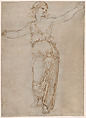
The figure’s strength and regal bearing are expressed in the lively ink line delineating the musculature and Roman military costume, while the anatomy is further accentuated with a smoky shading in black chalk and touches of white chalk. Drawn as if seen from below, the king stands in contrapposto, his right hand on his hip, recalling the muscular figure types of Michelangelo as well as the ancient statues of warriors and gods that Fréminet studied during his Roman sojourn. Overlaying these elements, is a lush and elegant sensibility derived from the richly textured milieu of the château of Fontainebleau where subjects of mythology, history, and religion were everywhere interwoven with a playful vocabulary of ornament and fantasy.
Perrin Stein, May, 2014
Artwork Details
- Title: A King of Judah and Israel
- Artist: Martin Fréminet (French, Paris 1567–1619 Paris)
- Date: n.d.
- Medium: Pen and brown ink, black chalk with heightening in white
- Dimensions: Sheet: 17 1/8 x 10 5/16 in. (43.5 x 26.2 cm)
- Classification: Drawings
- Credit Line: Mary Trumbull Adams, Van Day Truex, and Harry G. Sperling Funds, 2011
- Object Number: 2011.319
- Curatorial Department: Drawings and Prints
More Artwork
Related Content

 Free to download
Research Resources
The Met provides unparalleled resources for research and welcomes an international community of students and scholars. The Met's Open Access API is where creators and researchers can connect to the The Met collection. Open Access data and public domain images are available for unrestricted commercial and noncommercial use without permission or fee.
To request images under copyright and other restrictions, please use this Image Request form.
Feedback
We continue to research and examine historical and cultural context for objects in The Met collection. If you have comments or questions about this object record, please contact us using the form below. The Museum looks forward to receiving your comments.
Content Notice
The Metropolitan Museum of Art presents over 5,000 years of art from around the world, and our online collection reflects ongoing work conducted over the course of our more than 150-year history. You may encounter objects or images that may be inappropriate for some viewers or information that may be outdated.