Four anecdotes from the life of Wang Xizhi
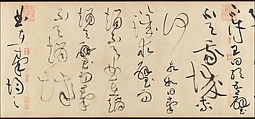
As a leading calligrapher, Zhao advocated a return to ancient models, successfully integrating styles of the Jin (265–420) and Tang (618-907) dynasties to create a new synthesis in both regular and cursive scripts. During the fourteenth century, the typefaces of printed books were modeled after his regular script, while his cursive script, seen here, formed the basis for many later writers' informal writing styles.
Four Anecdotes from the Life of Wang Xizhi testifies to Zhao's devotion to the "Sage of Calligraphy," Wang Xizhi (303–361). Strongly influenced by Wang's style, this scroll dates to about 1310.
Artwork Details
- 元 趙孟頫 行書右軍四事 卷
- Title: Four anecdotes from the life of Wang Xizhi
- Artist: Zhao Mengfu (Chinese, 1254–1322)
- Period: Yuan dynasty (1271–1368)
- Date: 1310s
- Culture: China
- Medium: Handscroll; ink on paper
- Dimensions: Image: 9 5/8 x 46 1/16 in. (24.4 x 117 cm)
Overall with mounting: 10 7/16 in. x 27 ft. 1 1/8 in. (26.5 x 851.2 cm) - Classification: Calligraphy
- Credit Line: Bequest of John M. Crawford Jr., 1988
- Object Number: 1989.363.30
- Curatorial Department: Asian Art
Audio
7465. Four Anecdotes from the Life of Wang Xizhi
More Artwork

Related Content
Timeline of Art History
Entries and chronologies from The Met's art encyclopedia.
Publications
Books, guides, and catalogues published by The Met.
Research Resources
The Met provides unparalleled resources for research and welcomes an international community of students and scholars. The Met's Open Access API is where creators and researchers can connect to the The Met collection. Open Access data and public domain images are available for unrestricted commercial and noncommercial use without permission or fee.
To request images under copyright and other restrictions, please use this Image Request form.
Feedback
We continue to research and examine historical and cultural context for objects in The Met collection. If you have comments or questions about this object record, please contact us using the form below. The Museum looks forward to receiving your comments.
Content Notice
The Metropolitan Museum of Art presents over 5,000 years of art from around the world, and our online collection reflects ongoing work conducted over the course of our more than 150-year history. You may encounter objects or images that may be inappropriate for some viewers or information that may be outdated.