English
DonateMembershipTickets

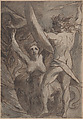
The Conversion of Polemon

1778–90
Not on view
Barry began work on this print in 1778, during the American Revolution and intended it as a political commentary. He represents a classical story recorded by Valerius Maxiumus that tells of Polemon, a frivilous youth who travels home at dawn after carousing and attempts to disrupt a discourse being delivered by Zenocrates on the virtues of modesty and temperance. Instead, as Polemon listens, he is converted, a change of heart indicated by the removal of the celebratory wreath from his head. The artist had dedicated earlier states of the etching to Charles James Fox, the Whig politician who was also a notorious gambler and heavy drinker, as well as a skilled orator. On February 2, 1778 he had delivered an electrifying Parliamentary speech against Britain's war with America. If Polemon refers to Fox, Barry intended the wise philosopher Zenocrates to compliment Edmund Burke. Like the artist, the latter was Irish and had been a significant patron early in Barry's career. Politically, Burke was a staunch defender of Whig principles and opposed the American War.

Artwork Details

Object Information
  • Title: The Conversion of Polemon
  • Artist: James Barry (Irish, Cork 1741–1806 London)
  • Date: 1778–90
  • Medium: Etching with engraving and roulette and traces of aquatint; ninth state of nine
  • Dimensions: Plate: 22 1/2 × 29 7/16 in. (57.2 × 74.8 cm)
    Sheet: 24 13/16 × 32 3/16 in. (63 × 81.8 cm)
  • Classification: Prints
  • Credit Line: Purchase, Friends of Drawings and Prints Gifts, 2020
  • Object Number: 2020.27
  • Curatorial Department: Drawings and Prints
More Artwork
Satan, Sin, and Death: "Death and Sin met by Satan on his Return from Earth", James Barry  Irish, Graphite, brush and brown ink, gray and brown wash heightened with touches of white
James Barry
Subject Relates to John Milton
1792–95
Oliver Cromwell, Jan van de Velde IV  Dutch, Engraving, aquatint, and roulette; second state
Jan van de Velde IV
after Robert Walker
after 1653
Orpheus Instructing a Savage People in Theology and the Arts of Social Life, James Barry  Irish, Etching and engraving; second state of three
James Barry
plate dated May 1, 1791, issued 1792
"O Spartan dog": plate 15 from Othello (Act 5, Scene 2), Théodore Chassériau  French, Etching, engraving, roulette, drypoint, aquatint or sulphur tint on chine collé
Théodore Chassériau
Subject William Shakespeare
1844
Job Reproved by His Friends, James Barry  Irish, Etching over traces of aquatint; third state of five
James Barry
dated 1777; issued ca. 1790

Research Resources

The Met provides unparalleled resources for research and welcomes an international community of students and scholars. The Met's Open Access API is where creators and researchers can connect to the The Met collection. Open Access data and public domain images are available for unrestricted commercial and noncommercial use without permission or fee.

To request images under copyright and other restrictions, please use this Image Request form.

Feedback

We continue to research and examine historical and cultural context for objects in The Met collection. If you have comments or questions about this object record, please contact us using the form below. The Museum looks forward to receiving your comments.

Send feedback

Content Notice

The Metropolitan Museum of Art presents over 5,000 years of art from around the world, and our online collection reflects ongoing work conducted over the course of our more than 150-year history. You may encounter objects or images that may be inappropriate for some viewers or information that may be outdated.