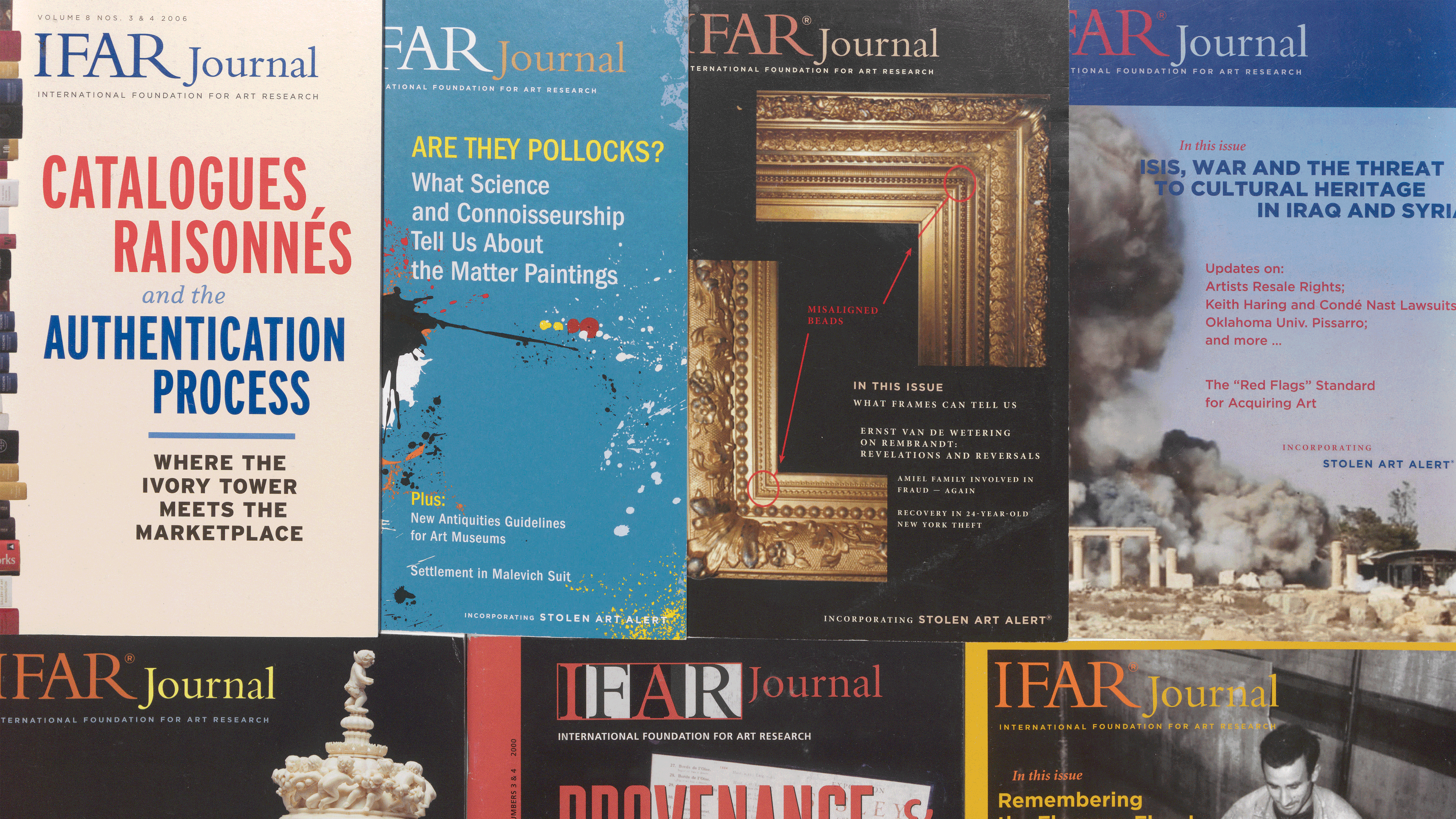
Watson Library recently completed a project to digitize and make freely accessible the full runs of newsletters and periodicals published by the International Foundation for Art Research (IFAR). In partnership with the Internet Archive, we worked closely with IFAR—founded in 1969 as an independent authority on attribution, provenance, cultural property law, and art market accountability—to digitize more than 250 issues spanning 1977 to 2023 as the organization prepared to permanently close in 2025. The digitized publications are now accessible through the Internet Archive.
The publications trace the organization’s evolution from newsletter-style reporting in Art Research News to the more investigative IFARreports series, and ultimately to the IFAR Journal. Interwoven throughout the run is the Stolen Art Alert (also known as the Art Theft Archive), a registry of thefts and recoveries that provides a uniquely longitudinal dataset for researchers concerned with art crime, restitution, and collection histories. The collection serves as a critical resource for scholars, provenance researchers, legal practitioners, museum professionals, and archivists working at the intersection of art history, cultural heritage, and law.
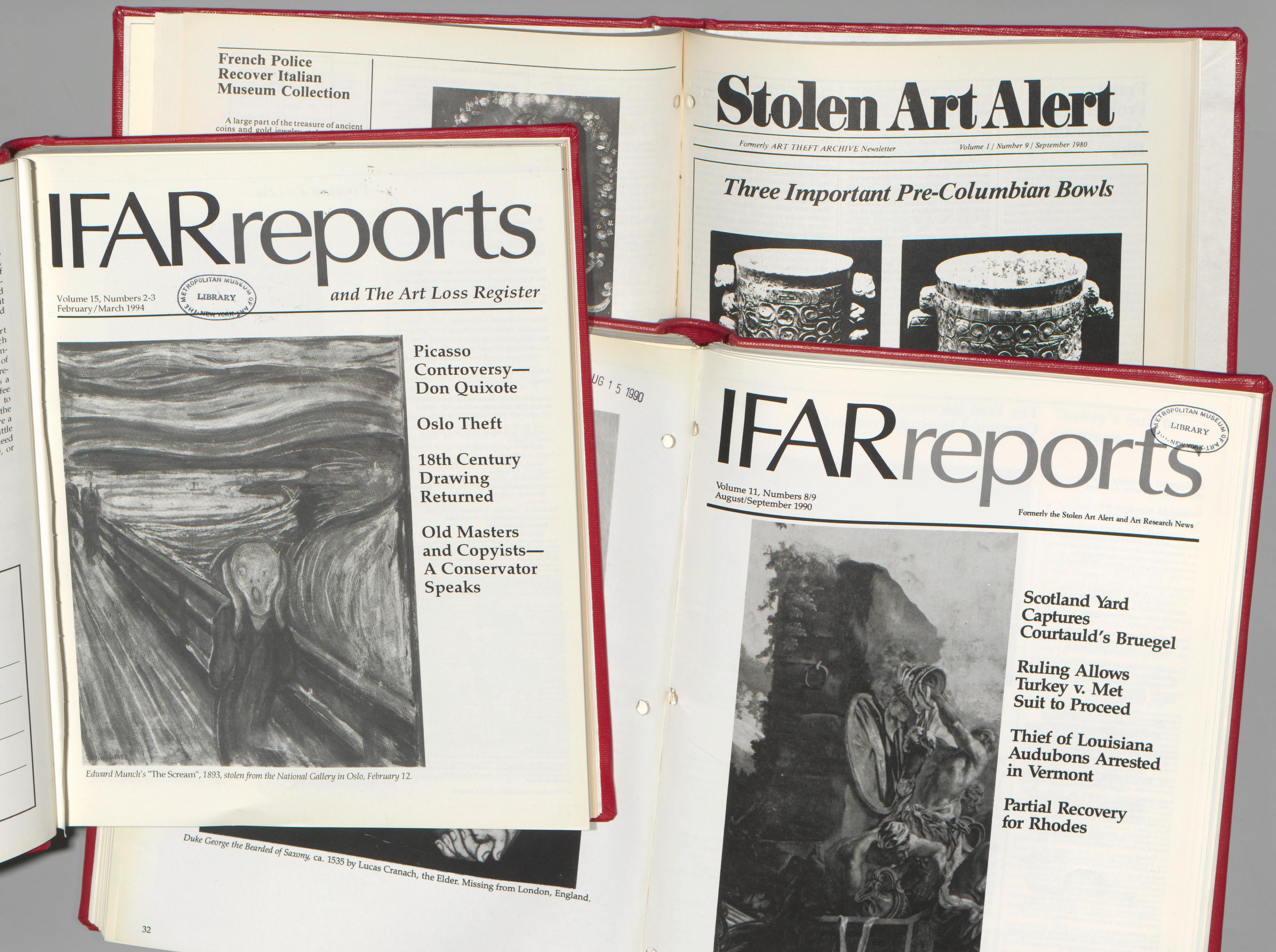
The September 1980 issue of Stolen Art Alert in the background, with the February/March 1994 and August/September 1990 issues of IFARreports in the foreground.
Although Watson Library maintains its own digitization equipment and content management system, the scale and accelerated timeline of this project made collaboration with the Internet Archive (IA) the most effective approach for scanning and hosting the IFAR publications. Our long‑standing partnership with IA—which has included the digitization of our extensive historic art auction catalog collection and several rare periodical runs—gave us full confidence in their ability to deliver timely, high‑quality results. The Internet Archive remains an excellent, cost‑effective resource for institutions seeking to digitize their collections.
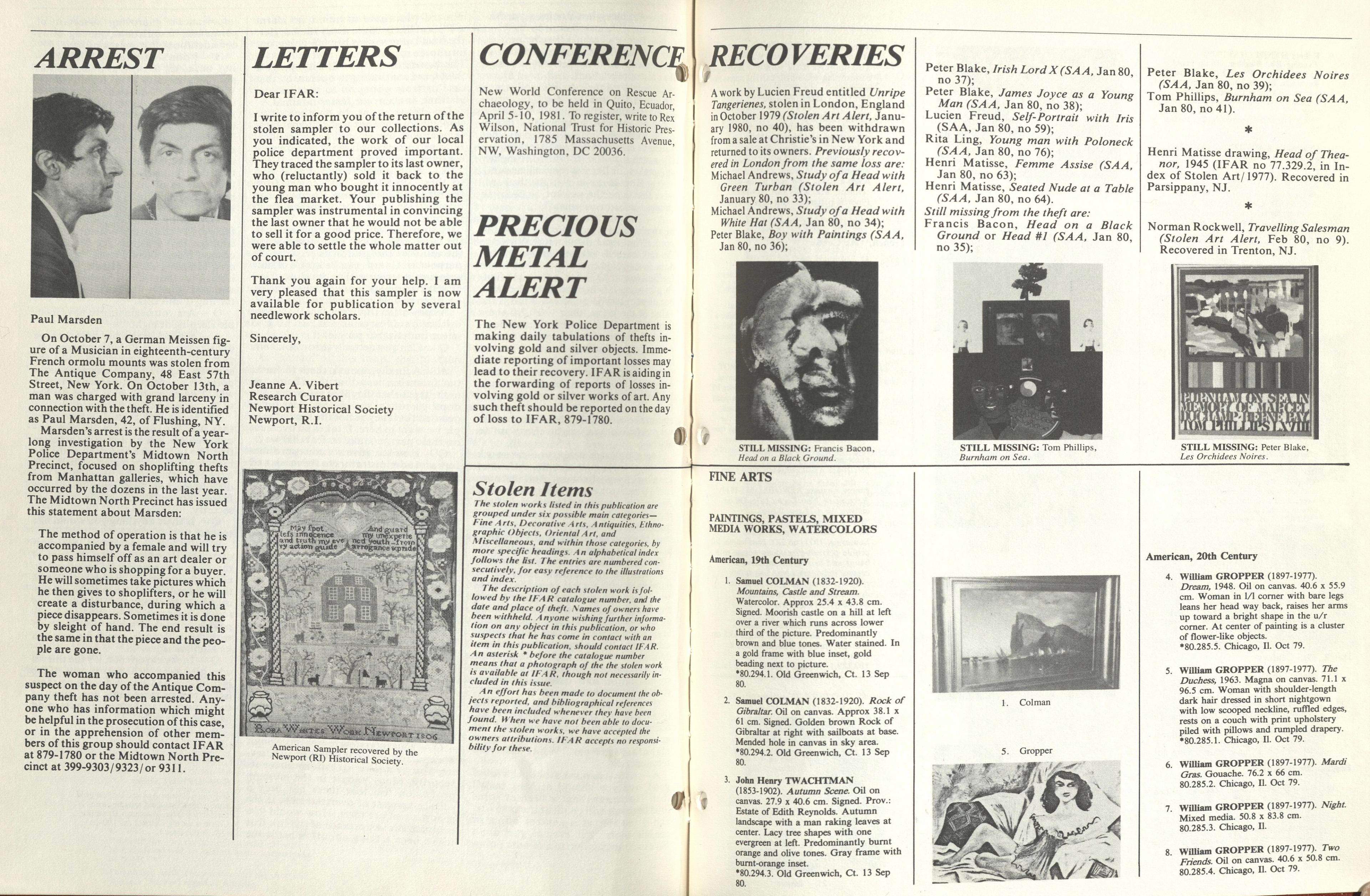
Vol. 1, No. 1 (1980) of Stolen Art Alert highlighted recent thefts and recoveries from cultural heritage institutions and private collections.
Before the materials could be sent out for scanning, each issue needed to be “cataloged” so that the Internet Archive would have accurate bibliographic information for record creation. Rather than producing full catalog records, we compiled a spreadsheet using standard metadata fields: title, publisher, date, author, and related elements. To enhance discoverability, we also included subtitles and tables of contents. Once this preliminary cataloging was complete, the issues were ready to be sent for digitization.
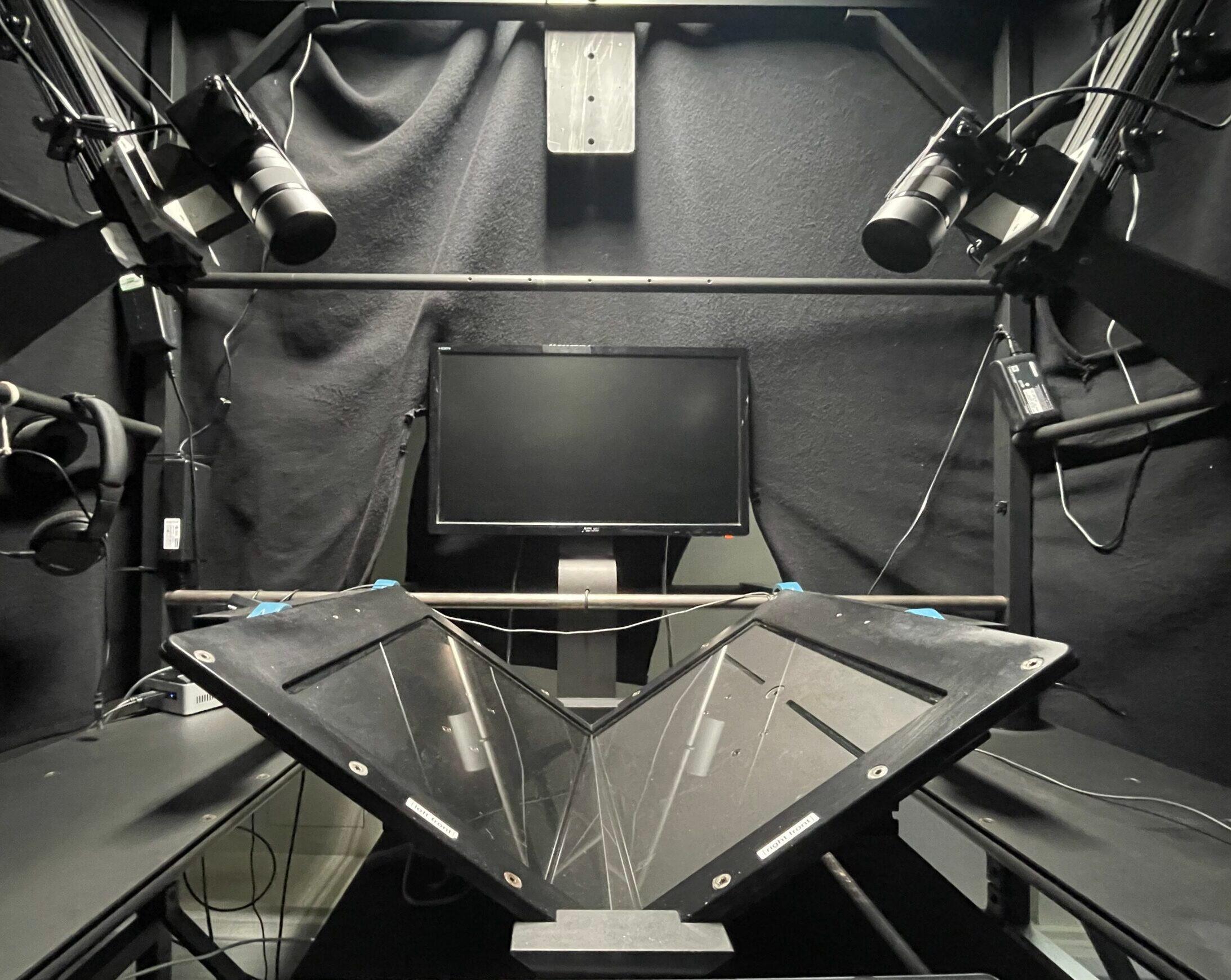
Typical scanning station setup at the Internet Archive. Photo courtesy of the Internet Archive
We packed all the volumes into sturdy plastic totes and shipped them to the IA’s digitization center in Princeton, New Jersey, where staff began scanning the materials. After scanning, they used the metadata from our spreadsheet to create digital records for each issue. The interface supports sorting by title or publication date, full‑text searching across the collection, and downloading individual issues in multiple formats, including PDF.
As we worked through the publications, we often found ourselves pausing to read particularly compelling articles. The collection includes everything from proceedings of symposia to unlikely recoveries of stolen artworks, making for engaging reading—especially when familiar names and institutions appeared.
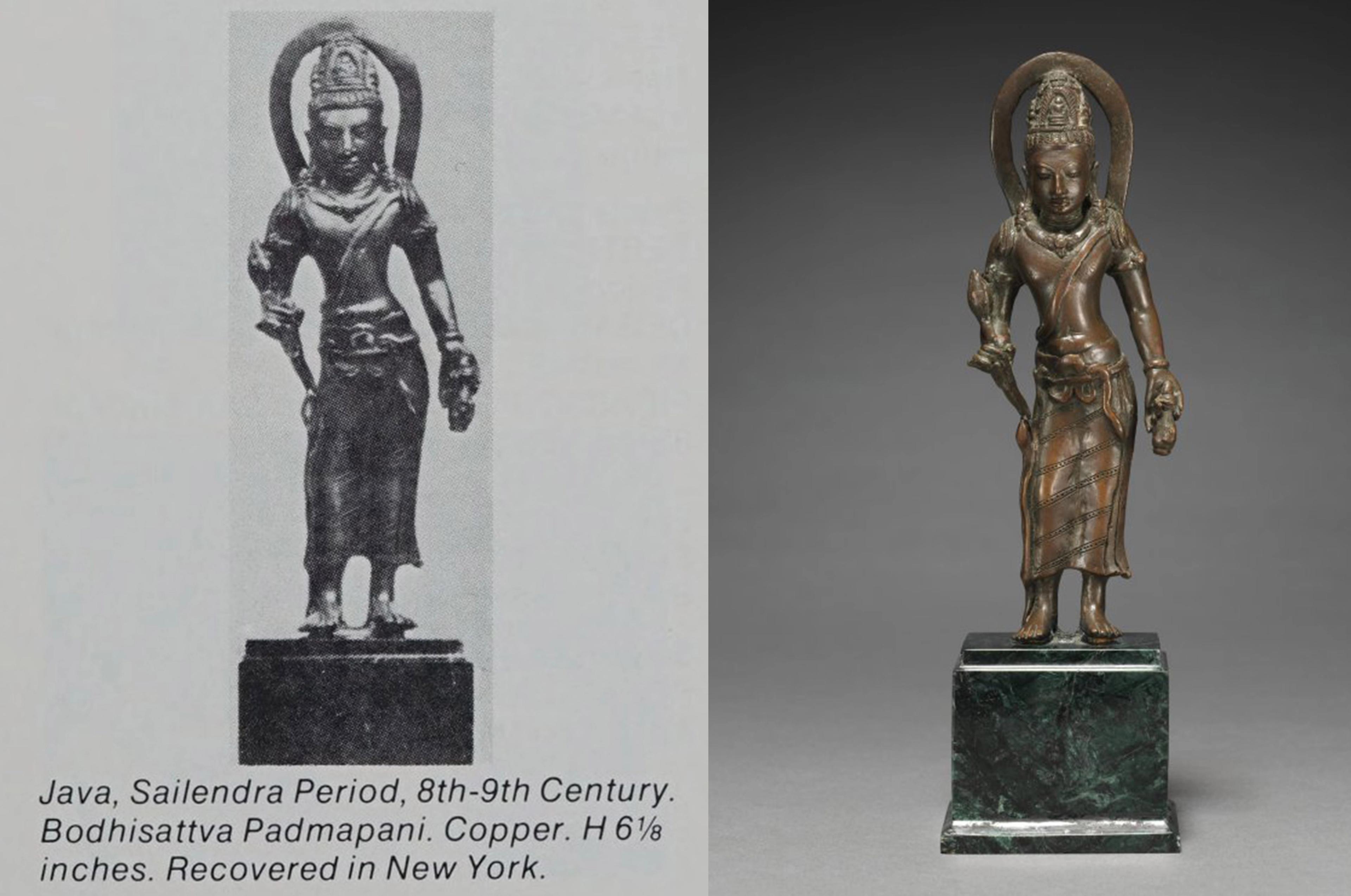
Left: Page from Vol. 4, No. 3 (1983) of Stolen Art Alert. Right: Bodhisattva Padmapani (ca. 700–800 CE). Image courtesy of the Cleveland Museum of Art
For example, the “Recoveries” section of the May 1983 issue of Stolen Art Alert recounts how Martin Lerner, then a curator of Indian and Southeast Asian Art at The Metropolitan Museum of Art, was asked by an antiquities dealer to appraise a Javanese statue. Lerner determined that the object matched a work stolen from the Cleveland Museum of Art seven years earlier, leading to its return to that museum’s collection, where it remains today.
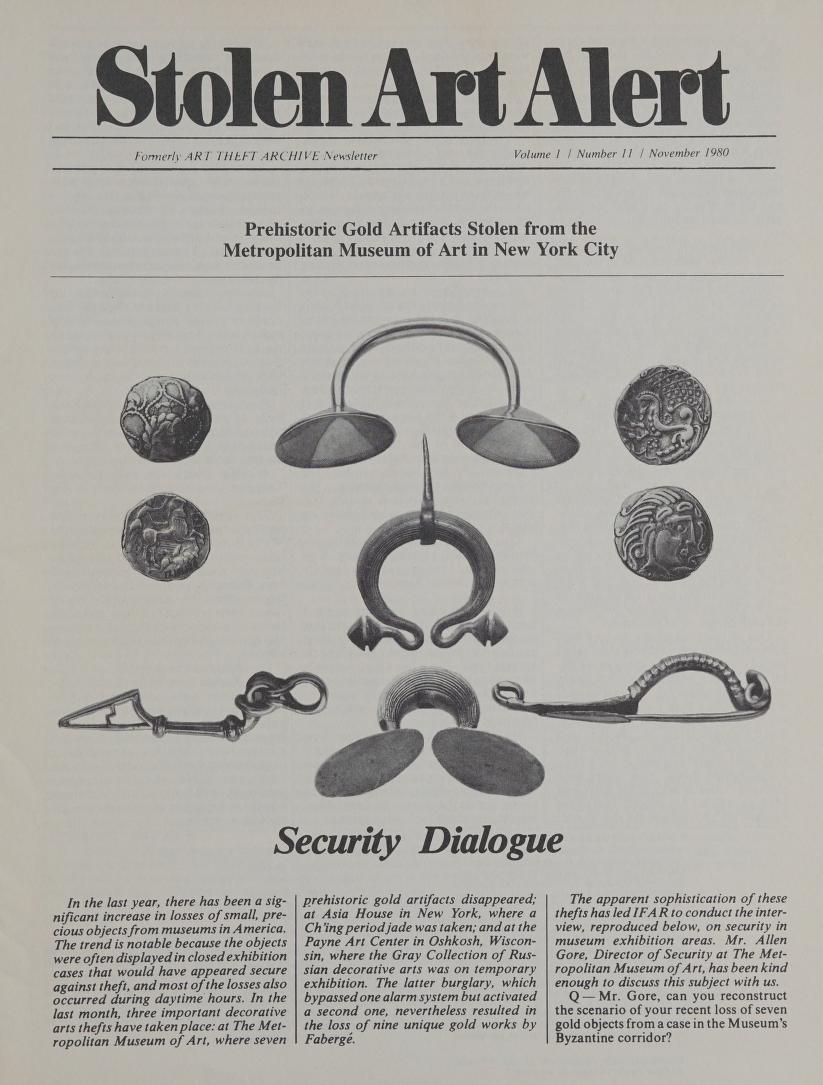
Page from Vol. 1, No. 11 (1980) of Stolen Art Alert
Unfortunately, as the name Stolen Art Alert implies, many articles focused on thefts and stolen artworks rather than recoveries. A November 1980 interview of the former Director of Security at The Met Allen Gore was prompted after several prominent museums in New York City, including The Met’s Byzantine galleries, suffered thefts. Gore and the interviewer discuss an apparent increase in museum thefts and how museum security departments can anticipate and respond to them. At the time, the interview was a rare opportunity for a Security staff member to share their perspective on issues facing the Museum.
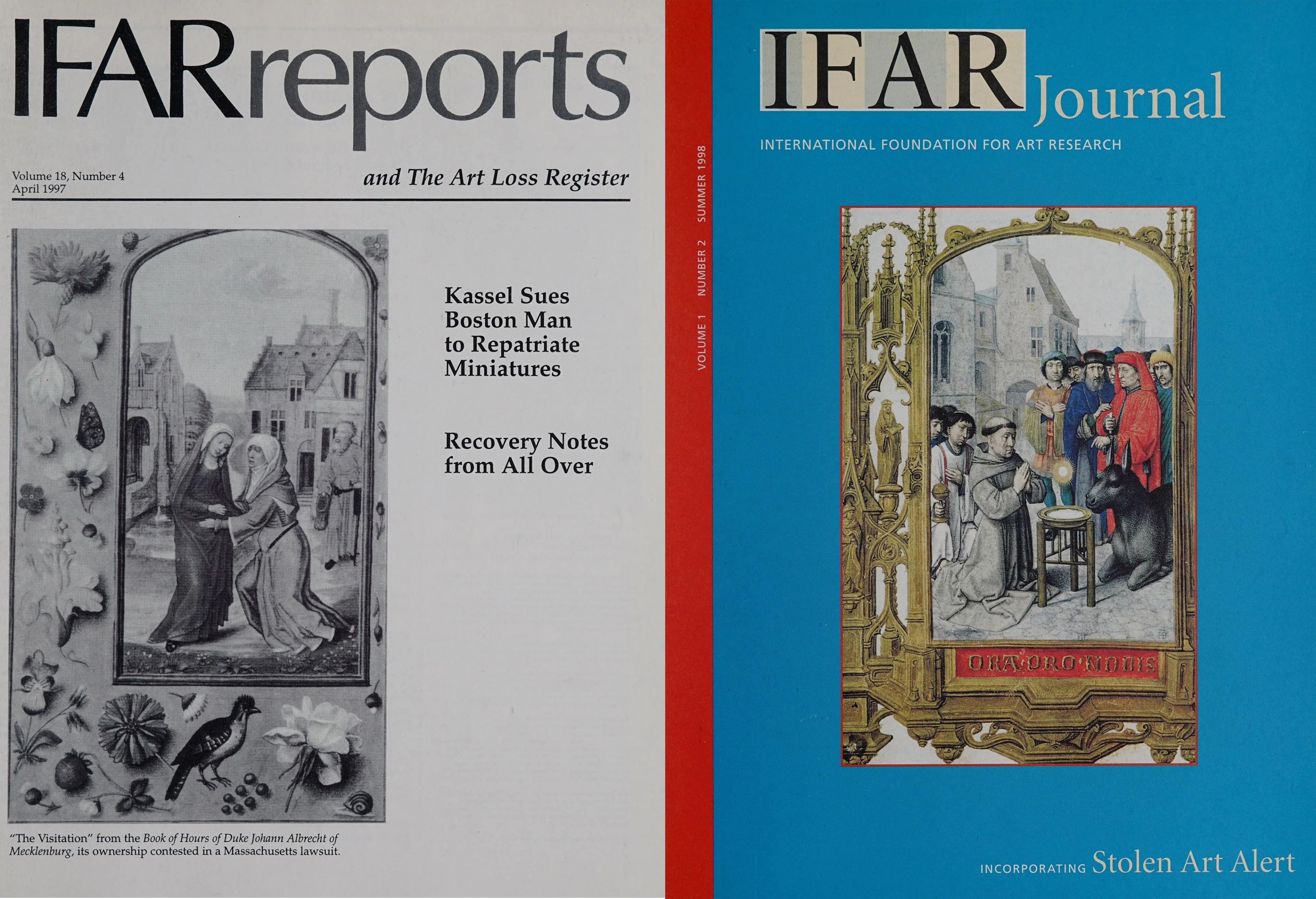
Vol. 18, No. 4 of IFARreports (left) and Vol. 1, No. 2 of IFAR Journal (right) documenting a WWII restitution case.
On occasion, a narrative thread can be traced across multiple issues of IFAR’s publications. For instance, Volume 6, Issues 4, 5, and 8-9 (1985) of IFARreports document the arrest, indictment, and conviction of Claire Eatz, owner of the Rothschild Gallery in Bridgewater, New Jersey, on fraud charges involving the consignment and transport of artworks including pieces by Martin Johnson Heade and Claude Monet. Similarly, IFARreports traced a court case on missing World War II art from an April 1997 article to Sharon Flescher’s account of the case’s positive resolution the following year.
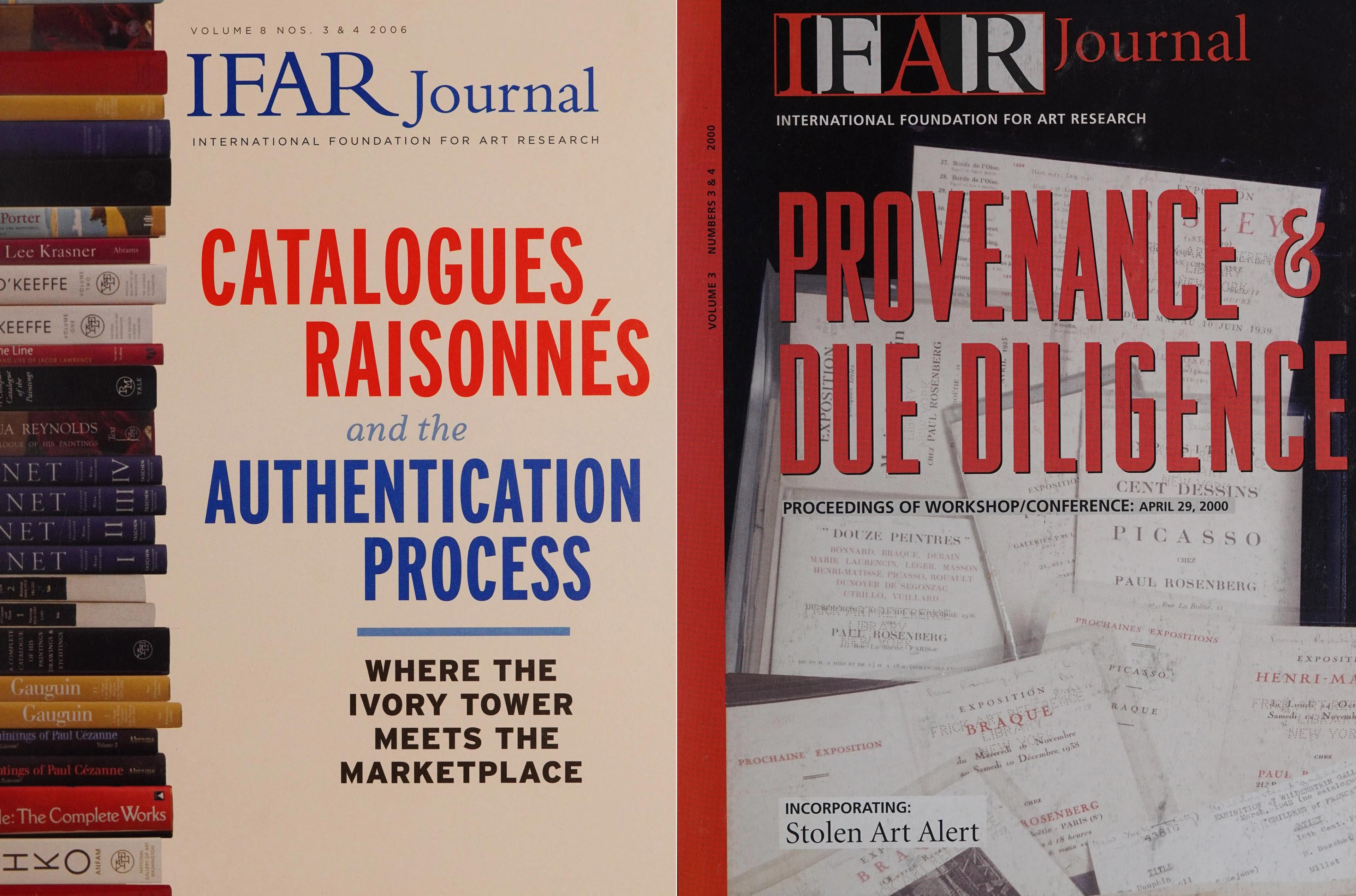
Vol. 8, Nos. 3 & 4 (2006) and Vol. 3, Nos. 3 & 4 (2000) of the IFAR Journal, featuring proceedings of important IFAR events.
The publications also document important symposia conducted by IFAR, including the seminal Catalogues Raisonnés and the Authentication Process: Where the Ivory Tower Meets the Marketplace on catalogues raisonnés in 2001. The 2006 issue of the IFAR Journal comprises the proceedings of the symposium, which included talks ranging from “Sponsorship and the Inevitability of Conflicts” (Jack Cowart) to “Are Opinions Dangerous Things to Give? Suits Against the Pollock-Krasner Authentication Board” (Ronald D. Spencer). Another symposium conducted in 2000 and published as the 2000 issue of the IFAR Journal focused on provenance, and included talks such as “Due Diligence for Acquiring Cultural Property in the New Millennium” (Linda F. Pinkerton) and “The Tale of the Two Chagalls or How N.Y. State Got Its Statute of Limitations Rule” (Herbert Hirsch).
Together, these efforts have helped secure long term access to a body of material that has shaped art world discourse for nearly fifty years, ensuring it remains a dependable resource for researchers in the years ahead.
In addition to our colleagues at The Metropolitan Museum of Art who assisted with this project—in particular Museum Archivist Janine Biunno, Associate Museum Librarian Daisy Paul, and Collections Specialist Kelsey Talbot—we’d like to thank Executive Director of IFAR Lindsey Schnieder and Princeton Cataloger Joe Ondreicka at the Internet Archive for their steadfast work throughout the project.