For Raphael, as for many Italians then and now, the ancient past had always been part of daily life. He could touch the stretches of Roman masonry at the base of the defensive wall surrounding his native Urbino. The remnants perched directly on the streets, forum, and building foundations of an ancient citadel the Romans called Urvinum Metaurense. (In ancient Umbrian, urvo meant “furrow” or “cultivated land, settlement,” hence “Settlement on the Metaurus,” the local river.) The city was strategically situated thirty miles inland from the Adriatic coast and three hundred miles due north of Rome. Somewhere between Urbino and the sea, in 207 BCE, the Roman army had fought off a contingent of Hannibal’s army on the banks of the Metaurus as they swept south from the Alps in hopes of taking Rome.
At the river’s mouth, in the coastal city of Fano, the Roman architect Vitruvius claimed to have constructed a basilica for the emperor Augustus around 25 BCE that, in his own words, “attain[ed] a high degree of dignified elegance.” The building itself was long gone by Raphael’s time. Still, Vitruvius left a description of it so detailed that architects ever since the fifteenth century, including Raphael, have spent hours imagining how it must have looked, and applying its innovations to their own designs. Both he and Michelangelo were inspired by the basilica at Fano when they submitted their designs for St. Peter’s Basilica in Rome. The stone foundations of the Vitruvian basilica have, remarkably, just been discovered beneath the parking lot of the Fano fish market as of January 2026.
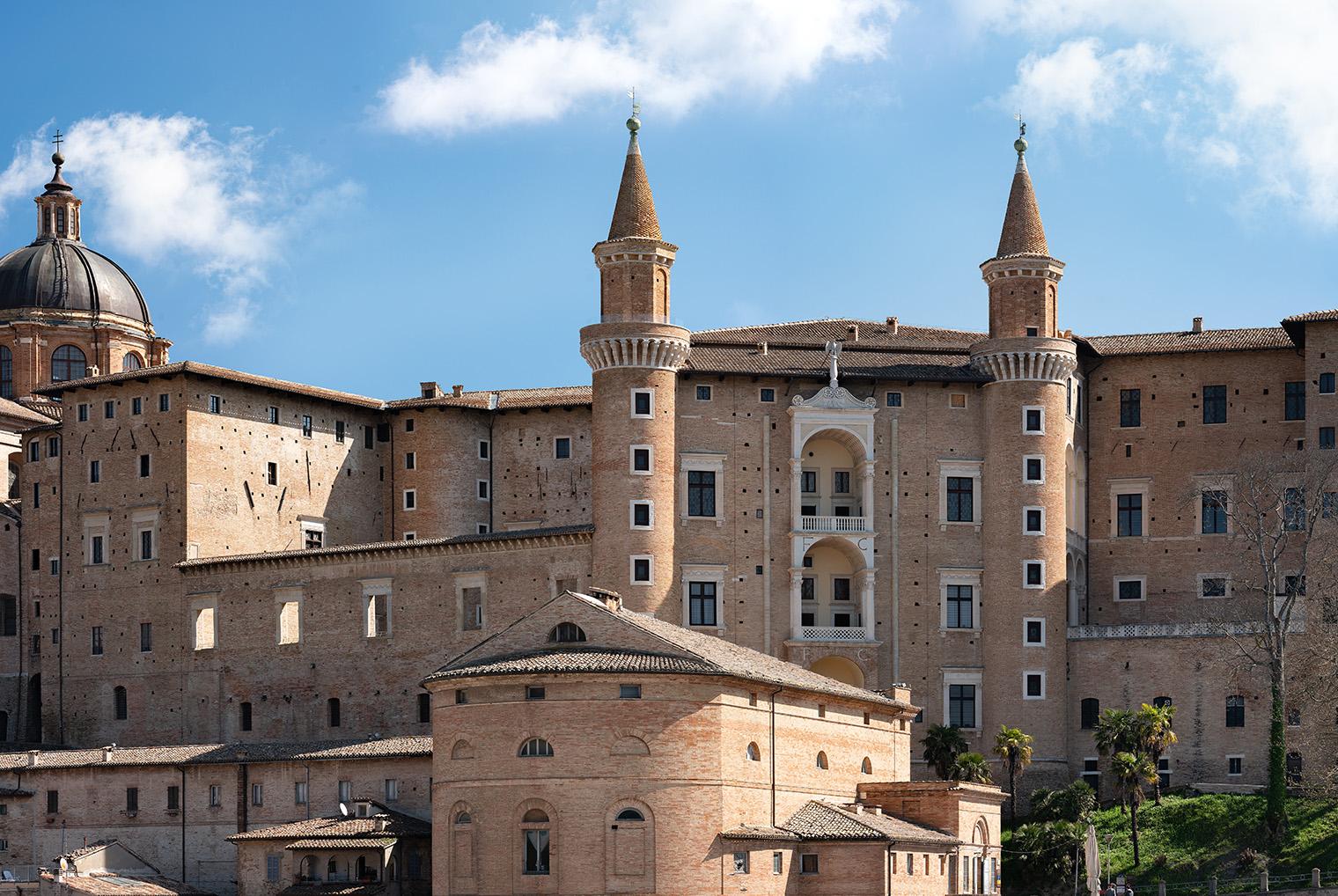
Image of the Ducal Palace of Urbino. Courtesy of Galleria Nazionale delle Marche, Urbino
In 49 BCE, Vitruvius and his basilica also inspired Urbino’s greatest architectural jewel, the Ducal Palace of Urbino, now a UNESCO heritage site. Within its elegant halls, Raphael’s father, Giovanni Santi, made his career as a painter and poet. Here, too, Raphael first learned to take the ancients as a model for every aspect of life, from moral behavior to city planning.
Ancient authors, artists, and architects gave Raphael and his contemporaries not only the lasting gifts of literature, philosophy, rhetoric, building, and visual art, but also advice on such fleeting skills as civil conversation, posture, and dance. By infusing the legacy of the ancients with Christian revelation, fifteenth- and sixteenth-century Italians hoped to attain the ultimate expression of a life worth living. Thus, in between battles, Federico da Montefeltro, the first Duke of Urbino, who commissioned the Ducal Palace and died in 1482, the year before Raphael’s birth, had his attendants read him inspirational excerpts from ancient authors to model his conduct on their example.
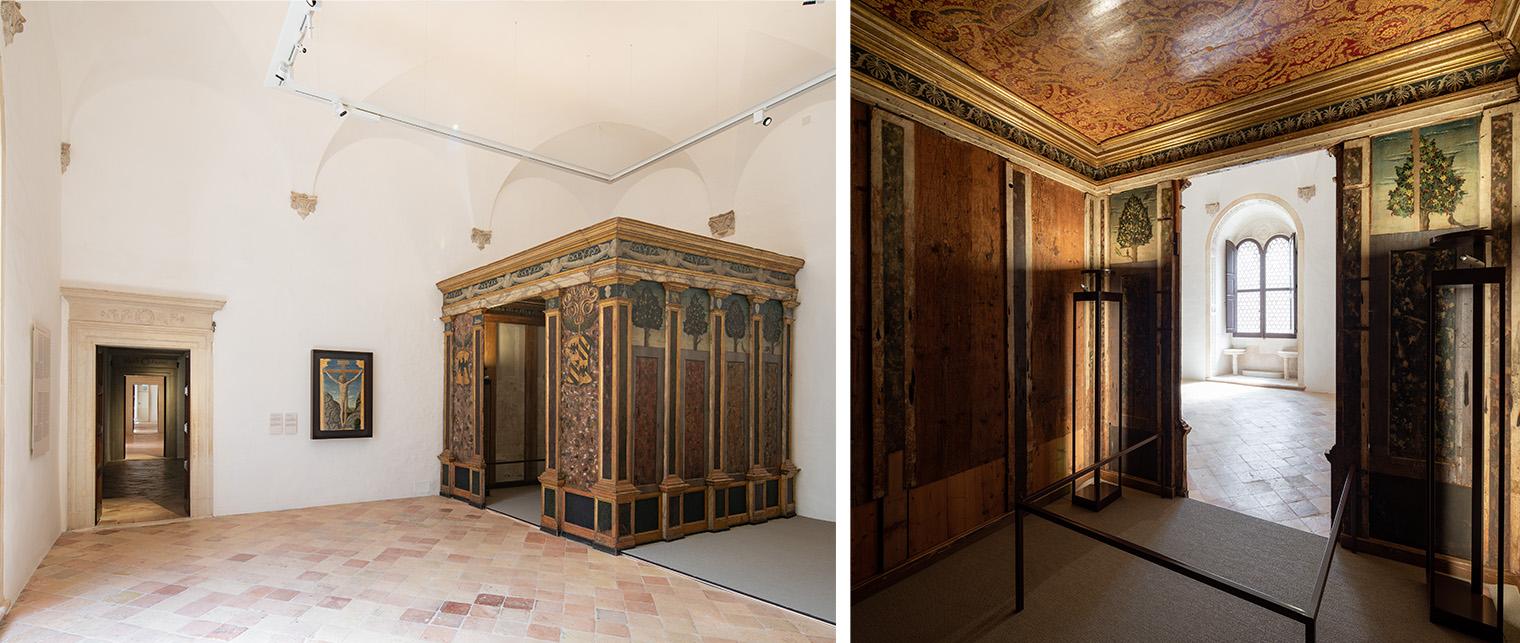
Alcova of Federico da Montefeltro in the Ducal Palace of Urbino. Courtesy of Galleria Nazionale delle Marche, Urbino
Federico’s court artists adopted a style inspired by ancient literature and surviving examples of ancient art. In a tour de force of flattery, painter Fra Carnevale designed an alcove bed for the Duke, recreated from the Roman biographer Suetonius’s description of the painted bedroom decor of the Emperor Augustus, implying that the lord of Urbino was a ruler of comparable stature. (We can compare the alcove’s ornamentation with the real bedroom frescoes in the House of Augustus on the Palatine Hill in Rome.)
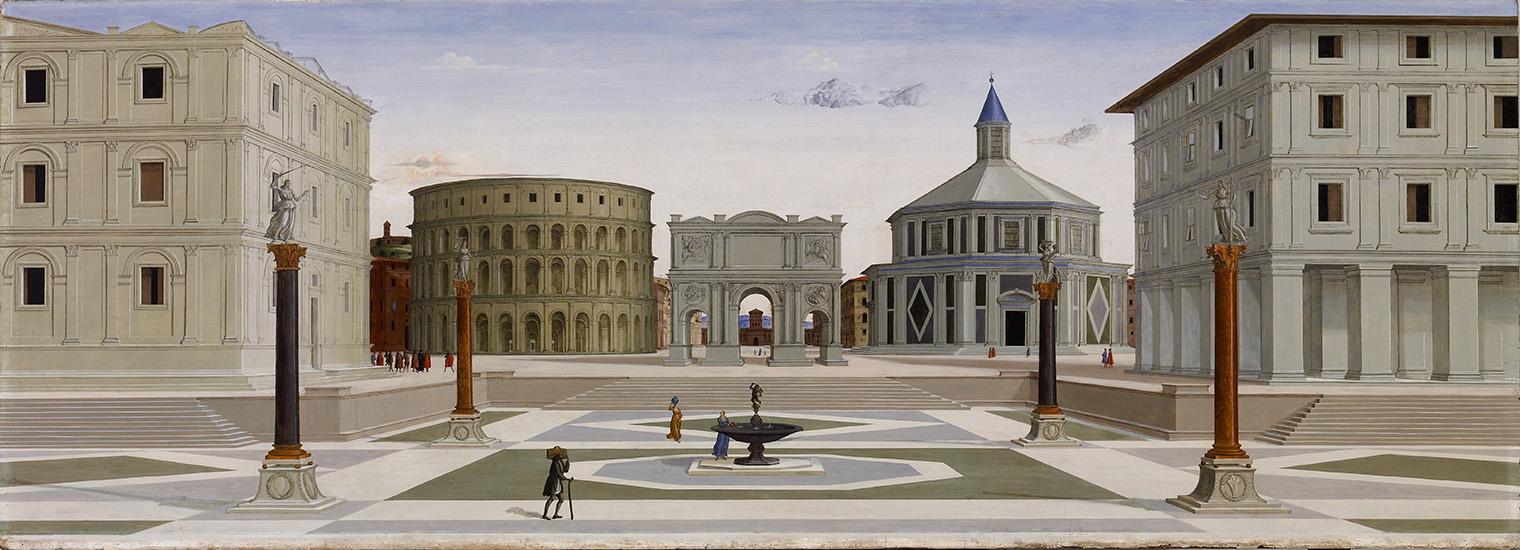
Central Italian artist for an Urbino patron (Italian). The Ideal City (Città Ideale), ca. 1475–90. Oil and tempera on panel, 30 1/2 × 86 5/8 in. (77.4 × 220 cm). Walters Art Museum, Baltimore (37.677)
These flattering visions were fantasy, of course. Federico’s library is famous both for the beauty of its manuscripts and for the sloppiness of the actual texts. Furthermore, as a professional soldier, the lord of Urbino had no intention of giving up the medieval inventions that had underpinned his career any more than he would have considered giving up his Christian faith. The beautifully dressed people in those beautifully ordered Italian cities we see in paintings like Fra Carnevale’s The Ideal City (circa 1475–90) had a predilection for feuds and street fighting worthy of Shakespeare’s Romeo and Juliet, a tragedy based on a true story. But the beauties of Urbino also had a real effect on Raphael as he passed through those harmonious streets or strolled beneath the spacious arcades of the Ducal Palace. Even today, we can’t help but stand taller and walk more gracefully—not to mention feel more expansively human—in such a glorious setting.
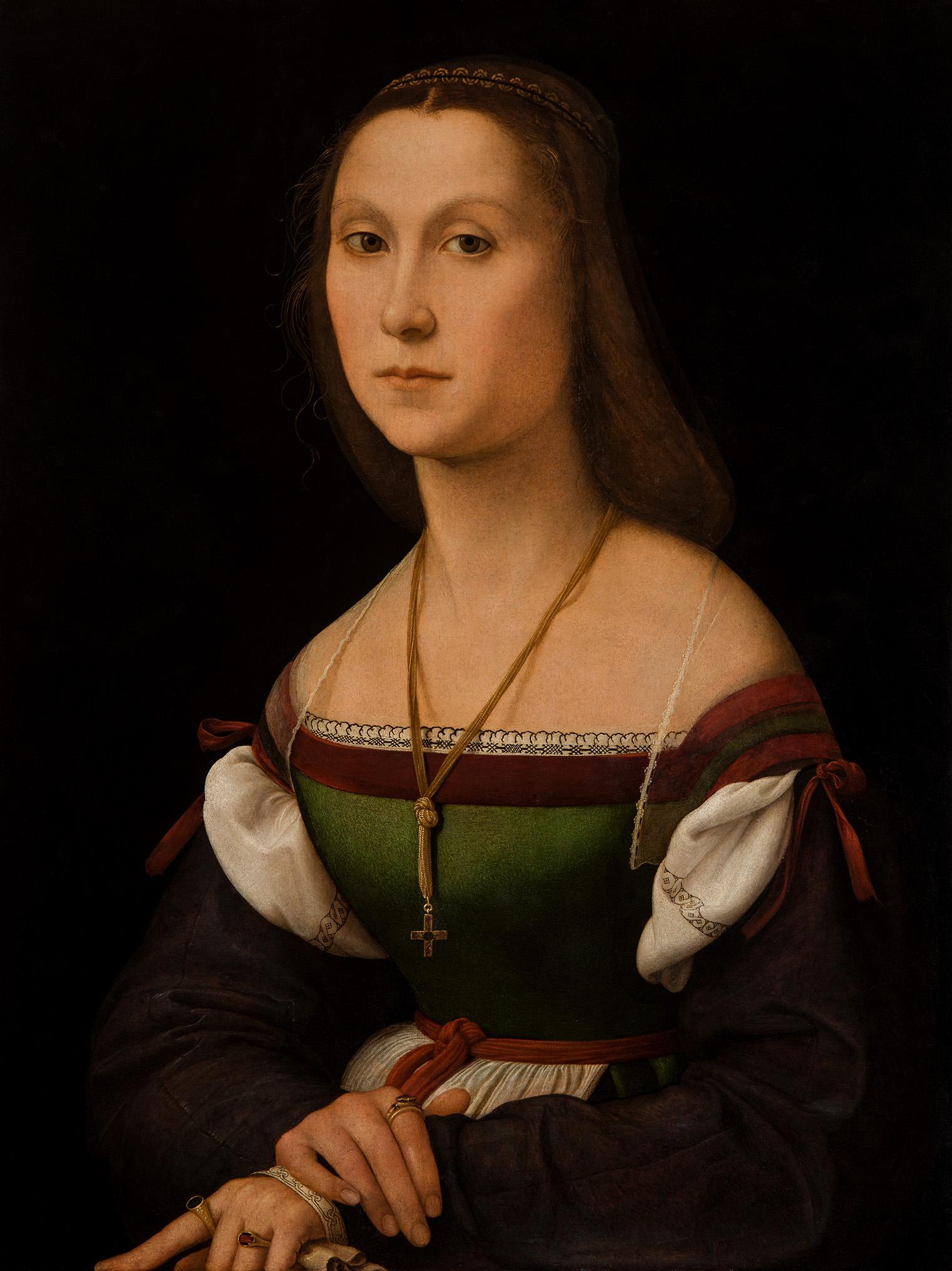
Raphael (Raffaello di Giovanni Santi; 1483–1520). Portrait of a Woman in Three-Quarter Length (La Muta), ca. 1503–5. Oil on limewood, 25 11/16 × 18 7/8 in. (65.2 × 48 cm). Galleria Nazionale delle Marche, Urbino (1990 DE 237)
Yet for Raphael, Urbino, gracious as it was, could never satisfy his questing spirit. Like the sitter in his enigmatic portrait, La Muta (circa 1503–5, plausibly identified by Met curator Carmen Bambach as his patroness Giovanna Feltria Della Rovere), he instinctively poked at boundaries, unfailingly polite but also unfailingly restless. He absorbed Plato’s idea, taken up by Christian writers like Saint Paul, that there must be a transcendent divine reality beyond the realm of our own physical experience, and he used paint to proclaim his own awareness that our sensory impressions might be fictions in their own right. Are we absolutely sure that La Muta is just a picture and that we are real? Or is she the real woman looking at our shadowy selves, mere projections of another reality altogether?
Early sixteenth-century Florence, where Raphael lived and worked between 1504 and 1508, was not a happy place for an ambitious young painter, though. The Medici, the city’s most reliable patrons, had been expelled in 1494, followed by the apocalyptic sermons and crackling bonfires of the fanatical friar Girolamo Savonarola, burned at the stake himself in 1499. By 1500, no city on the Italian peninsula, not even Venice, could rival the magnetic pull of Rome, with the epic scale of its connection to antiquity; the steady patronage of popes, cardinals, bankers, and feudal barons; and its unique position as the capital both of a long-gone ancient empire and of the urgently contemporary Western Christian Church. The figure who knit those together, ancient and early modern Rome into the single compelling image of the Eternal City, was the pope who emerged victorious from the conclave of December 1503: Giuliano Della Rovere, Julius II, the father, in many respects, of the modern papacy.
Like Raphael, Julius II maintained a Platonic view that reality operated on multiple levels, one of which was a brilliantly imagined future where a Church of truly global reach would be governed by a Christian Rome of such magnificence that foreign visitors would convert to Christianity on the spot. The pope’s visions attracted preachers, scholars, and artists to convey his vision in sermon, word, and image, bankers to subsidize armies and bribes, and, when all else failed, Julius summoned his special arsenal of religious weapons: excommunication for individuals, interdict for states, and a reforming council for the Church itself. The pope’s revolutionary mission was well underway when Raphael arrived in Rome around 1508, recommended by his distant uncle Bramante and his patroness Giovanna Feltria Della Rovere, the daughter of Federico, Duke of Urbino, who happened to have married a relative of this formidable pope.
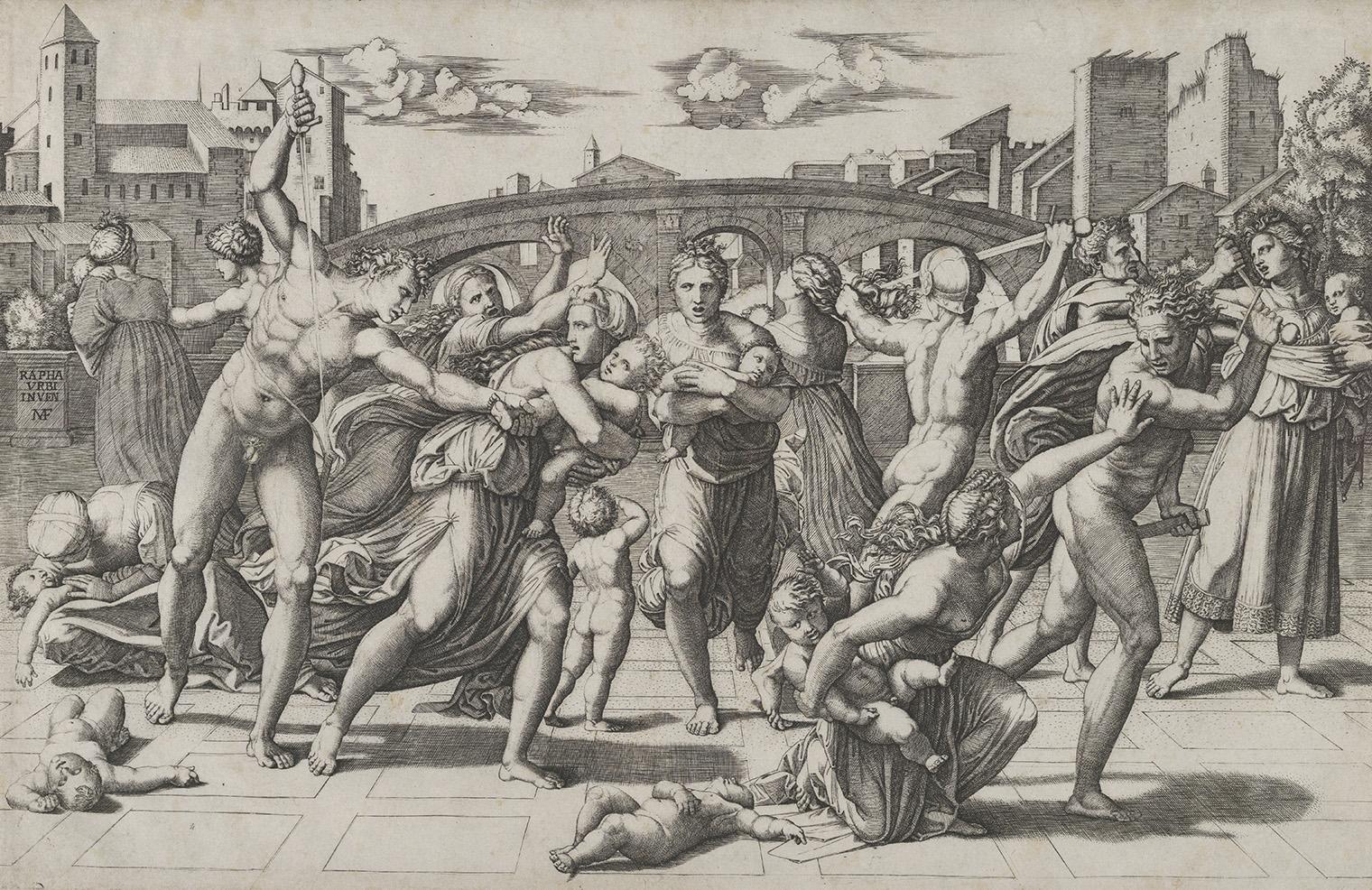
Marcantonio Raimondi (ca. 1480–before 1534) after Raphael (Raffaello di Giovanni Santi; 1483–1520). The Massacre of the Innocents, ca. 1512–13. Engraving, 11 1/16 x 16 15/16 in. (28.1 x 43.0 cm). The Metropolitan Museum of Art, New York, Rogers Fund, 1922 (22.67.21)
Raphel entered a city of 55,000 huddled amid the ruins of a metropolis that once housed a million. We can catch a glimpse of that Rome in the background of Marcantonio Raimondi’s engraving (designed by Raphael), The Massacre of the Innocents (circa 1512–13). Rather than an imaginary Holy Land, King Herod’s slaughter of the infants of Judaea has been set in a specific site in Raphael’s Rome, where the ancient bridge known as the Pons Cestius spans the river Tiber. Unlike the miniature Colosseum that further emphasizes the calm order of Fra Carnevale’s Ideal City, the ancient bridge sticks out as the only symmetrical object in a jumble of medieval towers, dilapidated hovels, a much-rebuilt medieval church, and, just peeking above the arc of the bridge, the tympanum of a modern Renaissance church. The chaotic spectacle reinforces the idea that Christ came into a world desperate for redemption, and so, perhaps, did the vision of a New Rome that emerged with the dawn of the sixteenth century.
Began in 1509, Raphael’s first assignments in the papal apartments, the Triumph of Theology (usually known as the Disputation over the Most Holy Sacrament) and the School of Athens, show how thoroughly he grasped Julius II’s revolutionary visions. He had already learned how to move from minute detail to grand design in creating his landscapes, but from the antiquities of Rome, under Bramante’s guidance, Raphael learned how the ancient system of visual aesthetics had relied on consistent proportions among grand design, ornamental detail, and the scale of the human beholder. Compare the simple architectural frames of an early predella for the Oddi Altarpiece, painted by someone who had never stood inside an ancient Roman bath or the Pantheon, with the soaring space that encloses the philosophers beneath the vault of the School of Athens, at the same time that the open windows project backward into infinity.
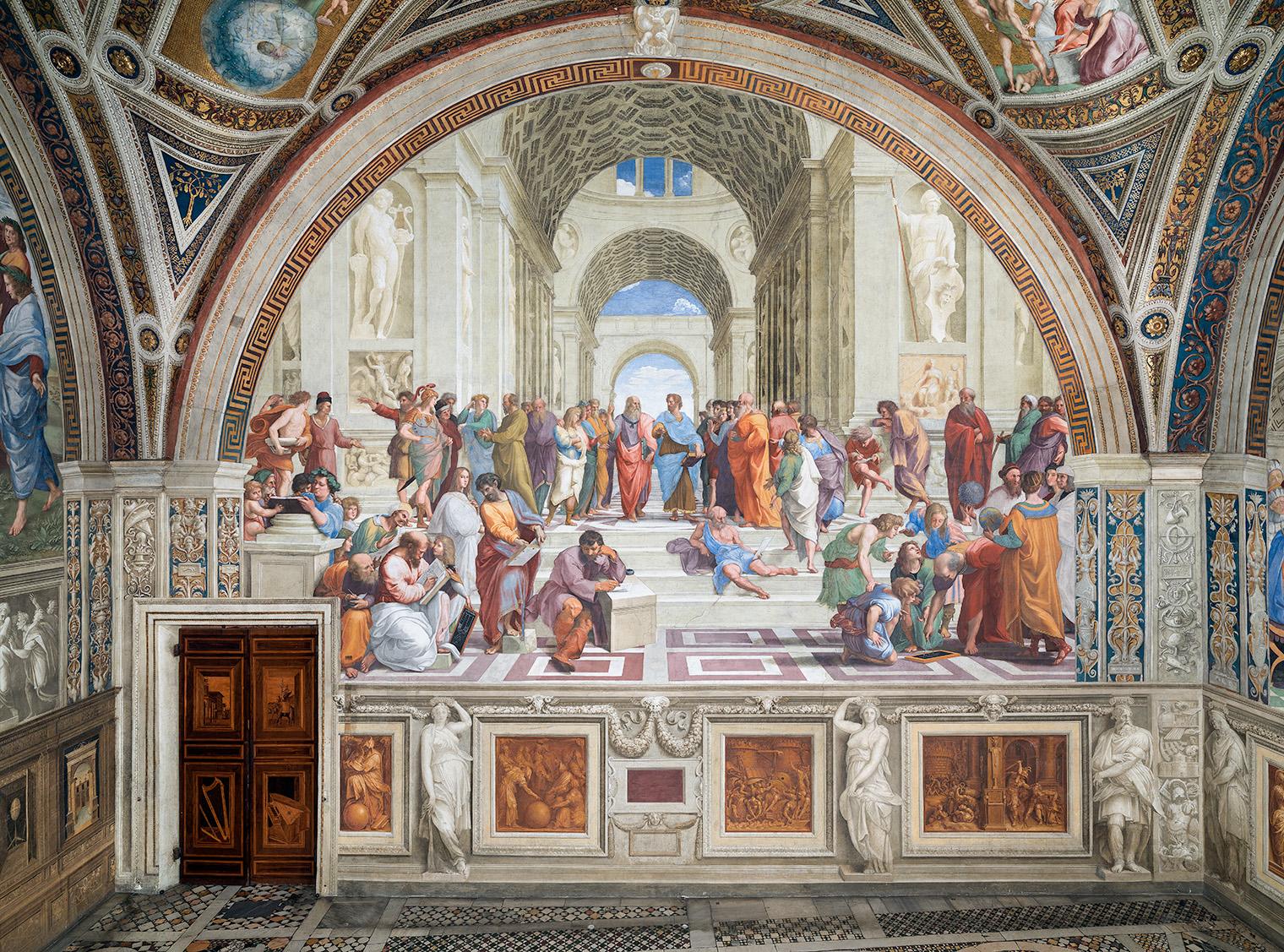
Raphael (Raffaello di Giovanni Santi; 1483–1520). The School of Athens,1509–11. Fresco, 16.4 ft × 25.3 (500 cm × 770 cm). Courtesy of the Vatican Museums, Vatican City
The buildings of ancient Rome gave Raphael penetrating new insight into classical architecture and the way its articulations fit together, about space, about human bodies and how to group them, to say nothing of the complex meanings behind the crowd of philosophers whose gestures—peering at books, making a point, arguing, sulking—and discussions so recognizably express real human behavior. That elusive sky, visible through three windows, reminds us that there is another, more real, reality outside the School, one more real still beyond the roof of the marvelous room on which Raphael has painted a scene where the books of the pope’s library have come almost literally to life in the figures of their authors. The School’s imposing architecture reminds us that a building of similar majesty was rising next to the papal palace where this painting is housed, the new St. Peter’s Basilica.
Like many who gravitated to Julius II, Raphael proved to be an exceptionally talented organizer of people, ideas, and forms. From his intensive study of surrounding ancient architecture, combined with close study of Vitruvius’s Ten Books of Architecture, the only surviving book on the subject from antiquity, he began to see how these structures worked both practically and philosophically. Around 1514, he paid the scholar Fabio Calvo to translate the Latin text into Italian vernacular to ensure that he truly understood what he was reading, and lent that learning to the project he undertook for the pope who succeeded Julius II in 1513, Leo X, the son of Lorenzo de’ Medici.
Unlike Julius, who was scrupulous with the papal treasury, Leo spent with gusto. Many of the former pope’s grand schemes for the urban renewal of the Eternal City were halted, slowed, or scaled back. Instead, Leo asked Raphael for a paper reconstruction of ancient Rome during its Imperial heyday—a way to call attention to the rapid destruction or pillage of ancient monuments for building materials, to make way for the new Rome. Characteristically, Raphael entrusted the drafting of his preface to the brilliant writer Baldassare Castiglione, who produced a poignant plea for what we now call historical preservation. One of the four surviving drafts of this preface, couched as a letter from Raphael to Pope Leo X, lays out the principles of design that governed ancient architecture.
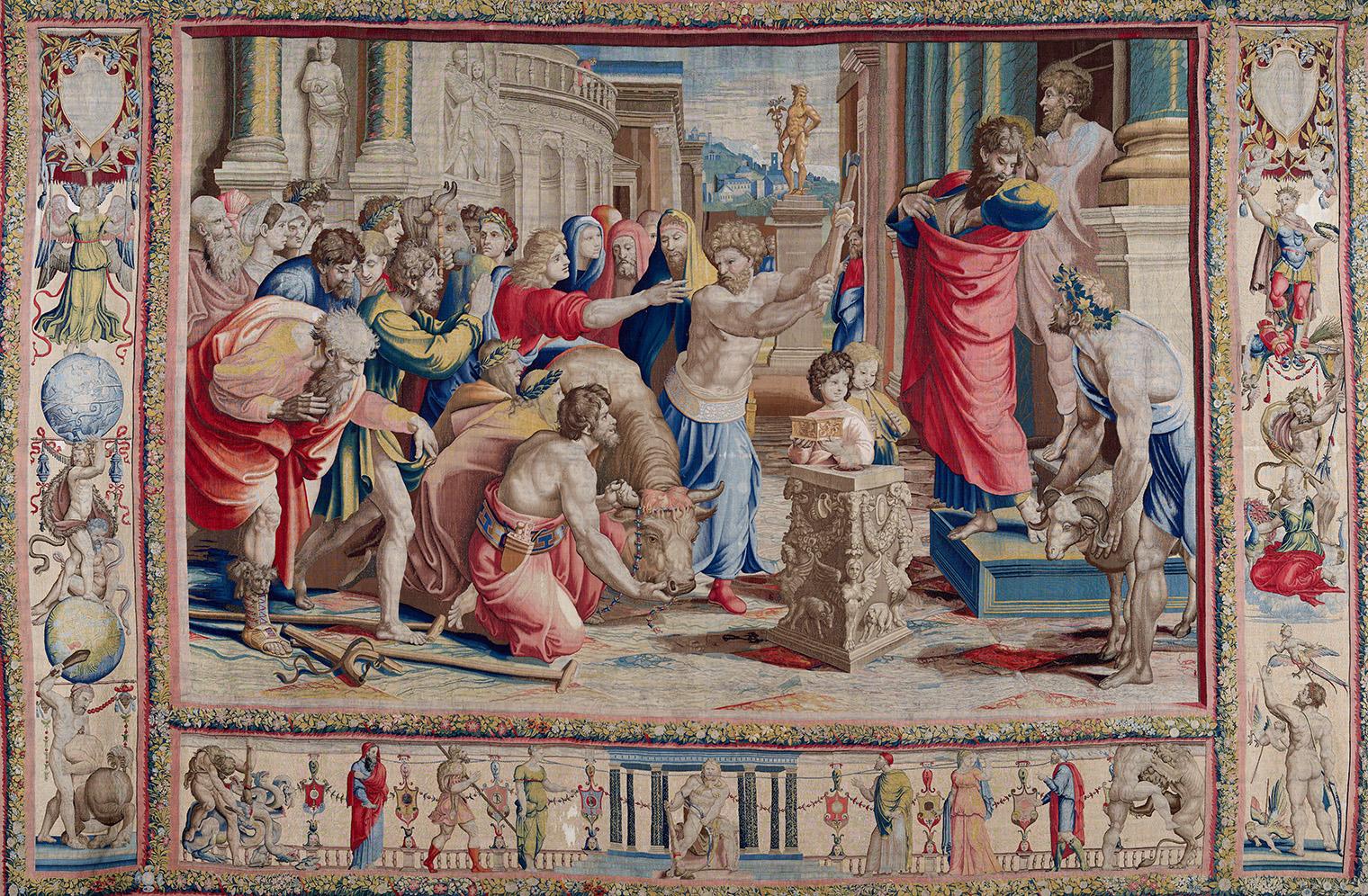
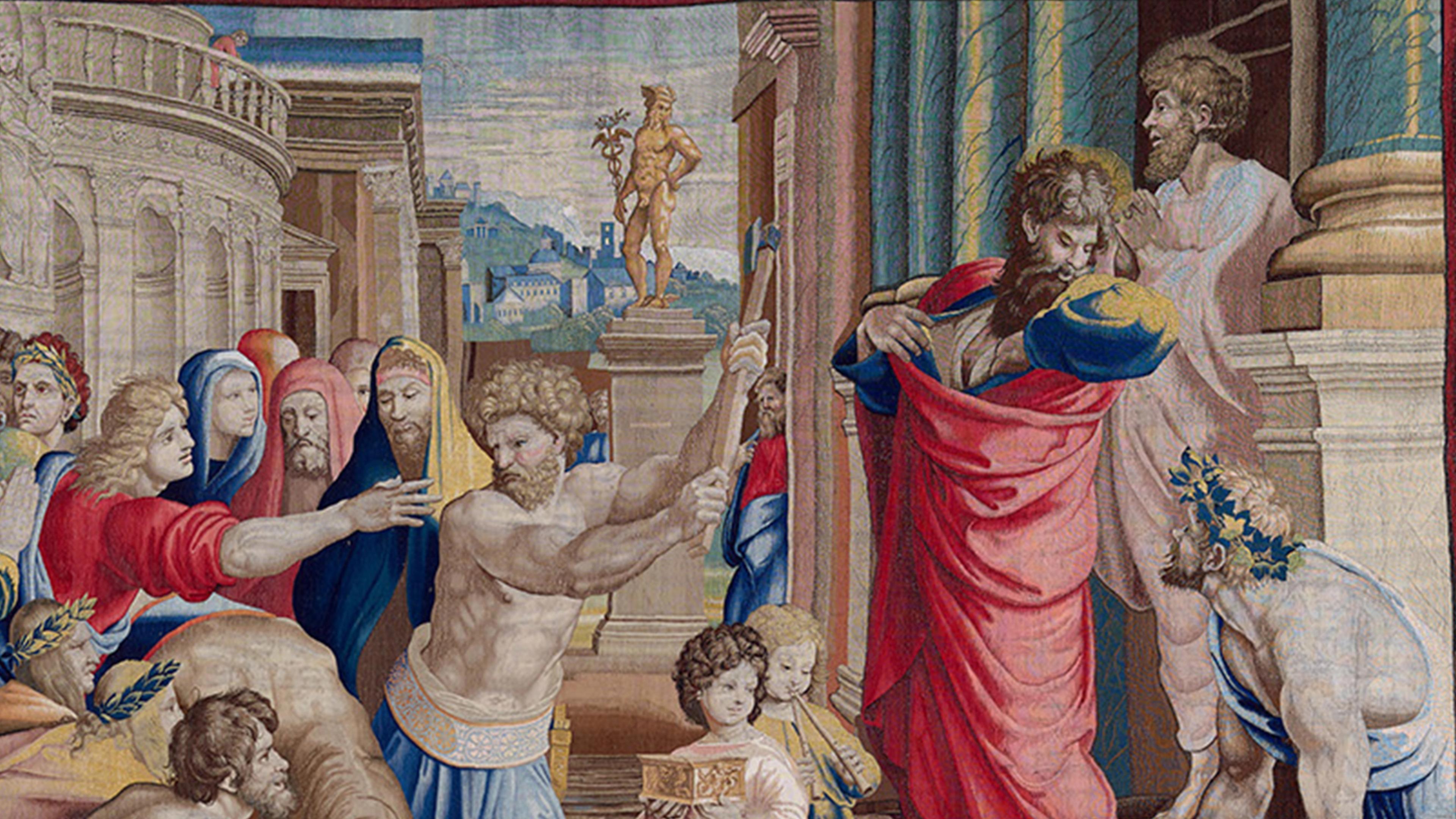
Jan van Tieghem (active ca. 1535–after 1573) and Frans Gheteels (active 1540–68) after Raphael (Raffaello di Giovanni Santi; 1483–1520). Saint Paul and Saint Barnabas at Lystra (from the Second Edition of the Acts of the Apostles Tapestry Series) (Late 1540s or early 1550s). Warp: wool, 7-8 per cm; weft: wool and silk, lined on the reverse, 34-38 per cm, 15 ft. 10 15/16 in. × 24 ft. 5 11/16 in. (485 × 746 cm). Patrimonio Nacional, Colecciones Reales, Madrid, Spain (10004084 (TA-12/8))
Here, for the first time, the different kinds of classical columns, Doric, Ionic, Corinthian, and Tuscan, are called “orders.” Vitruvius himself called them genera, and previous translators of Vitruvius into vernacular had called them “generations”—families. But Raphael’s term conveyed a sense of calm, systematic harmony that “genus” or “family” did not—families are often anything but orderly. By this time, his list of responsibilities also included the designing of St. Peter’s Basilica and a series of stately palazzi for wealthy Romans. So his deep involvement with ancient architecture always enhanced the greater enterprise of transforming Rome into the earthly version of the ideal city he held in his head. We can see intimations of that city in his designs for the tapestries commissioned by Pope Leo X for the Sistine Chapel, such as Saint Paul and Saint Barnabas at Lystra: ideal cities that, unlike Fra Carnevale’s Ideal City, are filled with people, as Raphael’s visions often are. For him, the ancient world, with its examples of grandeur, beauty, and order, was a living legacy to be shared for the benefit of all.
This essay is published in conjunction with the exhibition Raphael: Sublime Poetry, on view through June 28, 2026.


