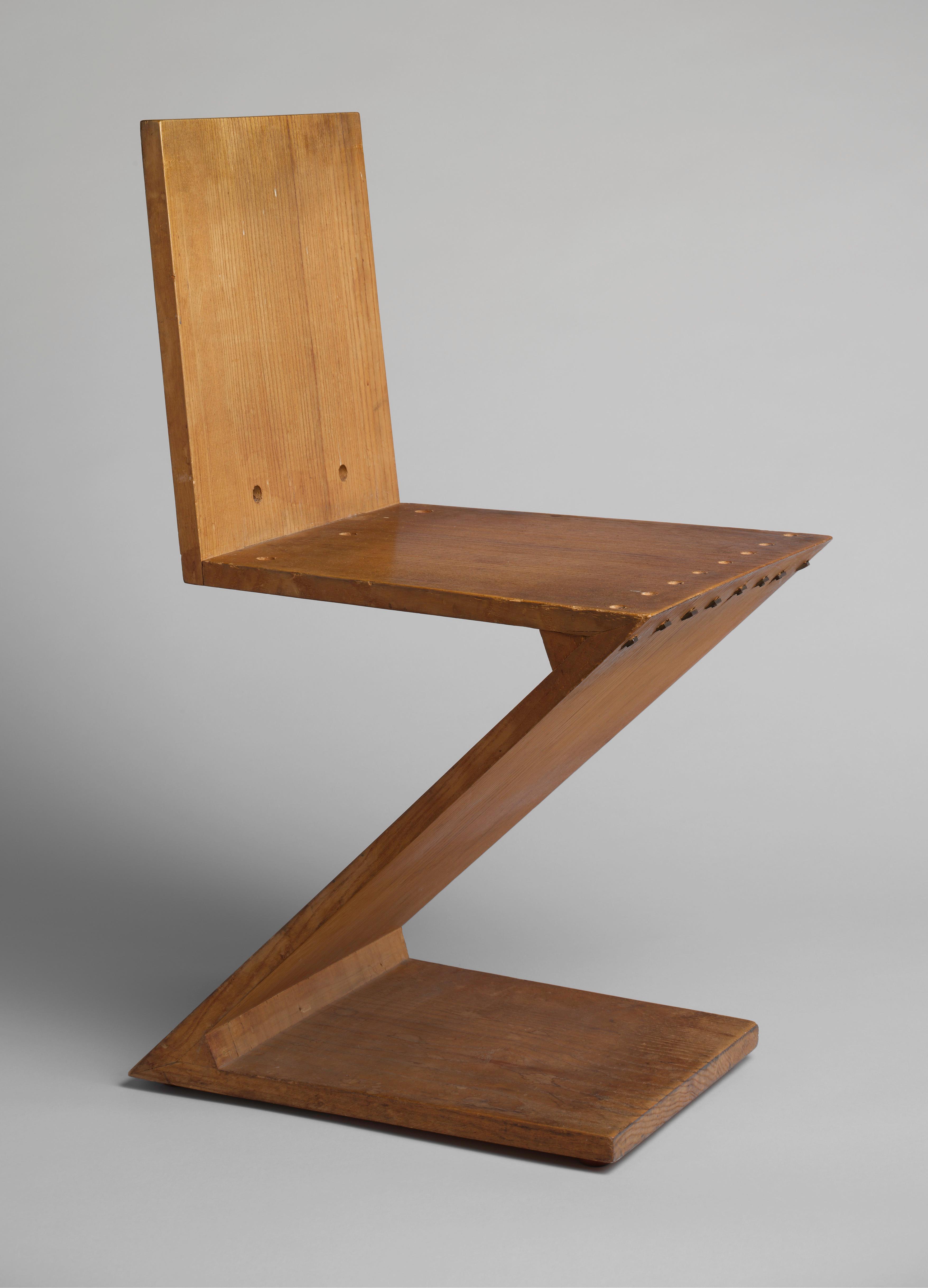
Gerrit Rietveld (Dutch, Utrecht 1888–1964 Utrecht). Zig Zag Stoel, 1937–40. Elm, 28 7/8 × 14 × 18 in., 14 lb. (73.3 × 35.6 × 45.7 cm, 6.4 kg). The Metropolitan Museum of Art, New York, Purchase, J. Stewart Johnson Gift, 2006 (2007.11). © 2026 Artists Rights Society (ARS), New York
My name is Vito Acconci.
I never really studied art. At the very end of the sixties, I started doing work involved with my own person. By the end of the seventies, I was starting to do something that resembled design, architecture. And I realized I wanted to do this because I really hated the position of “the viewer is here and the work is there.” That’s what bothered me about the word “performance”—you had to use words like “viewer,” “audience.” I wanted work that persons could be part of, almost like utensils. I want people to use the work I’m doing.
This is probably the easiest chair to make. Gerrit Rietveld—he’s one of the most precise thinkers I’ve ever come upon. It’s a kind of intellectual way of making.
It’s on the one hand such a basic chair, but on the other hand it’s incredibly rigorous. It’s almost a mathematical problem. There are four planes of wood. Two are the same size—one is to sit on and one is based on the ground. The front of the base is right below the front of the seat. It had no arms. He didn’t have to have the back of a chair, but I think he wanted to make something that talked 'chairness.'
And then he thought, “How do I put these together to be a support for itself?” And suddenly, I think, a light bulb went off and he said, “It has to be a diagonal.” Twenty years later in the early sixties there were new materials. Verner Panton didn’t need a diagonal because he could use all curves. And then Frank Gehry did kind of the same thing with cheaper materials. The Rietveld chair is the beginning. It’s almost like a chair pretending to be a person. If I crouch on the ground, I’ve kind of animated the chair.
It’s almost something that a monk or a priest would gravitate to. There’s a little bit of sacrifice here—you know, not feeling so comfortable.
I think he wanted to make geometry as much as he wanted to do a chair. It’s one of the few things I can look at and say, “This is incredibly beautiful.” Because “beautiful” isn’t about decoration, it’s not about a lot of different parts going together. But this seems so basically simple that it’s—I hate to say this because I come from a Catholic background—this is almost holy. This is an idea in his mind that I think became so real. It seems perfect.