Vase
It seems that the earliest products of Saint-Cloud were close imitations of Chinese blue-and-white porcelains,[4] but the factory soon developed its own distinctive style that reflected a blend of Chinese and European motifs. A number of forms based on Chinese porcelains, particularly vases and beakers, were employed by the factory, and the monochromatic palette of cobalt blue applied under the glaze, which the factory used exclusively until the 1720s, was a direct reference to Chinese porcelains. Chinese motifs, such as bands of stylized vegetation and scrolls, were used both as primary decoration and for borders, but European motifs were introduced as early as the mid-1690s. As has been demonstrated by Clare Le Corbeiller, the earliest of these motifs were often taken directly from the work of the French designer and architect Jacques Androuet Du Cerceau (1511–1586).[5] Du Cerceau’s ornament prints were enormously influential in France during the second half of the sixteenth century, and his series Petites Grotesques, first published in 1550, and his series Livre de Grotesques (1566), also known as the Grands Grotesques, widely disseminated a vast vocabulary of ornament designs that were employed by artisans working in a variety of media. His prints contain a seemingly endless repertoire of motifs in the so- called grotesque style that was rooted in Italian Renaissance imagery.[6]
Bertrand Rondot has noted that within this small group of early Saint-Cloud objects decorated with Du Cerceau motifs, two different types of decorative schemes exist.[7] In one type, the porcelain is painted with small-scale motifs arranged symmetrically in a relatively dense manner, occupying much of the surface of the object. In the second type, the placement of the motifs is organized more loosely, and a greater area of the porcelain surface is left undecorated, resulting in compositions that are less dense and lighter in overall effect.[8] It is to this second category that the Museum’s vase belongs.
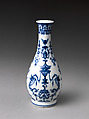
The vase is decorated with three vignettes composed of motifs derived from Chinese porcelains of the Kangxi period (1662–1722). In each vignette, vases are supported by or grouped around low tables. Two of the vases are based on the ancient Chinese bronze gu form; the other, more familiar vase shapes support stylized flowers and vegetation.[9] The most distinctive feature of the vase’s decorative scheme is the appearance of motifs in one of the vignettes that are taken either from Du Cerceau or from closely related imagery. A standing swan with outspread wings and a downward-curved neck is based on a larger composition in Du Cerceau’s Livre de Grotesques;[10] the winged snail near the base and the two satyrs are strongly reminiscent of motifs found elsewhere in Du Cerceau’s work.[11] It is unclear as to why these motifs would have been chosen for use in combination with imagery commonly found on Chinese porcelains of the seventeenth century, as the Du Cerceau motifs seem to exist entirely independent of the Chinese vases and tables that are the primary decoration of the vase.
Furthermore, it is difficult to explain why motifs from the works of Du Cerceau, which had been executed approximately one hundred and fifty years earlier, would have been selected for use on Saint- Cloud porcelain.[12] While grotesque decoration was fashionable in French court circles during the late seventeenth century, it is unclear if Du Cerceau’s prints were still readily available at that time. It is even less clear how the painters at the factory would have had access to Du Cerceau’s works, especially as their use implies a level of sophisticated taste that is remarkable for a small, experimental enterprise in its first decade of production. In any event, Du Cerceau’s motifs disappear from the decorative vocabulary at Saint-Cloud by the second decade of the eighteenth century to be replaced by more Baroque ornamental schemes that reflect a different style of employing motifs derived from both Renaissance art and from Chinese porcelain.
Footnotes
(For key to shortened references see bibliography in Munger, European Porcelain in the Metropolitan Museum of Art. NY: The Metropolitan Museum of Art, 2018)
1 See Rondot 1999b, p. 19.
2 See Bertrand Rondot in Rondot 1999a, pp. 124–41, nos. 16–33.
3 Le Corbeiller 1999b, p. 43.
4 Rondot in Rondot 1999a, pp. 118–19, nos. 6, 7.
5 See Le Corbeiller 1999b.
6 See French Renaissance in Prints 1994, pp. 371–72, no. 123.
7 Rondot in Rondot 1999a, p. 264.
8 Ibid.
9 For very similar motifs used on Saint- Cloud porcelain, see Sotheby Parke Bernet, New York, sale cat., December 3, 4, and 6, 1975, no. 230, and a vase in the Gardiner Museum, Toronto (G97.4.1).
10 From Du Cerceau’s Livre de Grotesques; see MMA 23.34.2(52), illustrated in Le Corbeiller 1999b, fig. 3- 6.
11 Clare Le Corbeiller has noted that the painters at Saint-Cloud copied Du Cerceau’s motifs faithfully, so it is likely that a specific source exists in his work that has not yet been located; Le Corbeiller, unpublished notes in the curatorial files, Department of European Sculpture and Decorative Arts, The Metropolitan Museum of Art, New York.
12 Le Corbeiller 1999b, p. 45.
Artwork Details
- Title: Vase
- Manufactory: attributed to Saint-Cloud factory (French, mid-1690s–1766)
- Decorator: Decoration after a design by Jacques Androuet Du Cerceau (French, Paris 1510/12–1585 Annecy)
- Date: ca. 1695–1710
- Culture: French, probably Saint-Cloud
- Medium: Soft-paste porcelain decorated in underglaze blue
- Dimensions: Overall (confirmed): 8 1/16 × 6 7/8 × 6 7/8 in. (20.5 × 17.5 × 17.5 cm)
- Classification: Ceramics-Porcelain
- Credit Line: Gift of J. Pierpont Morgan, 1917
- Object Number: 17.190.1911
- Curatorial Department: European Sculpture and Decorative Arts
More Artwork
Related Content
 Free to download
Research Resources
The Met provides unparalleled resources for research and welcomes an international community of students and scholars. The Met's Open Access API is where creators and researchers can connect to the The Met collection. Open Access data and public domain images are available for unrestricted commercial and noncommercial use without permission or fee.
To request images under copyright and other restrictions, please use this Image Request form.
Feedback
We continue to research and examine historical and cultural context for objects in The Met collection. If you have comments or questions about this object record, please contact us using the form below. The Museum looks forward to receiving your comments.
Content Notice
The Metropolitan Museum of Art presents over 5,000 years of art from around the world, and our online collection reflects ongoing work conducted over the course of our more than 150-year history. You may encounter objects or images that may be inappropriate for some viewers or information that may be outdated.