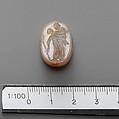
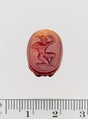
Scaraboide raffigurante un arciere che esamina una freccia
Artwork Details
- Titolo: Scaraboide raffigurante un arciere che esamina una freccia
- Artista: Attribuito ad Epimene
- Data: ca. 500 a.C.
- Cultura: Grecia
- Materiale e tecnica: Calcedonio
- Dimensioni: 1,7 cm
- Crediti: Fletcher Fund, 1931
- Numero d'inventario: 31.11.5
- Curatorial Department: Greek and Roman Art
Audio
1030. Chalcedony scaraboid
The ancient Greeks impressed carved gems, like the left-hand object in this pair, in clay or wax. The gems were personal seals, and the impressions they made identified people, as our signatures do today. On the right, you see a modern impression of the gem with the design reversed.
The material is chalcedony, a quartz hardstone suited to the rendering of fine details but difficult to carve with such precision. The artist who made this gem described a minute figure in remarkable detail with only the simplest tools. The gem displays in miniature the same fine workmanship that distinguishes the best Greek art on any scale.
The same imagery and principles of design that inform Greek art in other media also apply to Greek gems. The sinewy male nude here has many counterparts in vase-painting; compare it to the figures you see depicted elsewhere in this gallery. Like them, this youth testing his arrow is endowed with both a powerful body and a sense of purpose. His pose helps him perform his activity with ease and also turns his body into a compact shape, a perfect match for the oval field he occupies.
More Artwork
Related Content

Research Resources
The Met provides unparalleled resources for research and welcomes an international community of students and scholars. The Met's Open Access API is where creators and researchers can connect to the The Met collection. Open Access data and public domain images are available for unrestricted commercial and noncommercial use without permission or fee.
To request images under copyright and other restrictions, please use this Image Request form.
Feedback
We continue to research and examine historical and cultural context for objects in The Met collection. If you have comments or questions about this object record, please contact us using the form below. The Museum looks forward to receiving your comments.
Content Notice
The Metropolitan Museum of Art presents over 5,000 years of art from around the world, and our online collection reflects ongoing work conducted over the course of our more than 150-year history. You may encounter objects or images that may be inappropriate for some viewers or information that may be outdated.