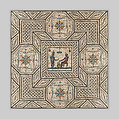
Mosaic floor panel
Artwork Details
- Title: Mosaic floor panel
- Period: Imperial
- Date: 2nd century CE
- Culture: Roman
- Medium: Stone, tile, and glass
- Dimensions: H. 89 in. (226.1 cm); width 99 in. (251.5 cm)
- Classification: Miscellaneous-Mosaic
- Credit Line: Purchase, Joseph Pulitzer Bequest, 1938
- Object Number: 38.11.12
- Curatorial Department: Greek and Roman Art
Audio
1076. Mosaic floor panel
Mosaic floors, like this one, were part of everyday life in ancient Rome. They were a common feature of Roman houses and public buildings. This mosaic panel probably decorated the entranceway to the central courtyard of a Roman villa. The mosaic was discovered in an olive grove at the site of Daphne, a popular vacation spot in Roman times. Wealthy Romans living in Antioch, the major city in Roman Syria, flocked to Daphne to escape the noise and heat of the big city. Here, they built vacation homes, and decorated them with colorful and ornate wall paintings and mosaic floors.
The Romans, however, made a distinction between mosaics and wall paintings like the ones you might have seen in the other galleries. They considered mosaic a more public form of art, one that the master or mistress of the house could share with visitors. As a respectable Roman, you really would not show a visitor the wall paintings that decorated your bedroom and other private areas of your home. On the other hand, you’d very likely call attention to mosaics, like this one, in your courtyard or dining area where you entertained your guests. These elaborate mosaic floors were another way to impress others with one’s wealth and social standing.
More Artwork
Related Content
Research Resources
The Met provides unparalleled resources for research and welcomes an international community of students and scholars. The Met's Open Access API is where creators and researchers can connect to the The Met collection. Open Access data and public domain images are available for unrestricted commercial and noncommercial use without permission or fee.
To request images under copyright and other restrictions, please use this Image Request form.
Feedback
We continue to research and examine historical and cultural context for objects in The Met collection. If you have comments or questions about this object record, please contact us using the form below. The Museum looks forward to receiving your comments.
Content Notice
The Metropolitan Museum of Art presents over 5,000 years of art from around the world, and our online collection reflects ongoing work conducted over the course of our more than 150-year history. You may encounter objects or images that may be inappropriate for some viewers or information that may be outdated.