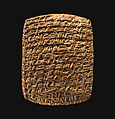
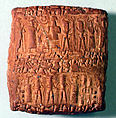
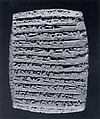
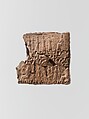
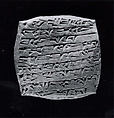
Cuneiform tablet case impressed with four cylinder seals, for cuneiform tablet 66.245.15a: quittance
This case once enclosed a cuneiform tablet (66.245.15a) which recorded the repayment of a loan from Karriya and Ashur-nada. The repayment of 9 ½ minas of silver was made in Kanesh, and because the tablet recording the original details of the loan was still in Ashur, this quittance was written to record completion of the transaction. The tablet is impressed with four cylinder seals belonging to the three witnesses to the loan repayment as well as Assur-tab, the son of Karriya who facilitated in the repayment. The variety of cylinder seals used on the envelope is typical of the artistic creativity and flexibility present at Kültepe. Two of the seals belong to the Old Assyrian stylistic tradition: the first depicts nude belted heroes bearing a flowing vase before a seated deity and the second depicts a procession of divine and human figures before a seated deity. The cuneiform inscription on this seal reads: “Puzur-Ishtar, son of Shu-Anum, the overseer”; a person not actually involved in the transaction. During the Old Assyrian period, seals inscribed with personal names were less common and when present, did not always correlate to the seal owner.
The third impression is from an Anatolian style seal with imagery borrowed from the traditional Mesopotamian presentation scene: a seated figure in a conical cap is approached by a kneeling male holding a bird-headed standard, and a Mesopotamian bull man wrestles a lion by its tail. The scene also includes an Anatolian weather god holding a cup and the reins of the bull on which he stands. Furthermore, the field of the images is filled with numerous animals and animal parts floating at all angles and the figures are rendered in a less linear style than that of the Assyrian tradition.
The fourth impression is from a cylinder seal belonging to a royal official of the Ur III king Ibbi-Sin. The inscription, framed in two registers and written in Sumerian, identifies the original owner of the seal: “Ibbi-Sin, the valiant king, the king of Ur, the king of the four quarters (of the world), Ur-lugal-banda, the scribe, son of Ur-nigin-gar, is your servant.” The image is a presentation scene in which the interceding goddess Lamma leads a worshipper toward the deified king. Ur III-period seals were used by Old Assyrian merchants as heirloom items and in some cases the legend was erased and re-cut with that of the new owner. In this example, the original inscription was left intact.
Artwork Details
- Title: Cuneiform tablet case impressed with four cylinder seals, for cuneiform tablet 66.245.15a: quittance
- Period: Middle Bronze Age–Old Assyrian Trading Colony
- Date: ca. 20th–19th century BCE
- Geography: Anatolia, probably from Kültepe (Karum Kanesh)
- Culture: Old Assyrian Trading Colony
- Medium: Clay
- Dimensions: 5.6 x 4.6 x 2.5 cm (2 1/4 x 1 3/4 x 1 in.)
- Credit Line: Gift of Mr. and Mrs. J. J. Klejman, 1966
- Object Number: 66.245.15b
- Curatorial Department: Ancient West Asian Art
More Artwork
Related Content
 Free to download
Research Resources
The Met provides unparalleled resources for research and welcomes an international community of students and scholars. The Met's Open Access API is where creators and researchers can connect to the The Met collection. Open Access data and public domain images are available for unrestricted commercial and noncommercial use without permission or fee.
To request images under copyright and other restrictions, please use this Image Request form.
Feedback
We continue to research and examine historical and cultural context for objects in The Met collection. If you have comments or questions about this object record, please contact us using the form below. The Museum looks forward to receiving your comments.
Content Notice
The Metropolitan Museum of Art presents over 5,000 years of art from around the world, and our online collection reflects ongoing work conducted over the course of our more than 150-year history. You may encounter objects or images that may be inappropriate for some viewers or information that may be outdated.