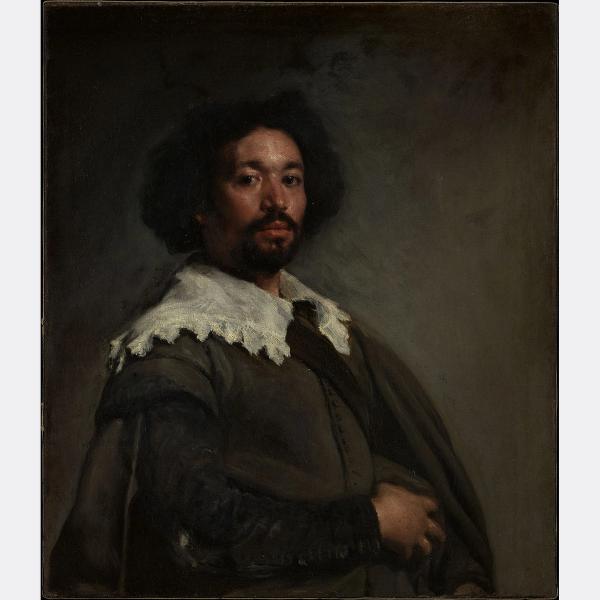
Juan de Pareja (1606–1670)
Artwork Details
- Titolo: Juan de Pareja (1606–1670)
- Artista: Velázquez (Diego Rodríguez de Silva y Velázquez), Spagnolo, 1599-1660
- Data: 1650
- Materiale e tecnica: Olio su tela
- Dimensioni: 81,3 x 69,9 cm
- Crediti: Acquistato, fondi Fletcher e Rogers, e lascito di Miss Adelaide Milton de Groot (1876-1967), con permuta, integrato da donazioni di amici del Museo, 1971
- Numero d'inventario: 1971.86
- Curatorial Department: European Paintings
Audio
5180. Juan de Pareja
Velázquez, 1650
STEPHANIE ARCHANGEL: It’s a very fierce painting. He’s fiercely looking at you. And he has a very piercing look. He’s really making his presence be felt.
My name is Stephanie Archangel and I’m a curator at the history department at the Rijksmuseum.
If you look at paintings from the seventeenth century, black people would mostly be looking down or up towards the white sitter, but not having this one-on-one connection with you as you are standing in front of it.
NARRATOR: During this period, many European paintings played to stereotypes in images of people of African descent.
DAVID PULLINS: This painting, by contrast, is truly a portrait.
NARRATOR: At the same time, when the artist Juan de Pareja sat for this portrait, he was enslaved by the man who painted him, Velázquez. Associate Curator David Pullins.
DAVID PULLINS: We can assume certain things about their relationship, but we do at the end of the day know that this is indeed a painting of a man who's enslaved by the person who paints it.
NARRATOR: Soon after the portrait was completed, Velázquez signed papers that freed Juan de Pareja.
DAVID PULLINS: And he establishes his own career as a painter. A large number of works by Juan de Pareja survive, largely in Spain, some of them enormous, over eleven feet wide, that really attest to both his ambition and his success as an artist in his own right.
STEPHANIE ARCHANGEL: People always ask this question like, did this painting give him his humanity and therefore did Velázquez free him as a person? And it’s almost like, do we think that Velázquez would have only seen his humanity after he painted that painting? He was working with him day and night, he was a talented painter and I bet Velázquez also saw that.
Listen to more about this artwork
More Artwork
Related Content

 Free to download
Research Resources
The Met provides unparalleled resources for research and welcomes an international community of students and scholars. The Met's Open Access API is where creators and researchers can connect to the The Met collection. Open Access data and public domain images are available for unrestricted commercial and noncommercial use without permission or fee.
To request images under copyright and other restrictions, please use this Image Request form.
Feedback
We continue to research and examine historical and cultural context for objects in The Met collection. If you have comments or questions about this object record, please contact us using the form below. The Museum looks forward to receiving your comments.
Content Notice
The Metropolitan Museum of Art presents over 5,000 years of art from around the world, and our online collection reflects ongoing work conducted over the course of our more than 150-year history. You may encounter objects or images that may be inappropriate for some viewers or information that may be outdated.