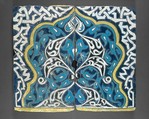
Twelve-Pointed Star-Shaped Tile
Artwork Details
- Title: Twelve-Pointed Star-Shaped Tile
- Date: dated 846 AH/1442–43 CE
- Geography: Attributed to Iran, Khargird
- Medium: Stonepaste; polychrome glaze within black wax resist outlines (cuerda seca technique)
- Dimensions: H. 15 7/8 in. (40.3 cm)
W. 15 7/8 in. (40.3 cm)
D. 1 1/4 in. (3.2 cm) - Classification: Ceramics-Tiles
- Credit Line: Gift of Philip M. Lydig, 1917
- Object Number: 17.143.1
- Curatorial Department: Islamic Art
Audio
6711. Star-shaped Tile
DENISE-MARIE TEECE: Hello, my name is Denise-Marie Teece… I'm here today with my colleague, Denise Beyazit. Can I ask you: why are all of these tiles together in this case?
DENIZ BEYAZIT: They're all of the same period. They're from the Timurid period. They come from Central Asia, 15th Century. They all come from a building, so from different buildings. And each one… has been created in a different technique. For example, the one which looks like it's a star…in the shape of a twelve-pointed star…this technique is called cuerda seca which is actually a technique where… you draw a line…which helps to separate the colors so they don't fusion together. And they liked to have the walls, all the visible surfaces; they were covered and decorated by these tiles. So that's another particularity of Timurid architecture. They built huge buildings; it was really a monumental style. And so like these three tiles we have here in the case; you have to imagine… let's say, the one which has this strange, curve, which looks like a part of a small circular, shape.
DENISE-MARIE TEECE: It also looks like a puzzle piece.
DENIZ BEYAZIT: Exactly. That is entirely covered by turquoise color. That probably comes from a dome… from an entrance gate. And you have to imagine like… hundreds of them. And they form a kind of honeycomb covering above the entrance.
More Artwork
Related Content
 Free to download
Research Resources
The Met provides unparalleled resources for research and welcomes an international community of students and scholars. The Met's Open Access API is where creators and researchers can connect to the The Met collection. Open Access data and public domain images are available for unrestricted commercial and noncommercial use without permission or fee.
To request images under copyright and other restrictions, please use this Image Request form.
Feedback
We continue to research and examine historical and cultural context for objects in The Met collection. If you have comments or questions about this object record, please contact us using the form below. The Museum looks forward to receiving your comments.
Content Notice
The Metropolitan Museum of Art presents over 5,000 years of art from around the world, and our online collection reflects ongoing work conducted over the course of our more than 150-year history. You may encounter objects or images that may be inappropriate for some viewers or information that may be outdated.