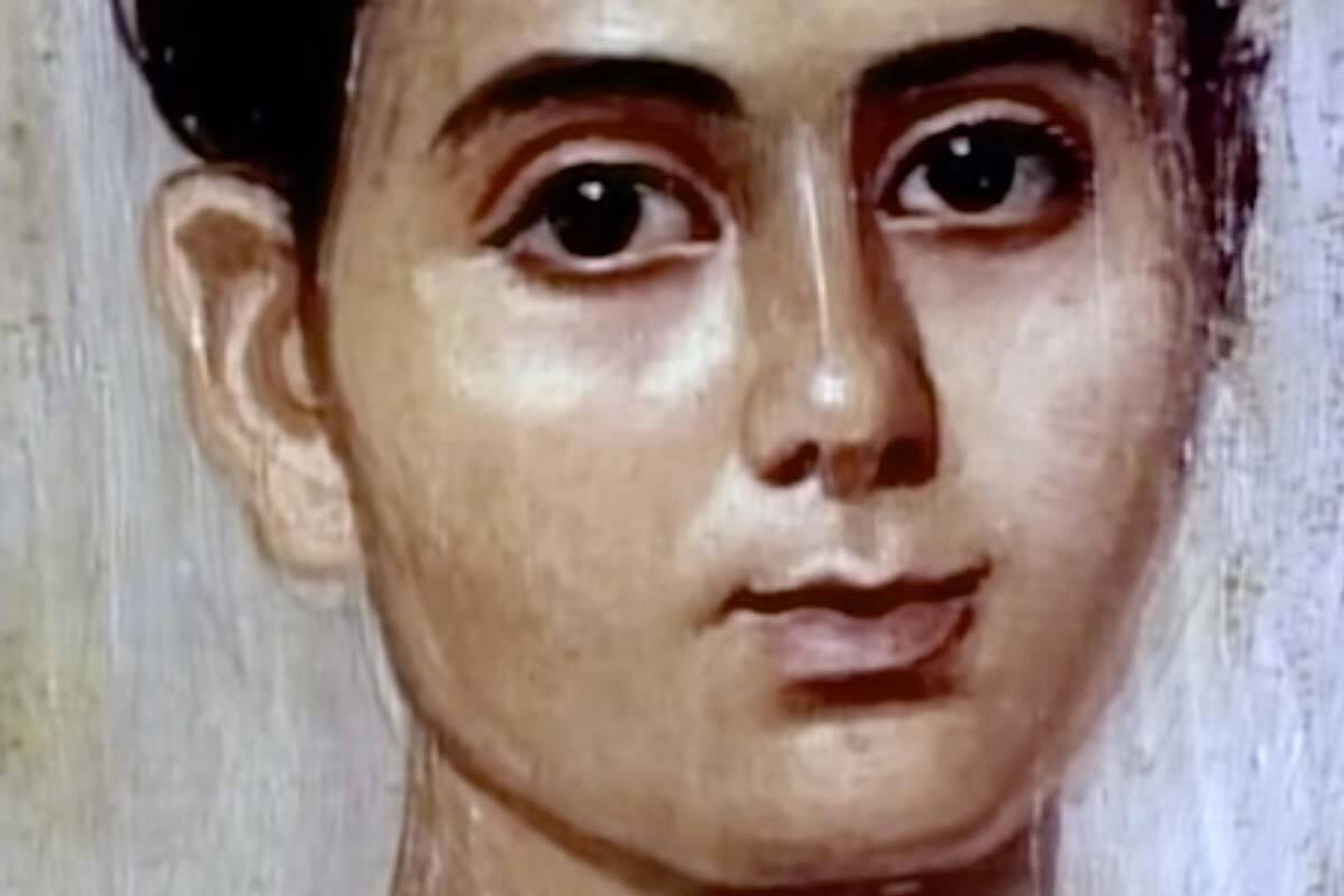
Ritratto per la mummia di Eutiche
Artwork Details
- Titolo: Ritratto per la mummia di Eutiche
- Periodo: Epoca romana
- Data: 100-150 d.C.
- Materiale e tecnica: Decorato a fuoco su legno, pittura
- Dimensioni: 38 x 19 cm
- Crediti: Dono di Edward S. Harkness, 1918
- Numero d'inventario: 18.9.2
- Curatorial Department: Egyptian Art
Audio
3536. Portrait of the Boy Eutyches
NARRATOR: The portrait of this smooth-faced young boy is particularly fine. It was made to be included in the wrappings covering his mummified body. Across the neck of his white tunic we see a painted inscription. The Greek letters seem to follow the folds of cloth. They tell us his name: Eutyches, and that he was a freed slave. Roger Bagnall is professor of Greek and ancient history at Columbia University.
ROGER BAGNALL: Only a small percentage of the mummy portraits have names on them; and Eutyches is an unusual portrait in that it not only has a name but an inscription that tells us something about who he was. What kind of a name is Eutyches? It’s Greek, actually, it means “Lucky.” And so you might say that Eutyches was a Greek, right? Well, it’s not actually that simple. For one thing he was an ex-slave and probably his parents didn’t give him his name, his owner did. For another, Eutyches is a name often used in Egypt to refer to the god of good luck, Shai, an Egyptian god but referred to in Greek translation.
NARRATION: By the time this portrait was painted— in the second century AD— the Greek and Egyptian cultures had been commingling for generations.
More Artwork

Related Content
Research Resources
The Met provides unparalleled resources for research and welcomes an international community of students and scholars. The Met's Open Access API is where creators and researchers can connect to the The Met collection. Open Access data and public domain images are available for unrestricted commercial and noncommercial use without permission or fee.
To request images under copyright and other restrictions, please use this Image Request form.
Feedback
We continue to research and examine historical and cultural context for objects in The Met collection. If you have comments or questions about this object record, please contact us using the form below. The Museum looks forward to receiving your comments.
Content Notice
The Metropolitan Museum of Art presents over 5,000 years of art from around the world, and our online collection reflects ongoing work conducted over the course of our more than 150-year history. You may encounter objects or images that may be inappropriate for some viewers or information that may be outdated.