English
DonateMembershipTickets

“Takebun,” from the Musical Drama “The New Piece” (Shinkyoku)

early 17th century
Not on view
These screens depict the “Takebun” episode of The New Piece (Shinkyoku), an example of the kōwakamai type of musical drama popular in the 1500s. Originally derived from the historical epic Taiheiki and later adapted into a Noh play, the tragic episode centers on the hero Takebun, the bravest and most loyal retainer of an imperial prince. In the right screen, Takebun, the repeated figure wearing a green robe, attempts to rescue the prince’s wife, who has been kidnapped by a samurai. Unable to save her, Takebun dies by ritual suicide, a scene depicted in the fifth panel from the right. The left screen represents the events after Takebun’s death, when he transforms into a vengeful spirit that takes the shape of crashing waves to thwart the samurai’s progress.

Artwork Details

Object Information
  • 新曲図屏風
  • Title: “Takebun,” from the Musical Drama “The New Piece” (Shinkyoku)
  • Period: Edo period (1615–1868)
  • Date: early 17th century
  • Culture: Japan
  • Medium: Pair of six-panel folding screens; ink, color, gold and silver leaf on paper
  • Dimensions: Image (each): 61 11/16 in. × 11 ft. 11 5/16 in. (156.7 × 364 cm)
    Overall (each): 67 3/16 in. × 12 ft. 4 13/16 in. (170.7 × 378 cm)
  • Classification: Paintings
  • Credit Line: Mary Griggs Burke Collection, Gift of the Mary and Jackson Burke Foundation, 2015
  • Object Number: 2015.300.104.1, .2
  • Curatorial Department: Asian Art
More Artwork
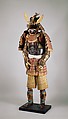
Armor (<i>Gusoku</i>), Saotome Ietada  Japanese, Iron, lacquer, silk, gilt copper, Japanese
Armorer Helmet bowl signed Saotome Ietada
Armorer Breastplate inscribed inside, Myōchin Munesuke
16th and 18th centuries
Autumn Grasses in Moonlight, Shibata Zeshin  Japanese, Two-panel folding screen; ink, lacquer, silver, and silver leaf on paper, Japan
Shibata Zeshin
second half of the 19th century
Helmet (<i>Zukinnari Kabuto</i>), Iron, lacquer, Japanese
Japanese
16th century
Spring Trees and Grasses by a Stream
, One of a pair of six-panel folding screens; ink, color, gold, and silver on paper, Japan
Japan
late 17th–early 18th century
Koto (箏), Metalwork by Goto Teijo, 9th generation Goto master, Japan  Japanese, Various woods, ivory and tortoiseshell inlays, gold and silver inlays, metalwork, cloth, laquer, paper,, Japanese
Metalwork by Goto Teijo, 9th generation Goto master, Japan
Workshop of Gotō Yūjō
early 17th century

Research Resources

The Met provides unparalleled resources for research and welcomes an international community of students and scholars. The Met's Open Access API is where creators and researchers can connect to the The Met collection. Open Access data and public domain images are available for unrestricted commercial and noncommercial use without permission or fee.

To request images under copyright and other restrictions, please use this Image Request form.

Feedback

We continue to research and examine historical and cultural context for objects in The Met collection. If you have comments or questions about this object record, please contact us using the form below. The Museum looks forward to receiving your comments.

Send feedback

Content Notice

The Metropolitan Museum of Art presents over 5,000 years of art from around the world, and our online collection reflects ongoing work conducted over the course of our more than 150-year history. You may encounter objects or images that may be inappropriate for some viewers or information that may be outdated.