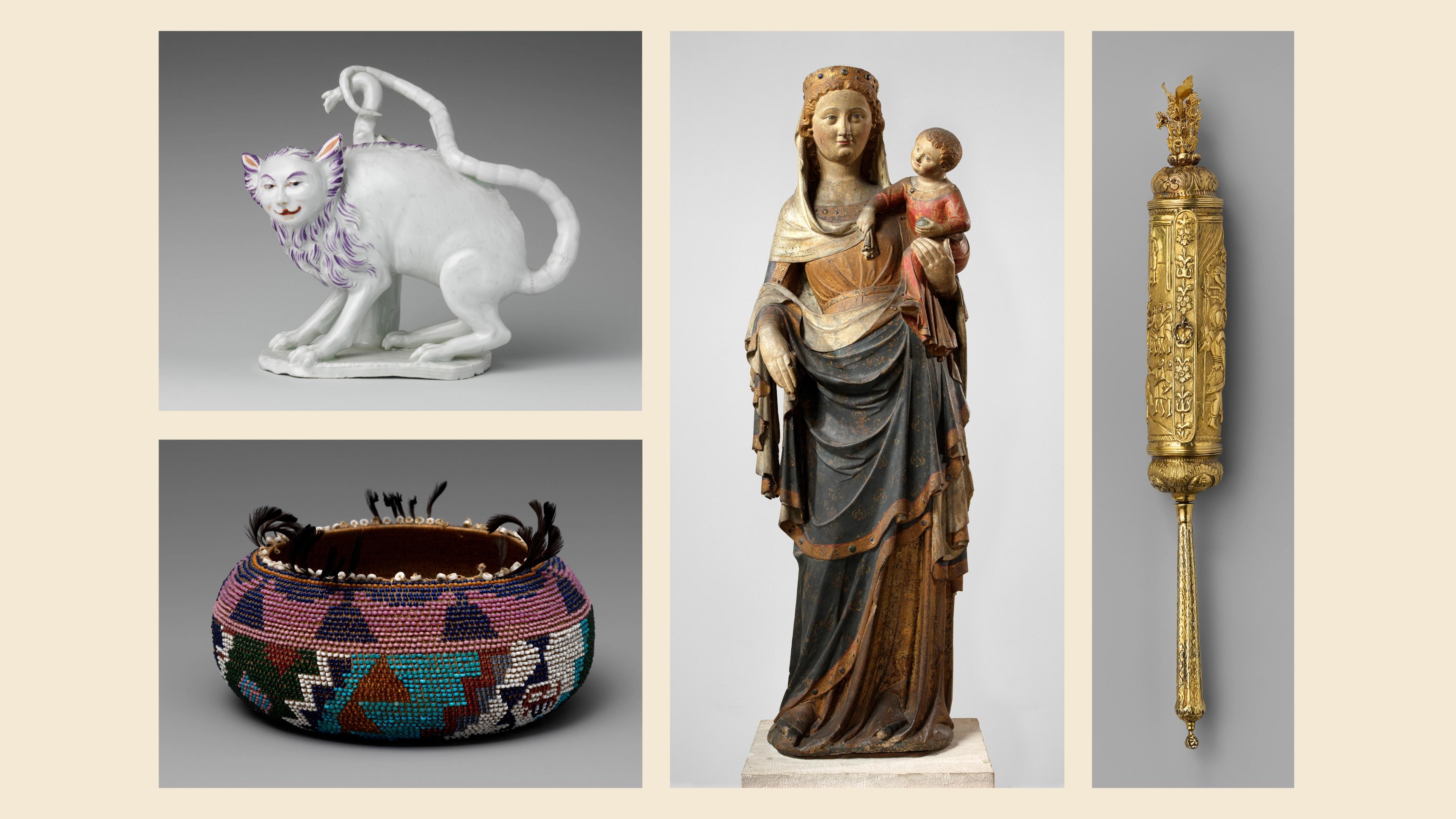
This article marks the eighth International Provenance Research Day, held annually on the second Wednesday of April. Below you will read studies of the history of four very different objects from The Met collection authored by provenance researchers across the Museum. The authors are partners in The Met’s cultural property initiatives, which includes an in-depth review of the history of artworks and cultural artifacts throughout the Museum’s holdings. Each story demonstrates the varied and complex nature of provenance research at The Met, and the context that this scholarship provides our interaction with each artwork.
A much-admired Virgin and Child
The story of a fourteenth-century French sculpture purchased by The Met in 1937 demonstrates how each object has its own complex history. It arrived in New York in October 1935 as a recent purchase by the Brummer Gallery, run by sculptor-turned-art dealer Joseph Brummer, a master at making lucrative sales who was adept at encouraging competition between museums. (The sculpture may, or may not, have been sought after by four separate American art museums.[1]) Both The Met and the Museum of Fine Arts, Boston, were interested, with Boston’s curator Edwin J. Hipkiss describing it in romantic terms in a 1937 correspondence: “My admiration is so great that it comes near to adoration and therefore it is difficult to speak with calm reasoning.” Brummer’s salesmanship was so expert that he sold it to The Met for seventy thousand dollars, five times what he paid for it several years earlier.
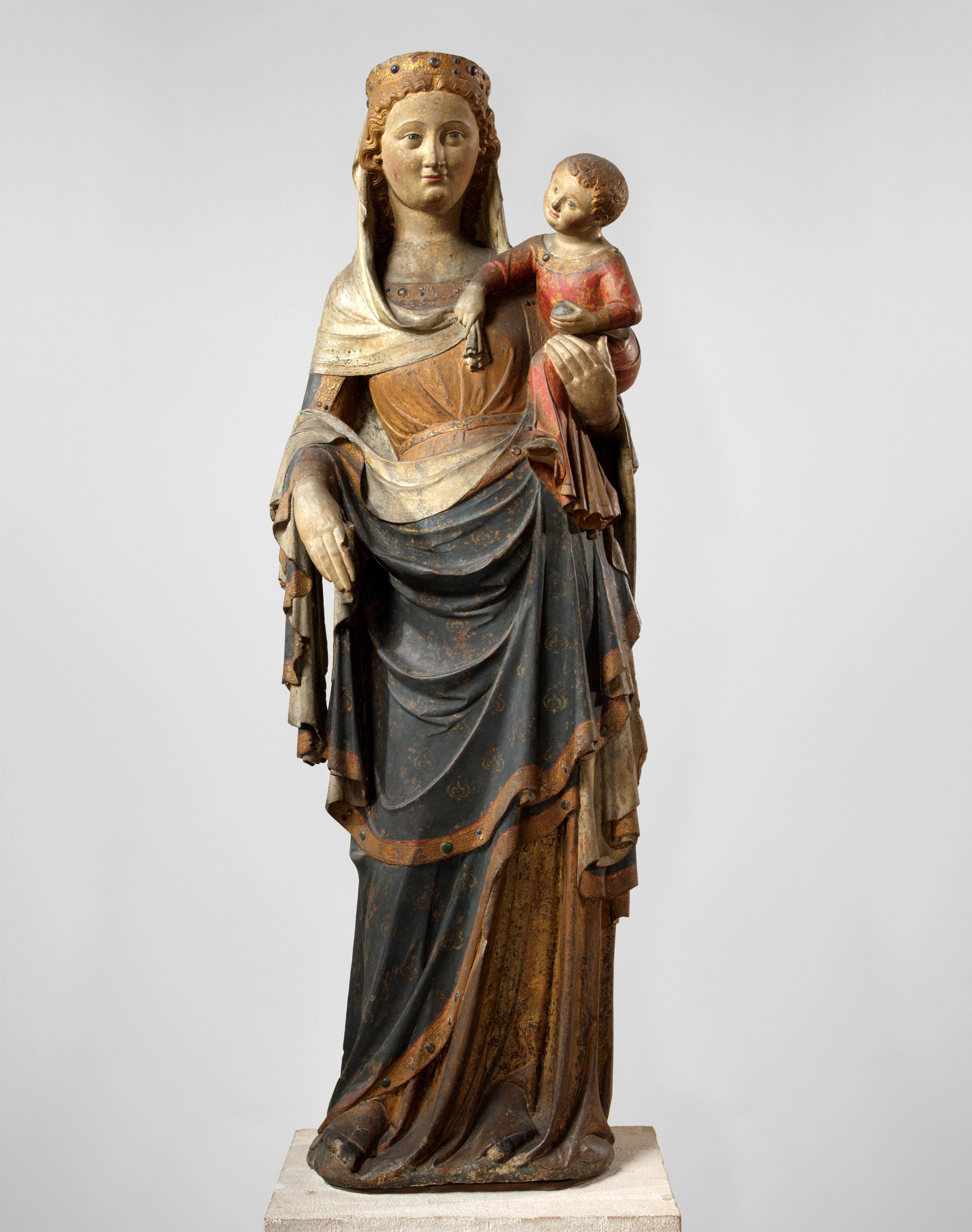
Virgin and Child, ca. 1340–50. French. Probably Paris, Île-de-France, France. Limestone with paint, gilding, and glass, 68 × 22 7/8 × 11 1/4 in. (172.7 × 58 × 28.5 cm). The Metropolitan Museum of Art, New York, The Cloisters Collection, 1937 (37.159)
Prior to this, the sculpture had been with the dealer Nicolas Brimo for a brief period. Brimo came from a family of art merchants of Armenian descent from Constantinople and eventually settled in Paris.[2] By the second decade of the twentieth century, Brimo specialized in selling medieval works of art.[3] He also dealt in works of art sold by continental European museums. The Met’s Virgin and Child reportedly was sold in 1935 by the Berlin Museums as partial payment for select medieval German artworks from the famed Guelph Treasure, a group of medieval objects belonging to the former Duke of Brunswick.[4] While Germany’s decision to sell the sculpture may seem surprising, it was a moment when acquiring German works was of paramount importance to them.
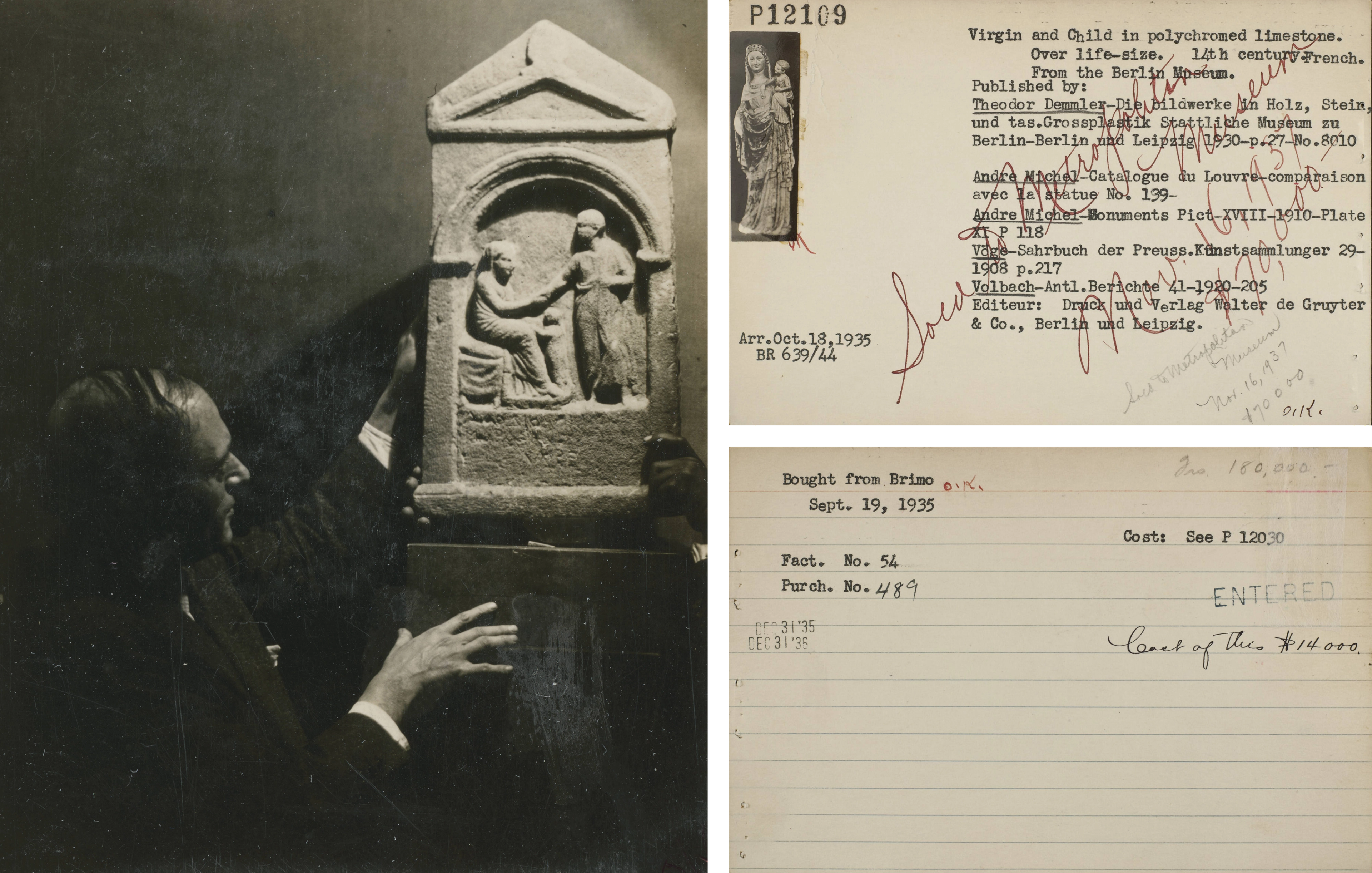
Left: Joseph Brummer, ca. 1925. Detail from stock card P1500. The Met Cloisters, The Brummer Gallery Records. Top right: Brummer Gallery stock card P12109 (recto). The Met Cloisters, The Brummer Gallery Records. Bottom right: Brummer Gallery stock card P12109 (verso). The Met Cloisters, The Brummer Gallery Records
Museum records in Berlin indicate that the sculpture had previously belonged to a man named James Simon (1851–1932), scion of one of the richest families in Germany. Over twenty years, Simon assembled an impressive art collection for display in his villa off Berlin’s Tiergarten. Surviving photographs show the Virgin and Child at his residence alongside other works in his possession, such as the famed bust of Nefertiti, whose excavation he subsidized. Simon gifted works from his personal collection to the Berlin Museums in 1904 and 1918; extant records identify the Virgin and Child as part of his 1918 gift to the Kaiser Friedrich Museum (now called the Bode Museum).[5] Simon, who was Jewish, died before the onset of the Second World War, and his legacy was erased until recently when interest in his significant role in building Germany’s national art collections was once again acknowledged.
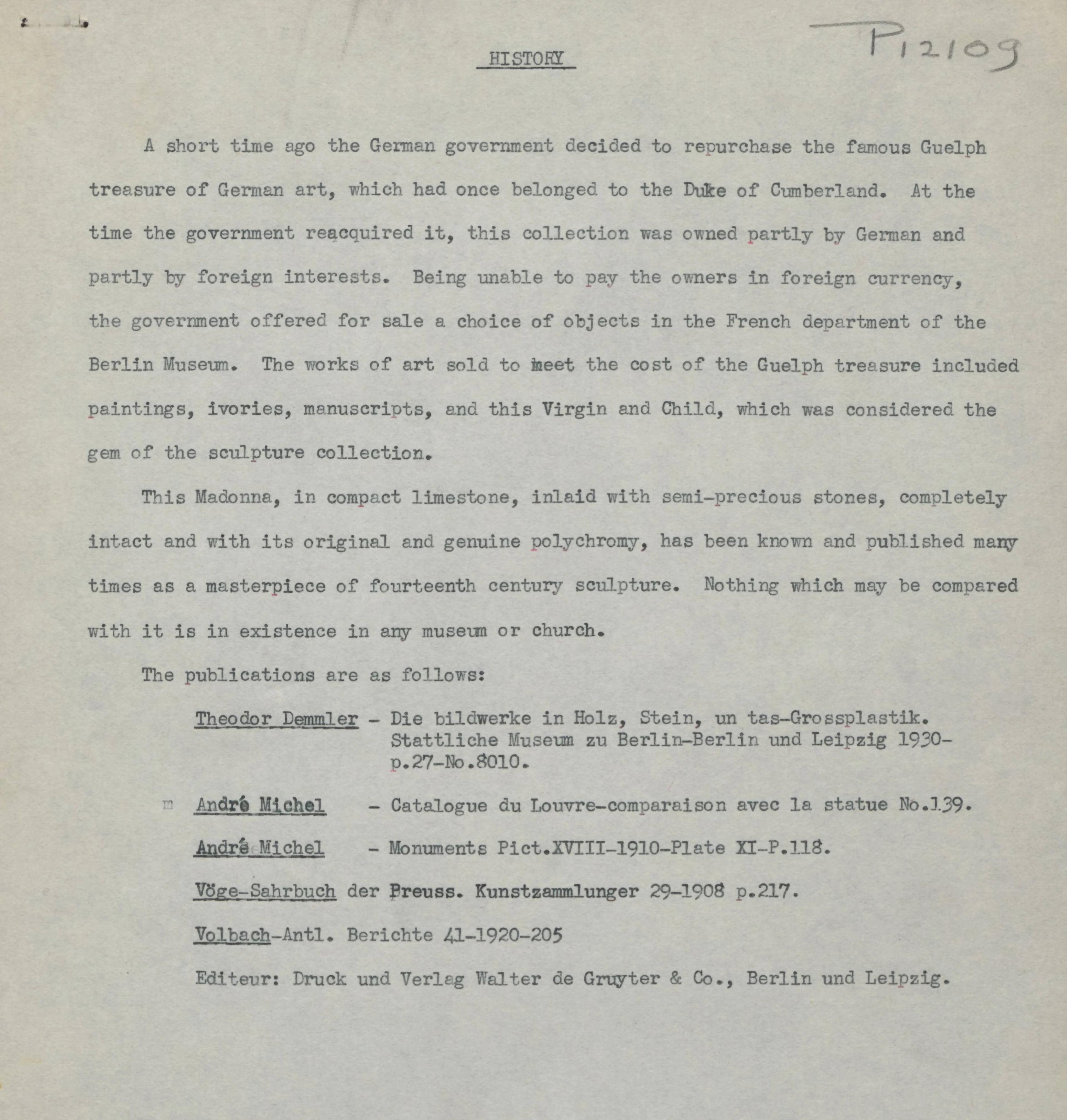
Provenance information for Virgin and Child. Brummer Gallery stock card P12109, The Met Cloisters, The Brummer Gallery Records
One mystery remains about the provenance of our Virgin and Child, however, and that is where and when Simon acquired it. Documentation from the early 1920s states it had belonged to one of the Earls of Caledon. As more private papers and dealer records become available and digitized, it may be possible to discover even more details about the provenance of The Met’s Virgin and Child that captivated curators at two American art museums.
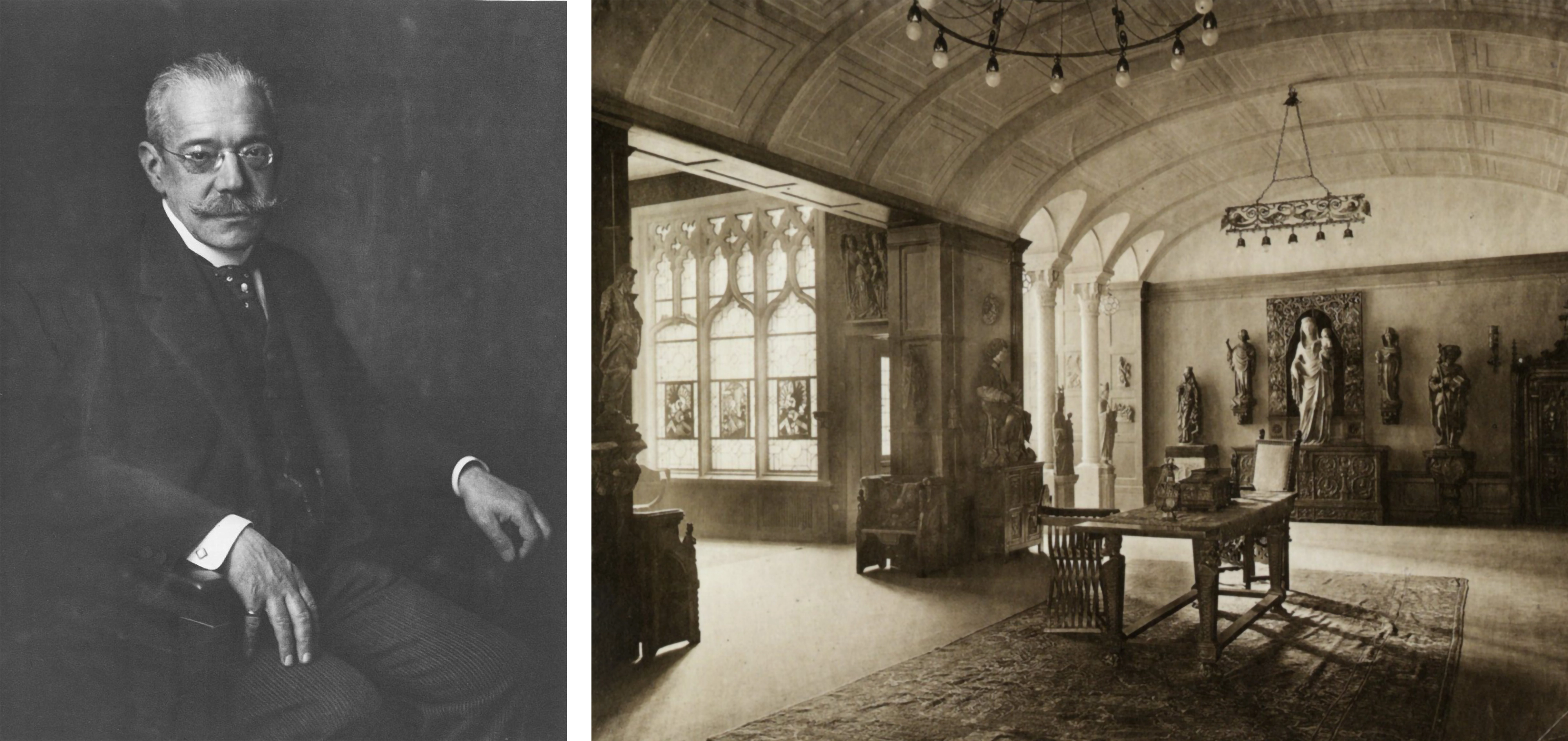
Left: James Simon, ca. 1915. Courtesy Staatliche Museen zu Berlin © Rudolf Dührkoop. Right: Villa James Simon, Berlin-Tiergarten, Tiergartenstrasse 15a, Groundfloor Hall with medieval sculpture, about 1910, Berlin, Zentralarchiv
The Bondy Manticore
In 2025, Monstrous Beauty: A Feminist Revision of Chinoiserie opened at The Metropolitan Museum of Art. The exhibition invited visitors to reconsider European porcelain as a historical and often fantastical construction of East Asia, placing contemporary artists in dialogue with historical objects. Among these was a small but striking porcelain figure of a manticore (circa 1735), a mythological creature originating in Persian folklore as a merciless predator.
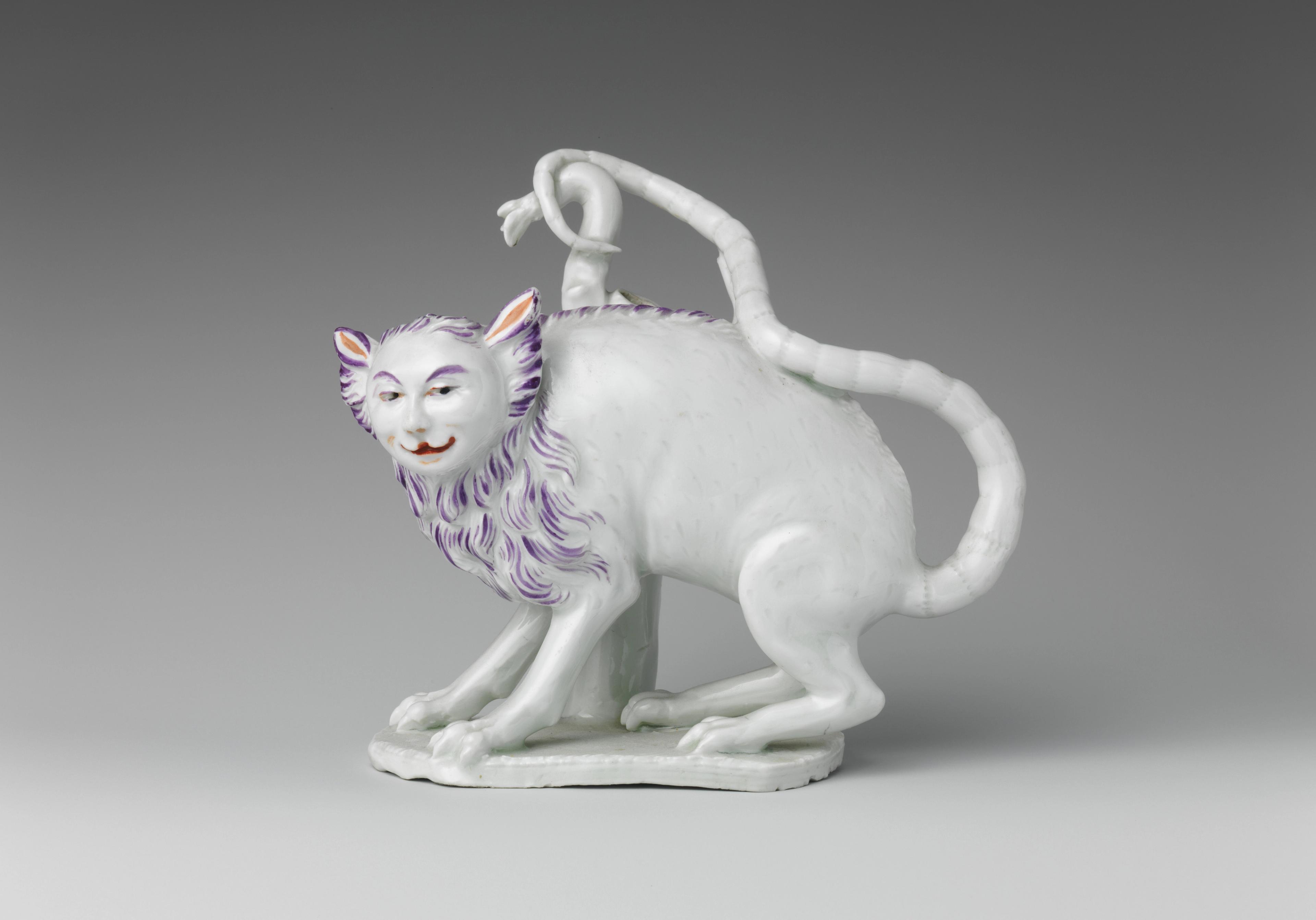
Vienna Porcelain Manufactory, Claudius Innocentius Du Paquier period (Austrian, 1718–1744). Manticore, ca. 1735. Hard-paste porcelain, 4 7/8 in. (12.2 cm). The Metropolitan Museum of Art, New York, The Hans Syz Collection, Gift of Stephan B. Syz and John D. Syz, 1995 (1995.268.310)
Yet the eighteenth-century sculptor of the Vienna Porcelain Manufactory combined the symbolism of this foreign beast with the functional form of a medieval vessel and softened its menace by transforming it into something playful, even seductive. While the leonine body and venomous reptilian tail remain intact, the alluring human face framed by a violet mane makes the creature appear flirtatious more than fearsome, exemplifying the way European porcelain recast the exotic as fantasy.
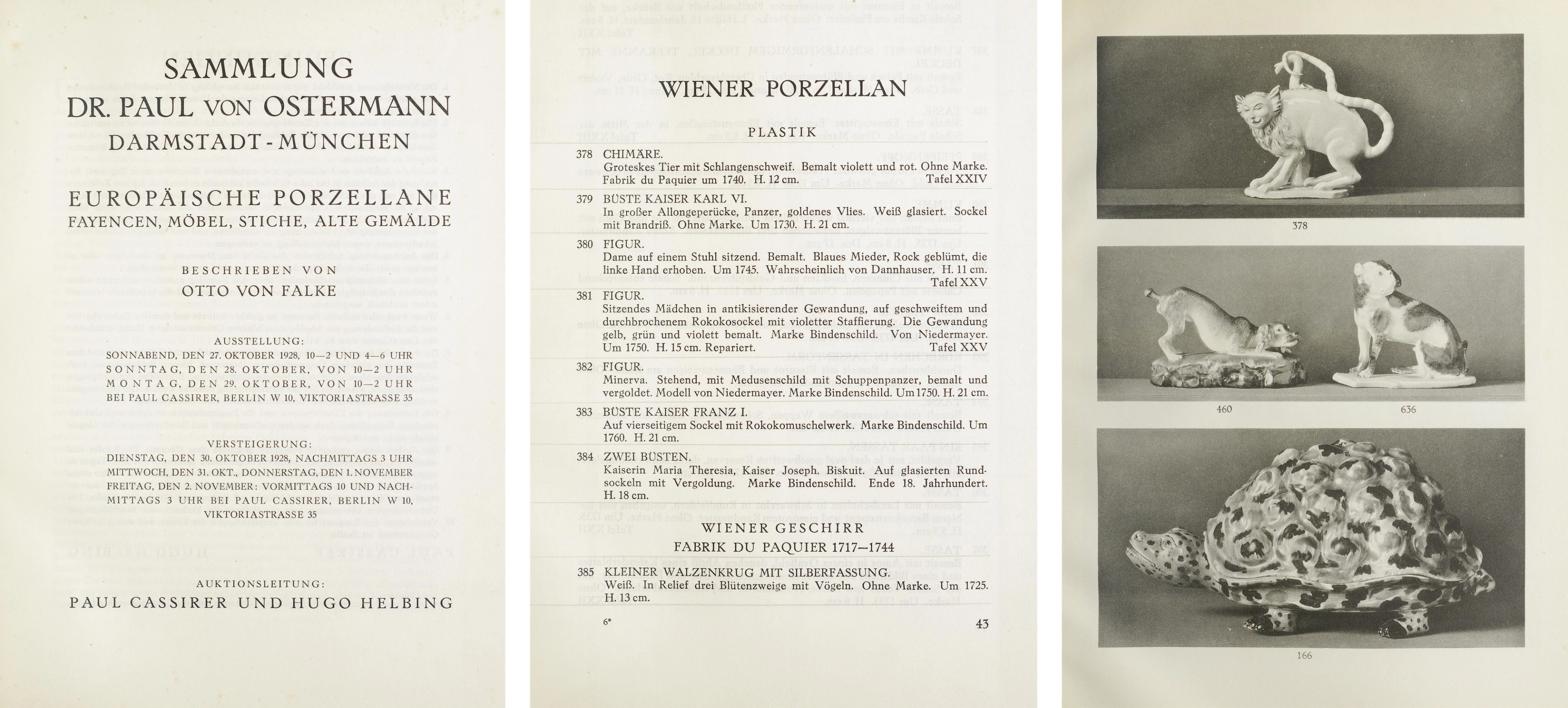
Sammlung Dr. Paul v. Ostermann, Darmstadt – München. Europäische Porzellane, Fayencen, Möbel, Stiche, alte Gemälde, beschrieben von Otto von Falke, pp. g, 43, Tafel 24, 1928. Helbig, Munich. Courtesy Heidelberg University Library
The earliest known chapter of this fascinating object’s provenance places it in the collection of Paul von Ostermann (1852–1927), a German collector renowned for assembling one of the most important collections of European porcelain, particularly painted vessels. After his death, Ostermann’s collection was dispersed at auction in 1928 through the firm of Paul Cassirer and Hugo Helbing in Berlin.[6] The manticore appeared as lot 378, misidentified as a “chimera” and described simply as a “grotesque animal.”[7] An annotation in the auctioneer’s copy of the catalogue records that it sold for the considerable sum of 1,500 Reichsmarks to Martin Schwersenz (1863–1943), a commission agent and art dealer of Jewish origins who probably acted on behalf of Oscar Bondy (1870–1944), a Viennese industrialist and prominent Jewish collector.
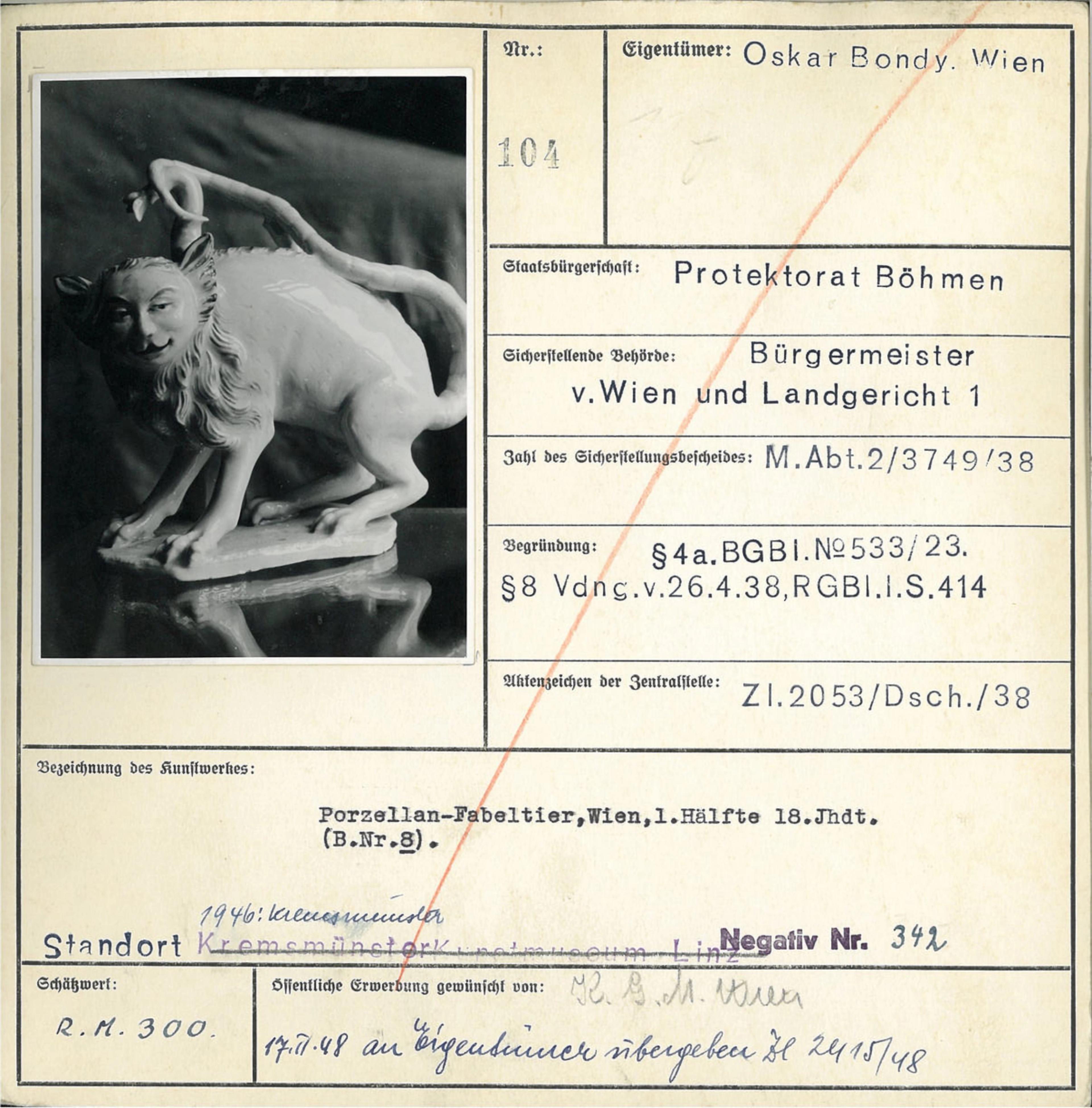
Archiv des Bundesdenkmalamts Wien (BDA-Archiv), Restitutionsmaterialien, Sicherstellungskartei, Oskar Bondy, Nr. 104. © Bundesdenkmalamt Wien
We know the manticore was in Bondy’s possession next because in 1938 it was documented by the Bundesdenkmalamt, the Austrian Federal Monuments Authority that seized his properties—a vast collection of paintings, sculpture, musical instruments, furniture, and decorative arts—from his apartment in Vienna following the annexation of Austria by Nazi Germany. Hundreds of Bondy’s most valuable artworks, including the manticore, were selected for Adolf Hitler’s planned Führermuseum in Linz, a never-realized project intended to house art appropriated from across occupied Europe, while others were distributed to various regional museums in Germany. In the face of persecution, Bondy and his wife, Elizabeth Soinig (1890–1974), fled Vienna first to Czechoslovakia, where Bondy was a citizen, then to Switzerland, and finally to the United States.
Oscar Bondy died in New York in 1944, living in exile. After the war, Elizabeth Bondy pursued restitution claims for the objects seized, eventually obtaining the return of many and putting them back into the art market, where Hans Caspar Syz (1894–1991)—a Swiss-born psychiatrist and a renowned collector of European and Asian porcelain and faience—acquired several ex-Bondy pieces, including the manticore. In 1963, Syz transferred the majority of his collection to the Smithsonian’s National Museum of American History. The manticore, however, was among nearly three hundred ceramics retained by his sons, John and Stephan Syz, who gifted these works to The Met in 1995.
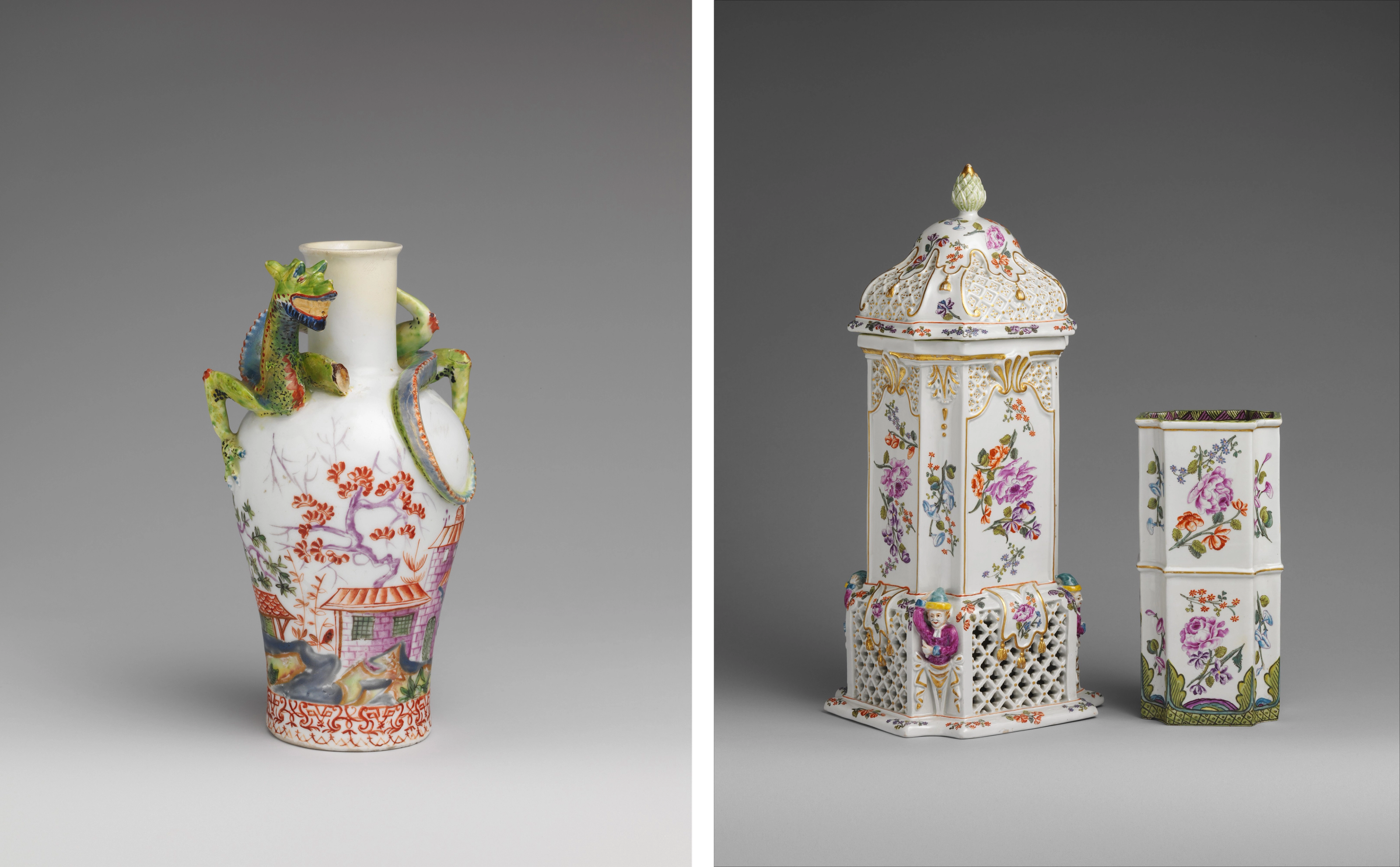
Left: Vienna Porcelain Manufactory, Claudius Innocentius Du Paquier period (Austrian, 1718–1744). Vase (one of a pair), ca. 1725. Hard-paste porcelain, 5 5/8 in. (14.3 cm). The Metropolitan Museum of Art, New York, The Hans Syz Collection, Gift of Stephan B. Syz and John D. Syz, 1995 (1995.268.276). Right: Vienna Porcelain Manufactory, Claudius Innocentius Du Paquier period (Austrian, 1718–1744). Food warmer with insert, ca. 1730–35. Hard-paste porcelain decorated in polychrome enamels, gold, 15 9/16 x 6 5/16 x 6 11/16 in. (39.5 x 16 x 17 cm); Insert: 8 9/16 x 4 1/4 x 3 1/2 in. (21.7 x 10.8 x 8.9 cm). The Metropolitan Museum of Art, New York, Gift of Irwin Untermyer, 1964 (64.101.269a–d)
The Bondy provenance of this object—and of two related works now in the Museum’s holdings (a vase and food warmer)—remained unknown until Monstrous Beauty brought them back into the spotlight last year, allowing us to recognize these porcelains as the same objects photographed by the Bundesdenkmalamt in Vienna in 1938 and offering an opportunity to reexamine the restitution histories of thirty-one ex-Bondy artworks now held by The Met’s Department of European Sculpture and Decorative Arts.
A rare Esther scroll and case
In 2025, The Met acquired a gold Esther scroll and case from the Sassoon collection, which once belonged to a multigenerational mercantile family of Baghdadi Jewish origin. They built one of the largest trade networks during the nineteenth century across the British Empire, from Mumbai to Hong Kong.[8] Their art collection includes textiles, ivories, paintings, ceramics, manuscripts, and Jewish ritual art. As part of a decade-long initiative, the Department of European Sculpture and Decorative Arts has been acquiring Judaica of the highest-quality materials, and craftsmanship. This scroll of Esther is the first to enter the Museum’s collection.
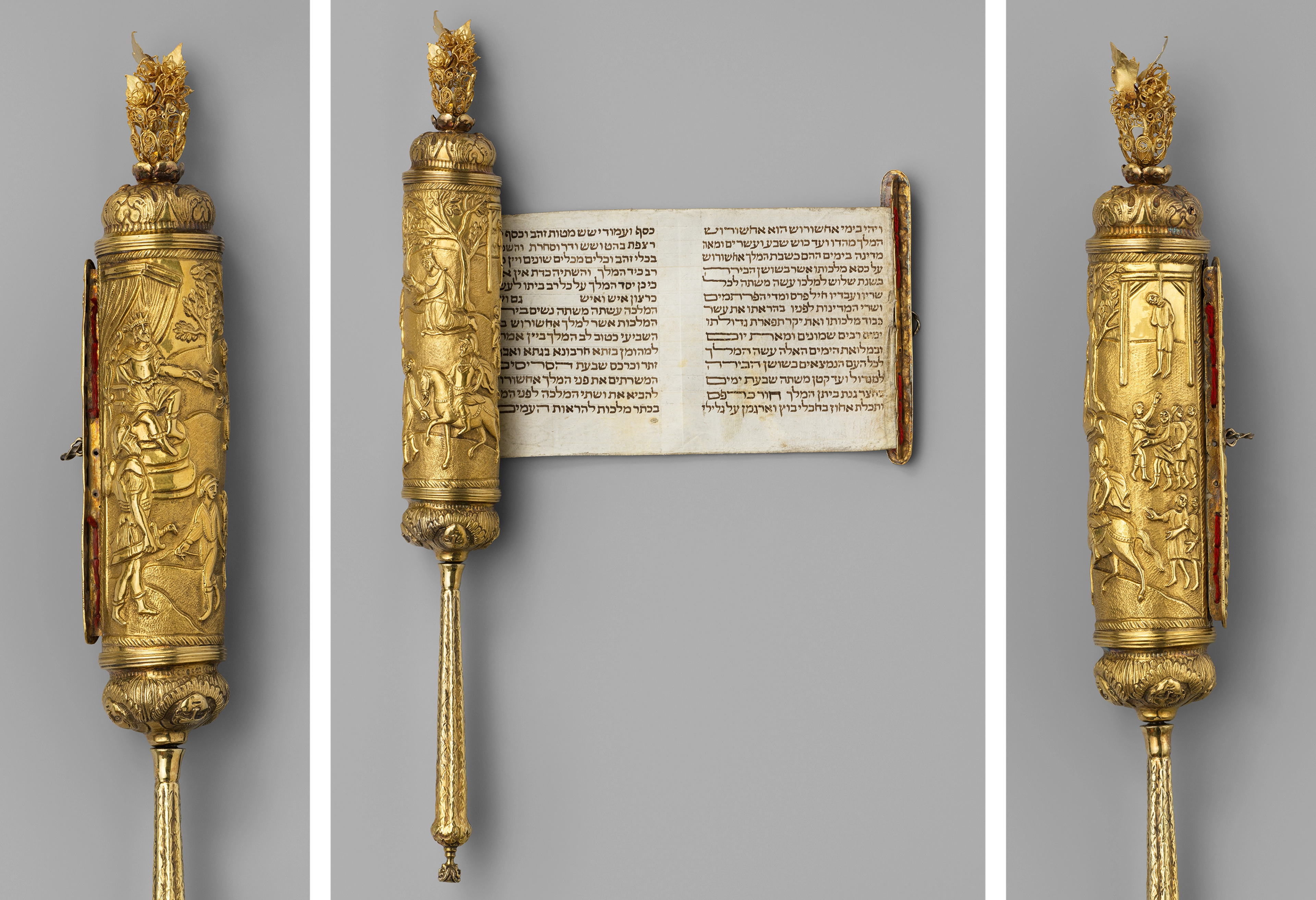
Esther scroll and case, 18th century. Italian. Gold, parchment, case 10 7/8 × 1 1/4 × 1 1/4 in. (27.6 × 3.2 × 3.2 cm). The Metropolitan Museum of Art, New York, Gift of Jane and Stuart Weitzman, in honor of Oscar L. Tang and Agnes Hsu-Tang, 2025 (2025.335a, b)
Manufactured in the eighteenth century for a patron, possibly on the occasion of a wedding, this cylindrical case presents scenes from the story of Esther and protects a parchment scroll. Esther scroll cases are rarely made from gold, and the inclusion of figurative scenes makes this a particularly extraordinary example. On a stippled surface, three bas-relief scenes feature Esther before King Ahasuerus (8:3); Haman leading Mordecai, who is dressed in the king’s robes and on the king’s horse (6:11); and the hanging of Haman (7:8-10). Chased on the lower body, below the narrative scenes, are four upturned, winged cherubim attached to an elongated handle with a Janus head at the bottom. Inside the case, the scroll is wound around a metal dowel that unrolls to over eight feet in length. Standard block Hebrew is meticulously executed on nine separate sheets of parchment. This was not a modified object or intentionally altered but designed for the specific purpose of encasing a scroll of Esther.
This gold case and parchment were first documented in the family collection under the ownership of Reuben David Sassoon (1835–1905), who gifted it to his great-niece and sister-in-law Flora Gubbay Sassoon. In 1858, half of the Sassoon family moved to England to expand their businesses, philanthropic work, and art collecting. Reuben David purchased the Judaica collection of Philip Salomons, whose family had one of the earliest Judaica collections in England. The Salomons were Ashkenazic Jews who emigrated from the Netherlands to England in the eighteenth century and were active members in the Jewish communities of Brighton and London.[9]
While one of the remarkable aspects of this acquisition is its provenance linking to the Sassoon family collection, more research is required to determine where the scroll of Esther was before 1836 if not in the Salomons collection. Since the scroll and case were documented in the Sassoon collection from the nineteenth century and remained in England through World War Two, the Museum was able to acquire the object and add it to the collection. Provenance research relating to Judaica is an ongoing challenge and assumes a particular complexity when applied to Jewish objects marked by displacement, forced migration, confiscation, and systematic looting most notably during the Holocaust. The fragmented or destroyed documentation resulting from these historical challenges complicates efforts to trace clear lineages of ownership.
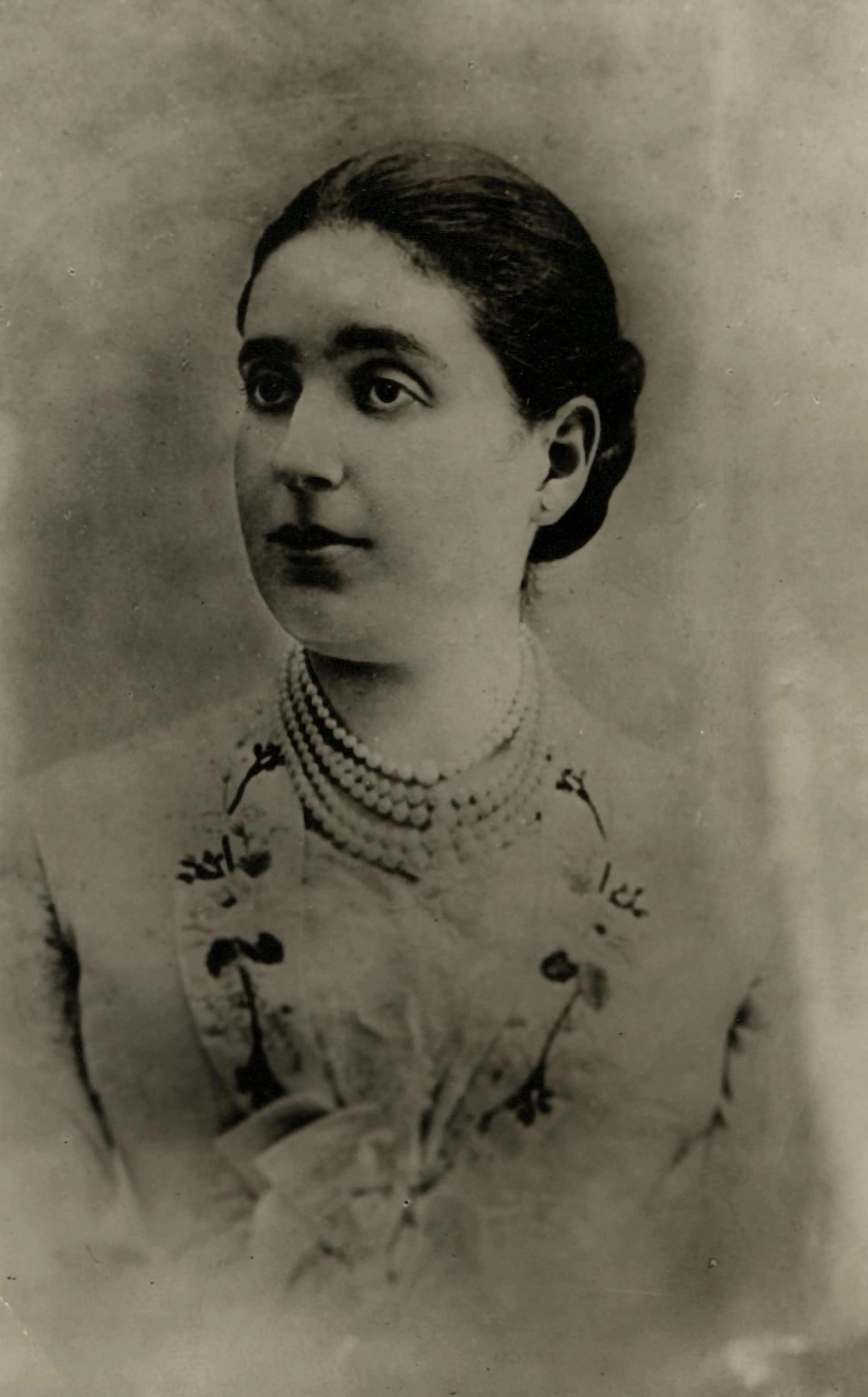
Photograph of Flora Sassoon, ca. 1880–1900, סימול ARC. Ms. Var. Yah 38 12 22 Abraham Shalom Yahuda Archive, Abraham Shalom Yahuda Archive. Courtesy The National Library of Israel
The second known heir of this object was Flora Gabbay Sassoon. She married Solomon Sassoon (brother of Reuben David) in 1876 and inherited Reuben David’s collection of Judaica in 1905. Flora was one of the few women collectors of Judaica and possessed a rare blend of piety, business acumen, and philanthropic interests that challenged traditional expectations placed on women at the turn of the century. Most women in her social position would not have been involved in the family business or collecting but merely observers of these pursuits in a male-dominated environment. This collection was inherited by Flora’s son David Solomon Sassoon, and later passed to his son Rabbi Solomon David Sassoon of Letchworth before being sold at auction in 2020.[10]
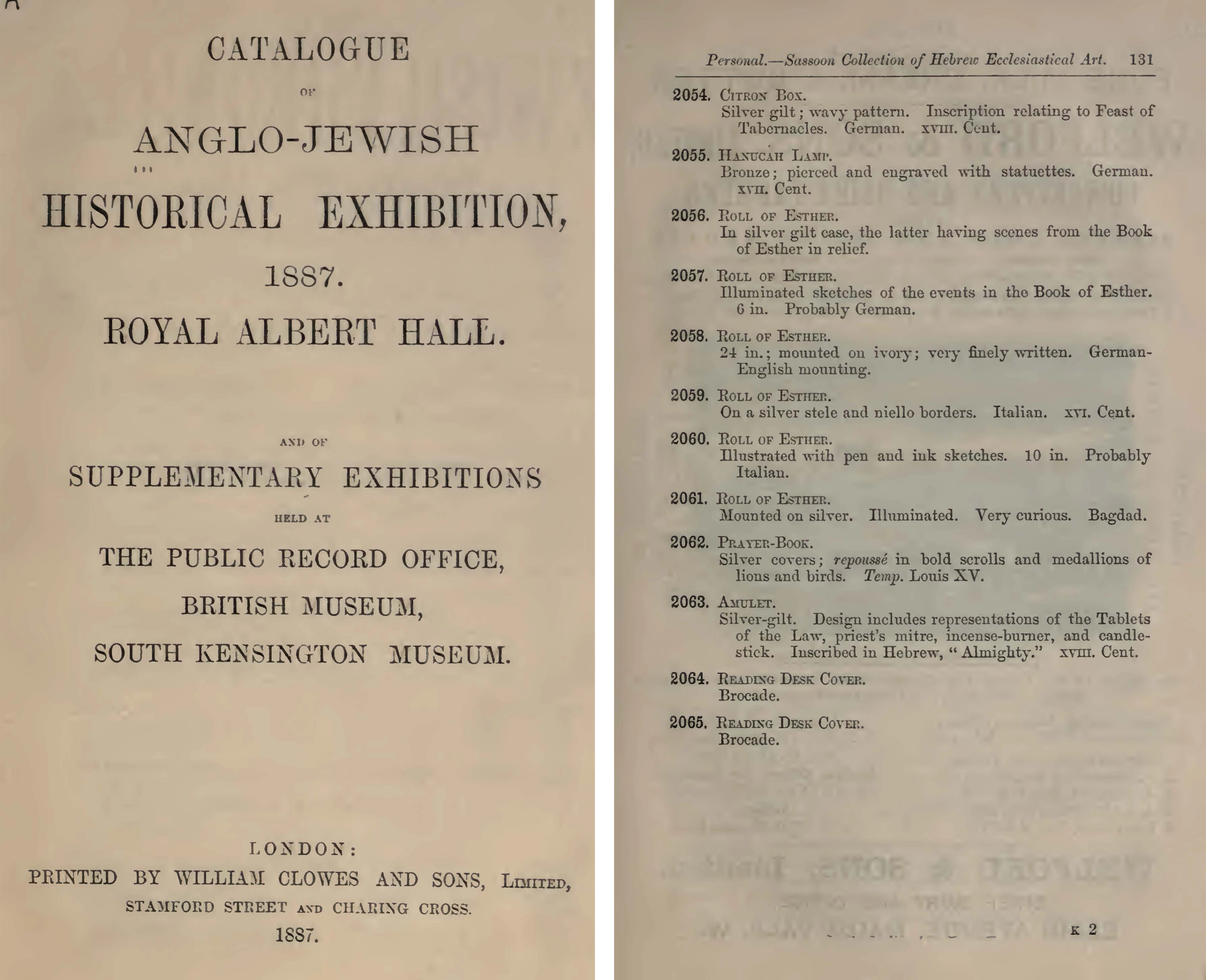
“Personal.—Sassoon Collection of Hebrew Ecclesiastical Art,” no. 2056, p. 131. In Catalogue of Anglo-Jewish Historical Exhibition: 1887, Royal Albert Hall, and of supplementary exhibitions held at the Public Record Office, British Museum, South Kensington Museum. Courtesy Internet Archive
This acquisition was exhibited publicly only once at the Anglo-Jewish Historical Exhibition at the Royal Albert Hall in 1887, where it was displayed under the title “The Sassoon Collection of Hebrew Ecclesiastical Art” and listed as “Roll of Esther in silver gilt case, the latter having scenes from the Book of Esther in relief.” This documentation is astonishing and rare—considering the complicated nature of Judaica provenance—and further highlights the significance of this acquisition.
A beaded Native American California basket
Sometimes we can nearly solve a provenance mystery, but a firm conclusion remains out of reach; this is the case for a small beaded Native American California basket in The Met collection. The basket in question dates from about the 1880s to 1910 and is nearly covered in tiny, jewel-like glass beads sewn onto the surface with almost invisible stitches in alternating colors and patterns. The bottom, which few would see from the basket’s usual placement on a table or shelf, is almost entirely covered with beads; only a small circle at the start of the basket is uncovered. Even there, the artist wove in the four arms of a tiny spiral, decorating the very spot least likely to be seen by a viewer.
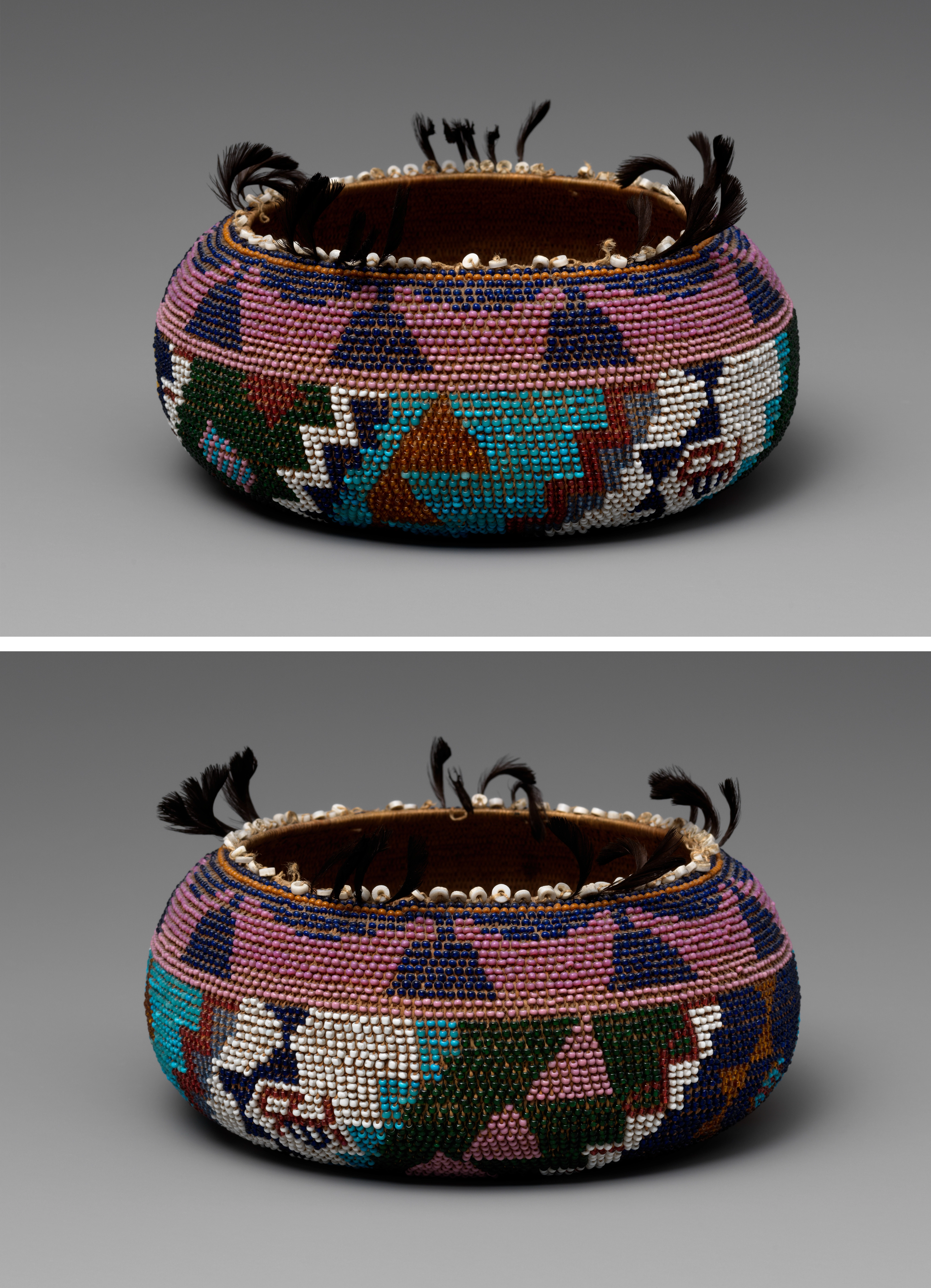
Attributed to Mary Mono (Wappo or Coast Miwok). Gift basket, ca. 1890. Sedge and dyed bulrush root, clamshell-disc beads, glass beads, and quail topknot feathers, 3 x 6 3/4 in. (7.5 x 17 cm). The Metropolitan Museum of Art, New York, The Charles and Valerie Diker Collection of Native American Art, Gift of Charles and Valerie Diker, 2025 (2025.860.2)
But who was this consummate basket maker and beader? According to Museum records shared by the donors, Charles and Valerie Diker, the maker’s name is Mary Mono, originally identified as a Pomo person, then later identified as likely from the Wappo or Coast Miwok tribes. According to these records, she was from Lytton Springs, Sonoma, California. However, no amount of sleuthing could find a Native American woman by the name of Mary Mono from any of these areas.
A sticker adhered to the interior base of the basket indicated the basket was woven at the “old Sonoma Mission, Sonoma Co. Cal.” Using some unfortunate language of the day, she was identified as being deaf and nonverbal. It is also noted on the sticker that the weave of the basket was the “same as Pomo single stick.”
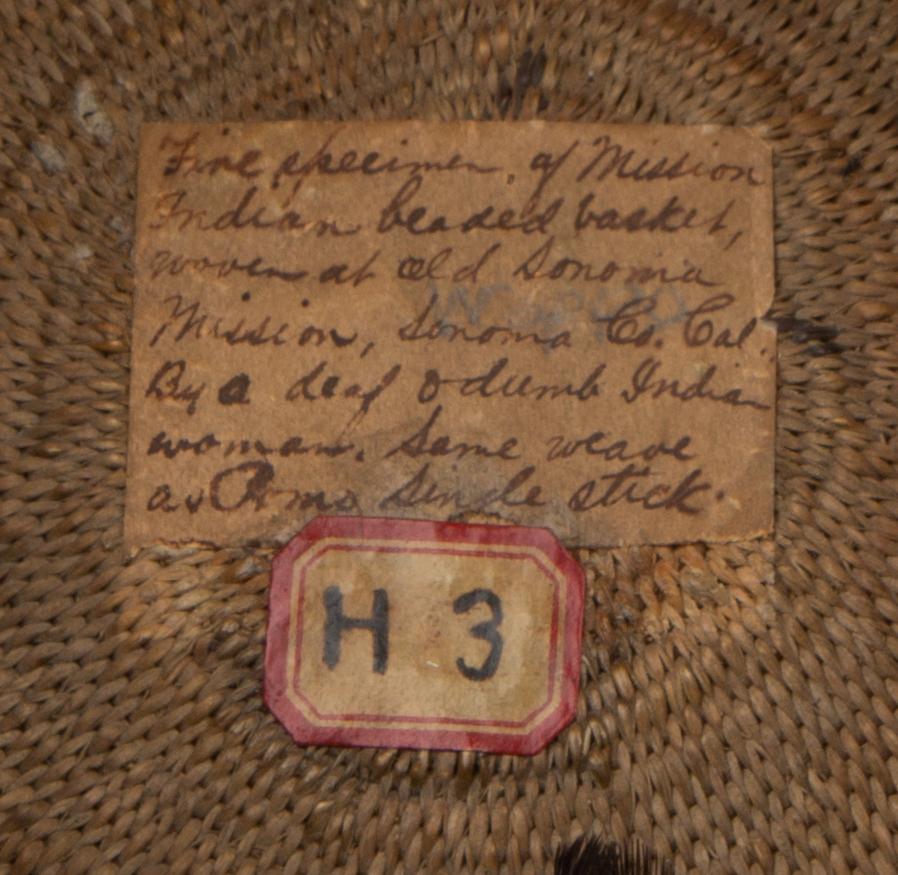
A sticker adhered to the interior of the basket displayed some provenance information.
During my research, it was brought to my attention that there was a Pomo basket weaver named Mary Mora who lived in the Santa Rosa area of Sonoma County. (“Mono” could have easily been a transcription error.) A photo of one of her baskets, a beautiful piece beaded on both the exterior and interior, is published in Essential Art: Native Basketry from the California Indian Heritage Center by Brian Bibby.
Continued sleuthing led to a woman named Mary Mora who would have been approximately the right age (born circa 1874), but who lived in the San Antonio Township (associated with the Mission San Antonio de Padua), Monterey County. Her full name was Maria Jesusa Encinales Mora. Could this be the elusive Mary Mono/Mary Mora? This Mary Mora was likely born in San Antonio Township, located approximately 225 miles south of Santa Rosa. She also appears to have belonged to what is now known as the Salinan Tribe of Monterey and San Luis Obispo Counties, a tribe recognized by the state of California. While this clue was tantalizing at first, it ultimately proved to be a dead end.
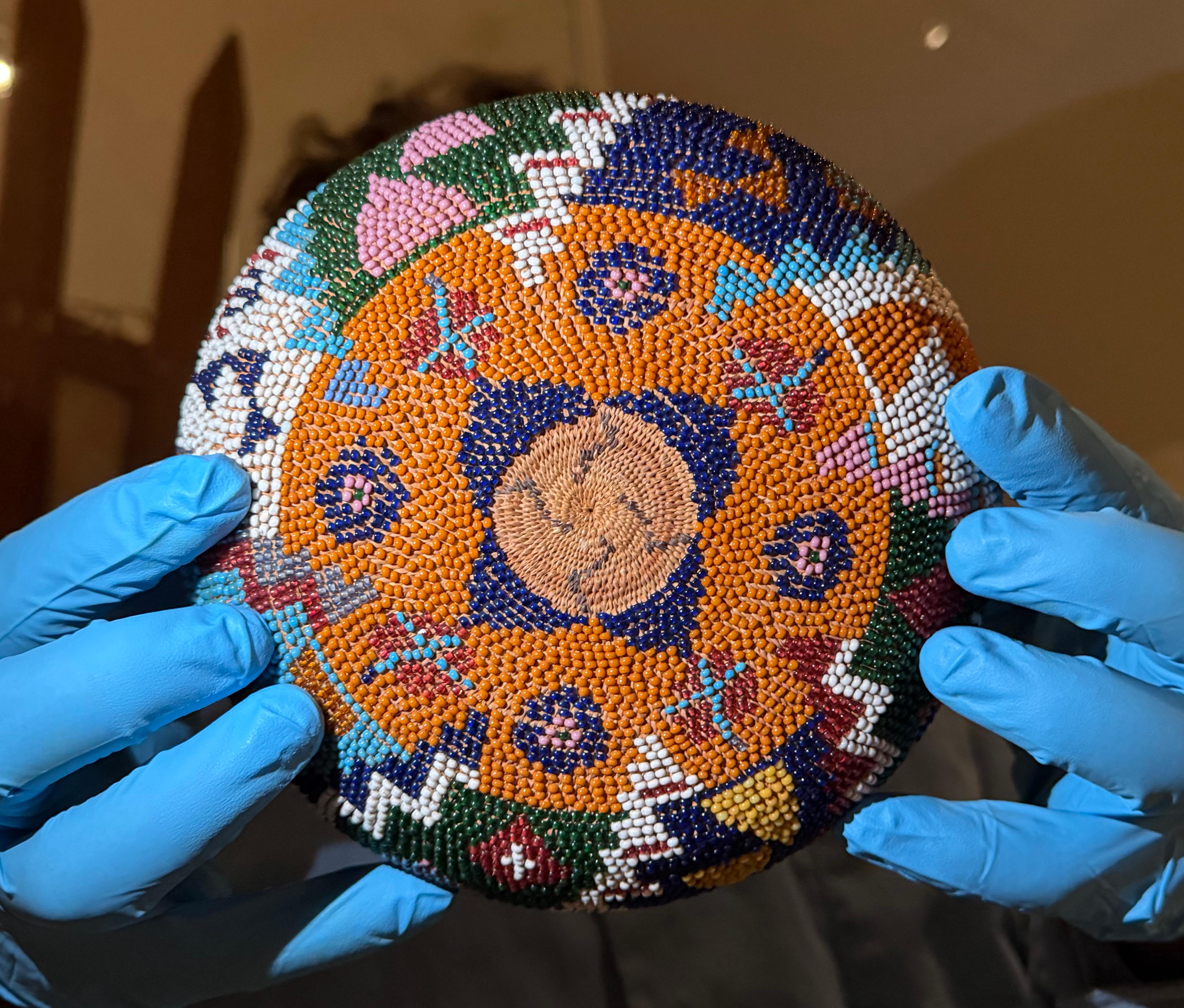
Underside of the gift basket.
The usual internet-based genealogical resources do not seem to hold the answer to whether a Mary Mono or a Mary Mora—or someone perhaps by a different name entirely—wove this basket. To learn more, we would likely need to visit two or three archives in Sonoma County, California, to research church and other local records. Perhaps there we’ll find reference to a deaf, nonverbal basket maker who made extravagantly decorated beaded works of art.
Notes
[1] Christine E. Brennan, “The Brummer Gallery and Medieval Art in America, 1914–1947,” in The Brummer Galleries, Paris and New York: Defining Taste from Antiquities to the Avant-Garde (Leiden/Boston: Brill, 2023), 341.
[2] Kenneth Haltman, “Making Sense of an Unusual Contribution to Art History,” in The Evolution of Taste in American Collecting, René Brimo, translated, edited, and with an introduction by Kenneth Haltman (University Park, PA: The Penn State University Press, 2016), 1-2.
[3] Kenneth Haltman, “Making Sense of an Unusual Contribution to Art History,” 4.
[4] “What to See in Art Museums, New York Herald Tribune, July 7, 1939.
[5] Kaiser-Friedrich-Museum Berlin, Abteilung der Bildwerke der christlichen Epochen; Staatliche Museen zu Berlin (Berlin, Ost). Skulpturensammlung, Erwerbungsbücher der Skulpturensammlung und des Museums für Byzantinische Kunst ([Band 3] Teil 3): Inventar Bildwerke der christl. Epoche [Die Bildwerke des Deutschen Museums], Berlin, 1910.
[6] Paul Cassirer and Hugo Helbing, Berlin, October 30–November 2, 1928.
[7] Sammlung Dr. Paul v. Ostermann, Darmstadt – München. Europäische Porzellane, Fayencen, Möbel, Stiche, alte Gemälde, beschrieben von Otto von Falke, Helbig, Munich, 1928, 43.
[8] Joseph Sassoon, The Sassoons: The Great Global Merchants and the Making of an Empire (New York : Pantheon Books, 2022). Esther da Costa Meyer and Claudia J. Nahson, The Sassoons (New Haven: Yale University Press, 2023).
[9] Tom Stammers and Abigail Green, “The stories we tell: Salomans Estate” in Juliet Carey and Abigail Green, eds., Jewish Country Houses (Brandeis University Press, 2024), 47-49. Part of the Sassoon collection was purchased by the Phillip Salomons collection before it went to auction in May 13, 1867. For further information regarding the sale, see: Christie, Manson & Woods, and Philip Salomons. 1867. Catalogue of the Magnificent Service of Silver & Silver-Gilt Plate, and the Very Choice Collection Objects of Art and Vertu, of Philip Salomons, Esq., Deceased, Removed from His Late Residence at Brighton : ... Christie Manson & Woods Catalogues. May–Dec. 1867, Priced. London: Christie, Manson & Woods.
[10] Sassoon: A Golden Legacy. New York: Sotheby’s, December 17, 2020, Lot. 30.