Sometimes you might be asked questions because of who you turn up with. So many times, I have been asked when I enter a local shop with my girlfriend, "is she your sister?" Who is she, is it a way of saying, who are you?
— Sara Ahmed, “Being in Question”
Presumably Eve has been asked many times: just who do you think you are? And why did you listen to that flicker of a tongue in your ear, hissing an invitation to understand the potential of your own body, to learn and to desire? Didn’t you know better than wanting to know more? Weren’t you happy enough with a god to do your gardening and a man to treat you as his very own, as dear to him as his bones?
The serpent in that garden, who like Eve is twined round a persistent origin story about women and sin, is cast as a cold-blooded temptation. But even the strictest origin story has to admit that the serpent is articulate, insightful, admirably knowledgeable in her field. In fact, you might like to spend an afternoon with her on the velvety grass before the beginning of human time. You might be quite pleased that she had turned up to keep you company, despite the questions raised by her presence.
In some versions this serpent is identified with Lilith, the first wife of Adam, who refused to be subordinated to her husband. Rejecting the basic tenets of heteropatriarchy, she walked out on the marriage and that garden called paradise. Thereafter Lilith is depicted as monstrous, inhuman, demonic: a screech-owl or a Lamia, a winged night-terror or a fishtailed half-woman.
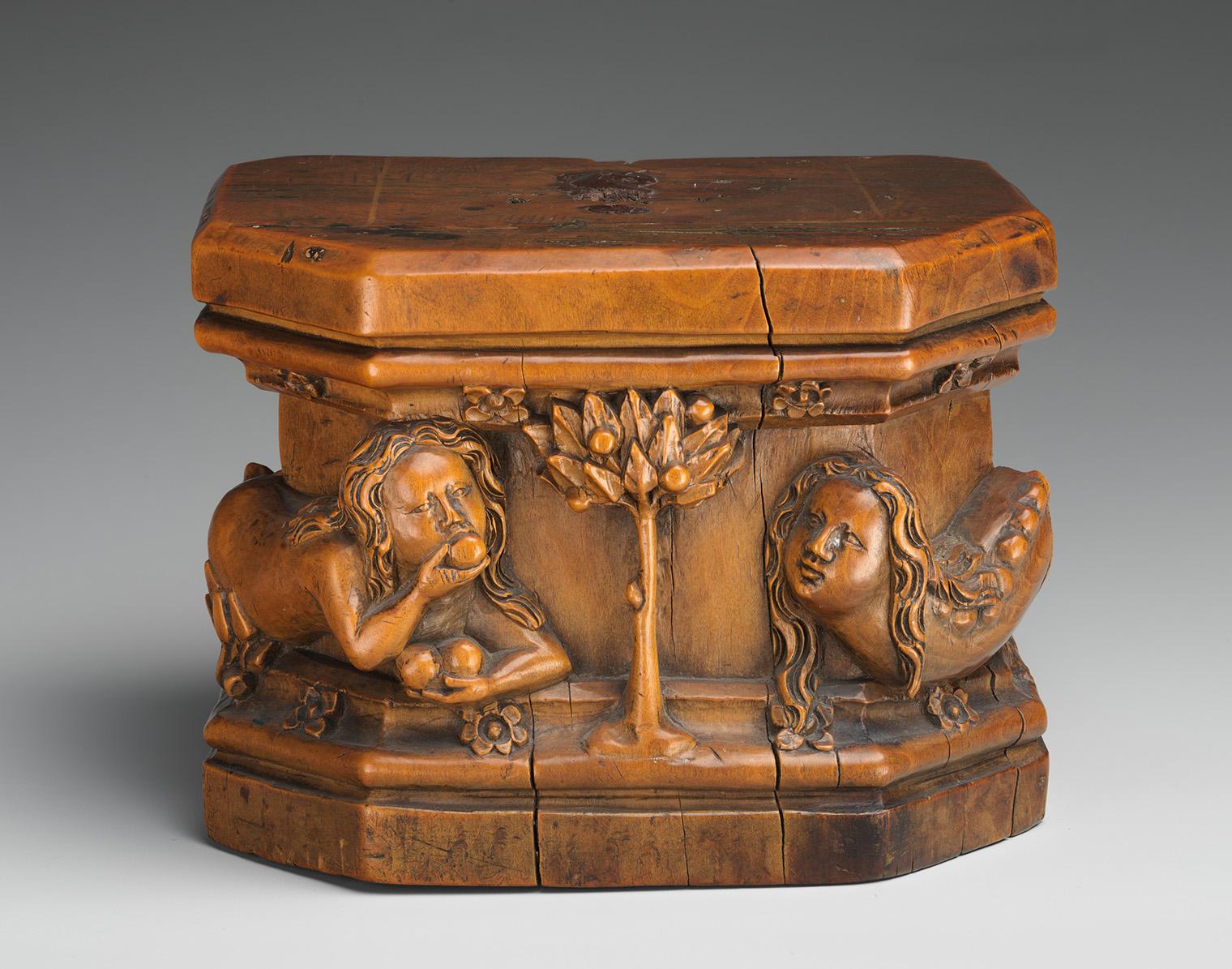
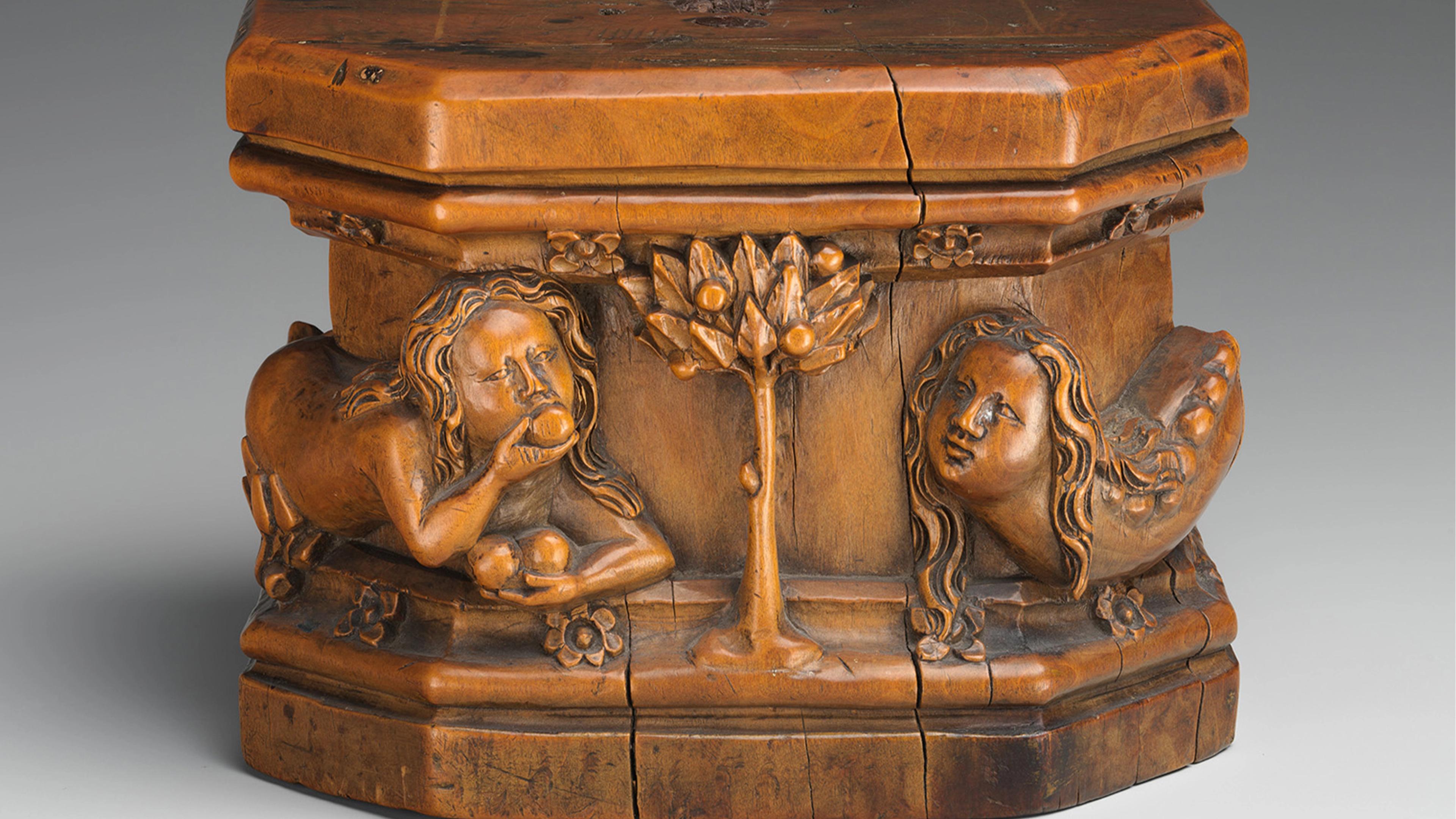
Base for a statuette, 1470-80. South Netherlandish. Boxwood. 3 1/2 × 4 7/8 × 3 3/8 in. (8.9 × 12.4 × 8.6 cm). The Metropolitan Museum of Art, New York, The Cloisters Collection, 1955 (55.116.2)
“We have many histories, many points of arrival, those who somehow find themselves as ‘not,’ as not universal, not human,” the queer feminist theorist Sara Ahmed observes. Writing more than five hundred years after the boxwood carving of Eve and the serpent, she calls this state “Being in Question”: when you are always being told what your origin story must be, what your body must mean. If Eve is—as was commonly believed in fifteenth-century Western Europe—the first woman, presumably she is also the first person to be lectured about what is wrong with her body and how this is all her fault.
Supine, with slightly parted lips, her hair falling in waves to the ground, the serpent on this boxwood statuette base looks like Eve. She also looks at Eve, tilting her chin up slightly. Eve looks back at the serpent, her hair curling down around her shoulders and an apple at her lips. What are the possibilities for the two bodies in this boxwood sculpture, if they aren’t just one wife after another? What does it mean that this serpent resembles Eve but keeps her own difference?
Who is she: is it a way of saying, who are you?
Eve and the Eve-faced serpent—facing each other, looking at each other, and looking like each other—are both lying on a horizontal plane. Their bodies are belly-down, like snakes, with undulations in their spines. One is scaly from the shoulders downward, and the other seems to have leaves growing into her genitals. Curving back round the statuette base, each has a strikingly hybrid body: the serpent is armless, with a ridge of knobs along her spine, and Eve appears to be part plant. Neither, strictly speaking, is cisgender, or even monospecies. Yet from each of their perspectives, the other looks like a woman with long wavy hair, tilting her face inquisitively toward you.
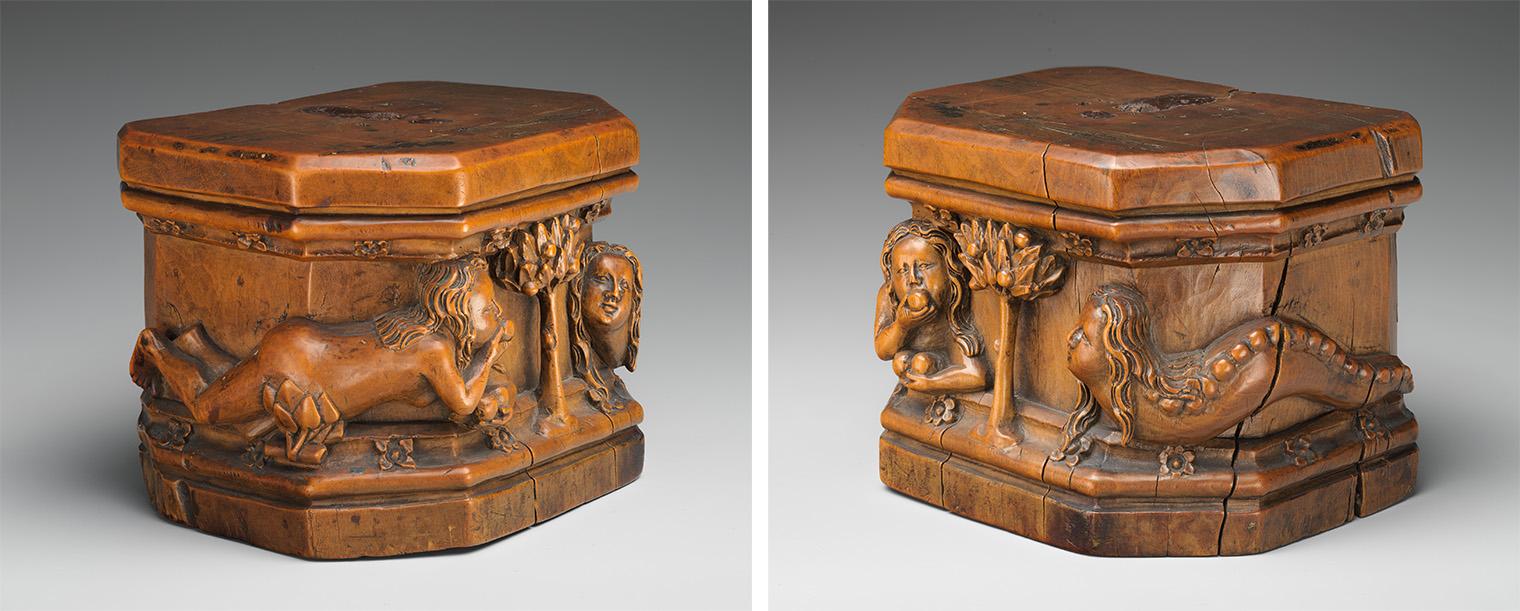
Angled views of the base depict the bodies of Eve and the serpent
The “female-headed serpent” who is “a mirror image of Eve,” curator Nancy Thebaut explains, connects “inappropriate desire for oneself and same-sex desire”: two original sins, conflated. A medieval theologian examining queer sexualities would see superfice, falsity, a watery reflection distorting the directions that sex should take. In other words, a woman gazing at another woman in the lush green light of paradise is just as bad as a woman looking at herself. A likeness was thought to be alikeness.
In “Being in Question,” Sara Ahmed retells an anecdote from her book Queer Phenomenology (2006) about a neighbor who stops her in front of the house she shares with her girlfriend to ask her, unnervingly: “Is that your sister, or your husband?” Although in that moment Ahmed is too taken aback to answer, she later offers this analysis of what the neighbor thinks her body must mean:
By facing Eve from the other side of the tree, the serpent is taking the place where Adam often stands. Eve and Adam, after all, are meant in the origin story to be a straight couple, closed to other influences. It is Eve who is open to ideas, to other bodily possibilities: this is precisely what makes everything her fault. In this boxwood statuette, Eve is open to the world as it grows around her, its leaves and fruits and suggestions; she lies down on the grass and looks at who else inhabits this place with her. She is interested in the transmission of knowledge, whether it comes from the wife before her or from a nonhuman source.
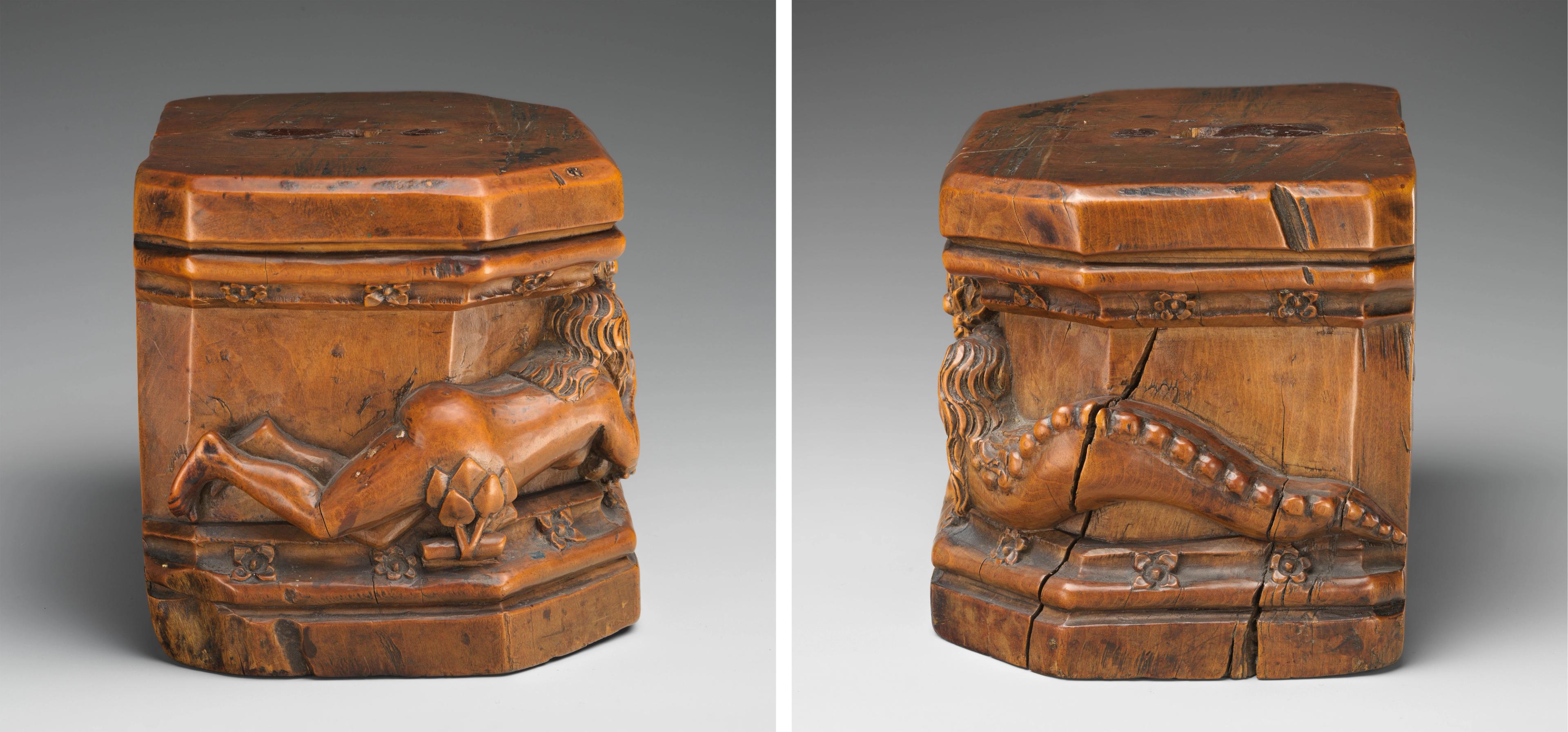
Side views of the base
Hybrid-bodied women, almost always considered monstrous, proliferate in ancient and medieval texts. There are mermaid variants, like Mélusine and Lamia, whose tails are simultaneously serpentine and fishy; Mélusine keeps the secrets of her body hidden from her husband until he spies on her in the bath, and Lamia is said to vengefully devour children, young men, or both. In Greek, a mermaid can also be called a γοργόνα, a “gorgona,” linking the fishtailed to the snake-haired Medusa, a blur of scales to scare even the bravest hero. Also submerged in the waters is Scylla, with dogs ringed round her waist, and the sirens, sometimes winged and sometimes swimming split-tailed, fatal to sailors.
Not being categorically all one thing, easily recognizable and neatly taxonomized, creates suspicion. Bodies that edge over the borders meant to divide genders—or species, or imaginary forms from real ones—can cross into the “(in)human” or “monstrous,” as trans scholar Susan Stryker proposes, existing in “intimate vacillations with human status.” What moves the sinuous serpent tail coiled round the side of this boxwood statuette, whose gender and species are beyond binaries? Is it a shiver of being so close to Eve? Is it a queer flicker of foreknowledge, that feeling of finding someone like you in a world otherwise filled with husbands and property and divine orders to subordinate yourself? Or is it simply a ripple of pleasure from being your own other half?
Sirens, mermaids, and the sin of Luxuria are often depicted in illuminated manuscripts as looking at themselves in mirrors, holding a reflection of their own faces in their hands the way that Eve might see herself in the serpent. Or the way that the serpent might see themself echoed—even invited—by Eve, who, after all, has more apples than she herself could eat. A likeness is not necessarily alikeness. What if “likeness” simply means a state of liking each other? A likeness: being together in a garden before the beginning of time, the serpent and Eve with her arms full of apples to share.
This essay is published in conjunction with the exhibition Spectrum of Desire: Love, Sex, and Gender in the Middle Ages, on view through March 29, 2026.


