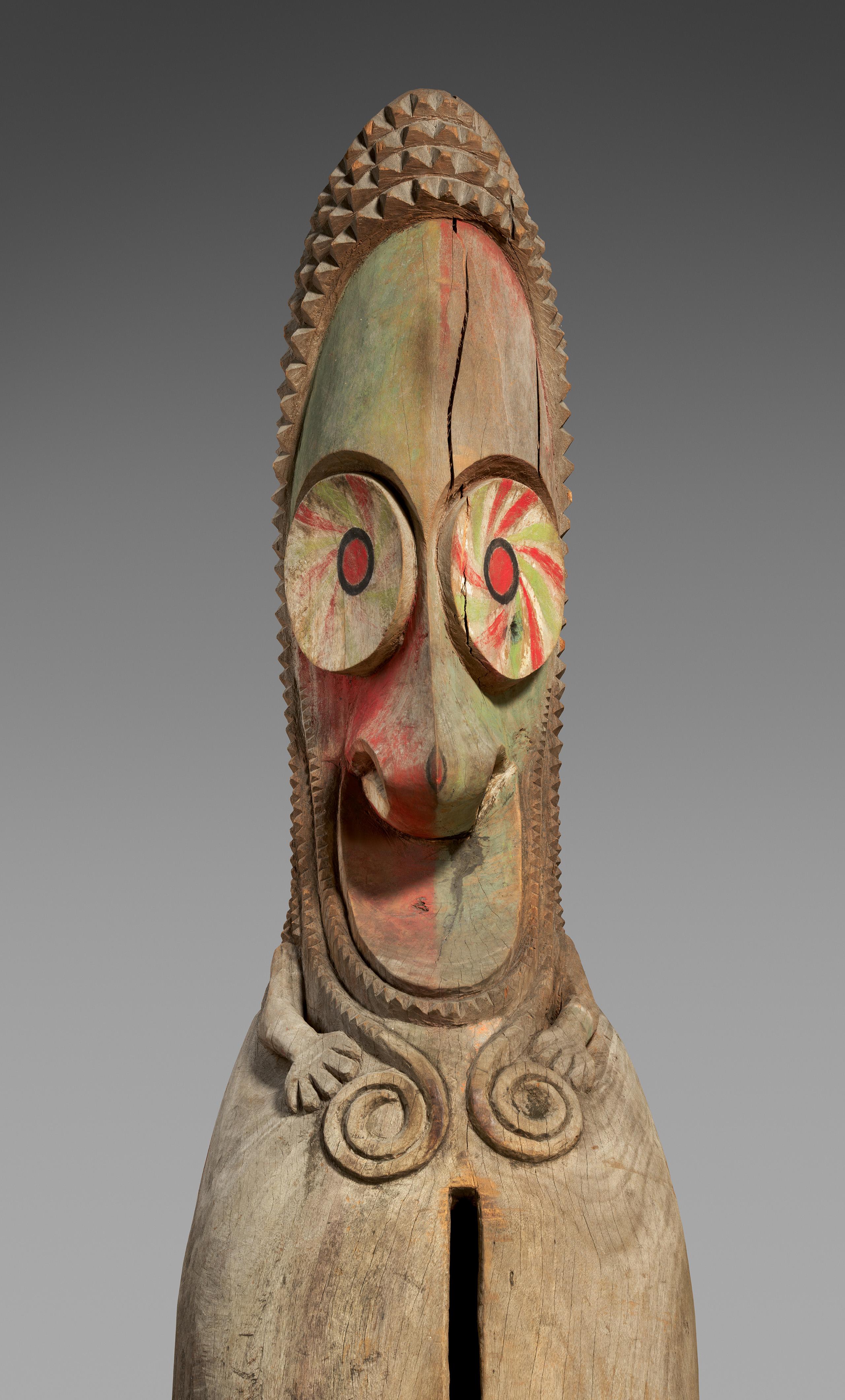
Tin Mweleun (commissioned by Tain Mal). Vanuatu, Ambrym Island. Atingting kon (slit gong) (detail), mid- to late 1960s. Wood, paint, 14 ft. 7 1/4 × 28 × 23 1/2 in. (445.1 × 71.1 × 59.7 cm); H. to top of peg: 12 ft. 4 1/2 in. (377.2 cm). The Metropolitan Museum of Art, New York, Rogers Fund, 1975 (1975.93)
My name is Jeffrey Gibson.
I started working in ethnographic collections in Chicago; I was a research intern. And it wasn't until my thirties that I started being able to kind of revisit those things and understand how much of an impact they had on the way that I think about definition, the way that I think about form, the way that I think about abstraction.
And these galleries I visit every single time and I never have researched what these objects are. And being Native American, that was kind of shocking to me cause I thought... we were just taught that this was one of the worst things you could do: you were basically a colonizer if you were approaching something without knowing the full story. First of all, that's an impossibility. Maybe, subconsciously, I'm resisting because there's a joy in this kind of childlike curiosity, that I could come in here and get lost in my imagination.
I tend to find them playful. I tend to find them quirky. I know that there's something figurative about them. I've always known that these were not made as art, 'cause they're made for a purpose and they're made to be used in a very specific context. And then by removing it from its context and putting it into another context, there's these gaps in knowledge that begin to occur. And those gaps can sometimes lead towards abstraction. I had no idea that these were gongs, and without that knowledge I was really always able to look at them as sculptures—all sides being equally important—looking for how the maker made decisions about form.
The eyes, you know, they have this like red pupil, and then there's something radiating from the center of them—something that is not human. We're anthropomorphizing it because we can understand head-arms-eyes. I always assumed that the part underneath what I read as the nose as being the mouth, but actually the slit down the front of the gong is considered the mouth. Which I think is amazing, because it's the one part that actually doesn't resemble our mouth. So it really takes on the function of the mouth, seeing that when you play the gong, that we're getting the ancestral voice coming out.
These things aren't things that happen quickly. The tree has to grow, the tree has to be hollowed out. There's the whole history of the deity and there's the ceremony that they take part in. I'm really drawn to objects that are some result of a commitment to a belief, because they make me question, like, what are we devoted to in our contemporary lives? I wasn't raised with a religion, nor do I have a specific spiritual practice, but I’m always really amazed when people make objects from a sense of faith. As a contemporary artist, I feel like I have struggled before with trying to figure out, okay, so we can all make things, but where are we gonna go? What’s gonna provide a new trajectory to push it even further?