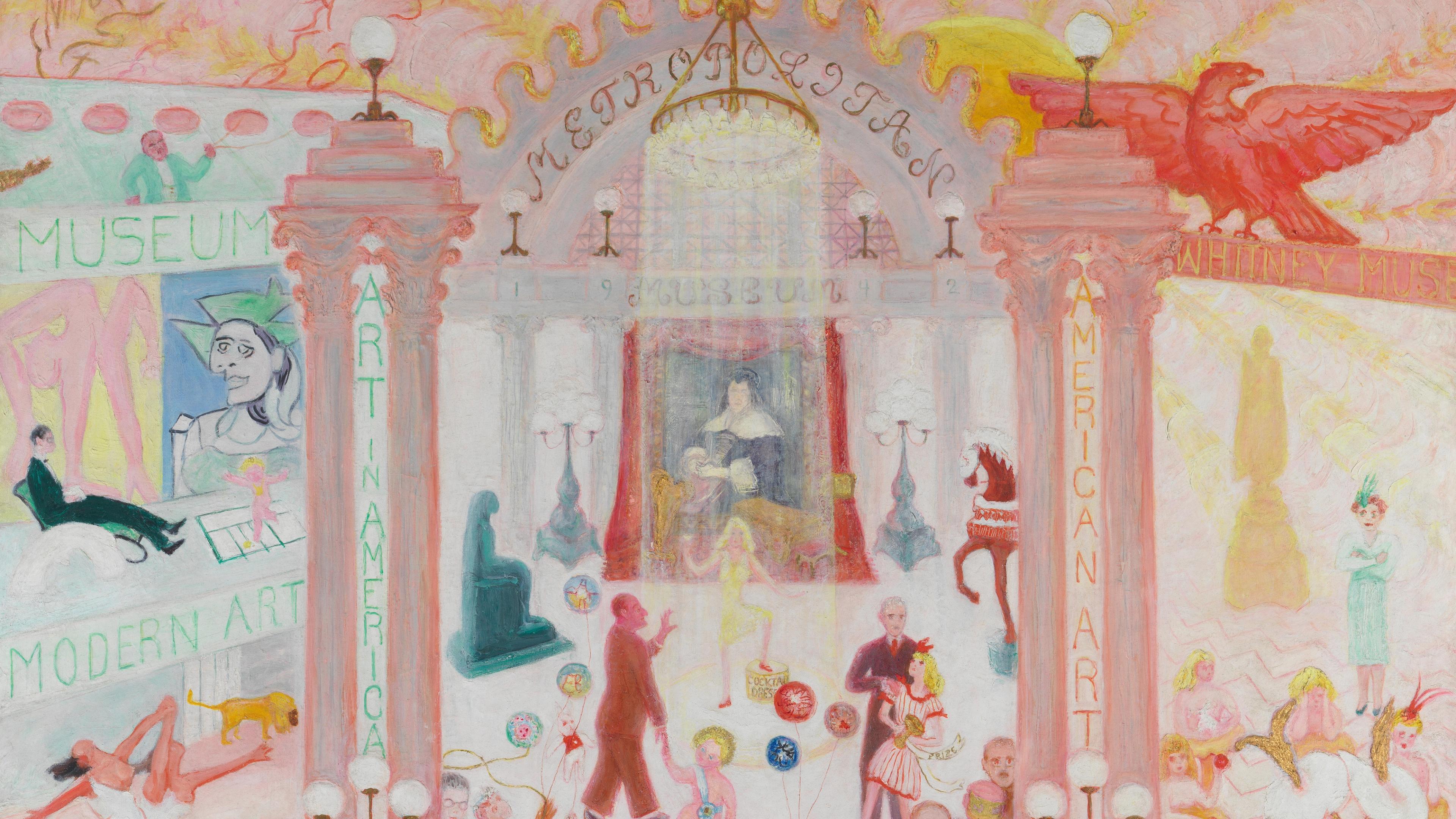
Florine Stettheimer (American, 1871–1944). The Cathedrals of Art (detail), 1942. Oil on canvas, 60 1/4 × 50 1/4 in. (153 × 127.6 cm). The Metropolitan Museum of Art, New York, Gift of Ettie Stettheimer, 1953 (53.24.1)
My name is Joan Snyder and I am a painter.
I’ve always loved the work of Florine Stettheimer. It was fascinating to me that this woman was so rich and yet she made these innocent, gorgeous, complicated paintings.
And she didn’t want to show it to anybody. She wanted to be very private, which is pretty much the opposite of what most artists want to be. Before she died she asked her sister to burn all her paintings or to bury them with her. Fortunately neither thing happened, so we get to see all of her work. And they’re so absolutely beautiful.
Hanging together are The Cathedrals of Art, The Cathedrals of Broadway, The Cathedrals of Fifth Avenue, and The Cathedrals of Wall Street. They’re iconic for her.
She is from the more-not-less school. She had almost a cinematic sensibility. She wanted to tell the whole story. She was like a reporter: she was watching everything and wanted to put it down on the canvas.
In The Cathedrals of Art the figures all have an attitude. These guards are standing with their arms folded and looking askance. This art dealer is sitting with his feet on a lounge chair. There’s even a journalist there with a flashlight on his head, kneeling down, and he’s typing. She’s really mocking this world that she lives in. She’s an insider and she’s an outsider. She really had a hard time with the art world, and, you know, a lot of us have a hard time with the art world. It’s a very difficult place to be.
Charlie Parker always said that it took a long time to play like Charlie Parker. You work and you work and you work, and then you become who you are. It’s hard to be this simple; on the other hand, that’s who she was when she went into the studio. She makes lots of choices about how delicate to be and how outrageous to be. And even though her figures are flat and very simply painted, for me they actually come alive.
The color is absolutely exquisite: her use of darks and lights and pinks and the way she uses gold. If you look up close she’s actually putting thick paint on her painting and then carving into it. She’s writing in her paintings. When I write in a painting, they call me a feminist, and it’s a dirty word. Florine Stettheimer didn’t have to worry about that. I’m sure that no one was saying to her, “You’re a feminist. You can’t write in paintings. Don’t write in that painting.”
But I think that Stettheimer—her palette and her narrative style—is a female sensibility. She puts herself in paintings. It’s so personal and so intimate. These are all things that I’ve been using in my paintings. It was like an innate thing, in the late 60s and early 70s, with young women making work, where we said, “We’re gonna just do it our way.”