メダル・キャビネット
Artwork Details
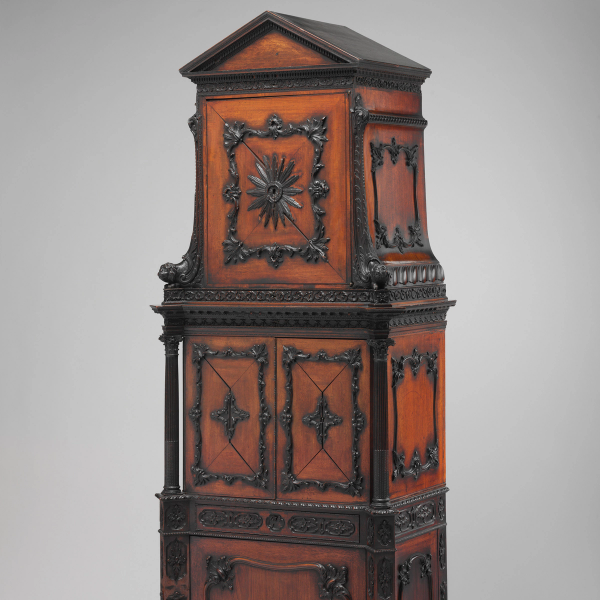
- 題: メダル・キャビネット
- アーティスト: 伝 ウィリアム・ヴァイル イギリス、1700/1705–1767年頃、及び ジョン・コブ イギリス、1715–1778年頃
- 月日: 1760–61年
- 手法: マホガニー
- 寸法: 200.7 x 68.6 x 43.8 cm
- 提供者: フレッチャー基金、1964年
- 受け入れ番号: 64.79
- Curatorial Department: European Sculpture and Decorative Arts
Audio
412. The Hanoverians and the Return of Royal Patronage
Gallery 512
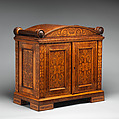
NARRATOR: You’re looking at a finely-crafted cabinet of coins and medals, a section of a larger piece made for Buckingham House by William Vile. Why so many? And what’s their purpose? Think of them as learning tools for an enlightenment education.
The student, King George III, was a keen patron, the first British king in many years to collect art. He went on to found the Royal Academy of Art, which still exists today. This cabinet may have played a role.
George would come to associate the faces in this case–rulers from history–with lessons and ideals of liberty and constitutional government. Medal collecting had long been a royal hobby, and his fascination was inspired by his mother, who was in turn inspired by her father. Though small in size, these objects speak to a shift in royal taste that happened in the eighteenth century. Backing up for a moment:
George married a kindred spirit: Queen Charlotte. Together, they became enormous patrons of the arts. To the right of the cabinets, you can find her portrait in the oval painting by the celebrated artist Thomas Gainsborough. Her tastes impressed one aristocrat, Mrs Powis, enough that she described Buckingham house in her diary:
MRS. PHILIP LYBBE POWIS: The queen’s apartments are ornamented, as one expects a Queen’s should be, with curiosities from every nation that can deserve her notice. The most capital pictures, the finest Dresden and other china; cabinets of minute curiosities. Among the pictures let me note the famed cartoons from Hampton Court; one room panell’d with the finest Japan. The floors are all inlaid in a most expensive manner… and frames of fine impressions, miniatures, etc.
NARRATOR: The Queen often wrote about her love of painting with her close friend and fellow art lover, the queen of France: Marie Antoinette.
Listen to more about this artwork
More Artwork
Related Content
Research Resources
The Met provides unparalleled resources for research and welcomes an international community of students and scholars. The Met's Open Access API is where creators and researchers can connect to the The Met collection. Open Access data and public domain images are available for unrestricted commercial and noncommercial use without permission or fee.
To request images under copyright and other restrictions, please use this Image Request form.
Feedback
We continue to research and examine historical and cultural context for objects in The Met collection. If you have comments or questions about this object record, please contact us using the form below. The Museum looks forward to receiving your comments.
Content Notice
The Metropolitan Museum of Art presents over 5,000 years of art from around the world, and our online collection reflects ongoing work conducted over the course of our more than 150-year history. You may encounter objects or images that may be inappropriate for some viewers or information that may be outdated.