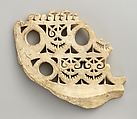
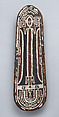
Barava (Shell plaque)
The imagery of barava varies widely. Some plaques have primarily geometric designs, but others, as here, include a formal schema of stylized human figures and faces. This example features stacked registers of humanlike figures with bent and linked arms suggestive of the poses adopted in group dances. Circular motifs, such as that seen at the base of this work, are common and likely to present shell rings, also made from the dense, hard shell of the giant clam, which served as currency and prestige objects due to their durability.
Artwork Details
- Title: Barava (Shell plaque)
- Artist: Choiseul Island artist
- Date: late 19th–mid-20th century
- Geography: Solomon Islands, Choiseul province
- Culture: Choiseul Island
- Medium: Tridacna shell
- Dimensions: H. 6 5/8 × W. 4 1/8 × D. 1/2 in. (16.8 × 10.5 × 1.3 cm)
- Classification: Shell-Sculpture
- Credit Line: Gift of Evelyn A. J. Hall, 1981
- Object Number: 1981.331.2
- Curatorial Department: The Michael C. Rockefeller Wing
More Artwork
Research Resources
The Met provides unparalleled resources for research and welcomes an international community of students and scholars. The Met's Open Access API is where creators and researchers can connect to the The Met collection. Open Access data and public domain images are available for unrestricted commercial and noncommercial use without permission or fee.
To request images under copyright and other restrictions, please use this Image Request form.
Feedback
We continue to research and examine historical and cultural context for objects in The Met collection. If you have comments or questions about this object record, please contact us using the form below. The Museum looks forward to receiving your comments.
Content Notice
The Metropolitan Museum of Art presents over 5,000 years of art from around the world, and our online collection reflects ongoing work conducted over the course of our more than 150-year history. You may encounter objects or images that may be inappropriate for some viewers or information that may be outdated.