English
DonateMembershipTickets

Pair of Pellet-Lock Pistols with Case with Accessories

Gunsmith Charles Moore British
ca. 1825
Not on view
English percussion mechanisms of the early nineteenth century utilized fulminate, a highly combustible chemical compound that burned faster than gunpowder and ignited when struck with force, as their means of ignition. Like gunpowder, it could be used in loose, powdered form or contained within different types of caps. These finely made pistols by Charles Moore used spherical pellets made of mercury fulminate coated with iron oxide (rouge), each about 2mm in diameter and weighing about 20 mg, which were considerably safer and more manageable than the loose powder. A pellet dispenser tool included with the pistol set would have facilitated the user in placing pellets precisely in the lock’s pellet cup under the cock. When the cock fell, the pellet cover (mounted under the cock) would automatically flip out of the way. Moore’s lock adapted a design previously patented by gunmaker Westley Richards (1788–1865) in 1821.

Artwork Details

Object Information
  • Title: Pair of Pellet-Lock Pistols with Case with Accessories
  • Gunsmith: Charles Moore (British, active in London and Paris, recorded ca. 1821–45)
  • Date: ca. 1825
  • Geography: London
  • Culture: British, London
  • Medium: pistols: steel, wood (walnut), platinum, brass; case: wood (mahogany), textile, brass, bone, paper; powder flask: brass; bullet mold: steel; nipple wrench: wood (mahogany?), brass, steel; ramrod: wood (mahogany?), bronze, steel; spare nipples: steel; spare firing pins: steel
  • Dimensions: Pistol (a); L. 14 15/16 in. (37.9 cm); L. of barrel 9 3/4 in. (24.8 cm); Cal. .56 in. (14.2 mm); Wt. 2 lb. 3.2 oz. (997.9 g); pistol (b); L. 15 in. (38.1 cm); L. of barrel 9 3/4 in. (24.8 cm); Cal. .57 in. (14.5 mm); Wt. 2 lb. 2.6 oz. (980.9 g); powder flask (c); H. 4 7/8 in. (12.4 cm); Wt. 5.4 oz. (153.1 g); bullet mould (d); L. 5 1/2 in. (14 cm); Wt. 2.6 oz. (73.7 g); ramrod (e); L. 5 1/2 in. (14 cm); Wt. 1 oz. (28.3 g); nipple wrench (f); L. 6 in. (15.2 cm); Wt. 2.2 oz. (62.4 g); case (g); H. 2 5/8 in. (6.7 cm); W. 11 in. (27.9 cm); D. 8 3/4 in. (22.2 cm); Wt. 5 lb. 4.2 oz. (2387 g)
  • Classification: Firearms-Pistols
  • Credit Line: Gift of Charles M. Schott Jr., 1917
  • Object Number: 19.53.108a–g
  • Curatorial Department: Arms and Armor
More Artwork
[Police Dogs Attack Demonstrators, Birmingham, Alabama Protests], Charles Moore  American, Gelatin silver print
Charles Moore
1963
The grammar of ornament, Owen Jones  British, Chromolithography
Author Owen Jones
Illustrator Francis Bedford
Publisher Day & Son, Ltd., London
1856
Pair of Four-Barreled Turnover Percussion Pistols of Henry Pelham Fiennes Pelham-Clinton, 4th Duke of Newcastle-under-Lyne (1785–1851), with Pair of Box-Lock Turn-Off Pocket Pistols, Case, and Accessories, James Purdey the Elder  British, Turnover pistols: steel, wood (walnut), gold, silver; pocket pistols: steel, wood (walnut); mallet: wood (walnut, rosewood, ebony), leather; ramrod: wood (ebony), brass; cleaning rod: wood (walnut), brass, steel; cleaning rod tip: brass; powder flask: copper, gold, brass, steel; bullet mold: steel; nipple wrench: wood (walnut), steel, brass; screwdriver: horn, steel, brass; socket wrench: steel; patch box: ivory; case: wood (mahogany), brass, ivory, textile, paper, British, London
Multiple artists/makers
1831
[Officer Demonstrating His Billy Club Swing to Group of Men, Mississippi], Charles Moore  American, Gelatin silver print
Charles Moore
1962
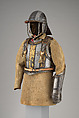
Harquebusier's Armor of Pedro II, King of Portugal (reigned 1683–1706) with Buff Coat, Richard Holden  British, Steel, gold, leather, textile, British, London; buff coat, European
Armorer Armor attributed to Richard Holden
Armorer Helmet cheek pieces and metal plates on shoulder straps made by Daniel Tachaux
ca. 1683 and later; buff coat, 17th–18th century

Research Resources

The Met provides unparalleled resources for research and welcomes an international community of students and scholars. The Met's Open Access API is where creators and researchers can connect to the The Met collection. Open Access data and public domain images are available for unrestricted commercial and noncommercial use without permission or fee.

To request images under copyright and other restrictions, please use this Image Request form.

Feedback

We continue to research and examine historical and cultural context for objects in The Met collection. If you have comments or questions about this object record, please contact us using the form below. The Museum looks forward to receiving your comments.

Send feedback

Content Notice

The Metropolitan Museum of Art presents over 5,000 years of art from around the world, and our online collection reflects ongoing work conducted over the course of our more than 150-year history. You may encounter objects or images that may be inappropriate for some viewers or information that may be outdated.