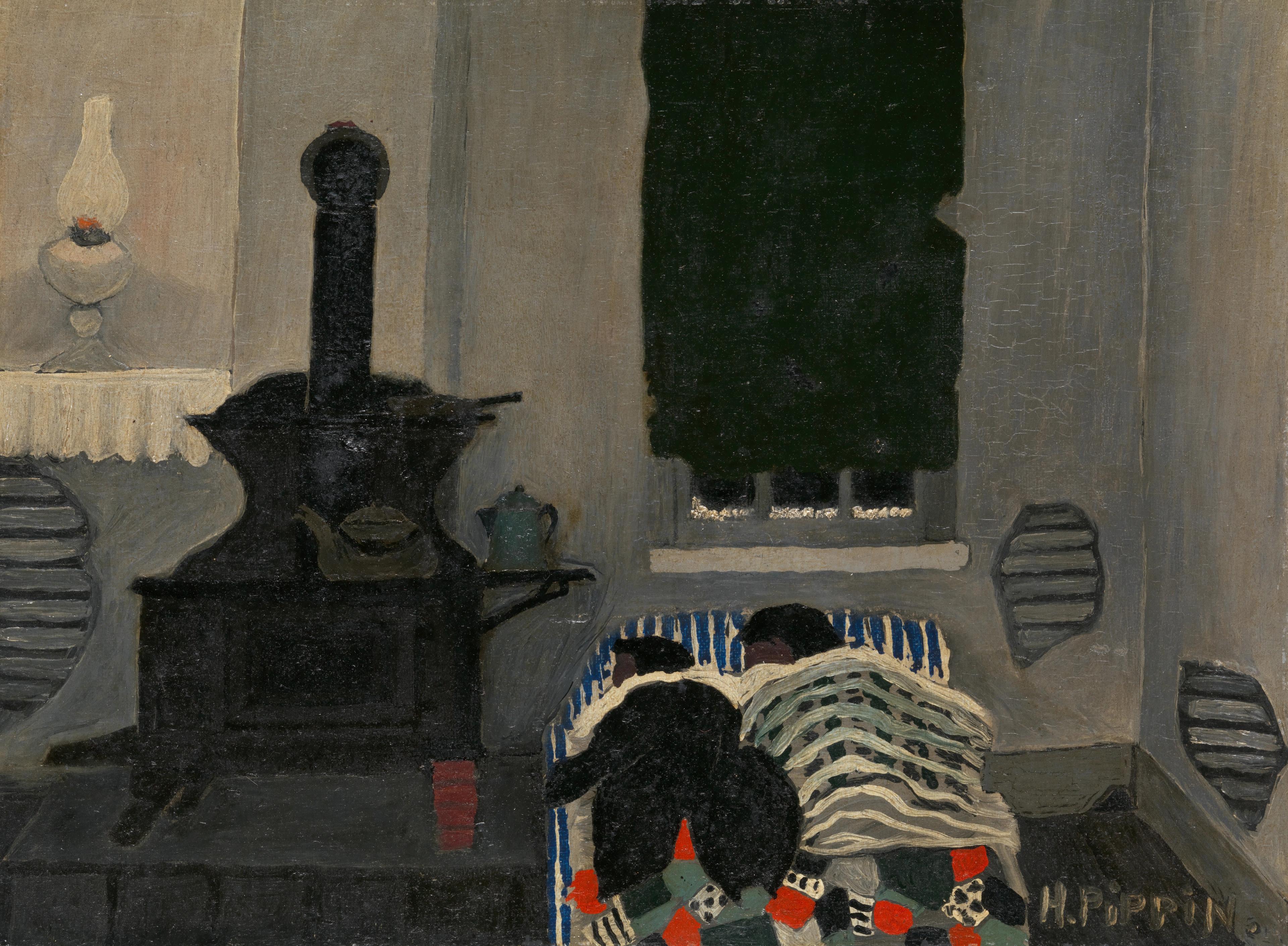
Horace Pippin (American, 1888–1946). Sleepers, 1943. Oil on canvas board, 9 × 12 in. (22.9 × 30.5 cm). The Metropolitan Museum of Art, New York, Bequest of Jane Kendall Gingrich, 1982 (1982.55.3)
My name is Josiah McElheny and I'm an artist.
Most of the American painters throughout the history of the country have looked to Europe—these grand essentially aristocratic painting traditions—as the thing that they need to live up to. That's not the United States, that's not the land neither built by immigration nor is it the land built by the horror of slavery. I think that Horace Pippin, in terms of a painter who has to do with our national identity and our national history, he is showing us where we are and where we come from. Many Americans' experience of life has been extremely constricted and not grand.
I like the fact that they're small as a kind of emblem of how many people have to live their lives. In this painting, Asleep, the legs of the stove are broken so they're replaced with brick; there's holes in the walls, so the kids have to have coats over them. And yet it also has a warmth to it, like an affection. At the core is this relationship to memory: seeing and looking and remembering are much more amorphous. He's taking from his life and turning it into both a set of symbols, a set of histories, and becomes a kind of beautiful vision in and of itself maybe; that's where abstraction begins.
He learned to be a painter initially as a kind of art therapy after World War I. Some people would say that he is a outsider artist; in some sense his work has that freedom, but what makes him, I think, one of the greatest American painters in our history is the way he began to play with his role. You know, the history of painting, oftentimes who's depicted? It's very, very wealthy people. This portrait evokes him thinking about his place in the world as a middle class person, as an artist, as somebody who wants to put his face forthright in our vision. And that's why I think it's a really important representation of American-ness. Who really makes America? It's the people who have labored and toiled to build this country. That's the thing that needs to constantly be returned to, of course.
Calling someone an outsider artist assumes that you only have insight if you are born in a very particular class of people. Every human being has the potential of great insight. Horace Pippin's work is showing us an aspect of society that's not normally focused on and used as the source for a great aesthetic experience.