Clock
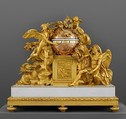
The square marble pedestal is adorned with gilt-bronze plaques in low relief showing classical subjects: Time or Chronos with scythe on the front seemingly defeated by the cherub symbolizing Love who indicates the time above. The plaques on the other sides of the pedestal show famous pairs of lovers: Anthony and Cleopatra, Hercules and Omphale, and Mars and Venus, further emphasizing the theme of Love.
The clock was made in the workshop of Jean-Baptiste Lepaute (1727–1802) a member of one of the most prominent firms of Parisian clockmakers which was active from the mid-eighteenth century until late in the nineteenth. Jean-Baptiste had joined his brother Jean-André Lepaute in Paris in the 1740s and continued the business after the latter retired in 1775. The revolving horizontal dials for which the Lepaute workshop was noted are also found on other timepieces in the Museum’s collection (17.190.2126; 37.160.10; 41.41).
This clock once belonged to Sir Richard Wallace (1818–1890) whose art collections are on display in his London residence, Hertford House in Manchester Square, better known as the Wallace Collection. Part of the collections Wallace kept at the château de Bagatelle, Paris, the clock is listed in the inventory of Bagatelle drawn up on August 13-14, 1890. Lady Wallace left the Paris collections of her late husband to John Murray Scott, her principal adviser, who had served as secretary to Richard Wallace.
Following Murray Scott’s death, his family sold his works of art, including this clock, at Christie's, London, on June 24-27, 1913, lot 31.
Artwork Details
- Title: Clock
- Maker: Clockmaker: workshop of Jean-Baptiste Lepaute (French, 1727–1802)
- Maker: and Pierre Henry, called Henry Lepaute (1749–1806)
- Maker: bronzes possibly by Pierre Philippe Thomire (French, Paris 1751–1843 Paris)
- Maker: and Louis Simon Boizot (French, Paris 1743–1809 Paris)
- Date: ca. 1775–80
- Culture: French, Paris
- Medium: Marble, bronze and gilt-bronze; chapter rings of white enamel; movement of brass and steel
- Dimensions: H. 28-3/8 x W. 10 x D. 10 in. (72.1 x 25.4 x 25.4 cm)
- Classification: Horology
- Credit Line: Bequest of Ogden Mills, 1929
- Object Number: 29.180.4
- Curatorial Department: European Sculpture and Decorative Arts
More Artwork


Related Content
Publications
Books, guides, and catalogues published by The Met.

Research Resources
The Met provides unparalleled resources for research and welcomes an international community of students and scholars. The Met's Open Access API is where creators and researchers can connect to the The Met collection. Open Access data and public domain images are available for unrestricted commercial and noncommercial use without permission or fee.
To request images under copyright and other restrictions, please use this Image Request form.
Feedback
We continue to research and examine historical and cultural context for objects in The Met collection. If you have comments or questions about this object record, please contact us using the form below. The Museum looks forward to receiving your comments.
Content Notice
The Metropolitan Museum of Art presents over 5,000 years of art from around the world, and our online collection reflects ongoing work conducted over the course of our more than 150-year history. You may encounter objects or images that may be inappropriate for some viewers or information that may be outdated.