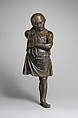
Spinario
In 1971, as a fledgling curator who had not yet been to Sicily, I came upon what seemed to be plausible documentation for our Spinario in a house in Messina and published my findings the following year.[1] I relied on the eighteenth-century chronicler Caio Domenico Gallo’s discussion of the great marble carver Antonello Gagini. Gallo was eager to present Gagini as a Messinese artist, but he was in fact born in Palermo, and several of the chronicler’s facts are accordingly wrong. The son of Domenico Gagini, the Ticinese sculptor who helped introduce the early Renaissance style to Genoa, Naples, and Sicily, Antonello was hugely prolific, almost always in marble; our thorn-puller is his only known bronze. Gallo claims that Gagini returned to Messina from Rome, where he had assisted Michelangelo on the tomb of Pope Julius II:
[Gagini] still delighted in casting statues of bronze, as he made known in that of a lifesized young boy in the act of extracting a thorn out of his foot in imitation of another similar one, which is to be seen in the Campidoglio, and in this work the good statuary taste of the ancients was very well understood, and one reads at the foot of it “the work of Antonii Gaginu, year 1500.” The said statue is conserved in the palace of Prince d’Alcontres, positioned for use as part of a fountain at the top of the beautiful staircase. From Messina, his fame having spread, he was called to Palermo.[2]
Hanno-Walter Kruft endorsed the attribution but emphasized that Gallo took most of his information from Francesco Susinno’s publication of 1724.[3] Susinno does not specify the material of the boy in the Palazzo d’Alcontres but names him “the shepherd Marzio,” reverting to an Italian medieval tradition in which the thorn-puller represents the month of March.[4] Kruft suspected the date of 1500 reported by both Susinno and Gallo had been wrongly transcribed. By comparing decorative carvings in Palermo and Rome, he was able to demonstrate a stylistic collaboration between Michelangelo and Gagini and dated the bronze to about 1505–6.[5]
Another Gagini Spinario, also of an unspecified material, emerges from a document of 1527. Gagini had been engaged in 1523 to execute the marble funerary monument to Laura Barresi by her husband Matteo, marchese of Pietraperzia, in the church of that town. In April 1527, he received payment for it, some marble window frames, and “that youth of whom it is said that he is pulling the thorn from his foot.”[6] By implication, the youth would also have been of marble. According to a letter of December 2, 2014, from Salvatore La Monica of Palermo, the statue was still in the Barresi castle at Pietraperzia in the second half of the nineteenth century.[7] As to our bronze, it is anybody’s guess how and when it got from Messina to the Paris art market.[8]
As superb in modeling and finish as our Spinario is, Gagini likely did not supply more than the model. We know little enough about Sicilian bronze casting, but the Campana (or del Campanaio) dynasty of bell founders in Tortorici, near Messina, were well established in the late fifteenth to early sixteenth century.[9] The simple, rounded forms of the Spinario would have been no great challenge for a bell founder. Our bronze appears to have been directly cast over a pre-formed clay core.[10]
Gagini does not give us a lot of bare flesh, so the best comparanda are Madonnas and their charges. The one closest to our boy is also the finest, the Madonna della Scala in the sacristy of Palermo Cathedral (fig. 163a). The Virgin’s pan-shaped face and the Child’s curls and slightly boneless limbs all come sufficiently close to those of our youth to suggest that it must date to around the same time: the Madonna della Scala is signed and dated 1503. But it should be borne in mind that the art of Gagini, once he had established his style, remained fairly conservative so that there are almost as many resonances in a slightly less distinguished work as late as 1528, the gracious Madonna degli Ansaloni in the Galleria Regionale della Sicilia, Palermo.[11]
Finally, we should consider the boy in relation to the position that the Alcontres fountain is said to have occupied: the top of a staircase. In Gagini’s day, a good height was in keeping with the display of the Capitoline Spinario. Jan Gossart’s well-known drawing shows how an elevation of several feet above eye level would reveal the lad’s modest, prepubescent genitalia (fig. 163b). By the twelfth century, the ancient bronze was even known as Priapus,[12] but Gagini, unlikely to have been familiar with that reading, seems unexcited by the nudity and more concerned with gentle forms filling space.
-JDD
(For key to shortened references see bibliography in Allen, Italian Renaissance and Baroque Bronzes in The Metropolitan Museum of Art. NY: The Metropolitan Museum of Art, 2022.)
Footnotes
1. Draper 1972.
2. Gallo 1756–58, vol. 2, p. 555: “Dillettossi ancora di gettare statue di Bronzo, come fello a conoscere in quella d’un Giovanetto al naturale in atto di cavarsi dal piè una spina, ad imitazione d’un’altra simile, che vedesi in Campidoglio, si scorge in questo lavoro il buon gusto antico statuario assai ben inteso, e leggesi a piè di essa Opus Antonii Gaginu A, MD. Conservasi la detta statua nel Palazzo del Principe d’Alcontres, accomodata per uso della fonte al capo della bellissima scala. Da Messina, divulgatasi la sua fama, fu chiamato in Palermo.”
3. Kruft 1980, p. 383.
4. Susinno 1960, p. 82; Glass 1970, p. 130, fig. 22.
5. Kruft 1975, pp. 598–99. The surviving Palazzo d’Alcontres in Messina is an eighteenth-century structure with no interior staircase.
6. “Et figura cuiusdam juvenis ut dicitur, che si leva la spina di lu pedi.” Kruft 1980, p. 494, doc. 118.
7. ESDA/OF. A photograph of a marble Spinario suggested by Dott. La Monica does not reflect Gagini’s style.
8. It is not the bronze once owned by Count Friedrich Pourtalès, German ambassador to Saint Petersburg, as put forth by Joseph Breck; a photograph of that statuette in a Berlin exhibition shows a work only 72 cm high of the standard pageboy type.
9. Di Marzo 1880–83, vol. 1, p. 635.
10. R. Stone/TR, 2011. Thick traces of the original core, containing fragments of bricks, remain on the underside of the draped seat. The cast shows areas of porosity, as well as numerous original plugs and patches, including a major repair to the left arm and neck. The surface of the sculpture is roughly finished, with chiseling on the draped seat, and rasp marks, some quite course, on the flesh. At some later point, the tip of the left foot was damaged and repaired in brass.
11. Kruft 1980, figs. 275, 276. One of his comparanda (of questionable relevance) is the bust of Saint Vitus, also in the Galleria Regionale (ibid., figs. 357, 358), but the partial gilding of the hair makes a difference.
12. Bober and Rubinstein 2010, p. 254.
Artwork Details
- Title: Spinario
- Artist: Attributed to Antonello Gagini (Italian, Palermo 1478–1536 Palermo)
- Date: early 16th century
- Culture: Italian, possibly Messina
- Medium: Bronze
- Dimensions: Overall: 34 1/4 × 20 × 21 3/4 in. (87 × 50.8 × 55.2 cm)
- Classification: Sculpture-Bronze
- Credit Line: Gift of George and Florence Blumenthal, 1932
- Object Number: 32.121
- Curatorial Department: European Sculpture and Decorative Arts
More Artwork
Related Content
 Free to download
Research Resources
The Met provides unparalleled resources for research and welcomes an international community of students and scholars. The Met's Open Access API is where creators and researchers can connect to the The Met collection. Open Access data and public domain images are available for unrestricted commercial and noncommercial use without permission or fee.
To request images under copyright and other restrictions, please use this Image Request form.
Feedback
We continue to research and examine historical and cultural context for objects in The Met collection. If you have comments or questions about this object record, please contact us using the form below. The Museum looks forward to receiving your comments.
Content Notice
The Metropolitan Museum of Art presents over 5,000 years of art from around the world, and our online collection reflects ongoing work conducted over the course of our more than 150-year history. You may encounter objects or images that may be inappropriate for some viewers or information that may be outdated.