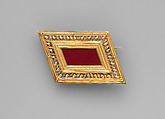
Pendant brooch in the form of a Gothic Cross
The jewelry made during this period encompassed Etruscan, ancient Roman, early Christian, Byzantine, and medieval styles. The firm of Castellani in Rome both pioneered and dominated the production of archaeological jewelry. Founded by Fortunato Pio Castellani in 1814, the company was run by three generations of the family before closing in 1927. Castellani jewelry achieved enormous popularity in the highest circles of European society, and its success encouraged many jewelers to work in a similar hisotiricizing vein, including Carlo Giuliano and his son Arthur, who established a successful firm in London in the last quarter of the nineteenth century.
The fashion for works of art that evoked antiquity ensured the popularity of cameos. Carved from hardstones such as onyx, sardonyx, and agate, cameos depicting subjects from ancient Greece or Rome or portraits executed in silhouette were often mounted in gold as jewelry. The most proficient cameo carvers, such as Benedetto Pistrucci and Luigi Saulini, produced works of remarkable technical skill. Their cameos were set in specially designed mounts by jewelers such as the Castellani, resulting in some of the finest decorative works of art of the nineteenth century.
[Jeffrey H. Munger, 2010]
Artwork Details
- Title: Pendant brooch in the form of a Gothic Cross
- Maker: Carlo Giuliano (Italian, active England, ca. 1831–1895)
- Date: ca. 1880
- Culture: British, London
- Medium: Gold
- Dimensions: Overall (confirmed): 2 3/8 x 2 3/8 x 9/16 in. (6.1 x 6.1 x 1.4 cm)
- Classifications: Metalwork-Gold and Platinum, Jewelry
- Credit Line: Gift of Judith H. Siegel, 2014
- Object Number: 2014.713.8
- Curatorial Department: European Sculpture and Decorative Arts
More Artwork
Research Resources
The Met provides unparalleled resources for research and welcomes an international community of students and scholars. The Met's Open Access API is where creators and researchers can connect to the The Met collection. Open Access data and public domain images are available for unrestricted commercial and noncommercial use without permission or fee.
To request images under copyright and other restrictions, please use this Image Request form.
Feedback
We continue to research and examine historical and cultural context for objects in The Met collection. If you have comments or questions about this object record, please contact us using the form below. The Museum looks forward to receiving your comments.
Content Notice
The Metropolitan Museum of Art presents over 5,000 years of art from around the world, and our online collection reflects ongoing work conducted over the course of our more than 150-year history. You may encounter objects or images that may be inappropriate for some viewers or information that may be outdated.